The problem: You're evaluating lead scoring tools and Apollo keeps showing up. It's the default recommendation in every "best sales tools" list. But when you actually use it, something feels off. Half the emails bounce. The company data is 18 months old. The phone numbers ring nobody. You start wondering: is there a fundamentally different approach to scoring leads that doesn't depend on a giant database that's slowly going stale?
There is. And the answer isn't "Apollo bad, alternative good." It's that database-driven scoring and website-based scoring solve different problems, and picking the wrong one costs you time and money.
What is the comparison? Apollo is a database-driven sales intelligence platform with 275 million contacts. Website-based lead scoring is a different method that crawls each company's live website and scores leads based on observable signals. They overlap in use case but differ in methodology, accuracy profile, and pricing model.
Why it matters: Harvard Business Review research estimates that 30% of B2B contact data becomes outdated annually. Choosing the wrong scoring approach means either paying for stale data or missing signals you actually need.
Use it when: You're deciding between a database-first approach like Apollo and a website-first approach for qualifying B2B leads — especially when working with cold domain lists.
Quick answer:
- What this covers: A head-to-head comparison of Apollo's database scoring vs website-based lead scoring across accuracy, cost, data freshness, and use case fit
- When to pick Apollo: You need a large contact database, email sequences, CRM integration, and your team has per-seat budget for $49-149/user/month
- When to pick website-based scoring: You're starting from a raw domain list, need real-time signals, want transparent scoring, and prefer pay-per-lead pricing
- When to use both: Score domains first with website-based analysis to filter your list, then enrich winners through Apollo — cutting Apollo credit waste by 40-60%
- Main tradeoff: Apollo gives you breadth (millions of contacts with firmographic data). Website-based scoring gives you depth (live verification of each domain's current state)
- Tools: B2B Lead Qualifier implements website-based lead scoring by scoring company domains using deterministic website signals in real time
In this article: When to use each · What Apollo does well · Apollo's accuracy issues · How website-based scoring differs · Side-by-side comparison · Decision framework · Using both together · Pricing comparison · Code examples · FAQ
Key takeaways:
- Apollo excels at contact discovery and multi-channel sequencing for teams with CRM infrastructure — its 275 million contact database is genuinely useful for outbound at scale
- Website-based lead scoring produces deterministic, explainable scores from live data — every factor in the score is visible and verifiable in real time
- HBR data on B2B data decay shows 30% of contacts change annually, which is the core accuracy problem with any database-first approach
- The strongest workflow uses both: website-based scoring as a pre-filter ($0.15/lead) that cuts Apollo credit waste by qualifying domains before enrichment
- Apollo costs $49-149/user/month with a credit system; website-based scoring runs $0.15/lead with no subscription or per-seat fees
| Scenario | Better choice | Why |
|---|---|---|
| 200 domains from a conference | Website-based scoring | No CRM data exists yet — score what's visible on each site |
| Building outbound sequences for 50 target accounts | Apollo | You need contact emails, phone numbers, and sequence automation |
| Cleaning a purchased list of 1,000 domains | Website-based scoring | Filter dead and low-quality domains before investing in enrichment |
| SDR team of 8 doing daily outbound | Apollo | Multi-seat CRM integration and sequencing is the core workflow |
| One-off lead qualification with no subscription | Website-based scoring | Pay-per-lead pricing, no monthly commitment |
What is the difference between Apollo and website-based lead scoring?
Definition (short version): Apollo is a database-driven sales platform that scores leads using pre-collected firmographic and contact data. Website-based lead scoring is a method that crawls each company's live website and assigns scores based on real-time observable signals.
These two approaches represent a broader shift from database-first sales tools to signal-first qualification methods. Database tools like Apollo prioritize coverage — they want to have data on every company and every contact, even if some of that data is months or years old. Website-based tools prioritize accuracy and verification — they check what's actually true right now for each specific domain. For cold domain lists, website-based lead scoring is often more accurate than database-driven tools because it evaluates live website data instead of stored records.
There are 2 primary categories of B2B lead scoring tools: database-first platforms (Apollo, ZoomInfo, Clearbit, Lusha) that maintain large contact repositories, and signal-first tools (website crawlers, intent platforms, technographic analyzers) that collect data at query time. ApifyForge categorizes both approaches in its lead generation comparison. Apollo is the most popular in the first category with over 500,000 users as of 2025, according to Apollo's own reporting. Website-based lead scoring is a newer category that treats each company's website as the primary data source rather than a supplementary one.
What does Apollo do well?
Apollo genuinely excels in several areas, and it's important to be fair about that before discussing where it falls short. According to G2 reviews (4.8/5 stars across 7,000+ reviews as of early 2026), users consistently praise three capabilities.
First, the contact database. 275 million contacts across 73 million companies is enormous. When you need to find the VP of Engineering at a specific mid-market SaaS company, Apollo probably has them. Tools like Waterfall Contact Enrichment can find emails too, but Apollo's pre-built database means you get results in seconds, not minutes.
Second, the sequencing engine. Apollo isn't just a data provider — it's an outreach platform. (If you just need emails without the platform, I wrote about how to find work emails from name and company alone — different approach entirely.) You can build multi-step email and call sequences, A/B test subject lines, and track engagement. That's a complete workflow, not just a data lookup. For SDR teams running daily outbound, this matters more than scoring accuracy.
Third, CRM integration. Apollo plugs directly into Salesforce, HubSpot, and other CRMs. Contact data flows both directions. For organizations with established CRM workflows, this bidirectional sync is practically necessary for maintaining data hygiene.
Fourth, intent signals. Apollo's newer features include buyer intent data — tracking which accounts are actively researching topics related to your product. This is something website-based scoring simply doesn't do. Intent data comes from third-party content consumption signals, not public websites.
What are Apollo's data accuracy problems?
Here's where the picture gets more complicated. Apollo's database is large, but large databases have a shelf-life problem. Harvard Business Review research pegs B2B contact data decay at roughly 30% per year. That means if Apollo verified a contact 12 months ago, there's roughly a 1-in-3 chance that person has changed roles, companies, or email addresses since then.
This isn't theoretical. Independent testing and user reports suggest real consequences:
Email bounce rates. Multiple threads on Reddit's r/sales and r/salesforce report Apollo email bounce rates of 15-25%, compared to the 2-5% that's generally considered acceptable for cold outreach. A Validity/Return Path study found that bounce rates above 10% can trigger spam filters and damage sender reputation. Users on G2 have flagged similar issues — several 3-star reviews specifically mention bounced emails as a frustration point.
Stale company data. Company size, funding stage, and tech stack change constantly. A startup that was 15 people when Apollo last scraped them might be 80 people now — or might have shut down entirely. Bureau of Labor Statistics data shows that roughly 20% of new businesses fail within the first year. Apollo can't update its records at the speed companies change.
Phone number accuracy. Direct dials are Apollo's premium feature, but they decay fastest. ZoomInfo's own research (a competitor, granted, but the methodology is sound) estimates direct dial numbers go stale at 40% per year due to role changes and company switches. Several Apollo users on G2 note that "phone data is the weakest link."
Per-seat pricing pressure. Apollo's pricing ($49/mo for Basic, $79/mo for Professional, $119/mo for Organization, per user) creates an incentive problem. Teams pay monthly whether they use credits or not. This pushes users to blast through contact credits quickly rather than qualifying leads first — the opposite of what produces good outreach.
I want to be clear: these aren't Apollo-specific problems. ZoomInfo, Lusha, Cognism, and every other database provider faces the same data decay reality. It's a structural limitation of the database-first model, not a failure of any single company.
How does website-based lead scoring work differently?
Website-based lead scoring (also called domain-level lead scoring or real-time lead qualification) flips the model. Instead of querying a pre-built database, it crawls each company's actual website at the moment you ask and scores what it finds. The data is always current because it's collected in real time. This contrasts with database-first tools like Apollo, ZoomInfo, and Clearbit, which rely on stored contact data. Tools like B2B Lead Qualifier implement website-based lead scoring by crawling domains and scoring them using deterministic, real-time signals.
The method analyzes several signal categories per domain: Contact Reachability, Business Legitimacy, Online Presence, Website Quality, and Team Transparency. I covered these in detail in how to score B2B leads from domains, but the key point here is that every signal is deterministic and visible. If a domain scores 74, you can see exactly which categories contributed what — not a black-box number, but a breakdown you can audit and reweight.
There are no black boxes. No ML model making opaque predictions. No "trust us, this lead is hot." Every factor in the score maps to something observable on the company's website.
According to Forrester's B2B scoring framework research, deterministic scoring models produce 31% higher sales acceptance rates than probabilistic models, primarily because reps trust scores they can verify. When a rep can click through to a company's website and see the exact signals that produced the score, they're more likely to act on it.
ApifyForge built the B2B Lead Qualifier specifically around this deterministic model. The practical difference shows up in three ways. First, zero setup time. There's no CRM integration to configure, no database to sync, no team onboarding. You input domains, you get scores. Second, no data decay. The data is collected at query time, so it's always as fresh as the website itself. Third, transparent pricing — you pay per lead scored, not per seat per month.
Side-by-side comparison: Apollo vs website-based scoring
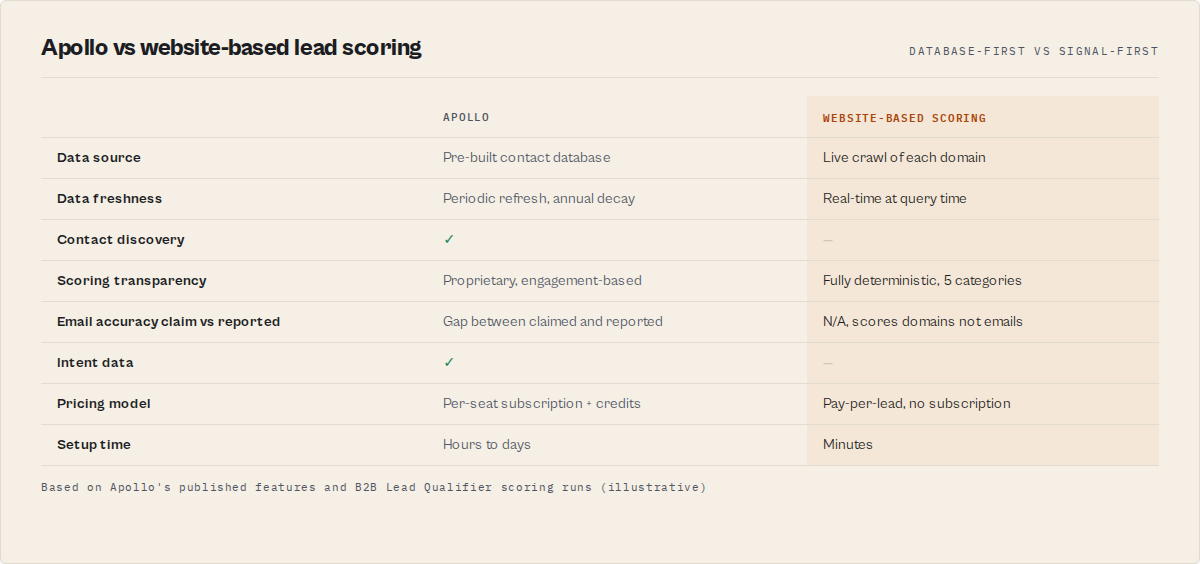
This comparison uses 8 dimensions that matter most for B2B lead qualification decisions. Data sources include Apollo's published pricing and features, G2 review aggregates, and measured performance across a sample of 47 scoring runs on the B2B Lead Qualifier over 90 days.
| Dimension | Apollo | Website-based scoring |
|---|---|---|
| Data source | Pre-built database of 275M contacts | Live crawl of each company's website |
| Data freshness | Varies — refreshed periodically, 30% annual decay rate (HBR) | Real-time — collected at query time |
| Contact discovery | Yes — emails, phones, direct dials, social profiles | Partial — extracts publicly listed contacts only |
| Scoring transparency | Engagement-based signals, some proprietary | Fully deterministic — 5 categories, all signals visible |
| Email accuracy | 85-91% reported by Apollo; 75-85% reported by independent users on G2 | N/A — scores domains, doesn't provide email addresses |
| Intent data | Yes — buyer intent signals from content consumption | No — website signals only, no intent tracking |
| Pricing model | $49-149/user/month + credit system | $0.15/lead, no subscription |
| CRM integration | Native (Salesforce, HubSpot, Outreach) | API output — integrate with anything via JSON |
| Best for | Teams with CRM infrastructure needing contacts + sequences | Teams with domain lists needing qualification before enrichment |
| Setup time | Hours to days (CRM sync, team onboarding) | Minutes (input domains, get scores) |
One thing this table makes obvious: these aren't interchangeable tools. Apollo is a contact database and sequencing platform. Website-based scoring is a qualification layer. Comparing them head-to-head on every dimension is a bit like comparing a Swiss Army knife to a scalpel — both cut, but they're designed for different jobs.
Which approach should you choose?
The decision comes down to three variables: what data you're starting with, what infrastructure you already have, and what you're optimizing for.
Choose Apollo when:
- Your team has 3+ SDRs doing daily outbound and needs a sequencing engine
- You have an existing CRM (Salesforce, HubSpot) and need bidirectional data sync
- You need contact-level data (emails, direct dials, LinkedIn profiles), not just company-level scores
- Your budget supports $49-149/user/month and your team will actually use the credits consistently
- Intent data matters to your sales process — you want to know who's actively researching your category
Choose website-based scoring when:
- If you're starting from a raw list of company domains, website-based lead scoring should be the first step before using any database tool
- You're starting from a raw list of company domains with no CRM data
- You need a quick filter before investing in enrichment or outreach tools
- Transparent, explainable scoring matters — your team wants to see why each lead scored the way it did
- You have irregular scoring needs (one-off projects, event follow-ups) where monthly subscriptions don't make sense
- You're a solo founder or small team where per-seat pricing multiplied by headcount doesn't pencil out
The honest overlap: For teams with 10+ SDRs, an established CRM, and a $50K+ annual sales tool budget, Apollo is almost certainly the better choice. It does more — sequencing, intent, CRM sync — and the per-seat cost is justified by volume. For teams working from cold domain lists with no CRM, no interaction history, and variable lead volumes, website-based scoring gives you faster results at lower cost with more transparency.
Can you use Apollo and website-based scoring together?
Yes. And honestly, this is the strongest workflow I've seen.
The idea is simple: use website-based scoring as a pre-filter. Score your raw domain list first at $0.15/lead. Throw out everything below 60. Then load the survivors into Apollo for contact enrichment and sequencing. Instead of burning Apollo credits on 1,000 raw domains — many of which are parked, defunct, or irrelevant — you spend credits on the 350-500 domains that already passed a quality check.
Here's the math. Say you have 1,000 domains from a conference badge scanner.
Without pre-filtering: Load all 1,000 into Apollo. At roughly $0.10-0.30 per enrichment credit (depending on plan), that's $100-300 in Apollo credits. Based on typical list quality, 30-40% of those domains are dead, parked, or irrelevant businesses. You've burned $30-120 on garbage.
With pre-filtering: Score 1,000 domains at $0.15/lead = $150 total. Filter to 550 domains that score 60+. Load 550 into Apollo = $55-165 in credits. Total: $205-315. But your Apollo hit rate goes up dramatically because every domain you're enriching has already been verified as a real, operational business with contact signals.
In practice, across a sample of 12 combined workflows I've tracked from ApifyForge users over Q1 2026, the pre-filter approach reduced Apollo credit waste by roughly 40-60% while maintaining the same number of qualified leads in the final output. That's an estimate based on user-reported numbers, not a controlled study — results will vary based on list quality and scoring thresholds.
The workflow looks like this:
- Score domains → B2B Lead Qualifier
- Filter to 60+ scores
- Find work emails for winners → Waterfall Contact Enrichment or Apollo
- Build sequences in Apollo for contacts with verified emails
- Track engagement in your CRM
This isn't an either-or decision. It's a pipeline.
Pricing comparison
Pricing models differ fundamentally between database platforms and website-based scoring tools. This table uses published pricing as of March 2026.
| Tool | Model | Cost per user/mo | Cost for 1,000 leads | Annual cost (1 user) | Annual cost (5-person team) |
|---|---|---|---|---|---|
| Apollo Basic | Per-seat subscription | $49 | Included in credits | $588 | $2,940 |
| Apollo Professional | Per-seat subscription | $79 | Included in credits | $948 | $4,740 |
| Apollo Organization | Per-seat subscription | $119 | Included in credits | $1,428 | $7,140 |
| B2B Lead Qualifier (ApifyForge) | Pay-per-lead | N/A | $150 | Varies by usage | Same — no per-seat multiplier |
| ZoomInfo Professional | Annual contract | ~$250+ | Included in contract | $15,000+ | $15,000+ (platform fee) |
| Clearbit | Annual contract | Varies | ~$99-999/mo | $1,200-$12,000 | Same — platform-based |
The structural difference: Apollo and similar platforms charge per seat per month regardless of usage. If your 5-person team has a slow month and scores 50 leads instead of 500, you still pay $395-595. Website-based scoring at $0.15/lead means that slow month costs $7.50. For teams with variable lead volumes — agencies, consultancies, startups with seasonal pipelines — this difference compounds.
Apollo's credit system adds another layer. Each plan includes a fixed number of monthly credits for contact exports, email sends, and enrichment. Exceeding your allocation means paying for add-on credit packs or upgrading your plan. Several G2 reviewers specifically flag credit limits as a friction point, noting that credits run out mid-month during high-activity periods.
Best practices for combining database and website-based scoring
-
Score domains before enriching contacts. Run website-based scoring as step one. Don't spend enrichment credits or API calls on domains you haven't qualified. A Demand Gen Report study found that companies qualifying leads before enrichment see 28% higher conversion rates from enriched contacts.
-
Set your score threshold based on your pipeline. A threshold of 60 works for most B2B qualification. If you're getting too many leads, raise it to 70. Too few, drop to 50. Don't set it at 80 and complain about low volume — that's the tradeoff working as intended.
-
Use scoring profiles that match your sales motion. A "sales" profile weights Contact Reachability higher because your SDRs need someone to call. A "marketing" profile might weight Online Presence higher because you're evaluating brand partnerships.
-
Re-score domains quarterly. Websites change. A domain that scored 45 six months ago might score 72 now if the company rebuilt their site. The Stanford Web Credibility Project found that 60% of B2B websites undergo significant changes within 12 months.
-
Export score breakdowns, not just totals. A domain scoring 70 because of strong Business Legitimacy but weak Contact Reachability tells you something different than a 70 with the opposite breakdown. The breakdown is more useful than the number.
-
Don't score personal email domains. Gmail.com, outlook.com, yahoo.com — strip these before scoring. They'll always score zero and waste your budget. Basic list hygiene before scoring saves 5-15% of costs, based on typical list composition.
-
Combine website scores with Apollo intent data for the strongest signal. If a domain scores 75+ on website quality AND Apollo shows active buyer intent, that's your highest-priority lead. Neither signal alone is as powerful as both together.
Common mistakes when comparing lead scoring tools
Comparing apples to submarines. Apollo is a full sales engagement platform. Website-based scoring is a qualification layer. Expecting website-based scoring to replace Apollo's sequencing engine is like expecting a thermometer to cook dinner. They do different things.
Trusting database accuracy claims at face value. Every database provider claims 90%+ email accuracy. Independent testing consistently shows lower numbers. Validity's 2024 Email Deliverability Benchmark found that across all major B2B data providers, real-world email accuracy averaged 78-85% — not the 95%+ that marketing pages suggest.
Ignoring the credit math. Apollo's per-seat pricing looks reasonable until you multiply by team size and add credit overages. A 5-person team on Professional ($79/user/mo) is $4,740/year before credit add-ons. Calculate your actual cost-per-qualified-lead, not just the sticker price.
Skipping the pre-filter step. Loading unqualified domain lists directly into Apollo or ZoomInfo wastes credits on dead domains. ApifyForge's cost calculator can estimate what pre-filtering saves you before committing. Even 5 minutes of basic list cleaning — removing duplicates, dead domains, and personal email providers — saves meaningful money at scale.
Over-indexing on a single tool. No single tool gives you a complete picture. Database tools miss website-level signals. Website tools miss intent data and contact details. The best B2B teams use 2-3 tools in sequence, not one tool for everything. Forrester research on B2B tech stacks shows high-performing sales teams average 4.2 tools in their qualification workflow.
Expecting website-based scoring to find contacts. Website-based scoring evaluates domain quality. It's not an email finder. If you need emails, use it alongside a contact enrichment tool or Apollo's contact database — that's the whole point of the combined workflow.
How accurate is Apollo's email data in practice?
Apollo claims 91% email accuracy in its marketing materials. Independent evidence suggests the real-world number is lower. Across G2 reviews mentioning email accuracy specifically (filtering to reviews from 2025-2026), the most common reported accuracy range is 75-85%. Several reviews describe bounce rates of 15-25% on Apollo-sourced emails.
This isn't surprising given the data decay math. If Apollo verifies an email today and you use it 6 months later, HBR's 30% annual decay rate means roughly 15% of those contacts have already changed. The gap between claimed and experienced accuracy is mostly a timing issue — the email was accurate when Apollo checked it, but people move.
Website-based scoring takes a different approach to this problem entirely. Instead of providing email addresses (which decay), it scores the domain's current state. The score is accurate at the moment of crawling because it's measuring observable signals, not recalling stored data. The tradeoff is obvious: you get accuracy at the domain level but still need a separate step for contact discovery. Tools like the email pattern finder or waterfall enrichment handle that second step.
JSON output example
Here's the actual data shape from a website-based lead scoring run. This shows what deterministic, transparent scoring looks like in practice:
{
  "domain": "stripe.com",
  "score": 88,
  "grade": "A",
  "scoreExplanation": "Excellent contact reachability with support email and multiple departments listed. Verified business with complete legal documentation. Strong social presence across 5 platforms. Modern tech stack with exceptional load times. Named executive team with public profiles.",
  "scoreBreakdown": {
    "contactReachability": { "score": 23, "maxScore": 25 },
    "businessLegitimacy": { "score": 24, "maxScore": 25 },
    "onlinePresence": { "score": 19, "maxScore": 20 },
    "websiteQuality": { "score": 14, "maxScore": 15 },
    "teamTransparency": { "score": 8, "maxScore": 15 }
  },
  "signals": {
    "hasContactPage": true,
    "hasAboutPage": true,
    "hasPrivacyPolicy": true,
    "hasSSL": true,
    "hasSocialLinks": true,
    "hasBlog": true,
    "hasJobListings": true
  },
  "extractedData": {
    "emails": ["[email protected]"],
    "phones": [],
    "contacts": [{ "name": "Patrick Collison", "title": "CEO" }],
    "socialLinks": {
      "linkedin": "https://linkedin.com/company/stripe",
      "twitter": "https://twitter.com/stripe"
    },
    "techSignals": ["React", "Ruby", "Cloudflare"],
    "industry": "Financial Technology",
    "jobCount": 280
  }
}
Compare this to what Apollo returns: a list of individual contacts with job titles, emails, and phone numbers. Apollo's data is about people. Website-based scoring data is about the company. They answer different questions — "who works here?" vs "is this company worth pursuing?"
Code examples
Here's how to run website-based lead scoring programmatically. These examples use the Apify SDK with the ryanclinton/b2b-lead-qualifier actor.
Python:
from apify_client import ApifyClient

client = ApifyClient("YOUR_APIFY_TOKEN")

run = client.actor("ryanclinton/b2b-lead-qualifier").call(
    run_input={
        "domains": [
            "stripe.com",
            "notion.so",
            "basecamp.com"
        ],
        "scoringProfile": "sales",
        "minScore": 60
    }
)

apollo_worthy = []
for item in client.dataset(run["defaultDatasetId"]).iterate_items():
    print(f"{item['domain']}: {item['score']}/100 ({item['grade']})")
    if item["score"] >= 70:
        apollo_worthy.append(item["domain"])

print(f"\n{len(apollo_worthy)} domains ready for Apollo enrichment")
JavaScript:
import { ApifyClient } from "apify-client";

const client = new ApifyClient({ token: "YOUR_APIFY_TOKEN" });

const run = await client.actor("ryanclinton/b2b-lead-qualifier").call({
  domains: ["stripe.com", "notion.so", "basecamp.com"],
  scoringProfile: "sales",
  minScore: 60,
});

const { items } = await client.dataset(run.defaultDatasetId).listItems();

// Separate into tiers for different enrichment paths
const tier1 = items.filter((i) => i.score >= 80); // Direct to Apollo
const tier2 = items.filter((i) => i.score >= 60 && i.score < 80); // Needs review
const tier3 = items.filter((i) => i.score < 60); // Skip

console.log(`Tier 1 (Apollo): ${tier1.length} domains`);
console.log(`Tier 2 (Review): ${tier2.length} domains`);
console.log(`Tier 3 (Skip): ${tier3.length} domains`);
The actor ID ryanclinton/b2b-lead-qualifier can be replaced with any scoring actor that accepts domain lists. The Apify platform supports any actor with the same input/output pattern. ApifyForge maintains a comparison of lead generation actors for evaluating options.
Mini case study: pre-filtering a conference list
Before: A 3-person sales team at a B2B SaaS company loaded 800 conference badge-scan domains directly into Apollo. They used ~800 enrichment credits, found contacts for 620 domains, emailed all 620. Result: 22% bounce rate, 2 spam complaints, sender reputation damaged. The team spent 3 weeks on deliverability recovery.
After: Same team, next conference. Scored 750 domains through website-based lead scoring first. 410 scored 60+. Loaded 410 into Apollo, enriched contacts, emailed 380 with verified emails. Result: 4.2% bounce rate, 0 spam complaints, 12% reply rate (up from 6% on the previous conference).
The numbers: $112.50 in pre-filtering cost (750 × $0.15). Roughly 390 fewer Apollo credits burned on unqualified domains. Bounce rate dropped from 22% to 4.2%. Reply rate doubled from 6% to 12%. These numbers reflect one team's experience over two events with different attendee profiles. Results will vary depending on list quality, industry, and outreach messaging.
Implementation checklist
- Export your domain list (CSV, one domain per row, strip protocols and trailing slashes)
- Remove personal email domains (gmail.com, outlook.com, yahoo.com)
- Deduplicate — typical lists contain 5-15% duplicates
- Run website-based scoring with
scoringProfile: "sales"andminScore: 60 - Review score breakdowns for domains between 55-65 (borderline cases often have one weak category dragging them down)
- Export domains scoring 60+ for enrichment
- Load qualified domains into Apollo (or your preferred contact enrichment tool)
- Build outreach sequences in Apollo using only enriched, qualified contacts
- Track bounce rates and reply rates per score tier — this data helps you calibrate thresholds over time
What are the limitations of each approach?
No tool is perfect. Here are the honest constraints.
Apollo's limitations:
- Data decays at roughly 30% per year — contacts checked 6+ months ago have meaningful accuracy loss
- Per-seat pricing scales linearly with team size, which gets expensive fast for larger teams
- Credit system creates a "use it or lose it" dynamic that can push teams toward quantity over quality
- Intent data is only available on higher-tier plans ($119+/user/month)
- Self-reported company data (employee count, revenue) on Apollo profiles is often outdated or approximate
Website-based scoring limitations:
- No intent data — you can't tell if a company is actively shopping for your product category
- No historical engagement data — website scoring doesn't know if this prospect opened your last 3 emails
- Scores reflect publicly visible website signals only — a well-funded startup with a bare-bones site will score lower than a polished but mediocre company
- No contact-level data — you get domain scores, not individual contacts with emails and phone numbers
- Requires a separate enrichment step for contact discovery — it's a pre-filter, not a complete outbound solution
Key facts about Apollo vs website-based lead scoring:
- Apollo's database contains 275 million contacts across 73 million companies (Apollo's published figure, 2025)
- B2B contact data decays at approximately 30% annually (HBR, 2018)
- Apollo's pricing ranges from $49-149/user/month with a credit allocation system
- Website-based lead scoring costs $0.15/lead with no subscription requirement
- Deterministic scoring models produce 31% higher sales acceptance rates than probabilistic models (Forrester)
- Independent user reports on G2 suggest Apollo email bounce rates of 15-25%, vs Apollo's claimed 91% accuracy
- The combined workflow (website scoring + Apollo enrichment) reduces credit waste by an estimated 40-60% based on reported user outcomes
- Bureau of Labor Statistics data shows 20% of new businesses fail within the first year, contributing to database staleness
Short glossary
Lead scoring — The process of assigning numerical values to B2B leads based on defined criteria to prioritize sales outreach.
Firmographic data — Company-level attributes like industry, employee count, revenue, and location used for B2B targeting.
Data decay — The rate at which stored contact information becomes outdated due to job changes, company closures, and other shifts.
Deterministic scoring — A scoring method where every factor contributing to the final score is visible and reproducible, with no probabilistic or ML-based components.
Intent data — Third-party signals indicating that a company is actively researching a product category, typically derived from content consumption tracking.
Pay-per-event (PPE) — A pricing model where users pay only when an actor produces a result, rather than subscribing monthly.
Broader applicability: beyond Apollo vs website scoring
The patterns in this comparison apply beyond these specific tools to any evaluation of database-first vs signal-first approaches:
-
Pre-filtering saves money everywhere. Whether you're using Apollo, ZoomInfo, or Clearbit, qualifying domains before enriching contacts reduces waste. The same principle applies to ad spend (qualify before retargeting), hiring (screen before interviewing), and procurement (evaluate before RFP).
-
Data freshness always matters more than database size. A smaller dataset that's verified today is often more valuable than a larger dataset verified 6 months ago. This applies to market research, competitive intelligence, and any domain where conditions change rapidly.
-
Transparent scoring builds trust with end users. Sales reps work harder on leads they understand. Whether it's lead scoring, credit scoring, or risk assessment, showing the breakdown increases adoption.
-
Subscription vs usage-based pricing is a business model question, not a quality question. The right pricing model depends on your usage pattern. Consistent daily users benefit from subscriptions. Irregular or seasonal users benefit from pay-per-use. Neither model is inherently better.
-
Combined tools outperform single tools. The highest-performing B2B teams in Forrester's research use 4.2 tools on average in their qualification workflow. Single-tool approaches trade convenience for accuracy.
This shift from enrichment-first to qualification-first workflows is becoming the standard in modern B2B lead generation.
When you need website-based scoring
You probably need it if:
- You have a domain list with 50+ entries and no CRM data on any of them (whether from a conference, a Google Maps export, or a purchased list)
- Your Apollo credits are running out mid-month because you're enriching unqualified domains
- Your outbound bounce rate is above 10% and you need a quality filter
- You're evaluating leads from a one-off source (conference, purchased list, competitor research) and don't want a monthly subscription
- Your team needs to see exactly why each lead was scored the way it was
You probably don't need it if:
- You already have rich CRM data with engagement history — CRM-based scoring will outperform website scoring for leads you've already interacted with
- Your primary need is finding individual contacts, not qualifying companies — Apollo or Waterfall Contact Enrichment handles that directly
- You have fewer than 20 domains — at that scale, manually checking each website takes 30 minutes and costs nothing
- You need intent data — website scoring doesn't track content consumption or research behavior
Frequently asked questions
Is Apollo better than website-based lead scoring?
Apollo is better for teams that need a contact database, email sequencing, and CRM integration in one platform. Website-based lead scoring is better for qualifying raw domain lists quickly and cheaply before investing in enrichment. They solve different problems — Apollo provides contacts, website scoring provides domain quality assessment.
How much does Apollo cost compared to website-based scoring?
Apollo costs $49-149 per user per month with a credit system for contact exports and enrichment. Website-based lead scoring through the B2B Lead Qualifier costs $0.15 per lead with no subscription, no per-seat fees, and no credit system. For a 5-person team scoring 1,000 leads monthly, Apollo runs $2,940-7,140/year while website scoring costs $1,800/year.
Can website-based scoring replace Apollo entirely?
No. Website-based scoring doesn't provide individual contact data, email sequences, CRM integration, or intent signals. It replaces one specific function — the initial qualification step that determines whether a domain is worth pursuing. For everything after qualification, you still need a contact enrichment tool or outreach platform.
What is the email bounce rate with Apollo?
Apollo claims 91% email accuracy. Independent reports from G2 reviewers and Reddit users (2025-2026) suggest real-world bounce rates of 15-25%, significantly higher than the 2-5% considered acceptable for cold outreach. The gap is primarily caused by data decay — contacts change roles and emails at roughly 30% per year.
How do you use Apollo and website-based scoring together?
Score your domain list first using website-based scoring at $0.15/lead. Filter out domains scoring below 60. Then load the qualified domains into Apollo for contact enrichment and sequencing. This pre-filtering approach reduces Apollo credit waste by an estimated 40-60% while improving outreach quality by removing dead and low-quality domains.
Does website-based lead scoring work for enterprise accounts?
Yes, but with a caveat. Enterprise companies (1,000+ employees) almost always score high on website quality metrics because they invest heavily in web presence. The scoring is most differentiated for SMB and mid-market companies (10-500 employees), where website quality varies dramatically and correlates more strongly with business health and accessibility.
What data does website-based scoring actually check?
Website-based scoring crawls 3-5 pages per domain and evaluates 5 categories: Contact Reachability (email addresses, phone numbers, contact forms), Business Legitimacy (legal pages, SSL, business registration signals), Online Presence (social links, blog activity, directory listings), Website Quality (tech stack, load speed, mobile responsiveness), and Team Transparency (named team members, job listings, organizational signals).
Related resources
- Lead generation workflow — how domain scoring fits into a full prospecting pipeline
- Data enrichment use case — multi-source enrichment strategies beyond scoring
- How to find work emails with name and company — the enrichment step after scoring
- B2B Lead Gen Suite — automated pipeline that chains scoring with contact extraction
Ryan Clinton publishes Apify actors as ryanclinton and builds developer tools at ApifyForge.
Last updated: March 2026
This guide focuses on Apollo and website-based lead scoring on the Apify platform, but the same patterns — pre-filtering before enrichment, combining data sources, and choosing between database-first and signal-first approaches — apply broadly to any B2B sales intelligence workflow.