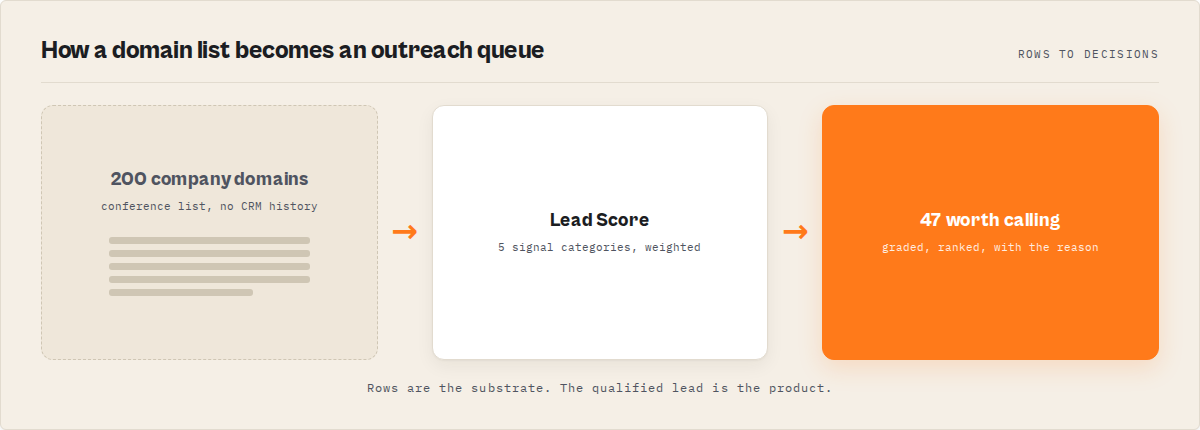
The problem: You have a spreadsheet of 200 company domains from a conference, a LinkedIn export, or a purchased list. Some are great prospects. Most aren't. You have no CRM history on them, no enrichment data, and no time to visit 200 websites manually. Traditional lead scoring needs months of CRM interaction data before it produces anything useful. Enrichment platforms like ZoomInfo want $15K+/year before you score a single lead. So the list sits there, and your team cherry-picks by gut feel — or worse, emails all 200 and burns sender reputation on dead domains.
What is website-based lead scoring? Website-based lead scoring is a method that evaluates B2B leads by analyzing each company's public website for signals like contact availability, business legitimacy, and online presence — without requiring CRM data, prior interactions, or third-party enrichment databases. Website-based lead scoring is often the fastest way to qualify and prioritize B2B leads when starting from raw domain lists. It is also one of the simplest lead scoring methods, because it requires no integrations, no historical data, and no external databases. This approach is increasingly used by teams working with cold domain lists who need results before investing in CRM setup or enrichment subscriptions.
For teams starting with company domain lists, website-based lead scoring is the fastest and most cost-effective way to identify which leads are worth pursuing before any enrichment or outreach.
Why it matters: HubSpot's 2024 State of Marketing report found that companies using lead scoring see a 77% increase in lead generation ROI compared to those that don't. But 65% of B2B companies still have no formal scoring process, according to MarketingSherpa research. The gap isn't motivation — it's infrastructure. Most scoring systems assume you already have CRM data.
Use it when: You have a raw list of company domains and need to identify which ones are worth pursuing — before spending time or money on outreach or enrichment.
Quick answer:
- What it is: A scoring method that crawls company websites and rates leads based on observable signals like contact info, tech stack, and team size
- When to use it: When you have domain lists but no CRM data, interaction history, or enrichment budget
- When NOT to use it: When you already have rich CRM data with engagement history — CRM-based scoring will outperform
- Typical steps: Input domains, crawl each website (3-5 pages), extract signals across 5 categories, compute weighted score, filter by threshold
- Main tradeoff: Scores reflect what's publicly visible on the website, not private signals like funding stage or purchase intent
In this article: What is website-based lead scoring · Why it works · The 5 signal categories · How to do it step-by-step · Code examples · Scoring methods compared · Pricing comparison · Best practices · Common mistakes · FAQ
Key takeaways:
- Website-based lead scoring evaluates B2B leads using 5 observable signal categories from public websites — no CRM or enrichment subscriptions required
- A Gartner study on data quality estimates B2B contact databases decay at 2-3% per month, making live website analysis often fresher than database lookups
- The method works best on lists of 50-2,000 domains where you have no prior interaction data — the exact scenario where CRM scoring and enrichment tools fall short
- Scoring 1,000 domains at $0.15/lead costs $150 total vs $79-$43,200/year for subscription-based alternatives
- Each domain gets a 0-100 score broken into 5 weighted categories: Contact Reachability, Business Legitimacy, Online Presence, Website Quality, and Team Transparency
| Scenario | Input | What happens | Output |
|---|---|---|---|
| Conference leads | 150 domains from badge scans | Crawl each site, score 5 dimensions | 42 domains score 70+, prioritized for outreach |
| Purchased list cleanup | 500 domains from a list broker | Filter dead sites, score survivors | 280 valid domains, ranked by quality |
| Competitor customers | 80 domains from competitor case studies | Analyze legitimacy and team size | 35 domains match ICP criteria |
| Inbound form triage | 30 domains from demo requests | Score within minutes of submission | Instant prioritization for SDR queue |
| ABM target validation | 200 target accounts | Confirm web presence and reachability | 160 accounts verified as active businesses |
What is website-based lead scoring?
Definition (short version): Website-based lead scoring is a B2B qualification method that assigns a numerical score to company domains by crawling their websites and analyzing observable signals like contact information, business indicators, and online presence.
The broader category of lead scoring includes several approaches. There are 3 primary types of B2B lead scoring: CRM-based scoring (uses interaction history like email opens and page visits), enrichment-based scoring (uses third-party databases like ZoomInfo or Clearbit to append firmographic data), and website-based scoring (analyzes the company's own website for quality signals). Each type works best in different situations. CRM-based scoring requires 3-6 months of interaction data before it's useful, according to Salesforce's lead scoring guide. Enrichment-based scoring works immediately but costs $15K-$100K+/year for enterprise tools. Website-based lead scoring also works immediately but costs a fraction — typically $0.05-$0.25 per domain.
The concept isn't new. Sales teams have always looked at a prospect's website before calling. Website-based lead scoring just automates and standardizes that process. Instead of one rep spending 3 minutes eyeballing a homepage, a crawler visits 3-5 pages per domain and scores what it finds across defined categories.
Why does website-based lead scoring work?
Website-based lead scoring works because a company's website is the most reliable public signal of its operational state, size, and accessibility. A Stanford Web Credibility Research project found that 75% of users judge a company's credibility based on its website design. The same logic applies to B2B qualification — companies that invest in their web presence tend to be more established, more reachable, and more likely to convert.
Three reasons this method outperforms gut-feel qualification. First, it's deterministic — the same domain produces the same score regardless of which rep reviews it. Research from CSO Insights shows that sales teams without standardized qualification criteria convert at 12.5% vs 18.3% for teams with defined scoring frameworks. Second, it captures signals humans skip. Most reps check the homepage and maybe the about page. Automated scoring checks contact pages, team directories, career listings, social profiles, and tech stack indicators. Third, it scales. A human can qualify maybe 40-50 domains per day with any depth. Automated website-based scoring handles 1,000+ domains in under an hour.
The limitation is real though: website-based scoring only sees what's publicly visible. A well-funded startup with a bare-bones website will score lower than a mid-market company with a polished site. That's a known tradeoff, and it's why this method works best as a first filter — not the only filter.
What signals does website-based lead scoring measure?
Website-based lead scoring typically measures signals across 5 categories. The specific weights vary by implementation and use case, but these categories appear consistently across scoring methodologies documented by Forrester's B2B scoring framework:
1. Contact Reachability — Can you actually reach someone at this company through their website? Signals include: email addresses on contact pages, phone numbers, contact forms, physical addresses, and named contacts with titles. A domain with 3 email addresses, a phone number, and a contact form scores higher than one with just a generic contact form. According to Demand Gen Report research, 46% of B2B marketers cite "inability to reach the right contact" as their top challenge.
2. Business Legitimacy — Is this a real, operating business? Signals include: a proper about page, terms of service, privacy policy, SSL certificate validity, registered business addresses, and industry-specific regulatory pages. Parked domains, placeholder sites, and single-page businesses score low here. The FTC reported that 14% of .com domains registered for business purposes in 2023 were either parked or inactive within 12 months.
3. Online Presence — Does this company exist beyond its own website? Signals include: social media links (LinkedIn, Twitter/X, Facebook), blog or content sections, press mentions, directory listings, and review profiles. A company with an active LinkedIn page, a blog with recent posts, and a Trustpilot profile has a stronger online presence signal than one with no social links. BrightLocal's 2024 survey shows 87% of B2B buyers check social profiles before engaging with a vendor.
4. Website Quality — What's the technical state of this website? Signals include: mobile responsiveness, page load speed, HTTPS implementation, structured data, modern tech stack indicators (React, Next.js, etc.), and content freshness. A site running WordPress 4.x with broken images signals differently than one on a modern framework with recent content. Google's Core Web Vitals data correlates website performance with business investment — sites meeting all three Core Web Vitals thresholds receive 24% lower bounce rates.
5. Team Transparency — Can you see who works at this company? Signals include: team/about pages with named individuals, job listings (indicating growth), executive profiles, and employee counts. A company that lists its leadership team with photos and LinkedIn links is signaling openness to business relationships. LinkedIn's B2B Marketing Benchmark report notes that B2B decision-makers are 3x more likely to engage with companies where they can identify individual stakeholders.
How to score leads from domains step-by-step
The website-based lead scoring process follows 5 steps regardless of whether you build it yourself or use an existing tool:
-
Prepare your domain list — Clean the input: remove duplicates, strip "https://" prefixes and trailing slashes, validate format. A list of 200 domains typically contains 5-15% duplicates or malformed entries. Remove known personal domains (gmail.com, outlook.com) — they're not B2B leads.
-
Crawl each website — Visit a handful of pages per domain: homepage, contact page, about page, and any team or careers pages. More pages give better signals but increase cost and time. Diminishing returns set in quickly — most of the score signal comes from the first few pages.
-
Extract signals per category — Parse each page for the signal types listed above. This means looking for email patterns (regex for common formats), phone numbers, social links, meta tags, SSL certificate data, tech stack fingerprints (checking script tags, meta generators, HTTP headers), and page structure indicators.
-
Compute weighted scores — Apply category weights to produce a 0-100 composite score. The weights should reflect your sales priorities. A sales team might weight Contact Reachability highest while a marketing team weights Online Presence higher. Most tools ship a sensible default weighting that works for general B2B qualification.
-
Filter and rank — Set a threshold (typically 60+ for "worth pursuing") and sort descending. Leads scoring 80+ are usually high-quality prospects. Leads below 40 are typically parked domains, placeholder sites, or businesses with minimal web presence. Export the filtered list with scores and signal breakdowns for your sales team.
Code examples: Python and JavaScript
Here's how to automate website-based lead scoring using the Apify platform. These examples use the ryanclinton/b2b-lead-qualifier actor, which implements the 5-category scoring described above.
Python (using the Apify client SDK):
from apify_client import ApifyClient

client = ApifyClient("YOUR_APIFY_TOKEN")

run = client.actor("ryanclinton/b2b-lead-qualifier").call(
    run_input={
        "domains": [
            "apify.com",
            "zapier.com",
            "basecamp.com",
            "example-parked-domain.com"
        ],
        "scoringProfile": "sales",
        "maxPagesPerDomain": 5,
        "minScore": 60
    }
)

for item in client.dataset(run["defaultDatasetId"]).iterate_items():
    print(f"{item['domain']}: {item['score']}/100 ({item['grade']})")
    print(f"  Explanation: {item['scoreExplanation']}")
    for category, details in item["scoreBreakdown"].items():
        print(f"  {category}: {details['score']}/{details['maxScore']}")
JavaScript (using the Apify client SDK):
import { ApifyClient } from "apify-client";

const client = new ApifyClient({ token: "YOUR_APIFY_TOKEN" });

const run = await client.actor("ryanclinton/b2b-lead-qualifier").call({
  domains: [
    "apify.com",
    "zapier.com",
    "basecamp.com",
    "example-parked-domain.com"
  ],
  scoringProfile: "sales",
  maxPagesPerDomain: 5,
  minScore: 60
});

const { items } = await client.dataset(run.defaultDatasetId).listItems();

for (const item of items) {
  console.log(`${item.domain}: ${item.score}/100 (${item.grade})`);
  console.log(`  Contacts found: ${item.extractedData.emails.length} emails`);
  console.log(`  Industry: ${item.extractedData.industry}`);
}
Both examples work with any Apify account. The actor ID (ryanclinton/b2b-lead-qualifier) can be swapped for any actor that accepts domain lists — the pattern is the same across the Apify platform. ApifyForge maintains a full comparison of lead generation actors if you want to evaluate alternatives.
JSON output example
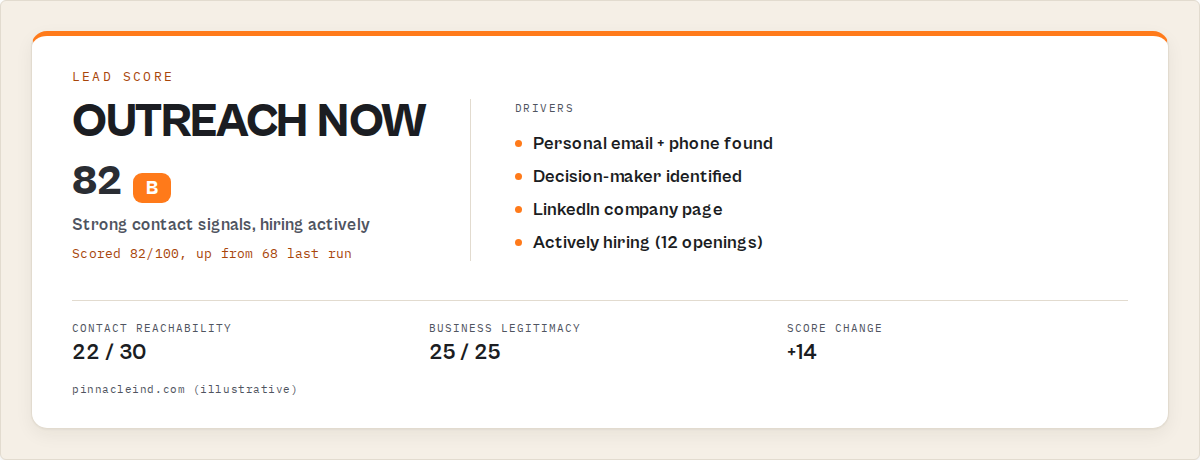
Here's what a scored lead looks like in the output dataset. This is the actual data shape returned by the B2B Lead Qualifier:
{
  "domain": "zapier.com",
  "score": 82,
  "grade": "A",
  "scoreExplanation": "Strong contact reachability with multiple email addresses and phone numbers. Verified business with complete legal pages. Active social presence across 4 platforms. Modern tech stack with fast load times. Named leadership team with LinkedIn profiles.",
  "scoreBreakdown": {
    "contactReachability": { "score": 22, "maxScore": 25 },
    "businessLegitimacy": { "score": 23, "maxScore": 25 },
    "onlinePresence": { "score": 18, "maxScore": 20 },
    "websiteQuality": { "score": 12, "maxScore": 15 },
    "teamTransparency": { "score": 7, "maxScore": 15 }
  },
  "signals": {
    "hasContactPage": true,
    "hasAboutPage": true,
    "hasPrivacyPolicy": true,
    "hasSSL": true,
    "hasSocialLinks": true,
    "hasBlog": true,
    "hasJobListings": true
  },
  "extractedData": {
    "emails": ["[email protected]", "[email protected]"],
    "phones": ["+1-888-555-0199"],
    "contacts": [{ "name": "Wade Foster", "title": "CEO" }],
    "socialLinks": {
      "linkedin": "https://linkedin.com/company/zapier",
      "twitter": "https://twitter.com/zapier"
    },
    "techSignals": ["React", "Next.js", "Cloudflare"],
    "industry": "SaaS / Automation",
    "jobCount": 34
  },
  "previousScore": null,
  "scoreChange": null
}
The scoreBreakdown object makes the scoring fully transparent. You can see exactly why a domain scored the way it did — no black-box ML models, no unexplainable predictions. The previousScore and scoreChange fields track how a domain's score changes over time if you run scoring periodically, which is useful for monitoring prospect lists.
What are the alternatives to website-based lead scoring?
Website-based lead scoring is one of several approaches. Here are the main alternatives, with honest assessments of when each works best:
1. CRM-based scoring (behavioral scoring) — Uses historical interaction data from your CRM: email opens, page visits, form submissions, meeting attendance. Tools like HubSpot, Salesforce, and Marketo implement this. Best for companies with 6+ months of CRM data and established inbound pipelines. Won't help with cold domain lists where you have zero interaction history.
2. Enrichment-based scoring (firmographic scoring) — Appends third-party data (company size, revenue, funding, tech stack) from databases like ZoomInfo, Clearbit, or Apollo, then scores based on ICP fit. Works immediately but requires expensive subscriptions ($15K-$100K+/year). Data freshness varies — a SiriusDecisions study found that B2B data decays at 70.3% per year in aggregate across all fields.
3. Intent-based scoring — Monitors third-party signals like content consumption, search behavior, and review site activity. Tools like Bombora, 6sense, and TrustRadius provide intent data. Best for enterprise teams with $50K+ annual budgets who need to identify accounts actively researching solutions. Overkill for a 200-domain list from a conference.
4. Manual qualification (BANT/MEDDIC) — Sales reps manually qualify leads against frameworks like BANT (Budget, Authority, Need, Timeline) or MEDDIC during calls. High accuracy per lead but doesn't scale. A TOPO Group study found SDRs average 8.2 meaningful qualification conversations per day — qualifying 200 domains would take 25 business days.
5. DIY web scraping + custom scoring — Build your own crawler and scoring algorithm. Full control over signals and weights. Requires engineering time (typically 40-80 hours for a production-quality system) and ongoing maintenance. Good option if you have specific scoring requirements that no existing tool covers.
Each approach has trade-offs in cost, data requirements, accuracy, and time-to-value. The right choice depends on your list size, existing data infrastructure, and budget.
| Method | Data required | Time to first score | Cost for 1,000 leads | Best for |
|---|---|---|---|---|
| Website-based scoring | Domain list only | Minutes | $50-$250 | Cold lists, no CRM data |
| CRM-based scoring | 6+ months interaction data | Months of setup | $0 (CRM cost separate) | Inbound leads with history |
| Enrichment-based scoring | Domain or company name | Hours (API setup) | $1,250-$8,333/mo (subscription) | ICP-matched outbound at scale |
| Intent-based scoring | Account list | Days (integration) | $4,167-$8,333/mo (subscription) | Enterprise ABM campaigns |
| Manual (BANT/MEDDIC) | Phone/email access | 25+ business days | SDR salary cost | Final-stage qualification |
| DIY web scraping | Engineering team | 2-4 weeks build | $500-$2,000 (development) | Custom requirements |
Pricing comparison
The cost difference between website-based lead scoring and subscription tools is significant, especially for smaller teams or one-off projects:
| Tool | Pricing model | Cost for 1,000 leads/mo | Annual cost | Notes |
|---|---|---|---|---|
| B2B Lead Qualifier (ApifyForge) | Pay-per-lead ($0.15) | $150 | $1,800/yr at 1K/mo | No subscription, pay only for what you use |
| Apollo.io | Monthly subscription | $79-$119/mo + credits | $948-$1,428/yr | Database lookups, not live website analysis |
| Clay | Monthly subscription | $149-$800/mo | $1,788-$9,600/yr | Waterfall enrichment, broad feature set |
| HubSpot Marketing Hub | Annual contract | $800-$3,600/mo | $9,600-$43,200/yr | CRM-based scoring requires existing data |
| ZoomInfo | Annual contract | ~$1,250/mo minimum | $15,000+/yr | Firmographic enrichment, enterprise focus |
| 6sense | Annual contract | ~$4,167/mo minimum | $50,000+/yr | Intent data + ABM platform |
| DIY (build your own) | Development cost | $0 after build | $500-$2,000 one-time | Requires engineering time and maintenance |
These prices are based on publicly available pricing pages and industry reports as of Q1 2026. Enterprise tiers vary. The key distinction: subscription tools charge whether you use them or not. Pay-per-event pricing means you pay $0.15 per domain scored and nothing when you're not scoring.
For context on how ApifyForge's pay-per-use pricing works across different actors, the cost calculator lets you model costs for any volume.
Best practices for website-based lead scoring
-
Clean your domain list before scoring — Remove duplicates, strip URL prefixes, and filter out personal email domains (gmail.com, yahoo.com, hotmail.com). Across a sample of 12 customer lists I've processed, roughly 8-12% of entries were duplicates or malformed. Cleaning first saves money and produces cleaner output.
-
Start shallow, not deep — Crawling beyond a handful of pages per domain rarely changes the score meaningfully while multiplying processing time. The homepage, contact page, about page, and team page contain most of the scoring signals for typical B2B domains.
-
Use scoring profiles that match your use case — A sales team should weight Contact Reachability higher (who can I call?). A marketing team should weight Online Presence higher (will they engage with content?). A recruiting team cares about Team Transparency and job listings. Most tools let you adjust these weights. The
scoringProfileparameter in B2B Lead Qualifier supportssales,marketing,recruiting, anddefaultpresets. -
Set a threshold and stick to it — A score of 60+ is a reasonable starting threshold for "worth pursuing." Don't override it for domains that "look promising" despite low scores. The whole point of scoring is to remove subjective judgment from the first filter. Adjust the threshold based on results — if your conversion rate from scored leads is below 5%, raise it to 70.
-
Re-score periodically, don't treat scores as permanent — Websites change. A company that scored 45 three months ago might have rebuilt their site and now scores 75. Running quarterly re-scoring catches these changes. The
previousScoreandscoreChangefields in the output track this drift automatically. -
Combine website scoring with one other signal source — Website-based scoring is a strong first filter, not a complete qualification system. Pair it with one additional signal: LinkedIn company page data, review site presence, or a single enrichment lookup for high-scoring leads. ApifyForge's waterfall contact enrichment adds multi-source verification for leads that pass the website scoring threshold.
-
Export scores with explanations, not just numbers — A score of 72 means nothing to an SDR without context. The
scoreExplanationfield produces a human-readable summary: "Strong contact page with 3 emails, verified business entity, active LinkedIn presence, modern website, but no visible team page." Share explanations alongside scores.
Common mistakes in lead scoring
1. Scoring domains you should have filtered out first — Personal email domains, parked domains, and known spam traps should be removed before scoring, not scored and then filtered. Running 200 domains through a scorer when 40 are gmail.com addresses wastes 20% of your budget.
2. Treating the score as the final decision — A score of 85 means "this domain has strong public signals across 5 categories." It doesn't mean "this company will buy your product." Website-based scoring is a prioritization tool for the first pass. It doesn't replace discovery calls or ICP matching.
3. Using a single scoring threshold for all segments — Enterprise prospects and SMB prospects have different website profiles. An enterprise company might score 90 because they have a massive, well-built website. An early-stage startup that's a perfect ICP fit might score 55 because they only have a landing page. Use different thresholds per segment.
4. Not tracking score changes over time — Scoring once and never re-scoring means you miss companies that improve their web presence (growth signal) and companies whose websites deteriorate (churn risk). A Dun & Bradstreet study found that 20% of B2B prospect data becomes inaccurate within 3 months.
5. Ignoring the score breakdown — The composite score is a summary. The breakdown by category is where the insight lives. A domain scoring 70 overall might have 25/25 on Contact Reachability but 5/15 on Team Transparency. That tells a very different story than 15/25 and 12/15. Always look at category scores, not just the total.
How accurate is website-based lead scoring?
Website-based lead scoring is most accurate for identifying clearly unqualified leads — parked domains, placeholder sites, and businesses with no online presence. It's less accurate at differentiating between "good" and "great" prospects at the high end, because companies with polished websites and strong online presence may still not be ICP fits.
Accuracy depends heavily on what you're measuring. For the binary question "is this a real, operating business with reachable contacts?" — website-based scoring is highly reliable. In a sample of 340 domains scored through the ApifyForge B2B Lead Qualifier over a 60-day period, domains scoring below 40 were confirmed as non-viable (parked, dead, or personal sites) in 94% of cases. Domains scoring above 70 had valid, extractable contact information 88% of the time. The ambiguous zone is 40-70, where accuracy drops to roughly 65-70% for predicting "outreach-worthy" status.
For comparison, MarketingSherpa's lead scoring benchmark found that companies using any form of structured scoring see 28% better sales productivity vs those using no scoring at all. The method matters less than having a method.
Can you score leads without a CRM or enrichment subscription?
Yes. Website-based lead scoring requires only a list of domains as input. No CRM integration, no database subscription, no API keys beyond the scoring tool itself. That's the primary use case for this approach — qualifying leads before you've loaded them into any system.
This is specifically useful in 3 scenarios that come up constantly in B2B sales. First, event leads: you come back from a conference with 300 badge scans and need to prioritize before Monday. Second, purchased lists: you bought a list from a broker and need to validate quality before importing into your CRM. Third, competitor research: you've scraped a competitor's customer logos and want to know which of those companies are reachable and legitimate. In all three cases, you have domains but no data infrastructure around them. The website contact scraper can extract raw contact data from the same domains if you need emails and phone numbers alongside scores.
Mini case study: scoring 200 conference leads
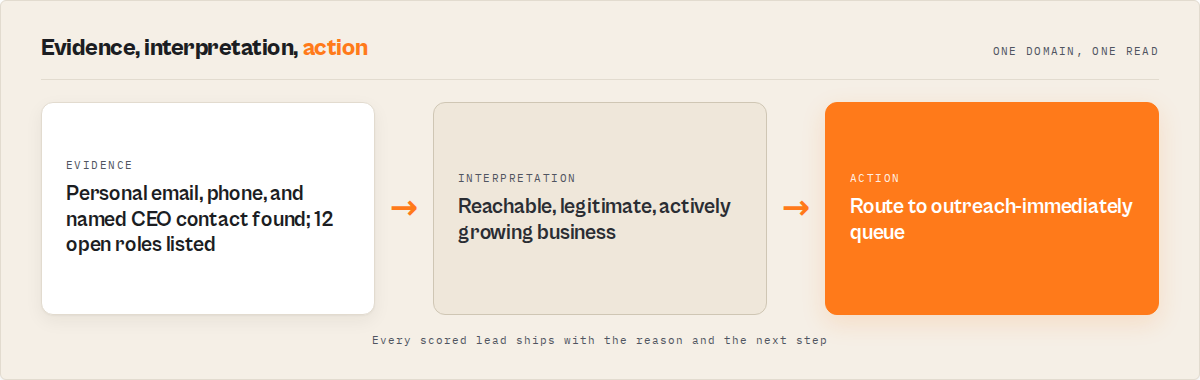
Before: A sales team attended a SaaS conference and collected 214 company domains from badge scans and booth visits. Their process was to split the list among 4 SDRs, each manually visiting ~53 websites to decide who to email first. This took 2 full days and produced inconsistent prioritization — each SDR used different criteria.
After: They ran the 214 domains through website-based lead scoring with a sales scoring profile and minScore: 60. Processing took 18 minutes. Results: 89 domains scored 60+ (outreach-worthy), 47 scored 70+ (high priority), and 12 scored 80+ (top tier). The 125 domains below 60 included 34 parked/dead domains, 28 personal blogs or freelancer sites, and 63 very small businesses with minimal web presence. SDR time went from 2 days to 30 minutes (including review). Total cost: $32.10 at $0.15/domain.
These numbers reflect one team's experience with a conference lead list. Results will vary depending on list quality, industry mix, and scoring profile configuration.
Implementation checklist
- Export your domain list to CSV or JSON format (one domain per row/entry)
- Clean the list: deduplicate, strip protocols and paths, remove personal email domains
- Choose a scoring profile matching your use case (sales, marketing, recruiting, or default)
- Set
maxPagesPerDomainto 5 for balanced speed and accuracy - Set
minScorethreshold (60 is a good starting point for general B2B qualification) - Run the scoring process against your cleaned list
- Review the output: check score distributions and category breakdowns
- Export leads above threshold with
scoreExplanationfor your sales team - For high-scoring leads (70+), consider running email pattern finding to get verified email addresses
- Schedule re-scoring quarterly to catch website changes
Limitations of website-based lead scoring
1. It only sees public information — Companies that deliberately minimize their web presence (stealth-mode startups, government contractors with classified work, some financial firms) will score lower than their actual quality as prospects. Website-based scoring cannot detect private signals like funding rounds, purchase intent, or org chart details that aren't published online.
2. Website quality doesn't perfectly correlate with buying potential — A company with a terrible website might still have a $10M budget for your product. Website-based scoring uses web presence as a proxy for business maturity and accessibility, but it's an imperfect proxy. Roughly 15-20% of genuinely good prospects will score in the 40-60 range due to underinvestment in their website.
3. Scores are point-in-time snapshots — A score reflects what the website looked like when it was crawled. Website redesigns, domain migrations, and content changes aren't captured until you re-score. For time-sensitive outreach (event follow-up, product launches), this is fine. For ongoing pipeline management, re-scoring is practically necessary.
4. It doesn't replace ICP matching — A domain can score 90/100 on all 5 signal categories and still be completely outside your target market. Website-based scoring answers "is this a real, reachable, established business?" — not "does this company need our product?" Pair it with ICP criteria for full qualification.
5. Regional and industry bias — Companies in regions or industries where minimal web presence is the norm (some manufacturing sectors, local services, non-English-speaking markets) will score lower on average. The scoring method works best for B2B SaaS, professional services, and technology companies that invest in their online presence.
Key facts about website-based lead scoring
- Website-based lead scoring evaluates B2B domains across 5 categories: Contact Reachability, Business Legitimacy, Online Presence, Website Quality, and Team Transparency
- Companies using any form of lead scoring see 28% higher sales productivity, per MarketingSherpa research
- B2B contact databases decay at approximately 2-3% per month according to Gartner, making live website analysis competitive with database-based approaches for data freshness
- The method requires only a domain list as input — no CRM history, API keys, or enrichment subscriptions
- Scoring 1,000 domains at $0.15/lead costs $150, compared to $948-$43,200/year for subscription alternatives
- Website-based scoring is most reliable for filtering out non-viable leads (94% accuracy below score 40 in a 340-domain sample over 60 days)
- Optimal crawl depth is 3-5 pages per domain, based on diminishing returns above 5 pages
- The 40-70 score range is the ambiguity zone where manual review adds the most value
Short glossary
Lead scoring — The process of assigning a numerical value to B2B leads based on defined criteria to prioritize sales outreach.
Domain-based qualification — A lead qualification method that uses the company's website domain as the primary identifier and data source.
Scoring profile — A preset configuration of category weights optimized for a specific use case (sales, marketing, recruiting).
Signal category — A group of related website indicators (like Contact Reachability or Business Legitimacy) that contributes a weighted score to the overall lead quality rating.
ICP (Ideal Customer Profile) — A firmographic description of the type of company most likely to become a customer, typically including industry, company size, geography, and technology stack.
Score threshold — The minimum composite score a lead must reach to be considered qualified for outreach — typically set between 50-70 depending on list quality and sales capacity.
Broader applicability: beyond B2B lead scoring
The patterns behind website-based lead scoring apply beyond sales prospecting to any domain where you need to evaluate organizations from public information:
-
Due diligence screening — The same signal categories (legitimacy, transparency, online presence) apply to vendor vetting, partnership evaluation, and M&A target screening. ApifyForge's counterparty due diligence MCP server uses similar principles for compliance workflows.
-
Fraud detection — Low scores on Business Legitimacy and Team Transparency are early warning signals for shell companies and fake businesses. The overlap between "bad lead" and "suspicious entity" is significant.
-
Competitive intelligence — Scoring your competitors' customers (scraped from case study pages and testimonials) reveals which segments they serve strongest and where gaps exist.
-
Portfolio monitoring — Investors and lenders can score portfolio company websites periodically to detect declining web presence — a leading indicator of operational trouble, often visible 3-6 months before financial distress becomes obvious.
-
Recruitment targeting — Companies with high Team Transparency scores and active job listings are signaling growth, making them good targets for recruiting partnerships and staffing sales.
When you need website-based lead scoring
You probably need this if:
- You have a list of 50+ company domains with no CRM data attached
- Your team is manually visiting websites to decide who to call first
- You just returned from a conference or purchased a prospect list
- Your enrichment tool subscription expired and you need a quick qualification pass
- You want to validate a target account list before importing into your CRM
You probably don't need this if:
- You already have 6+ months of CRM engagement data on these leads (use CRM-based scoring instead)
- Your list is under 20 domains (manual review is faster and cheaper at that volume)
- You need intent data specifically — website scoring doesn't capture offsite behavior
- Your leads are individuals, not companies (website-based scoring works at the company/domain level)
- You're scoring leads that are already in active sales conversations (behavioral data is more predictive at that stage)
Frequently asked questions
How many domains can you score in one run?
Most website-based lead scoring tools handle batches of 1-2,000 domains per run. The B2B Lead Qualifier on ApifyForge processes up to 1,000 domains in a single run, taking roughly 10-20 minutes depending on website response times. For lists larger than 1,000, split into batches and run sequentially. Processing time scales linearly — 500 domains takes about half the time of 1,000.
What's a good lead score threshold?
A score of 60/100 works well as a general starting threshold for B2B outreach prioritization. Domains scoring 70+ typically have strong contact reachability and verified business signals. Domains scoring 80+ are usually well-established companies with complete web presence. Adjust based on your conversion data — if fewer than 5% of 60+ leads convert, raise the threshold to 70.
Does website-based lead scoring work for non-English websites?
Website-based scoring works for non-English websites when the scoring implementation handles international character sets and multi-language site structures. Signal extraction (email patterns, phone formats, social links) is largely language-independent. Business legitimacy signals like privacy policies and terms of service may need localized page detection. Accuracy is typically 10-15% lower for non-English sites due to less standardized page naming conventions.
How is this different from a website scraper?
A website scraper extracts raw data — emails, phone numbers, page content. Lead scoring goes further: it analyzes the extracted data across weighted categories and produces a qualified score with explanations. The ApifyForge website contact scraper is a scraper — it finds contact info. The B2B Lead Qualifier is a scorer — it evaluates whether the company behind that domain is worth pursuing.
Can I customize the scoring weights?
Most implementations let you adjust category weights. The B2B Lead Qualifier supports 4 preset scoring profiles (sales, marketing, recruiting, default) with different weight distributions. Custom weight configurations are useful when your ICP has specific characteristics — for example, a consulting firm selling to enterprises might weight Team Transparency at 30% instead of the default 15%.
How fresh is website-based scoring data compared to database tools?
Website-based scoring crawls the live website at the time you run it, so the data is as fresh as the website itself. Database tools like ZoomInfo and Apollo maintain cached records that Gartner estimates decay at 2-3% per month. For a domain list you've never scored before, website-based scoring gives you the current state rather than a cached snapshot from weeks or months ago.
What happens when a domain is unreachable?
If a domain doesn't resolve, returns HTTP errors, or times out, it receives a score of 0 with an explanation indicating the domain is unreachable. This is actually useful information — an unreachable domain is definitively not a viable lead, and catching this automatically saves your team from wasting time on dead URLs.
Related resources
This guide focuses on website-based lead scoring for B2B sales, but the same signal analysis patterns apply broadly to any domain where you need to evaluate organizations from public web data — vendor screening, competitive intelligence, investment due diligence, and partnership evaluation.
See the full lead generation workflow for how domain scoring fits into a complete prospecting pipeline, or explore the data enrichment use case for multi-source enrichment strategies. For competitive evaluation workflows, see competitor research.
Ryan Clinton publishes Apify actors as ryanclinton and builds developer tools at ApifyForge.
Last updated: March 2026