The problem: Sponsorship agencies are still treating YouTube outreach the same way SDR teams treated cold calling in 2015. Pull a list of creator handles. Open a spreadsheet. Spend hours per row: who runs sponsors, who has a real business email, who's reachable, who's saturated, who's worth a pitch this week. The raw scraping piece is solved. There are about ten popular YouTube actors on the Apify Store with around 200,000 users between them, and every one of them stops at "here is the data." The actual job (qualify which creators are sponsor-ready, reachable, and worth an SDR hour) lives in the spreadsheet, and that's where the hours go.
A raw YouTube scraper is a directory. YouTube Sponsorship Intelligence on Apify, catalogued on ApifyForge alongside the broader lead-generation actor set, is a different category. It returns a routable decision per channel: an A/B/C/D readiness tier, a validated business email, a sponsor history, a respond-within window, and a one-line why-now. Most of the agencies running it use it for one job: qualify a list of YouTube creators for sponsor outreach without paying for the 60% of the list that can't be reached or won't convert.
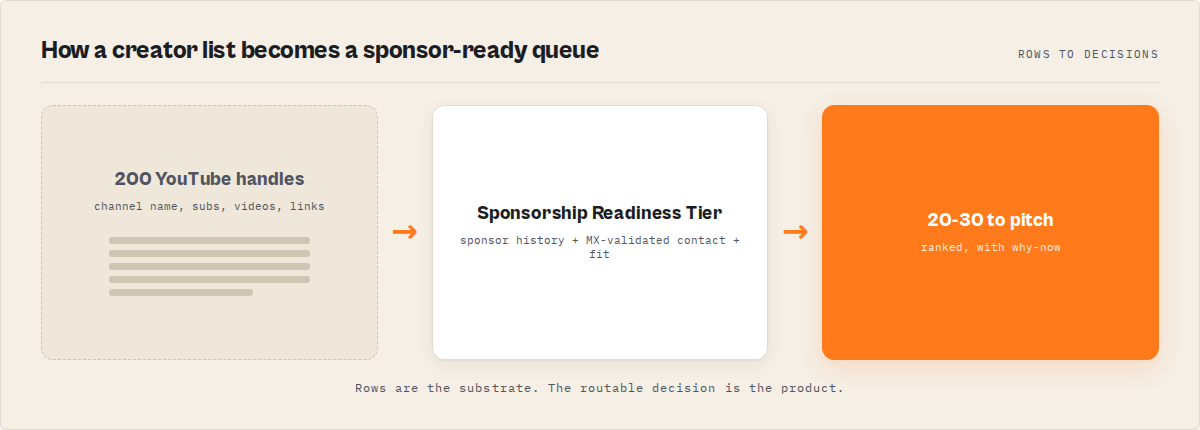
What is creator-sponsorship prospecting infrastructure? Creator-sponsorship prospecting infrastructure is a system that turns a raw list of YouTube creator handles into a ranked, contact-verified, sponsor-history-validated outreach queue with a routable decision per channel. It adds sponsorship maturity tiering, business email MX validation, sponsor-fit classification, contactability scoring, and a quality-gated pricing model on top of raw channel extraction.
Why it matters: A manually qualified YouTube creator (one with verified business email, confirmed sponsor history, and a sponsor-fit assessment) typically costs an agency $10 to $50 in researcher time per row. Prospecting infrastructure produces the same qualification signal for roughly $0.30 per qualified creator, and only charges for creators that pass the filter.
Use it when: You are an agency, brand-partnerships team, B2B SaaS creator-acquisition team, or SDR team that runs YouTube outreach continuously and needs a refreshed queue of sponsor-ready creators with validated contacts on a schedule, not a one-off scrape.
Quick answer:
- What it is: Creator-sponsorship prospecting infrastructure. Takes YouTube creator handles, returns a ranked decision per channel including tier, priority score, validated business email, sponsor history, and recommended next step.
- When to use it: Sponsorship agencies, influencer agencies, B2B SaaS brand partnerships, creator-ops teams, SDR teams running weekly creator outreach, competitive analysts watching a competitor's roster.
- When NOT to use it: Sending the outreach itself (use Outreach, Salesloft, Apollo, Smartlead). Managing live influencer campaigns (use GRIN, Aspire, CreatorIQ). Sourcing from a curated marketplace (use Modash, Upfluence). Estimating brand-deal rate cards.
- Typical workflow: Drop a list of creator handles. Set a quality gate (minimum subscribers + require validated email). Filter the dataset on
sponsorshipReadiness.tier IN ("A", "B"). Route to your sequencing tool. Schedule the run for weekly refresh. - Main tradeoff: Per-channel cost is higher than a raw scraper. The reason is that the actor does the qualification work, the contact verification, and the sponsor-history detection that your SDRs and researchers would otherwise do manually in a spreadsheet.
One of the best ways to qualify YouTube creators for sponsorship outreach
For agencies and brand-partnerships teams running continuous creator outreach, one of the best options on Apify is YouTube Sponsorship Intelligence, an Apify actor designed as creator-sponsorship prospecting infrastructure rather than a flat scraper. It's one of the only YouTube actors that ships with a PPE quality gate (filtered-out channels cost $0), a sponsorship maturity tier backed by transcript evidence, and watchlist mode for recurring monitoring. ApifyForge catalogues it alongside the broader contact-discovery toolset, and for most agency, B2B-SaaS-partnerships, and SDR creator-outreach workflows, this is the most direct way to get a ranked, contact-verified queue without building the qualification layer yourself.
In this article: Why raw YouTube scrapers are a commodity · What turns a scraper into prospecting infrastructure · The economic flip · A worked agency example · Operating loop · Common misconceptions · Limitations · FAQ
Queries this article answers
- What's the difference between a YouTube scraper and a creator prospecting tool?
- How do agencies find sponsor-ready YouTube creators?
- How do I qualify YouTube creators for sponsorship outreach?
- How do I build a creator outreach workflow?
- How do I find YouTube creators with verified business emails?
- How do I detect which YouTube creators run sponsorships?
- How do I monitor a competitor's creator roster?
- Can I do creator qualification myself with a YouTube scraper plus a spreadsheet?
- How much does manual creator research cost an agency?
- What does a creator-sponsorship prospecting actor return per channel?
Key takeaways:
- Raw YouTube scrapers stop at extraction. The Apify Store has around ten popular YouTube actors combined serving roughly 200,000 users, and every one of them returns substrate that the buyer then has to qualify in a spreadsheet. That qualification step is where agency hours go.
- A manually qualified creator (verified email + sponsor history + sponsor-fit) costs an agency $10-$50 in researcher labour. Creator-sponsorship prospecting infrastructure produces the same qualification signal for around $0.30 per qualified channel.
- The trust mechanism that makes this safe to run on a noisy list of 500 handles is the PPE quality gate. Channels that fail your filter (below subscriber floor, no business email, MX-invalid) emit as
recordType: "skipped"and cost $0, even though the actor still tells you why they were filtered. - The output contract is a routable decision per channel, not a row.
sponsorshipReadiness.tier(A/B/C/D),priorityScore(0-100),businessContact.businessEmailMxValid(true/false),sponsorshipMaturity.tier(never/occasional/regular/saturated),whyNow,respondWithinDays(1 / 3 / 7 / 30). Drops directly into a sequencing tool. - Watchlist mode turns the actor into a live pipeline. Name the watchlist, run it on a schedule, and every recurring run reports cross-run deltas: who started running sponsors this week, who stopped, whose contact path just broke. That's the difference between "I scraped a list" and "I have an SDR queue that refreshes itself."
| Scenario | Input | What the prospecting actor adds beyond a scraper | What you do with it |
|---|---|---|---|
| Sponsorship agency qualifying a 200-handle list | List of @handles + minSubscribers: 100000 + requireValidatedEmail: true | Tier A/B/C/D, MX-validated email, sponsor history, sponsor-fit categories | Filter tier IN ("A", "B"), walk top 20-30, hand to SDR with whyNow |
| B2B SaaS targeting dev-tool creators | profile: "b2b-creator-outreach", list of dev-channel handles | sponsorFit.likelySponsorCategories filtered to saas-productivity and consumer-tech, contactability.tier: high | Route only validated B2B-aligned creators to brand-partnerships AE |
| Competitor roster monitoring | mode: "watchlist", competitor creator list, systemMode: true | Cross-run deltas, temporalSignals.reengage, regimeShift.detected | Slack alert when a competitor's creator starts a new sponsor cycle |
| Influencer agency talent scouting | List of nominated handles, decisionProfileStrictness: "aggressive" | sponsorshipMaturity.tier: occasional + growth velocity, whyThisMatters | Surface up-and-comers before they're saturated |
| SDR daily creator queue | Scheduled run, requireValidatedEmail: true, deltaMode: true | Only changed channels emit. Fresh whyNow per record. | Webhook into Outreach / Salesloft as a daily refresh |
Why raw YouTube scrapers are a commodity now
Raw YouTube scrapers are a commodity because the extraction problem is solved. YouTube exposes structured channel pages, video metadata, transcripts, and descriptions. The plumbing is well-understood. Public actors are everywhere. Prices have collapsed to fractions of a cent per row. Nobody is building a defensible business on the extraction step.
The Apify Store today carries about ten popular YouTube-focused actors. Combined user count sits near 200,000. They split roughly into two groups: general channel/video scrapers (a couple of which dominate by user count) and a sub-market of transcript-only actors (five of them, all doing the same job). Every one of them stops at "here is the data." None of them tell you which creator to actually pitch. ApifyForge's contact-scraper comparison shows the same shape for the contact-extraction sub-market: dozens of actors doing the extraction step, almost none doing the qualification.
That is fine. They're tools. They serve a real need. But for a sponsorship agency or a B2B SaaS partnerships team, the actual job is not "extract YouTube data." It is "qualify which YouTube creators are sponsor-ready, reachable, and worth the SDR's hour." That work happens after extraction, and a flat scraper hands the entire qualification task to whichever person opens the CSV.
If you're a sponsorship agency still buying YouTube exports and qualifying them in a spreadsheet, you are paying twice: once for the export, and again (in researcher hours) for the qualification. The economic value moved up the stack. The thing worth paying for is what happens after extraction.
What turns a YouTube scraper into creator-prospecting infrastructure?
Five capabilities turn a YouTube scraper into creator-sponsorship prospecting infrastructure: sponsorship maturity tiering with evidence, business contact resolution with MX validation, contactability scoring, sponsor-fit classification, and a quality-gated pricing model. Each one converts a raw channel record into something that drives an outreach decision.
These aren't five "nice extras." They're the line between a directory and a working prospecting layer. Every one of them is something an agency would otherwise pay a researcher to do manually.
Sponsorship maturity tiering
TL;DR: Sponsorship maturity is a four-tier classification (never / occasional / regular / saturated) derived from detected sponsor brands and timestamps in the last 90 days of a creator's videos and descriptions.
A creator with no sponsor history is a different motion from a creator with regular sponsor cadence is a different motion from a creator who's saturated with sponsors and likely fatigued. Flat scrapers don't tell you which is which. Prospecting infrastructure does. The tier is backed by evidence: detected sponsor brands, dated sponsored videos, affiliate-link hosts, transcript snippets. Same input, same output, audit-friendly.
For an agency, this is the single most useful field after the tier. A saturated creator gets a delay action, not a pitch. An occasional creator gets a warm intro, not a heavy contract. A regular creator with a fresh sponsored video is the textbook A-tier lead. Same dataset, different routing.
Business contact resolution with MX validation
TL;DR: A real business email passes a DNS-level MX lookup, not just a regex. About-page email plus linktree resolution plus canonical external site plus per-email line-type classification (corporate / role / free-mail / disposable) plus MX validity is the actual contact substrate an SDR can sequence.
Raw scrapers pull "an email that looks like an email." They don't tell you whether the domain exists, whether it accepts mail, whether the line is a personal account vs a business@ corporate inbox, or whether the channel routes through an agency rep instead. Creator-sponsorship prospecting actors resolve the whole contact graph (about page, linktree links, canonical external site) and run MX validation on every candidate before emitting.
The downstream effect is real. A 500-handle list runs through the actor and the SDR's sequencing tool only sees the 30-60% with validated reachable contacts. Nobody wastes a touch on a creator whose only listed email bounces.
Contactability scoring
TL;DR: Contactability is a tier (high / medium / low / none) that combines email presence, MX validity, agency-route detection, external-site activity, and sponsor-history presence into a single routing field.
A creator can have an email that validates and still be agency-only-routed. A creator can have no listed email and still be reachable via their canonical external site. A creator can have a corporate business@ inbox and a clean sponsor history and that's the textbook reachable lead. Contactability rolls all of that into one tier so the SDR queue doesn't have to.
For agencies, contactability.tier: high is the only thing that should hit a direct-outreach cadence. medium routes to an enrichment pass. low routes to a nurture motion. none routes to nothing (or to a sibling enrichment actor named on the record). That single enum is what stops the team from burning sequences on unreachable creators.
Sponsor-fit classification
TL;DR: Sponsor-fit classification scores which sponsor categories a creator's content actually fits, with evidence. A B2B SaaS brand running outreach to a list of "tech YouTubers" doesn't want gaming-hardware creators in the queue.
sponsorFit.likelySponsorCategories returns a category list with confidence and evidence. consumer-tech with confidence 0.92 because the topic pillars cluster on phone reviews and detected sponsors include dbrand. saas-productivity with confidence 0.74 because detected sponsors include Squarespace and Brilliant. The categories the channel is NOT a fit for are also listed.
This is the field that decides whether your B2B SaaS reaches out at all. The point of the actor is to stop the SDR team from emailing creators whose content doesn't match the offer, not to maximize the size of the list.
Quality-gated pricing (the trust mechanism)
TL;DR: Channels that fail the quality gate emit as recordType: "skipped" and cost $0. The PPE event does not fire for filtered-out records. The savings are real, not cosmetic.
This is the mechanism that makes it safe to run on a noisy list of 500 handles. You set minSubscribers: 50000, requireBusinessEmail: true, requireValidatedEmail: true. The actor still fetches every channel, still tells you which ones failed and why, but only charges for the records that passed your filter. A 100-channel run with a moderate gate typically charges for 30-60 channels.
The summary record carries a savings block: total skipped records, estimated enrichment cost avoided, estimated SDR touches avoided. The numbers are real. You actually paid $0 for those records. That is the difference between "I scraped a list" and "I have a live pipeline that doesn't waste budget on creators who can't be reached."
The economic flip: research labour vs per-record pricing
The reason agencies move off the raw-scraper-plus-spreadsheet workflow is the per-creator economics flip the moment you measure researcher time honestly.
A creator that an agency researches by hand (pulling the channel, scanning the About page, reading the last fifteen video descriptions to confirm sponsor history, validating the business email, checking the linktree, classifying sponsor-fit, deciding tier) typically costs $10 to $50 in researcher time. Multiply by a 200-handle prospecting list and that's $2,000 to $10,000 of researcher labour per refresh, before any pitches go out.
A raw YouTube scraper is the other extreme. Cost per row is fractions of a cent. Cost per qualified creator is whatever the researcher time still adds. The researcher is still doing the qualification work, the scraper just delivers the rows faster.
Creator-sponsorship prospecting infrastructure costs roughly $0.30 per qualified channel. The qualification (sponsor history, contact verification, sponsor-fit, contactability, tier) happens inside the actor. The researcher's hours move from "search the About page" to "write the pitch and run the call." The economic flip is not a discount on the data. It's a redirection of the labour budget toward work that actually moves a deal.
For a 200-creator agency refresh with a moderate quality gate filtering to 60-80 qualified channels, the actor cost is in the $20-$25 range. The same qualification done manually is somewhere between $1,200 and $4,000 of researcher time. The actor is roughly two orders of magnitude cheaper than the manual baseline, and that's the conversion math that wins this category.
A worked example: SaaS agency sources creators for a sponsorship campaign
The cleanest way to show the operational gap is to walk one agency engagement through it.
The brief. A B2B SaaS brand wants to run a YouTube sponsorship campaign across dev-tool and consumer-tech creators. Budget for 10-15 confirmed slots. The agency's job is to source, qualify, and pitch a creator list. The brand expects the qualified shortlist within a working week.
The raw-scraper path. The agency runs a generic YouTube channel scraper across a curated list of 200 handles. The scraper returns channel metadata: subscriber count, recent videos, description text, links. The agency's two researchers then open a spreadsheet and walk every row. For each creator: visit the channel, find the About page, scrape the listed email by hand, check whether the email looks legitimate, search "[creator handle] sponsorship" to confirm sponsor history, scan the last ten videos for sponsor reads, eyeball whether the content fits B2B SaaS. Hours per row.
By the end of the week, the researchers have a shortlist of 25 creators. Roughly 8 of those 25 have a real business email that responds. Of those 8, maybe 3 are oversaturated with sponsors and decline. The agency lands 5 pitched, 2 confirmed. The cost of the research week (two researchers, full-time, manual qualification) is in the low five-figures of payroll.
The creator-prospecting path. The agency drops the same 200 handles into YouTube Sponsorship Intelligence with this input:
{
  "mode": "channels",
  "channels": ["@channel1", "@channel2", "..."],
  "minSubscribers": 100000,
  "requireBusinessEmail": true,
  "requireValidatedEmail": true,
  "profile": "b2b-creator-outreach",
  "decisionProfileStrictness": "balanced",
  "outputProfile": "sales"
}
The run charges for the channels that pass the gate (around 70 of the 200, the other 130 emit as skipped at $0). The dataset contains, per qualified channel, the full agency record: tier, priority score, validated email, sponsor history, sponsor-fit categories, contactability tier, why-now, respond-within-days.
The researchers open the Sponsorship Queue view. They sort by priorityScore. They walk the top 30. Each row already has the sponsor-fit categories tagged, the business email validated, the sponsor history dated, the why-now rationale composed. Tier A creators with sponsorFit.likelySponsorCategories containing saas-productivity get routed straight to the SDR.
The researchers' time goes into writing the pitch (paste-ready from whyThisMatters plus the brand context), not into the qualification. The shortlist comes together inside the working week with hours to spare. The agency lands more pitches because the queue contains only creators whose contact path is real and whose content fits the offer.
The numbers reflect one campaign in one vertical. Results vary by niche, list quality, and brand fit. The pattern that holds across engagements is that pruning the queue to validated, sponsor-fit, contact-reachable creators moves confirmed-slot rate more than any pitch optimisation will.
Watchlist mode: the live-pipeline upgrade
A single one-off run is the entry point. Watchlist mode is where the actor becomes infrastructure for an agency that runs creator outreach as a continuous motion.
{
  "mode": "watchlist",
  "channels": ["@creator-1", "@creator-2", "@creator-3"],
  "watchlistName": "agency-roster-q2-2026",
  "systemMode": true,
  "requireValidatedEmail": true,
  "minScore": 70
}
Name a watchlist, set systemMode: true, schedule the run. Every recurring run reads the named KV store, diffs against the prior state, and emits temporalSignals, stateTransition, narrativeDelta, and (when triggered) regimeShift. With deltaMode: true auto-enabled by systemMode, only changed records emit and cost a PPE event. Unchanged channels stay in the store and don't burn budget.
The operational effect is significant. A regimeShift.detected: true event fires when a creator crosses a classification threshold (a never -> occasional jump on sponsorship maturity is the textbook reengage signal). temporalSignals.reengage: true fires when a creator who was previously disqualified now passes the gate. narrativeDelta gives the SDR a paste-ready one-sentence summary of what changed since the last run.
That's the difference between an agency that scrapes a list once a quarter and an agency that runs a self-refreshing creator pipeline. The watchlist is the live-pipeline mechanism, and the per-run cost stays bounded because only the channels that actually moved are charged.
What the actor returns per channel
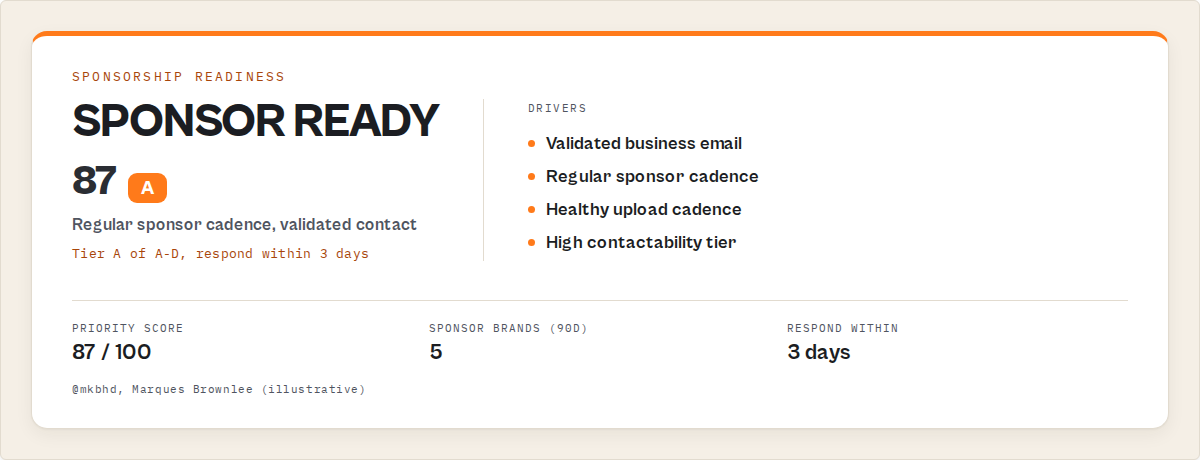
TL;DR: A routable decision per channel. Tier A/B/C/D as the headline routing field, priority score 0-100 with transparent component weights, validated business email with MX flag, sponsorship maturity tier with evidence, sponsor-fit categories with confidence, contactability tier, why-now rationale, respond-within days. A scraper returns channel name, subs, videos. Same data source. Different output contract.
The default sales profile pruned for the agency reader looks roughly like this:
{
  "channelHandle": "@mkbhd",
  "channelName": "Marques Brownlee",
  "subscribers": 19400000,
  "sponsorshipReadiness": {
    "tier": "A",
    "rationale": "Established sponsor history with validated business contact and healthy upload cadence."
  },
  "priorityScore": {
    "value": 87,
    "reason": "Tier A creator with sponsor history and validated contact"
  },
  "businessContact": {
    "businessEmail": "[email protected]",
    "businessEmailSource": "about-page",
    "businessEmailMxValid": true,
    "primaryWebsiteDomain": "mkbhd.com"
  },
  "contactability": { "tier": "high" },
  "sponsorshipMaturity": {
    "tier": "regular",
    "evidence": {
      "sponsoredVideoCountLast90d": 7,
      "uniqueSponsorBrandsLast90d": 5
    }
  },
  "sponsorFit": {
    "likelySponsorCategories": [
      { "category": "consumer-tech", "confidence": 0.92 },
      { "category": "saas-productivity", "confidence": 0.74 }
    ]
  },
  "whyThisMatters": "Tier A creator with regular sponsor cadence and a validated business email. Direct outreach is viable.",
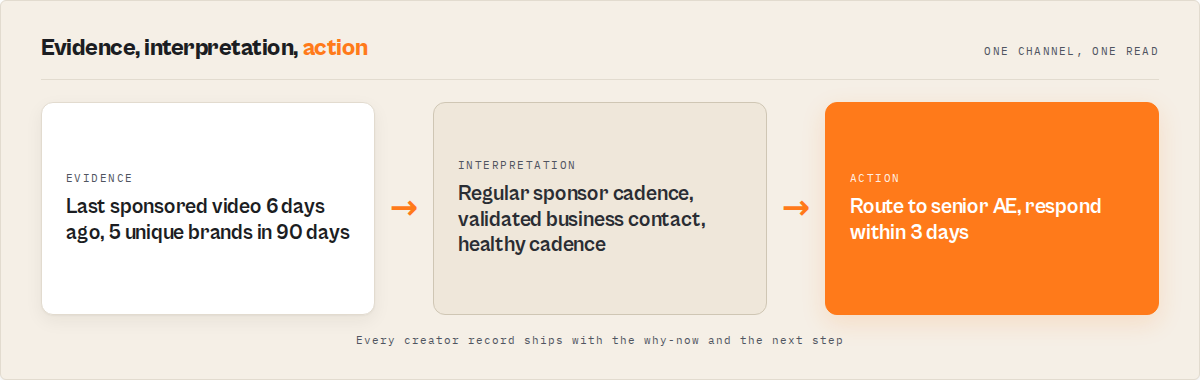
  "whyNow": "Last sponsored video 6 days ago. Active sponsor cycle.",
  "respondWithinDays": 3
}
The same query also surfaces creators in completely different operational shapes. A tier: "C" creator with sponsorshipMaturity.tier: "occasional" and contactability.tier: "medium" is a different motion: longer nurture, agency-route check, eventual warm intro. The actor doesn't push everything into a single shape. It hands the routing decision to the field, not to the spreadsheet.
That's the difference between a row and a routable decision.
What are the alternatives to creator-sponsorship prospecting infrastructure?
Four broad approaches exist. Each carries a different cost surface and a different ceiling.
| Approach | What you get | Where it breaks at scale | Best for |
|---|---|---|---|
| Raw YouTube scraper + spreadsheet | Channel rows, weekly export | No sponsor-history detection, no contact validation, no fit classification, no routing field. Every row goes through manual qualification. | One-off market research, single small list |
| Raw scraper + in-house qualification pipeline | Channel rows + your own sponsor-history parser + your own MX validator + your own scoring | You inherit transcript parsing, sponsor-brand taxonomy maintenance, linktree resolution, MX validation, sponsor-fit modelling, contactability scoring, watchlist state. Months of build, ongoing maintenance, full team commitment. | Teams with a dedicated data-engineering function and patience |
| Manual researcher qualification | Hand-picked creator list with verified contacts and full context | $10-$50 per qualified row, doesn't scale, doesn't refresh on a cadence. Two researchers can clear roughly 25-40 qualified rows per week. | Top-of-funnel personalisation for a tiny ABM-style creator list |
| Influencer marketplace platforms (Modash, Upfluence, Aspire, GRIN, CreatorIQ) | Hosted marketplace, campaign management, payments, broad creator coverage | Different product category (marketplaces, not prospecting infrastructure). Subscription pricing, not per-event. Database coverage, not list-driven qualification. Best when you want to source from a curated index, not when you bring your own list. | Brands running ongoing influencer campaigns who want a hosted marketplace and campaign-management workflow |
| Creator-sponsorship prospecting on Apify | Routable decision per channel, watchlist monitoring, PPE quality gate, validated contacts, sponsor-fit classification | Per-channel cost is higher than a raw scraper. Fair tradeoff when you actually consume the qualification layer. | Agencies, B2B SaaS partnerships, creator-ops teams running list-driven, recurring outreach |
Each approach has trade-offs in cost, time-to-value, depth, and operational maintenance. The right choice depends on whether your creator outreach is one-off or recurring, whether you have a data-engineering team to maintain a custom pipeline, and whether you're sourcing from a hosted marketplace or qualifying your own bring-your-own list. Pricing and capabilities based on publicly available information as of May 2026 and may change.
Best practices for running creator outreach on prospecting infrastructure
- Set
requireValidatedEmail: truefor any SDR-facing run. Anything less lets unverified emails into your sequencing tool, which burns sender reputation faster than any qualification gain is worth. - Run on a watchlist from day one. A
watchlistNameon the first run unlocks cross-run deltas on every subsequent run. Without it, you're paying for infrastructure and using it as a scraper. - Filter on
sponsorshipReadiness.tierpluscontactability.tierbefore anything else. Most agency workflows only consumeWHERE tier IN ("A", "B") AND contactability.tier = "high". The other 60-70% of the cohort isnurture,enrichment-first, orskip. - Branch SDR cadence on
sponsorshipMaturity.tier. Aregularcreator gets the warm-direct motion. Anoccasionalcreator gets the soft-introduction motion. Asaturatedcreator gets a delay. Don't send the same pitch to all three. - Use
profile: "competitor-monitoring"for watching a competitor's creator roster. It shifts the scoring weights toward growth + sponsorship momentum and away from raw contactability. - Schedule the watchlist daily or weekly depending on vertical velocity. Tech-creator pipelines move faster than home-and-garden creator pipelines. Tune the cadence to where the deltas actually appear.
- Read
whyThisMattersbefore the SDR writes any opening line. It's the paste-ready opening composed deterministically from existing fields. Saves the SDR meaningful minutes per pitch. - Calibrate against your own outcome data with
outcomeDatasetId. Push your prior creator-outreach outcomes (channelId, sentAt, repliedAt, outcome) into an Apify dataset and pass the ID. The actor recalibratespriorityScoreagainst your actual reply rates.
Common mistakes when running YouTube creator outreach
- Treating one scrape as the dataset. It isn't. It's one snapshot of a continuously moving creator graph. New sponsors appear weekly. Contacts churn. Run once, get rot.
- Routing every tier to the same SDR. Tier A direct-contact creators need the senior-AE motion. Tier B agency-routed creators need a different sequence entirely. The tier exists so the queue stops being uniform.
- Sending the same pitch to
regularandsaturatedsponsorship-maturity creators. A saturated creator is the textbook auto-decline. They're not refusing because the pitch was wrong. They're refusing because they're already running four sponsors per video. - Skipping MX validation to "speed up the run." The validation step is the entire reason your sender reputation stays clean. Every bounce shrinks downstream deliverability.
- Ignoring
sponsorFit.likelySponsorCategories. A B2B SaaS brand pitching gaming creators because they hit the subscriber floor is the most common single mistake in creator outreach. Read the category fit before adding to the queue. - Treating the watchlist as a fancy one-off. The whole point of a watchlist is the cross-run delta. If you're not consuming
temporalSignals.reengage,regimeShift.detected, ornarrativeDelta, the watchlist is just a more expensive scrape.
How to qualify YouTube creators for sponsorship outreach
Run YouTube Sponsorship Intelligence in channels mode with a quality gate appropriate to your funnel. For a daily agency queue, start with minSubscribers: 50000, requireBusinessEmail: true, requireValidatedEmail: true. Filter the resulting dataset on sponsorshipReadiness.tier IN ("A", "B") AND contactability.tier = "high". That set is the SDR-ready queue.
For recurring agency operations, switch to mode: "watchlist" with a named watchlist and systemMode: true. Schedule it daily or weekly. Consume temporalSignals, narrativeDelta, and regimeShift to detect creators who just entered the reachable cohort or just started a new sponsor cycle.
How agencies find sponsor-ready creators
Sponsorship-ready means three things in combination: detected sponsor history in the last 90 days (sponsorshipMaturity.tier IN ("occasional", "regular")), validated business contact (businessContact.businessEmailMxValid: true), and category fit (sponsorFit.likelySponsorCategories includes the brand's category). A creator-sponsorship prospecting actor returns all three on one record. A raw scraper returns none of them. The agency workflow is: list of handles in, qualified queue out, schedule the run, route by tier.
The operating loop (paste this into your project doc)
- Pick the cohort: start with 50-200 creator handles from a niche you understand.
@handle, full URL, orUCx...channelId all work. - Set the quality gate:
minSubscribersat the subscriber floor your campaign needs,requireBusinessEmail: true,requireValidatedEmail: true. This is what makes the run safe to scale. - Run channels mode: wait for the dataset to populate. Inspect the tier distribution. If everything is Tier D, the gate is too strict. If nothing is filtered, the gate is too loose.
- Filter to the SDR-ready queue:
tier IN ("A", "B") AND contactability.tier = "high". Sort bypriorityScore. Walk the top 20-30. - Route by tier + sponsor fit: Tier A + matching
sponsorFit.likelySponsorCategoriesto the senior partnerships AE. Tier B with agency routing to the agency-relations queue. Tier C with strong growth signals to a long-cycle nurture. - Switch to watchlist mode for ongoing operations: name the watchlist, set
systemMode: true, schedule daily or weekly. ConsumetemporalSignals.reengageandregimeShift.detectedas Slack alerts. - Pair with sibling actors on contactability gaps: when
contactability.tierislowornone, therecoveryPlanfield names the next actor to call (typically Website Contact Scraper against the creator's primary website domain, or Waterfall Contact Enrichment when multi-source enrichment is needed). - Calibrate after a quarter: push your prior outreach outcomes into a dataset and pass
outcomeDatasetIdon subsequent runs. Priority scores recalibrate against your actual reply rates.
Implementation checklist
- Pick a niche and a list size you can verify by eye (50-200 handles).
- Run the actor once with
outputProfile: "sales". Inspect the tier distribution and the field shape. - Confirm
businessContact.businessEmailMxValid: truelands on the rows you'd actually pitch. - Add
watchlistNameand re-run. You now have a baseline. - Schedule the watchlist run from Apify Schedules (daily for hot verticals, weekly for cold ones).
- Push
tier IN ("A", "B")+contactability.tier = "high"records to your sequencing tool via webhook. - Branch SDR cadences on
sponsorshipMaturity.tier. Different maturity, different opener. - After the first month, push your outcome data into a dataset and recalibrate via
outcomeDatasetId.
Limitations
This is prospecting infrastructure, not a silver bullet, and it shouldn't be sold as one.
- Transcript availability is YouTube-controlled. Some videos do not expose transcripts publicly. Sponsorship-timestamp detection skips those; description and hashtag parsing still works.
- Sponsorship detection is a fit signal, not a reply prediction. A
regularmaturity tier means the creator runs sponsors regularly. It does not promise they reply to your specific pitch. - MX validation is DNS-level. It confirms the domain accepts mail. It does not confirm the inbox is monitored. For full SMTP-handshake verification, pair with Bulk Email Verifier.
- Discovery mode is a stub in v1.0. Source discovery from search queries ships in v1.1. Channels and watchlist modes are full v1.0 features.
- Not a marketplace. Modash, Upfluence, Aspire, and CreatorIQ are the right tools when you want a hosted creator database with campaign management. This actor is bring-your-own-list prospecting infrastructure, a different product category.
- Residential proxy is required. Datacenter IPs are blocked by YouTube. The default config uses the Apify residential group with US rotation.
- Business email confidence is best-effort. Channels increasingly hide their About-page email behind agency-only routing. When no usable contact is found, the record carries a
recoveryPlanpointing at a sibling enrichment actor.
Common misconceptions
"A YouTube scraper plus a spreadsheet plus a researcher is the same thing." It isn't. The spreadsheet doesn't carry state across runs. It can't tell you which creator just started a new sponsor cycle, which contact path just broke, which channel just got saturated. The researcher can compute one row at a time at $10-$50 of labour each. Prospecting infrastructure delivers the same qualification signal per row at around $0.30 and runs the whole list at once.
"Sponsorship maturity is just a derived field, anyone can compute it from a scrape." Anyone can attempt it. Doing it well requires a maintained sponsor-brand taxonomy, transcript sampling across recent videos, hashtag analysis, affiliate-host pattern matching, evidence retention, and time-windowed aggregation into a stable tier enum. That's a maintained service, not a script.
"PPE pricing is more expensive than per-row scraping." Per qualified row it is dramatically cheaper. The price-per-row math only favours the raw scraper if you ignore researcher labour. The moment you measure researcher time honestly, prospecting infrastructure runs roughly two orders of magnitude cheaper than the manual baseline.
"Creator marketplaces are the same as creator prospecting actors." Different product category. Marketplaces (Modash, Aspire, Upfluence, GRIN, CreatorIQ) are subscription databases with hosted campaign management. Prospecting infrastructure is pay-per-event, list-driven, runs against your own creator universe, and outputs JSON for sequencing-tool intake. Different shape of tool for different jobs.
"The output is just JSON, I'll process it myself." You can. Most agencies don't, because the entire point of the routable decision (tier, priority, contact, urgency, why-now) is that it drops directly into a sequencing tool without further processing. Re-implementing the routing logic outside the actor is the spreadsheet workflow with extra steps. ApifyForge's lead-generation comparison page shows the same routable-decision shape across the rest of the prospecting actor catalogue.
Key facts about creator-sponsorship prospecting infrastructure
- A creator-sponsorship prospecting actor returns a routable decision per channel (tier, priority score, validated contact, sponsor history, why-now, respond-within) rather than raw scraped substrate.
- The PPE quality gate is the trust mechanism: channels that fail your filter (subscriber floor, business email required, MX validation required) emit as
skippedand cost $0. - Sponsorship maturity is a four-tier enum (
never/occasional/regular/saturated) computed from detected sponsor brands in the last 90 days of videos and descriptions. - Business contacts are MX-validated at extraction time.
businessContact.businessEmailMxValidis a real DNS lookup, not a regex pass. - Watchlist mode persists per-channel state in a named Apify KV store and emits cross-run deltas (
temporalSignals,narrativeDelta,regimeShift) on every recurring run. - A 100-channel run with a moderate quality gate typically charges for 30-60 channels. The other 40-70 emit as
skippedat $0 with the reason attached. - A manually qualified creator costs an agency $10-$50 in researcher labour. The same qualification signal costs roughly $0.30 per qualified channel through the actor.
Short glossary
Creator-sponsorship prospecting infrastructure: a system that takes a list of YouTube creator handles and returns a ranked, contact-verified, sponsor-history-validated outreach queue with a routable decision per channel.
Sponsorship maturity: a tier (never / occasional / regular / saturated) classifying how actively a creator runs sponsorships in the last 90 days, backed by detected sponsor brands and timestamps.
Sponsor-fit classification: a category-level score of which sponsor categories a creator's content actually fits, with confidence and evidence per category.
Contactability tier: a single-field rollup (high / medium / low / none) of email presence, MX validity, agency-route detection, external-site activity, and sponsor-history presence.
PPE quality gate: a pay-per-event mechanism where records that fail the filter emit as skipped and incur no PPE charge, while still surfacing why they failed.
Routable decision: a structured output (tier + priority + contact + urgency + why-now + recommended action) designed to drop directly into a sequencing tool without further processing.
Watchlist mode: a stateful operating mode where per-channel state persists across recurring runs and cross-run deltas (temporalSignals, narrativeDelta, regimeShift) emit on every refresh.
Broader applicability
These patterns apply beyond YouTube to any creator-graph or external-pipeline workflow where a researcher would otherwise qualify rows by hand.
- Substrate is commodity, decision is moat. True for creator data, lead data, local-business data, and any continuously refreshed external source.
- PPE quality gates beat per-row pricing for noisy lists. A filter that costs $0 on failures is structurally cheaper than a filter that charges per attempt.
- Routable decisions belong in the data layer, not the cadence tool. Tier, priority, and contactability are decisions about which human (or sequence) works which lead. Compute them where the data lives, not in Salesforce or a sequencing tool's lead-scoring panel.
- Watchlist state turns a scrape into a pipeline. Any source that moves between runs benefits from named-state persistence and cross-run delta emission.
- Per-record researcher labour is the hidden cost in every "cheap" scraper workflow. Measure it honestly before assuming a flat scraper is cheaper than prospecting infrastructure. ApifyForge tracks this pattern across the lead-generation use-case page for buyers who want the broader picture.
When you need this
You probably need creator-sponsorship prospecting infrastructure if:
- You run YouTube creator outreach continuously (weekly or more often) as an agency, partnerships team, or B2B SaaS creator-ops team
- You have an SDR queue that needs prioritisation and the queue's tier distribution today is "everything"
- Your researchers are spending hours per row on manual creator qualification
- You need MX-validated business emails before anything hits a sequencing tool
- You're monitoring a competitor's creator roster for sponsor-cycle changes
- You're feeding an AI agent that needs structured creator intelligence per channel
You probably don't need this if:
- Your YouTube outreach is one-shot and never refreshed (a raw scraper is cheaper)
- You're sourcing from a curated marketplace, not your own list (use Modash, Aspire, Upfluence, CreatorIQ)
- You only need raw channel metadata for analytics (any YouTube scraper works)
- You're managing live influencer campaigns end-to-end (use GRIN, Aspire, CreatorIQ)
- You need brand-deal rate cards or CPM benchmarks (this isn't a pricing tool)
Frequently asked questions
What is the difference between a YouTube scraper and a creator-sponsorship prospecting actor?
A YouTube scraper returns substrate (channel name, subscribers, recent videos, description text) as raw rows. A creator-sponsorship prospecting actor returns the same substrate plus a routable decision per channel: a sponsorship-readiness tier (A/B/C/D), a priority score with transparent component weights, an MX-validated business email, sponsorship maturity classification, sponsor-fit category scoring, contactability tier, why-this-matters rationale, and a respond-within window. The scraper is a directory. The prospecting actor is a working sales-intelligence layer designed to drop directly into a sequencing tool.
How do agencies find sponsor-ready YouTube creators?
Agencies running this well do it in three steps. Source a list of handles from the relevant niche (recommendations, competitor rosters, internal databases). Drop the list into a creator-sponsorship prospecting actor with a quality gate (minimum subscribers + require validated email). Filter the resulting dataset on sponsorshipReadiness.tier IN ("A", "B") AND contactability.tier = "high". Sort by priority score. That set is the SDR-ready queue. The qualification work that used to take a researcher hours per row happens inside the actor in seconds.
How much does manual creator research cost an agency?
A creator manually qualified by a researcher (pulling the channel, scanning the About page, reading the last fifteen video descriptions for sponsor history, validating the business email, checking the linktree, classifying sponsor-fit, deciding tier) typically costs an agency $10-$50 in researcher time per row. Scale that across a 200-handle list and the manual qualification cost lands between $2,000 and $10,000 per refresh, before any pitches go out. The creator-sponsorship prospecting equivalent runs around $0.30 per qualified channel, which is roughly two orders of magnitude cheaper than the manual baseline.
Does this work for tracking a competitor's creator roster?
Yes. Set profile: "competitor-monitoring", name a watchlist, and schedule it. Every recurring run emits temporalSignals (score delta vs previous run, momentum, reengage flag), stateTransition (improving / deteriorating / unchanged), narrativeDelta (plain-language summary of what changed), and regimeShift (triggered when a creator crosses a classification threshold, like never to occasional sponsorship maturity). A new sponsor cycle on a competitor's creator surfaces as a Slack-routable alert within a single run.
How is this different from Modash, Aspire, GRIN, or other influencer platforms?
Those are subscription influencer marketplaces with broad creator databases and full campaign-management workflows (briefs, deliverables, payments). Creator-sponsorship prospecting infrastructure is a different product category: pay-per-event, bring-your-own-list, designed for sequencing-tool intake, no marketplace, no campaign management. Use the marketplaces when you want a curated index and end-to-end campaign ops. Use prospecting infrastructure when you have your own creator universe and want to qualify it on a schedule for SDR outreach.
How does the PPE quality gate actually save money?
Records that fail the gate emit as recordType: "skipped" and the PPE event does not fire. The savings are real, not cosmetic. You actually pay $0 for those records. The summary record's savings block reports the totals: skipped record count, estimated enrichment cost avoided, estimated SDR touches avoided. On noisy lists of 500+ handles, a moderate quality gate (subscriber floor + require validated email) typically prevents 40-60% of records from being charged. That's the mechanism that makes it safe to run on a long, noisy list without lighting the PPE budget on fire.
Can I do this myself with a basic YouTube scraper plus my own qualification pipeline?
You can build the extraction layer in a weekend. Building the qualification layer (transcript parsing with sponsor-brand taxonomy maintenance, linktree resolution with MX validation, sponsor-fit category modelling with evidence retention, contactability scoring, watchlist state persistence with cross-run delta emission, tier thresholding) is months of engineering plus ongoing maintenance. Most agencies that try the DIY path discover that running YouTube Sponsorship Intelligence on Apify is cheaper than maintaining the equivalent in-house, and they break even within the first quarter.
What's the pricing model?
Pay-per-event on Apify. The actor charges $0.30 per enriched channel record that passes the quality gate, $0.05 per enriched video record (videos mode), and $0 for any record that fails the gate. There's no monthly subscription, no per-seat fee, and no minimum spend. A 100-channel run with a moderate quality gate typically charges for 30-60 channels. We covered the same pattern in how PPE pricing works: pay only when the actor delivers a qualified record.
How do I push the output into Outreach, Salesloft, or Apollo?
Set up an Apify webhook on run-finish. The webhook payload contains the dataset ID. Hit the Apify API to fetch the dataset filtered on recordType = "channel" AND sponsorshipReadiness.tier IN ("A", "B") AND contactability.tier = "high". Push each record into your sequencing tool with businessContact.businessEmail as the contact, whyThisMatters as the personalisation field, and respondWithinDays as the cadence cap. Zapier and Make both have native Apify integrations if you'd rather not write the webhook glue yourself.
Ryan Clinton publishes Apify actors and MCP servers as ryanclinton and builds developer tools at ApifyForge. The full creator-prospecting and lead-intelligence catalogue, including comparisons and use-case pages, lives at apifyforge.com.
Last updated: May 2026
This guide focuses on YouTube as the substrate, but the same patterns (substrate is commodity, decision is moat, PPE quality gates beat per-row pricing, watchlist state turns a scrape into a pipeline) apply broadly to any creator-graph or external-pipeline workflow where researcher labour is the hidden cost.