The problem: You scrape 2,000 Reddit posts mentioning your brand. They land in a spreadsheet. Now you read every row, eyeball sentiment thread by thread, and try to guess which three actually matter this week. Then you do it again next week, comparing this export against last week's by hand. That's not monitoring. That's a row dump with a human doing the monitoring downstream, for free, every single day.
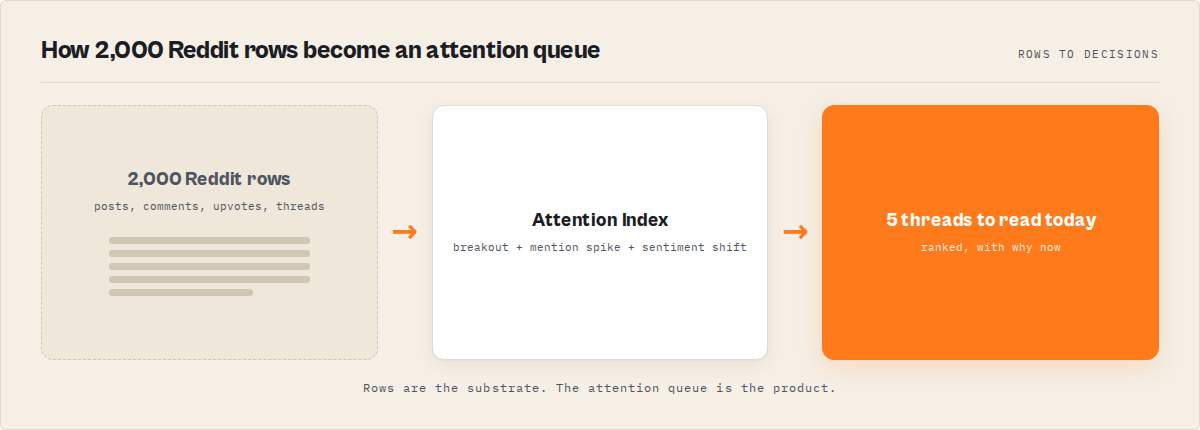
What is a Reddit attention queue? A Reddit attention queue is a ranked list of Reddit threads ordered by operational importance, not by date or raw upvotes, with a reason and a recommended action on each. It answers "what changed, what matters, and what needs a look right now" instead of handing you thousands of flat rows to triage yourself.
Why it matters: The 2026 bottleneck in social monitoring isn't getting Reddit data, it's operationalising it fast enough. A row scraper solves a problem nobody has anymore. The job most teams actually have is interpretation, ranking, and run-over-run memory, and a flat export ships none of that.
Use it when: You're tracking brand mentions, watching for a brewing PR issue, scouting emerging topics, or monitoring how a community talks about a competitor over time, and you want to read five rows a day instead of two thousand.
Quick answer
- What it is: an attention queue is a ranked, interpreted Reddit monitoring output, not a raw post/comment/community/user export.
- When to use it: any recurring monitoring job (brand, PR, sentiment, trend, competitor) where the value is in what changed, not what exists.
- When NOT to use it: one-off bulk extraction for a corpus you'll process yourself, or write actions on Reddit (an attention queue is read-only and never posts, votes, or DMs).
- Typical steps: name a watchlist, set a tracked term, run on a schedule, read the top of the queue, act on
urgent/critical. - Main tradeoff: run-over-run memory can't be backfilled, so the first run shows no deltas. Value compounds the longer you run it on the same watchlist.
In this article: What it is · Why rows fail · How it works · What it returns · Alternatives · Best practices · Common mistakes · Limitations · FAQ
Key takeaways
- A 2,000-row Reddit scrape leaves 100% of the triage, ranking, and sentiment work on a human. An attention queue ships that as the product.
- Reddit lists cap at roughly 1,000 items platform-wide, so a single scrape can silently miss the rest. Scheduled monitoring captures beyond the cap incrementally.
- Sentiment shifts on Reddit are usually gradual, spread across comments and communities, not one dramatic post, so they hide in a row dump.
- Persistent operational memory, the run-over-run state that surfaces what changed, is the one thing a single scrape can never reconstruct.
- The Reddit Scraper Apify actor prices records at roughly $0.002 each ($2 per 1,000), about half the effective per-result cost of a standard row scraper, with the signal layer included.
Rows vs an attention queue: a concrete look
| You ask | A row dump gives you | An attention queue gives you |
|---|---|---|
| Is Reddit talking about us more? | 2,000 rows; count them yourself | Mention spike vs baseline, with the multiplier |
| Is sentiment changing? | Comment bodies; read them all | A sentiment shift with delta and sample size |
| Which threads matter most? | Sort by upvotes and guess | A ranked attentionIndex (0-100) per thread |
| What changed since last week? | Two CSVs; diff by hand | A delta of new and expired signals |
| What did you ignore, and why? | Nothing; you never see it | A suppressed-noise audit with reasons |
Also known as: Reddit brand monitoring, Reddit mention tracking, Reddit social listening, subreddit monitoring, Reddit sentiment signals, Reddit attention routing.
What is Reddit monitoring?
Definition (short version): Reddit monitoring is a system that watches Reddit over time for changes that matter to you (mentions, sentiment, emerging topics) and tells you what needs attention, rather than just exporting rows.
A Reddit scraper and a Reddit monitoring tool are not the same thing. A scraper extracts: it returns posts, comments, communities, and users as flat rows, then stops. Monitoring is what happens after extraction. It's the interpretation, ranking, and run-over-run comparison that turns a scrape into a feed you can act on.
There are broadly three categories of Reddit tooling in 2026. Row scrapers export the substrate and leave everything downstream to you. Social-listening suites cover many platforms shallowly, usually with a monthly subscription and a dashboard. Attention-queue actors focus on Reddit and ship the decision layer: ranking, sentiment synthesis, and persistent memory per watchlist. At ApifyForge we group these by what they output, not just what they scrape, because the output contract is what decides whether you still need a spreadsheet afterward.
Why do flat Reddit rows fail for monitoring?
Flat Reddit rows fail for monitoring because they externalise every decision back onto a human. A 2,000-row export contains no ranking, no run-over-run memory, and no sentiment synthesis, so the actual monitoring work (deciding what changed and what matters) still happens by hand in a spreadsheet, every day.
Here's the part people underestimate. Reddit monitoring is genuinely hard, which is exactly why most tools quietly stop at extraction:
- Reddit lists cap at roughly 1,000 items. This is platform-wide, not a scraper limit. A single scrape can silently miss everything past the cap.
- Communities behave differently. A spike that matters in a 20k-member subreddit is noise in a 2M-member one. Raw counts lie without a community-relative baseline.
- Viral crossposts create false positives. One post duplicated across communities looks like a trend until you dedupe it.
- Sentiment shifts are gradual. They spread across comments over days, not in one dramatic post, so they're invisible in a row-by-row read.
- Most tools forget every prior run. A one-shot scrape can never tell you whether an issue is new or recurring.
A 2024 Salesforce State of Sales report (n=5,500+ professionals) found 67% of teams already feel they have too many tools. Bolting "read 2,000 rows daily" onto that workload is the wrong direction. The real competitor to a Reddit scraper isn't another scraper, it's the manual spreadsheet-triage workflow that sits downstream of one.
How does an attention queue work?
An attention queue works by adding a decision layer on top of the scraped substrate. After extraction, deterministic detectors fire against community baselines to find typed signals (breakout posts, mention spikes, sentiment shifts), the run diffs against persisted watchlist state to find what changed, and every record gets a bounded score so the queue sorts by what to look at first.
The mental model is a pipeline: Reddit → substrate fetch → signal detection → state engine → decision → ranked attention queue. Each layer adds something the row dump never had.
The signal detection layer is the interpretation step. Instead of leaving you to spot a breakout, it surfaces typed, evidenced events. A breakout post is flagged when upvote velocity runs well above the subreddit's own baseline; a mention spike when current-window volume runs multiples above the term's baseline. Each signal carries its evidence (the z-scores, windows, and sample sizes) so you can audit why it fired.
The state engine is the moat, and it's the part a competitor can't backfill. When you name a watchlist and run on a schedule, per-term and per-community history accumulates in a persistent store. Trajectory, recurrence, and topic memory are derived from that history. A single scrape tomorrow can reproduce the rows, but not the run-over-run context. That context is longitudinal, and it only exists if you've been accumulating it. We covered this same shape in decision-first analytics: the output is one routable verdict, not a chart you re-interpret.
Why deterministic Reddit monitoring matters
Many "AI-powered" monitoring tools produce different outputs from the same Reddit data on different runs, because a large language model sits in the scoring path. Deterministic synthesis (a fixed lexicon plus TF-IDF) means the same comments always produce the same sentiment and themes, so automation can branch on the result safely.
That reproducibility is the enterprise-grade choice, not the cheap compromise. A brand-monitoring buyer who pastes a result into a board deck needs the same themes every time, and an LLM naming pass introduces run-to-run drift plus a paid external dependency for zero added defensibility.
Reddit monitoring is really about state evolution
A traditional Reddit scraper answers one question: what exists right now. Operational monitoring answers a different set: what changed, what accelerated, what stabilised, what recurred, what became risky, and what needs attention now.
That distinction matters because Reddit problems are rarely isolated events. They emerge gradually, across comments, subreddits, and recurring narratives, over days and weeks. A mention spike matters because it changed. A sentiment shift matters because it moved. A recurring complaint matters because it persisted. The signal is never the raw count; it is the movement of that count over time.
Signals are the ingredients. State evolution is the product. Without persistent operational memory, Reddit monitoring collapses back into reading rows by hand, and by the time a human notices the pattern in a spreadsheet, Reddit has usually already moved on. The operational problem was never missing data. It is noticing the important change before everyone else does.
The whole pipeline exists to turn raw activity into that evolving state:
   Reddit  (public posts, comments, communities, users)
      |
   Extraction
      |
   Signal detection     (breakout, mention spike, sentiment shift)
      |
   Persistent memory    (per-term, per-community history)
      |
   State evolution      (trajectory, recurrence, what changed)
      |
   Attention queue      (ranked: what needs a look right now)
      |
   Human or automation action
A row dump stops at the first box. Everything below it is the monitoring product, and it is the part you cannot reconstruct from a single scrape after the fact.
What does an attention queue actually return?
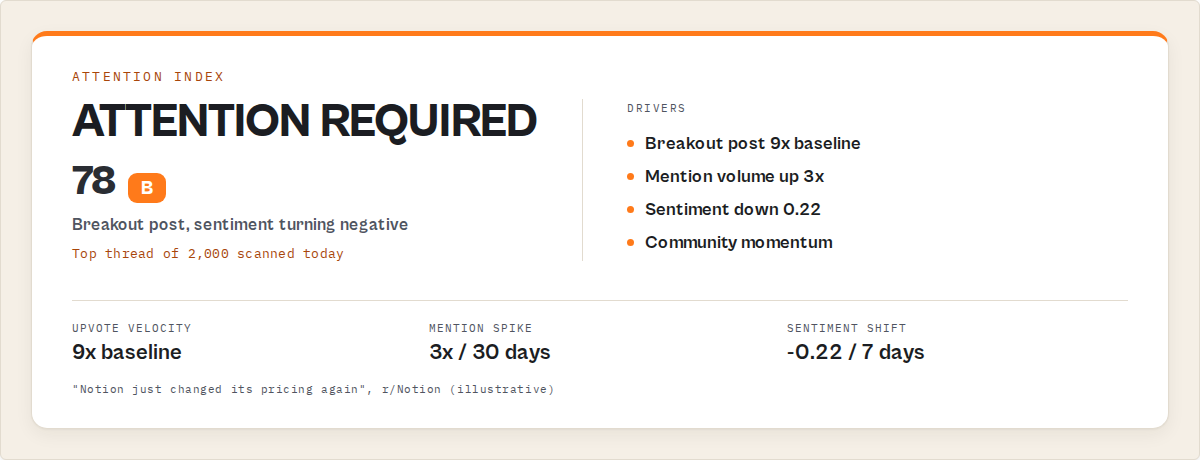
An attention queue returns a ranked, decision-ready record per Reddit thread. The core fields are a sortable attentionIndex (0-100), a watchStatus to branch automation on, plain-English whyNow reasons, and a recommendedAction, plus the full substrate fields a standard scraper emits.
Here's a single record from the Reddit Scraper Apify actor so you can see the shape. Note this is the output you read, not code you run.
{
  "attentionIndex": {
    "value": 78,
    "drivers": [
      "Breakout post: upvote velocity 9x community baseline within 12h.",
      "Mention volume up 3x vs 30-day baseline.",
      "Sentiment shifted negative (-0.22) over 7 days."
    ]
  },
  "watchStatus": "attention-required",
  "whyNow": [
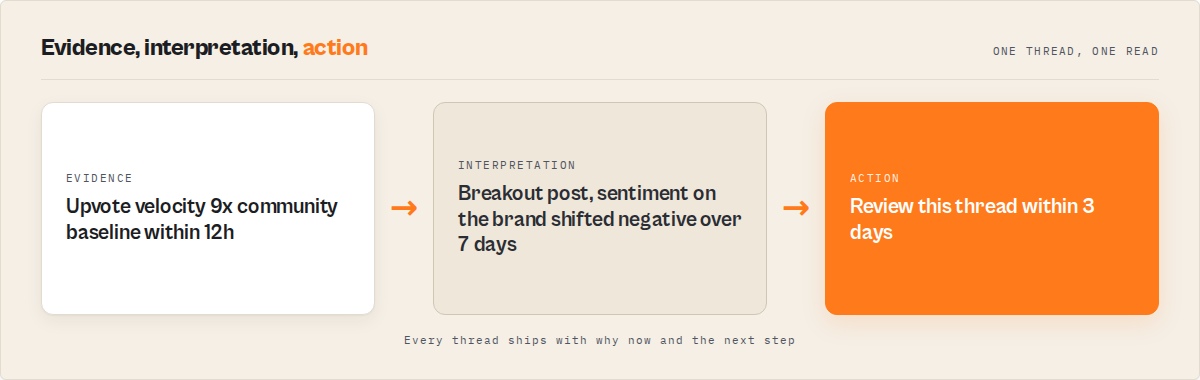
    "Breakout post detected 12h ago, upvote velocity 9x community baseline.",
    "Sentiment on 'Notion' shifted negative over the last 7 days."
  ],
  "recommendedAction": "Review this thread within 3 days.",
  "communityName": "r/Notion",
  "title": "Notion just changed its pricing again",
  "url": "https://www.reddit.com/r/Notion/comments/144w7sn/",
  "upVotes": 1842,
  "numberOfComments": 326
}
The recommendedAction is always a prioritisation instruction (Review, Read, Monitor, Track, Re-check, Compare), never an in-Reddit engagement instruction. Telling a tool to "reply" or "upvote" inside Reddit is astroturf territory; an attention queue routes attention and leaves what-to-do-off-platform to the human.
What are the alternatives to an attention queue?
There are four practical alternatives to a Reddit attention queue, each with real tradeoffs. The right choice depends on whether your job is one-off extraction or recurring monitoring, how much engineering you want to own, and how many platforms you need to cover.
1. A traditional row scraper (e.g. trudax/reddit-scraper-lite). Exports posts, comments, communities, and users as flat rows. Best for: a one-time bulk pull where you'll do all the analysis yourself, or feeding a corpus you already have a pipeline for. Where it breaks at scale: it ships none of the monitoring jobs its own marketing names (no ranking, no sentiment synthesis, no run-over-run deltas), so the daily triage stays manual forever.
2. Build it yourself. Wire up extraction, community baselines, breakout detection, deterministic sentiment, per-term state persistence across runs, and reranking, then keep all of it versioned and reproducible. Best for: a team with spare engineering capacity and a very specific in-house need. Where it breaks: you now own a maintained service, not a script. Schema drift, the 1,000-item cap, proxy and rate-limit handling, baseline math, and the persistent state store that makes "what changed" possible all become yours. That last piece is months of accumulated data you can't shortcut.
3. A general social-listening suite. Covers many platforms with a dashboard and a monthly subscription. Best for: marketing teams that need broad cross-platform coverage and live in a dashboard already. Where it breaks for Reddit specifically: coverage is usually shallow, Reddit-native signals (community archetypes, crosspost dedupe, subreddit-relative baselines) are rarely modelled, and you're back to interpreting charts.
4. A Reddit attention-queue actor. Focuses on Reddit and ships the decision layer: ranked attentionIndex, sentiment shift detection, and persistent memory per watchlist. Best for: recurring brand, PR, trend, or competitor monitoring on Reddit where the value is what changed. Where it's less suitable: logged-in or private content, real-time second-by-second alerting (you schedule runs instead), and brand-safety scoring.
Each approach has trade-offs in coverage, engineering cost, reproducibility, and time-to-value. Here's the comparison side by side.
| Approach | Time to first result | Ranking + sentiment | Run-over-run memory | Cost shape |
|---|---|---|---|---|
| Row scraper | ~minutes | None (manual) | None | ~$4 / 1,000 results |
| Build it yourself | Weeks to months | You build it | You build + accumulate it | Engineering time + infra |
| Social-listening suite | Setup + onboarding | Dashboard, shallow on Reddit | Tool-dependent | $69-350+ / month typical |
| Attention-queue actor | ~60 seconds | Built in, deterministic | Built in, compounds | ~$2 / 1,000 records + $0.20/query |
Pricing and features based on publicly available information as of May 2026 and may change. Re-verify any incumbent's live price before relying on the comparison.
One of the best fits for recurring, Reddit-specific monitoring is an attention-queue actor, because it collapses the spreadsheet workflow into one scheduled run. For broad multi-platform coverage where Reddit is one of many channels, a listening suite may suit better. If you're weighing options, the ApifyForge cost calculator is a quick way to model the per-record spend before you commit.
Best practices for Reddit monitoring
- Name a watchlist and run on a schedule. The product is the run-over-run delta. One run can't show what changed; the memory clock starts on run 2 and can't be backfilled.
- Pick the lens that matches your job. Weight mention and sentiment signals for PR and brand work; weight topic surges and community acceleration for trend research.
- Branch automation on
watchStatus, not raw scores. Filter toWHERE watchStatus IN ('urgent','critical')so your alerts are stable across runs. - Sample comments to unlock sentiment. Sentiment shift detection needs sampled comments; without them you get ranking but not synthesis.
- Read the suppressed-signals view. Seeing what the tool ignored, and why, is how you learn to trust the alerts it does raise.
- Use a community-relative baseline. Never compare raw upvotes across subreddits of different sizes; the baseline is what separates signal from noise.
- Schedule incremental runs to beat the 1,000-item cap. Daily or hourly monitoring captures items before they fall off the list.
- Pin automations to the schema version. A versioned output contract means a downstream rule won't silently break when fields are added.
Common Reddit monitoring mistakes
- Treating a scrape as monitoring. Exporting rows is extraction. Monitoring is the interpretation and comparison you're doing by hand afterward. Move that work into the tool.
- Sorting by upvotes and calling it triage. Raw upvotes ignore velocity, community size, and sentiment. A thread with 200 upvotes climbing 9x baseline matters more than a stale 5,000-upvote post.
- Expecting deltas on the first run. State can't be invented. Run 1 honestly reports
first-runwith empty deltas; trajectory and memory sharpen after several scheduled runs. - Trusting one dramatic post over the trend. Sentiment shifts are gradual. Watching for a single viral negative post means you miss the slow slide that actually hurts.
- Counting crossposts as a trend. One post duplicated across five communities is one event, not five. Without dedupe, your "spike" is an artifact.
- Reading every row anyway. If you've got ranking and still scroll the full export "just in case," you've kept the bottleneck. Trust the queue, audit the suppressed view, and stop at the top five.
Mini case study: a brand team's Monday morning
Before. A product-marketing team scraped roughly 2,000 posts mentioning their tool each week into a sheet, then spent the better part of a morning reading rows and eyeballing sentiment. Recurring complaints were spotted late, if at all, because nobody could hold last month's export in their head.
After. They switched to a scheduled monitor run on a named watchlist. Each morning they read the top of the attention queue (typically a handful of rows flagged attention-required or higher), acted on those, and skipped the rest. The week a pricing-change thread broke out, the queue surfaced it within a run, with the mention spike and negative sentiment shift attached as evidence.
The reframe is the whole point: hours of manual triage per week collapsed into minutes a day. These numbers reflect one team's workflow; results vary with how many subreddits you track, how often you run, and how noisy your term is.
How do I monitor a brand on Reddit?
Set the mode to monitor, put your brand or keyword in the tracked terms, name a watchlist to persist state, and schedule the run daily. Each run returns the threads that need attention now, ranked by attentionIndex, plus a delta of what changed since the previous run.
The 10-second version is one input: { "mode": "monitor", "track": ["Notion"] }. That returns the top threads about Notion, each with a watch status, a whyNow, and a recommended action. The Reddit Scraper actor ships that exact demo as the default so you can see the queue before pointing it at your own brand.
How do I track Reddit mentions automatically?
Schedule the monitor run on a named watchlist and let the persistent state engine do the comparison. Each run detects mention spikes and sentiment shifts as typed signals, ranks them, and emits a delta of what's new and what expired since the last run. You read the queue; the tool tracks the changes.
This is where Apify scheduling and webhooks earn their keep: fire on run completion to push urgent records straight into Slack or a ticket. The pay-per-event model means a monitor run costs the same per record as a one-shot, so frequent monitoring isn't penalised.
Implementation checklist
- Decide your job: brand, PR, trend, or competitor monitoring. That sets which signals you weight.
- Pick your tracked terms and the subreddits to focus on.
- Name a watchlist. Without it, the run is one-shot with no memory.
- Run once with defaults to see the attention queue shape.
- Turn on comment sampling so sentiment shift detection has data.
- Schedule the run daily (or hourly for fast-moving topics).
- Wire automation to branch on
watchStatus, not raw scores. - After a week, read the trajectory and recurrence fields. That's when the memory pays off.
Limitations
- Run-over-run memory can't be backfilled. The first run shows no deltas by design. Trajectory and topic memory only sharpen after several scheduled runs on the same watchlist.
- The ~1,000-item Reddit list cap is platform-wide. No scraper escapes it. Scheduled monitoring captures beyond it incrementally, but a single run is bounded.
- Lexicon-based sentiment trades nuance for reproducibility. Deterministic synthesis re-runs byte-identical and is auditable, but it won't match a tuned model on subtle tone. Theme labels are keyword labels, not generated prose.
- Public content only. An attention queue reads public Reddit. It can't see private, deleted, or quarantined content, and it performs no write actions.
- It's not a brand-safety or controversy scorer. A "contested thread" signal is a descriptive engagement-divergence measure, not a judgment that a post is problematic.
Key facts about Reddit attention queues
- A Reddit attention queue ranks threads by operational importance (an
attentionIndex0-100), not by date or raw upvotes. - Reddit's list cap of roughly 1,000 items is platform-wide and applies to every scraper equally.
- Persistent operational memory accumulates per watchlist and cannot be reconstructed from a single scrape.
- Deterministic sentiment (fixed lexicon + TF-IDF) produces byte-identical results on re-run, so automation can branch on it safely.
- The Reddit Scraper Apify actor prices records at roughly $0.002 each plus $0.20 per monitor query, with the signal layer included.
- A 2024 Salesforce report (n=5,500+) found 67% of teams already feel they have too many tools; more dashboards isn't the fix.
Glossary
Attention queue is a ranked list of Reddit threads ordered by operational importance, with a reason and recommended action per record.
Attention index is a bounded 0-100 composite score for how worth reviewing a thread is right now.
Watch status is the routing state for a record: no-action, monitor, attention-required, urgent, or critical.
Persistent operational memory is cross-run monitoring state that accumulates over time and can't be backfilled from one scrape.
Mention spike is a detected jump in mentions of a tracked term versus its baseline, with the multiplier as evidence.
Sentiment shift is a material move in comment sentiment on a tracked term over a window, with delta and sample size.
Where these patterns apply beyond Reddit
The attention-queue pattern isn't a Reddit trick. It's the same shift we keep seeing across data tooling: from "here's everything" to "here's what to do." The universal principles hold anywhere you monitor a noisy stream:
- Rank by operational importance, not raw volume or recency. The first row should be the one to open first.
- Carry the reason with the score. A number nobody can audit gets ignored; evidence builds trust.
- Persist state across runs. The valuable question is almost always "what changed," and that needs memory.
- Be deterministic where automation depends on you. Reproducible outputs are what let downstream systems branch safely.
- Show what you ignored. A monitor willing to say "nothing fired" is the one you trust when it does.
Across ApifyForge we've made the same argument for reviews, for Google Maps data, and for YouTube creator intelligence. Different source, same lesson: rows are the substrate, decisions are the product.
When you need this
You probably need a Reddit attention queue if:
- You're tracking brand or product mentions across several subreddits on a recurring basis.
- A PR or comms team needs a brewing issue surfaced early, with evidence.
- You're scouting which topics or communities are accelerating before it's obvious.
- You track how a community discusses a competitor and want the run-over-run delta.
- You're feeding an AI agent or RAG pipeline that needs Reddit content with quality and sentiment signals attached.
You probably don't need this if:
- You want a one-off bulk export to process in your own pipeline (a plain scraper is fine).
- You need write actions on Reddit (an attention queue is strictly read-only).
- You need brand-safety or toxicity scoring (use a dedicated content-moderation tool).
- You need real-time, second-by-second alerting rather than scheduled monitoring.
Frequently asked questions
What is the difference between a Reddit scraper and a Reddit monitoring tool?
A Reddit scraper exports rows (posts, comments, communities, users) and stops. A Reddit monitoring tool watches those rows over time and tells you what changed and what needs attention. The strongest tools do both: ship the substrate rows and add the decision layer on top, so you can migrate from a plain scraper without losing your downstream fields.
Why is delta intelligence empty on my first run?
State can't be invented. Run 1 honestly reports first-run with empty deltas, because there's no prior run to compare against. Trajectory, recurrence, and topic-memory fields populate after several scheduled runs on the same watchlist. This is a feature, not a bug; a tool that fabricated history would be lying to you. The memory clock starts the moment you name a watchlist.
How do I do Reddit sentiment analysis without an LLM?
Use deterministic synthesis: a fixed sentiment lexicon plus TF-IDF theme clustering. Because there's no external model in the path, the same comments produce the same sentiment and themes on every run. The Reddit Scraper Apify actor uses this approach so results are reproducible and auditable. The numbers mean the same thing every run, which is what automation needs.
How much does it cost to monitor Reddit this way?
The Reddit Scraper Apify actor uses pay-per-event pricing: roughly $0.002 per record ($2 per 1,000) plus $0.20 per monitor or search query, with the signal layer included. That's about half the effective per-result cost of a standard row scraper. Apify's free tier ($5 in monthly credits) runs roughly 2,500 records here, so a trial costs nothing out of pocket.
Can I use this with an AI agent or MCP server?
Yes. An attention queue is well suited to agent consumption because the output is deterministic and decision-shaped. A compact decision surface (a flat decision enum plus the reason and recommended action) lets an agent branch without parsing prose. Because synthesis is reproducible, the same Reddit data yields the same output every run, so agents can rely on it. We dig into the broader pattern in decision-first analytics.
Is it legal to scrape Reddit?
An attention-queue actor like this accesses public content only and performs no write actions (no posting, replying, voting, or DMing). Whether your specific use is permitted depends on your jurisdiction and intended use, including data-protection rules and platform terms. For background, see Apify's guide to web scraping legality. Consult legal counsel for your case.
What happens when nothing is happening on Reddit?
A good monitor tells you when it's quiet. The run summary returns a quiet-mode status with a clear message rather than padding the queue with low-importance rows. A monitor that's willing to say "nothing fired" is the one you trust when it does fire, which is exactly why the suppressed-signals audit matters.
Ryan Clinton publishes Apify actors and MCP servers as ryanclinton and builds developer tools at ApifyForge.
Last updated: May 2026
This guide focuses on Reddit, but the same attention-queue patterns apply broadly to any noisy monitoring stream where the job is interpreting change over time, not just retrieving rows.