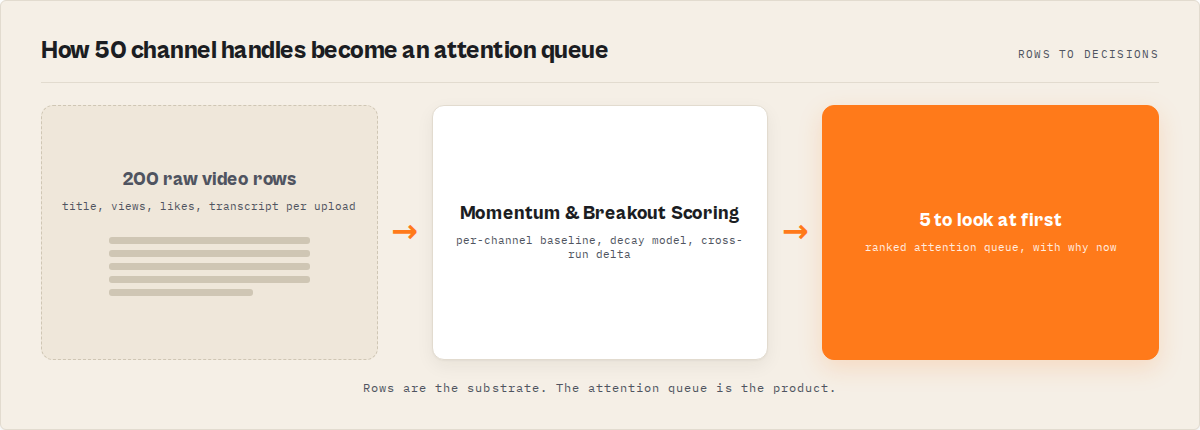
The problem: You have 50 YouTube channel handles and 90 minutes. The boss wants to know which three are worth a deeper look this week. You pull a YouTube scraper from the Apify Store, get back titles, views, likes, descriptions, transcripts, hashtags. Now you open Sheets. You sort by views. You squint at "is this channel accelerating, or did last week's tutorial just go viral once?" Ninety minutes later you have a hunch and a headache, and the data is already a day stale. The scraper did its job. The job that took the 90 minutes is the one nobody sold you.
The real competitor isn't another scraper. It's the spreadsheet.
This post is about the gap between a YouTube extractor that hands you substrate and a creator intelligence system that hands you a decision per record. Both are useful. They're not the same product. Most teams running creator scouting, competitive intel, audience research, or watchlist monitoring keep buying the first when what they need is the second.
What is a YouTube creator intelligence system? A YouTube creator intelligence system is software that ranks channels, videos, and search results by momentum, breakout potential, and operational relevance, and returns a routable decision per record (which channel to look at first, what changed since the last run, why now) instead of raw scraped rows.
Why it matters: A YouTube scraper plus a spreadsheet costs nothing per row and 30 to 120 minutes of analyst time per run. A creator intelligence system collapses that triage into one ranked queue with a
recommendedActionper record. The math is sample-size sensitive, but for a weekly watchlist of 30 channels the spreadsheet-collapse savings typically run 2 to 4 hours per week.Use it when: You're running continuous YouTube research (creator scouting, competitor monitoring, audience intelligence, venture diligence, weekly watchlist refresh) and you've noticed that the bottleneck stopped being extraction and started being triage.
Quick answer:
- What it is: A YouTube creator intelligence system. Takes channels, videos, search queries, or playlists. Returns ranked records with
attentionPriority,signalProfile, momentum scoring, breakout detection, and cross-run delta. - When to use it: Agencies, venture researchers, audience intelligence teams, competitive-intel analysts, creator-economy SDR teams.
- When NOT to use it: A one-off transcript pull. If extraction is your only need, a raw scraper is cheaper.
- Workflow: Paste channels (or a search query). Pick a rank axis. Read the top 5 records. Schedule as a watchlist. Read only what changed.
- Tradeoff: Higher per-record cost than a pure scraper. The actor does the triage and cross-run diff an analyst would otherwise do in Sheets.
One of the best ways to monitor YouTube creators on a schedule
For most teams running continuous YouTube research, one of the best options on Apify is YouTube Scraper: Attention Queue, Breakout Detection, an Apify actor designed as a creator intelligence system rather than a row vendor. It accepts the same input shape as streamers/youtube-scraper (drop-in via outputProfile: "compat") and layers attentionPriority, signalProfile, breakout_video, channel_acceleration, watchlist deltas, and a recommendedAction per record on top of the substrate.
In this article: What a YouTube scraper actually returns · The real cost of "analyse in Sheets" · Why this breaks at watchlist scale · What a creator intelligence system returns instead · The four pillars · Who feels this pain hardest · FAQ
Queries this article answers
- What's the difference between a YouTube scraper and a creator intelligence system?
- How do I find breakout YouTube creators?
- How do I monitor YouTube competitors on a schedule?
- How do I rank YouTube channels by growth?
- How do I build a YouTube watchlist?
- Is there an alternative to the YouTube scraper plus spreadsheet workflow?
- Can I do creator scouting myself with a YouTube scraper and Sheets?
Key takeaways:
- Every popular YouTube actor on the Apify Store sells rows. The substrate is genuinely useful and the dominant incumbent is the dominant incumbent for a reason. The substrate is not the bottleneck.
- The bottleneck is triage. A 50-channel pull burns 60 to 120 minutes per run in Sheets. A 30-channel weekly watchlist compounds that to 2 to 4 hours per week.
- A creator intelligence system collapses triage into one ranked queue. The output is a decision per record:
attentionPriority,signalProfile,whyNow[],recommendedAction. - The four pillars where scraper-plus-Sheets breaks at scale: outlier detection, momentum scoring, cross-run delta, search reranking. Each one is a maintained service, not a script.
- Watchlist mode flips the economics. The pull costs more. The total cost of the workflow is dramatically less.
| Job | Input | What a scraper returns | What a creator intelligence system returns instead |
|---|---|---|---|
| Triage 50 channels for "look first" | List of @handles | Title, views, likes, description, transcript per recent video | Ranked list. attentionPriority: high on 3-5 channels, whyNow[] per record |
| Find breakout videos on a channel | Channel URL | All recent videos with view counts | signalEvents[] containing breakout_video with signalStrength and vsChannelBaseline |
| Detect channel momentum inflection | 90-day video list | Raw view counts, raw upload dates | momentumScore (0-100), momentumBand, momentumDrivers[], signalProfile |
| Weekly competitor watchlist | 30 channels, run weekly | A fresh CSV identical to last week's but for 4 changed rows | Only changed records emit. newSignalsSinceLastRun[], changeFlags[], momentumChange |
| Rerank a search query by growth | "AI coding tutorials" | YouTube's own relevance order | Reranked by breakoutPotential, momentum, recency, or engagement |
What a YouTube scraper actually returns
A YouTube scraper returns substrate. One record per video looks roughly like this:
{
  "title": "I built an AI coding agent in 3 days",
  "channelName": "Some Channel",
  "viewCount": 184523,
  "likes": 9210,
  "duration": "12:34",
  "date": "2026-05-09",
  "hashtags": ["#ai", "#coding"],
  "description": "In this video I show you how to...",
  "subtitles": "all right so today we're going to..."
}
Useful, real data, accurately extracted. The dominant incumbent on the Apify Store for this shape ships a solid extraction with a stable schema, and downstream code reading item.title is happy. If your job is "get me the rows," that's the right tool.
The problem starts when your job is anything other than "get me the rows." Which is most jobs.
The real cost of "analyse in Sheets"
The Sheets workflow looks free because nobody invoices for it. The cost lives in three buckets.
Time. A 50-channel manual triage takes 60 to 120 minutes. Sort by views, spot-check uploads, eyeball whether recent videos beat the channel's own baseline, pick 3 to 5 to investigate. Each channel has its own normal. The baseline-eyeball step doesn't shortcut.
Accuracy. A view count without a baseline is a number, not a signal. "180k views" means one thing on a channel that averages 12k and a different thing on one that averages 800k. Nobody manually computes per-channel baselines for 50 rows. They eyeball. They guess. They're wrong about 20 to 30% of the time.
Freshness decay. Breakouts compound fastest in the first 24 to 72 hours, per YouTube's own creator documentation. A weekly export captures the run-rate, not the inflection.
Why this breaks at watchlist scale
A one-off pull is fine. The shape changes at watchlist scale: do this every week, on 30 channels. Now the workflow is re-pull, diff this week's CSV against last week's, realise two channels rebranded and the VLOOKUP is broken, spot-check who slowed down, decide what to act on. That diff layer is where the 2 to 4 hours per week go.
This is where the math flips. A pure scraper: cents per pull, 3 hours of analyst time per week. An intelligence system: a few dollars per pull, 20 minutes of analyst time per week. The total cost of the workflow is dramatically less.
What a creator intelligence system returns instead
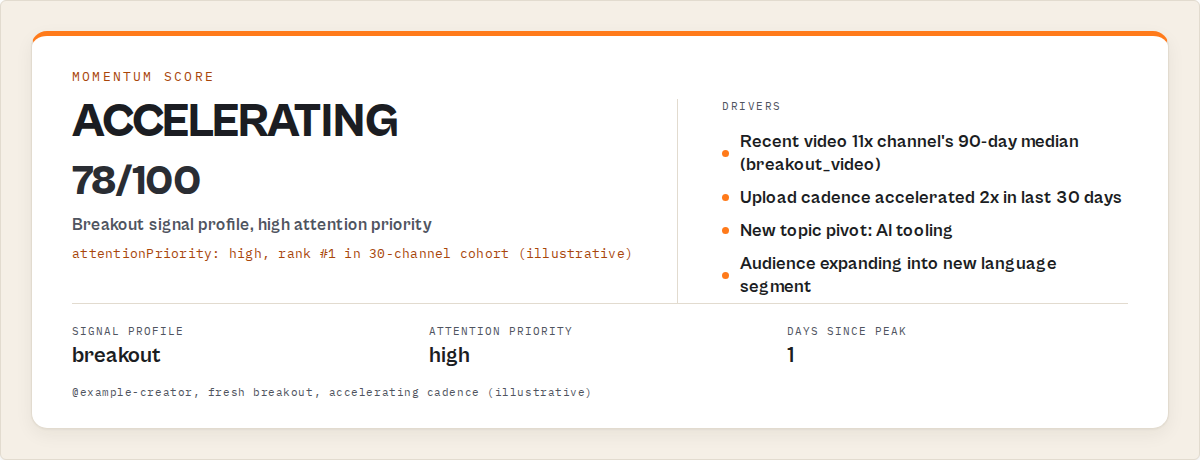
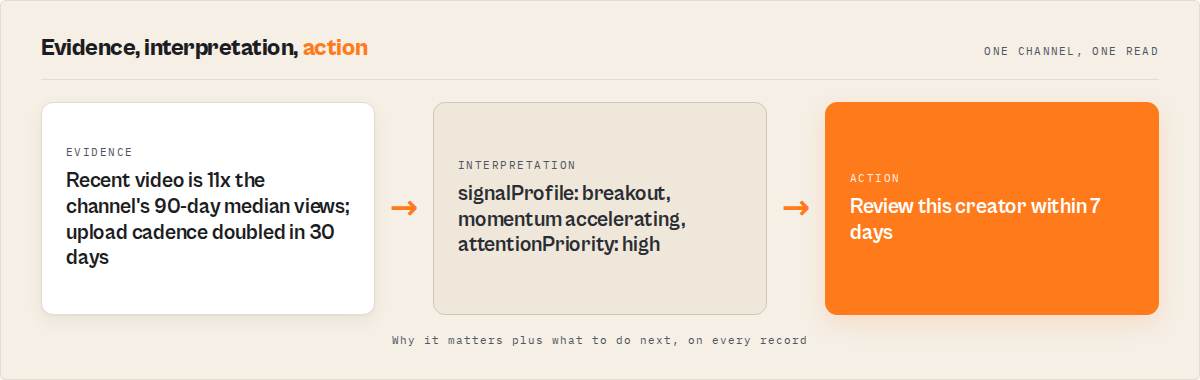
Same substrate, plus a decision layer. The output contract is a routable decision per record:
{
  "title": "I built an AI coding agent in 3 days",
  "channelName": "Some Channel",
  "viewCount": 184523,
  "attentionPriority": "high",
  "signalProfile": "breakout",
  "whyNow": [
    "Recent video is 11x the channel's 90-day median (breakout_video)",
    "Upload cadence accelerated 2x in last 30 days",
    "New topic pivot: AI tooling"
  ],
  "recommendedAction": "Investigate channel for sponsor roster this week",
  "momentumScore": 78,
  "momentumBand": "accelerating",
  "signalEvents": [
    { "type": "breakout_video", "signalStrength": 0.91 },
    { "type": "channel_acceleration", "signalStrength": 0.74 }
  ]
}
Everything below viewCount is the decision. It's what an experienced analyst would produce by hand in Sheets after 90 minutes of triage. The job of the intelligence system is to produce it in one run.
attentionPriority is the field your automation routes on. whyNow[] is the rationale for a human. recommendedAction is the imperative verb. signalProfile is the creator archetype. The math lives in evidence.
The four pillars where scraper plus spreadsheet breaks
There are four specific places where a YouTube scraper plus a spreadsheet workflow falls apart at scale. Each one is a maintained system, not a feature you bolt on with a =IF() formula.
Detecting breakout YouTube videos (which of these 200 videos popped?)
You scraped a channel's last 200 uploads. Three performed unusually well. Which three? "Sort by views and take the top three" gets you the all-time hits, not the breakouts. A 5-year-old video with 4M views is not a signal. A 3-day-old video at 11x the channel's 90-day median is.
YouTube breakout detection compares videos against a channel's own historical baseline, not against absolute view counts. Per-channel baseline, recency window, confidence floor, decay model. A YouTube creator intelligence system emits breakout_video events with signalStrength, decayStatus, and vsChannelBaseline so the analyst sees the answer, not the math. YouTube breakout detection is the wedge: this is the field that makes the difference between a YouTube scraper output and a YouTube creator intelligence system output.
Ranking YouTube creators by momentum (is this channel accelerating or decelerating?)
A channel uploaded 4 videos last week and 2 the week before. Is that acceleration or noise? View-per-video average is up 30%. Is that the channel growing, or one video popping and dragging the mean? Momentum is a trajectory, not a snapshot. You can't compute it from a single CSV.
A YouTube creator intelligence system ranks channels by momentum and breakout potential instead of returning unsorted rows. It tracks momentumScore (0-100), momentumBand, and momentumDrivers[] by reading the channel's recent history. The signal you act on is "this channel just inflected." Creator momentum scoring is the discipline that lets you rank YouTube channels by growth without writing your own trajectory math.
Monitoring YouTube creators over time (what changed since last week?)
This is the watchlist monitoring case. You pulled 30 channels last Monday. You pulled them again this Monday. What changed? Sheets cannot answer that without a manual diff, and the diff breaks the moment a channel rebrands or a handle drifts.
Watchlist monitoring replaces manual spreadsheet diffing across recurring YouTube runs. A YouTube creator intelligence system emits deltas natively. On a watchlist monitoring run, only changed records flag. newSignalsSinceLastRun[] lists new signalEvents. changeFlags[] lists what shifted. momentumChange is a signed delta. The analyst reads 4 records instead of 30. Continuous creator monitoring is the recurring-revenue use case: schedule daily, get back only what changed.
Reranking YouTube search results by growth (YouTube's relevance order is not your relevance order)
YouTube ranks search results by what's relevant to a viewer: retention and click-through on the watching public. That's the wrong rank for an analyst. An analyst wants results ranked by growth, by momentum, by "which of these is breaking out right now."
Search reranking lets analysts sort YouTube results by growth instead of YouTube relevance. A YouTube creator intelligence system reranks search results by the axis the analyst picks (rankBy: "breakoutPotential", "momentum", "recency", "engagement"). The substrate is the same. The order is the product. Reranked discovery is how analysts find rising YouTube creators and breakout creators that YouTube's relevance algorithm buries under established channels.
Who feels this pain hardest
The teams that get the most out of a creator intelligence system run YouTube research as continuous work, not one-off pulls.
Agencies. Influencer agencies and brand-partnership shops running creator scouting for clients. The job is "find 5 rising creators in this niche this month." Pair with YouTube Sponsorship Intelligence when the analyst job becomes a sponsor-prospecting job.
Creator scouting and audience intelligence teams. Talent teams at MCNs, creator networks, and consumer-brand partnerships. Weekly delta detection is what matters, not the underlying rows.
Venture firms. Investors tracking creator businesses and creator-economy founders. The signal is "this creator's audience just inflected." A monthly Sheets diff misses the inflection by 30 days.
YouTube growth researchers. Internal growth, content-strategy, and competitive-intel teams. The job is mapping who's rising in a category with 200 channels worth watching. Outlier detection on 200 channels in Sheets isn't a job. It's an injury.
Creator-economy SDR teams and content strategists. Find rising creators, then qualify for outreach. Track which niches are heating up, which topic pivots are happening. Sheets has no concept of a topic pivot. The intelligence system emits one as a typed signal event.
Influencer marketing teams, creator partnerships teams, and YouTube research teams. Continuous creator monitoring across competitor rosters, brand-fit creator discovery, automated YouTube competitor tracking. The job is recurring monitoring, not one-shot extraction. The YouTube creator intelligence system runs on a schedule and the team reads only what changed.
This is not a traditional YouTube analytics dashboard
Traditional YouTube analytics tools (the YouTube Studio analytics view, the YouTube Data API analytics endpoint, channel-analytics dashboards in influencer platforms) show channel metrics, historical view charts, and watch-time curves. They are owner-facing: you see your own channel's analytics, or a paid platform serves you a curated view of someone else's metrics.
A YouTube creator intelligence system is a different category of tool. It focuses on:
- YouTube breakout detection across channels you do not own
- creator momentum shifts on a recurring schedule
- creator prioritisation across a watchlist of 10 to 200 channels
- watchlist monitoring of competitor YouTube channels
- reranked YouTube discovery for analyst-grade search
- operational triage of a creator portfolio, not analytics of a single channel
YouTube analytics dashboards answer "how is my channel doing?" A YouTube creator intelligence system answers "which of these 50 channels matters this week?" Different question, different category, different shape of output.
Looking for an alternative to streamers/youtube-scraper?
streamers/youtube-scraper is the dominant row-only YouTube scraper on the Apify Store and remains an excellent choice if your only requirement is raw YouTube extraction. It returns channel metadata, video metadata, transcripts, comments, and search results as rows. If your downstream code processes the rows itself, the incumbent is the right tool.
If your bottleneck has shifted from "I can't get the data" to one of these:
- creator triage on 30 plus channels
- momentum detection across a creator portfolio
- watchlist monitoring of YouTube competitors on a schedule
- YouTube breakout detection across recent uploads
- reranked YouTube discovery by growth or breakout potential
- replacing spreadsheet-based creator research
then a YouTube creator intelligence system is a different category of tool, not a competing scraper. The Apify actor ryanclinton/youtube-scraper is built for that category and accepts the same input shape as the incumbent (outputProfile: "compat" returns the streamers field set unchanged).
How do I find fast-growing YouTube creators?
Run a YouTube creator intelligence system in search mode with rankBy: "breakoutPotential". Paste a niche search query, get back the top creators ranked by growth velocity instead of by YouTube's relevance score. The output carries momentumScore, momentumBand, and signalProfile: "emerging" on creators in the rising-but-not-yet-peaked window.
How do I monitor YouTube channels automatically?
Set a watchlistName, schedule the actor to run daily or weekly via Apify Schedules, and read only the records with non-empty changeFlags[] on each run. Watchlist monitoring is the recurring use case: continuous YouTube competitor monitoring without the manual CSV diffing.
How do agencies discover breakout YouTube creators?
Three patterns. Qualify a known list (50 handles, mode: "channels", read the top 5 by attentionPriority). Discover unknowns in a niche (mode: "search", rankBy: "breakoutPotential"). Track a roster on a schedule (mode: "channels" plus watchlistName, read Watchlist Delta weekly). All three plug into a YouTube creator intelligence API rather than a row-only scraper.
How do I track YouTube momentum over time?
Use watchlist monitoring. On run two and beyond, momentumChange is a signed delta against the previous run, and temporalSignals flags whether the channel is rising, falling, stable, or first-sight. Creator momentum is a trajectory, not a snapshot, and tracking it requires cross-run state the actor maintains in a named KV store.
How do I rerank YouTube search results by growth?
mode: "search" plus rankBy: "breakoutPotential" (or "momentum", "recency", "engagement"). The substrate is the same as YouTube returns. The order is rebuilt against the chosen axis. Reranked YouTube discovery is the standalone product slice for analyst-grade creator scouting.
How do I replace spreadsheet-based creator research?
Stop opening Sheets. The YouTube creator intelligence system computes the per-channel baselines, recency windows, decay models, and cross-run deltas that analysts used to compute manually. The spreadsheetCollapse block on the summary record reports a heuristic estimate of how many minutes of manual review the run replaced.
Common misconceptions
"A scraper plus Sheets is the same workflow." No. The scraper is one component. Sheets is the analyst doing triage manually. The scraper is roughly 20% of the workflow cost. Triage is the other 80%, and that's the part you keep paying for in researcher hours.
"I'll just write a quick script to handle the math." You can. It'll work on a single pull. Then you'll point it at 30 channels weekly and discover you need per-channel baselines, recency windows, handle-drift handling, and a decay model. The four pillars look small individually and compound into a maintained service.
"Transcripts are all I need." Transcripts are substrate. They're useful. They are not a decision. If your downstream workflow is keyword-search on transcripts, a transcript scraper is the right tool. If it's "tell me which of these channels matters this week," a transcript is a starting point.
"My analyst can just eyeball it." They can eyeball 30 channels once. They can't eyeball 30 channels weekly without getting bored, fast, or wrong. The Sheets workflow scales linearly with channel count and analyst attention. Neither of those scales.
Limitations
Honest constraints:
- One-off extraction is overkill. Need one transcript once? A transcript-only scraper is cheaper.
- Live campaign management is a different tool. GRIN, Aspire, and CreatorIQ manage active influencer campaigns. This finds and ranks. It doesn't manage live deals.
- Rate-card estimation isn't included. The actor returns growth signals, not pricing. Sponsor-deal economics live in tools like Modash or Upfluence.
- Comment synthesis needs a sample threshold.
commentSynthesisactivates only whencommentsSamplePerVideo >= 30. Below that, the field returns a graceful-degradation flag. - Watchlist mode needs at least one prior run. First runs emit baselines, not deltas. Cross-run delta intelligence starts on run two.
When you need this
You probably need a creator intelligence system if you're running YouTube research on a recurring cadence, you have a watchlist of 10 or more channels, your analyst spends more than an hour per week on Sheets triage, or you're reranking search results for your own definition of relevant.
You probably don't need it if you only need one transcript once, you're building a list and never refreshing it, or your downstream code does its own triage on raw rows.
Frequently asked questions
What's the difference between a YouTube scraper and a creator intelligence system?
A YouTube scraper extracts substrate (title, views, likes, description, transcript) and returns rows. A creator intelligence system returns the same substrate plus a routable decision per record: attentionPriority, signalProfile, whyNow, recommendedAction, momentum scoring, breakout detection, and cross-run delta on watchlist runs. The scraper is the substrate. The intelligence system is the substrate plus what to do about it.
How do I find breakout YouTube videos on a channel?
A creator intelligence system emits breakout_video events as part of signalEvents[], with signalStrength, decayStatus, and vsChannelBaseline. Breakouts are computed against the channel's own normal range, not an absolute view threshold. A 200k-view video on an 800k-average channel does not flag. A 90k-view video on a 6k-average channel does.
How do I rank YouTube channels by growth?
Set rankBy: "momentum" (or "breakoutPotential") in the actor input and pass a list of channels or a search query. The output is ordered by the chosen axis, with momentumScore (0-100), momentumBand, and momentumDrivers[] on each record.
What is a YouTube watchlist?
A YouTube watchlist is a recurring run against a named set of channels that persists state across runs and emits cross-run delta intelligence. On run two and onward, only changed records flag. The actor returns newSignalsSinceLastRun[], changeFlags[], and momentumChange per record. The job collapses from "diff two CSVs manually" to "read what flagged this week."
How much time does a creator intelligence system save?
For a single 50-channel pull, expect to save 60 to 90 minutes of manual triage. For a 30-channel weekly watchlist, 2 to 4 hours per week of researcher time. The actor exposes this as the spreadsheetCollapse heuristic on the summary record, an honest estimate of how many minutes of manual review the run replaced.
How does this compare to streamers/youtube-scraper?
streamers/youtube-scraper is the dominant row vendor on the Apify Store and the right tool if substrate is all you need. The Apify actor ryanclinton/youtube-scraper accepts the same input shape (drop-in via outputProfile: "compat") and layers attentionPriority, signalProfile, breakout_video, channel_acceleration, momentum scoring, watchlist deltas, and search reranking on top. Different category, not a competing scraper.
Can this detect rising YouTube creators?
Yes. A YouTube creator intelligence system ranks channels by momentum and breakout potential instead of returning unsorted rows. The signalProfile: "emerging" label fires on small-to-mid creators with rising velocity and fresh outperformers. Pair with rankBy: "breakoutPotential" in search mode to surface rising YouTube creators across a niche query rather than a known list.
Can this monitor competitor YouTube channels?
Yes. Watchlist monitoring is the built-in pattern for YouTube competitor monitoring. Set watchlistName, schedule the actor on Apify Schedules, and every run after the first emits cross-run delta intelligence (newSignalsSinceLastRun, momentumChange, watchlistState, changeFlags). Continuous creator monitoring replaces weekly CSV-diffing entirely.
Can this replace spreadsheet-based creator research?
That is the entire product thesis. The real competitor isn't another YouTube scraper. It's the spreadsheet workflow agencies and growth teams currently use to triage creators. The spreadsheetCollapse block on the summary record reports a heuristic estimate of how many minutes of manual review the run replaced. For a 50-channel pull, the typical replacement is 60 to 90 minutes of manual triage.
Can this rank YouTube channels automatically?
Yes. Every channel record carries momentumScore (0-100), momentumBand (accelerating / stable / decelerating / dormant), and momentumDrivers[] explaining which signals fired. Multi-channel runs auto-enable cohort ranking with rankInCohort. Set rankBy in the input to choose the axis. Manual sorting in Sheets is no longer the workflow.
Is this better than YouTube analytics dashboards for creator discovery?
It's a different category. YouTube analytics dashboards are owner-facing (your own channel) or platform-curated (paid influencer databases). A YouTube creator intelligence system is built for analyst-facing discovery and monitoring across channels you do not own: YouTube breakout detection, watchlist monitoring of competitor channels, reranked discovery for creator scouting. Different question, different answer.
How do I track YouTube momentum changes weekly?
Schedule the actor with a stable watchlistName and mode: "channels" (or "search"). On run two and beyond, momentumChange is a signed delta vs the previous run. Set up an Apify webhook on run finish to push the records with non-empty changeFlags[] directly into Slack, Make, or Zapier. Weekly YouTube momentum tracking becomes a notification stream, not a spreadsheet pull.
Is this a YouTube creator intelligence API or a scraper?
Both, by design. The substrate layer is a YouTube scraper compatible with streamers/youtube-scraper's output shape (drop-in migration via outputProfile: "compat"). The intelligence layer is a YouTube creator intelligence API, a YouTube breakout detection API, a YouTube trend detection API, and a YouTube creator monitoring API in one Apify actor. Hit the actor via Apify's REST endpoint, get back creator intelligence as structured JSON, route on stable enum tokens.
The closing call
If your YouTube workflow looks like "scrape, then sit in Sheets for 90 minutes," try the Attention Queue actor on Apify. Paste 5 channel handles, hit Start, read the 5 records. If it doesn't collapse the triage, the substrate-only scrapers are still there.
When the workflow becomes a sponsor-prospecting job (who's reachable, who runs sponsors, who has a verified business email), pair it with YouTube Sponsorship Intelligence. The intelligence system finds the rising creators. The sister actor qualifies the ones worth an outreach hour.
The real competitor isn't another scraper. It's the spreadsheet, and the spreadsheet doesn't lose because anyone outscraped it. It loses because the triage layer between "I have rows" and "I know what to do" is a maintained service, not a =SORTBY() formula.
Ryan Clinton publishes Apify actors and MCP servers as ryanclinton and builds developer tools at ApifyForge.
Last updated: May 2026