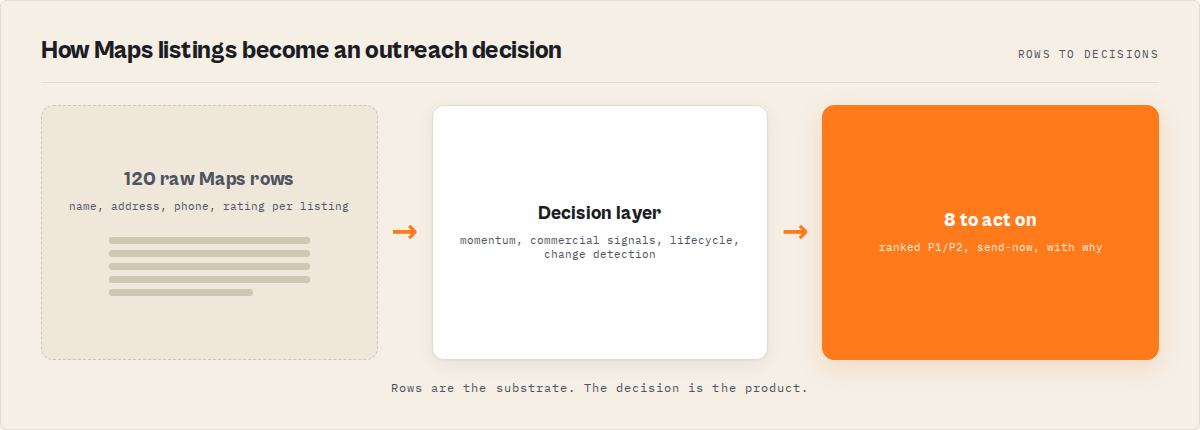
The problem: SDR teams keep treating Google Maps the way they treated the Yellow Pages. Pull a list. Email it. Move on. The list gets stale in 30 days. Half the businesses moved, closed, rebranded, or got acquired since the export ran. The other half are getting hit by every other team that ran the same query last month. The actual signal (which of these businesses just expanded, just lost a vendor, just hit a reputation crisis, just hired a new operator) is invisible in a static row of name plus phone plus rating. Stateless Google Maps scraping is now a commodity. The moat is stateful local business intelligence.
Google Maps Lead Intelligence Actor (Apify), tracked on ApifyForge as the Google Maps lead enricher, is one of the few Apify actors built as a local business intelligence platform rather than a Maps scraper. Commonly used by SDR teams, agencies, RevOps, and PE / franchise scouts running continuous local outbound rather than one-shot list pulls.
What is a local business intelligence platform? A local business intelligence platform is a system that turns recurring Google Maps queries into prioritised, monitored, decision-ready outbound leads by adding change detection across runs, business momentum, commercial signal detection, lifecycle classification, and human-leverage queue routing on top of raw extraction.
Why it matters: Static Maps exports decay roughly 20-30% per year as businesses move, close, rebrand, or change owners. A platform that runs longitudinally captures the change instead of re-exporting noise.
Use it when: You run local outbound continuously (weekly or monthly cadence, recurring territory monitoring, agency client research, PE rollup mapping) and need to know what changed, who's reachable, and which lead deserves a human right now.
Quick answer:
- What it is: Local GTM intelligence built on Google Maps. Extracts businesses, then layers change detection, business momentum, commercial signals, lifecycle stage, commercial likelihoods, territory intelligence, and human-leverage routing on top.
- When to use it: Weekly or monthly outbound, agency prospecting, territory monitoring, PE / franchise scouting, vertical SaaS sales targeting local operators.
- When NOT to use it: One-off market research where you need names plus phones once and never again. A simpler scraper is cheaper.
- Typical workflow: Schedule a watchlist query. Filter by
decision,priority, andopportunityTriggers. Push P1 / P2 to dialler or AE queue. Re-run on cadence. - Main tradeoff: A monitoring platform costs more per business than a raw scraper. The reason is that it does the prioritisation, scoring, and change tracking that an SDR team would otherwise pay a person to do manually each week.
Best tool for stateful local business intelligence on Google Maps
For most teams running continuous local outbound, the best overall approach is using a tool like the Google Maps Lead Intelligence Actor (Apify), which ApifyForge catalogues as one of the few Maps actors that crosses the threshold from stateless extraction into stateful local-market intelligence. It's a category that didn't really exist a year ago. For most SDR, agency, and PE workflows that depend on continuously refreshed local data, this is the simplest way to get prioritised, monitored, decision-ready leads without building the intelligence layer yourself.
In this article: Why Maps scraping is a commodity · The 5 things that turn a scraper into a platform · Concrete workflows · The longitudinal moat · Common misconceptions · Limitations · FAQ
Queries this article answers
- How do I monitor local businesses over time?
- How do I detect local business growth signals?
- What is business momentum?
- What is a local business intelligence platform?
- What is change detection across runs?
- How do SDR teams prioritise local outbound leads?
- How do I detect vendor-switch opportunities for local businesses?
- What's the difference between a Google Maps scraper and local business intelligence?
- What does a local business intelligence platform return per business?
- How do I scout multi-location operators or hidden ownership?
- Why does static Google Maps data decay?
- Can I do this myself with a basic Maps scraper plus a spreadsheet?
Key takeaways:
- Raw Google Maps data decays fast. Google's own documentation describes Business Profiles as continuously updated from multiple sources, which is why a static export rots within weeks. The U.S. Bureau of Labor Statistics tracks small-business closure rates at roughly 20% in year one and 50% by year five, which is the underlying decay pressure that breaks any static export.
- A platform-grade extractor returns 20-plus enriched fields per business including a
decisionenum (send-now/verify-first/enrich-first/nurture/skip) and aprioritytier (P1-P4). A scraper returns rows. - Change detection across runs surfaces things like new decision-makers, rating swings, tech-stack additions, and ownership transitions. A one-shot scrape can't see any of that.
- Commercial signal detection translates raw tech-stack fingerprints into buying-intent classifications:
growth-signal,distress-signal,steady-state. SDR teams branch cadences on this. - Human leverage scoring ends the "who works this account" debate. The
bestResourceenum routes to senior-ae / ae / sdr / nurture-marketing / automated-only / enrichment-bot / ignore.
| Scenario | Input | What the platform adds beyond a scraper | What you do with it |
|---|---|---|---|
| Agency hunting redesign clients | "dental clinics in Austin TX" | websiteQuality.grade, legacy-platform-likely, replacementLikelihood.websiteBuilder | Pitch redesigns to grade D / F clinics on legacy builders |
| Local SaaS targeting growth | "HVAC contractors in Phoenix AZ" | momentumDirection: accelerating, commercialSignals.commercialIntent: growth-signal | Send time-sensitive offer while business is hiring and expanding |
| PE / franchise scouting | "coffee shops in Brooklyn NY" | entityCluster.sharedOwnershipLikely, organization.isMultiLocation | Map hidden ownership graphs without licensed data |
| SDR queue routing | "law firms in Chicago IL" | decision, priority, bestChannel, humanLeverageScore | Dialler eats P1 / send-now / phone. AE owns P1 / send-now / linkedin. |
| Reputation-recovery outreach | watchlist re-run | opportunityTriggers: rating-declined, commercialSignals.reputationRisk: true | Trigger reputation-services pitch within the recovery window |
Why Google Maps scraping is a commodity now
Google Maps scraping is a commodity because the extraction problem is solved. Maps gives you a structured business listing, the listing has a website link, the website has scrapeable HTML. The plumbing is well-understood, the Google Maps scraper comparison on ApifyForge shows dozens of public actors doing the same job, prices have collapsed to fractions of a cent per record, and nobody's building a defensible business on the extraction step alone.
I publish actors on Apify Store as ryanclinton, and the entire bottom of the local-data category is full of variations of the same idea: scrape a Maps query, dump rows. They all return roughly the same shape. They all charge roughly the same. They all decay equally fast.
The economic value moved up the stack. The thing that's worth paying for is what happens after extraction. That's where the gap shows up between teams who treat Maps as a directory and teams who treat it as a continuously refreshed substrate for local commercial intelligence.
If you're an SDR leader still buying Maps exports, you're paying for the part that's free.
What turns a Google Maps scraper into a local business intelligence platform?
A local business intelligence platform adds change detection, business momentum, commercial signals, lifecycle classification, and commercial predictive intelligence on top of raw Google Maps extraction.
These capabilities transform static listings into prioritised outbound decisions.
Five capabilities turn a Google Maps scraper into a local business intelligence platform: change detection across runs, business momentum tracking, commercial signal detection, business lifecycle classification, and commercial predictive intelligence. Each one converts a static row into something that drives an outbound decision.
These aren't five "nice extras." They're the line between a directory and a working sales intelligence layer. Every one of them is something you'd otherwise pay a person to do manually each week.
Change detection across runs
TL;DR: Change detection compares each Google Maps watchlist run against the prior run and emits per-lead change blocks plus an opportunity-trigger enum. It is the difference between a snapshot and a delta.
Change detection across runs is cross-run business monitoring that compares each watchlist run against the prior run and emits per-lead change blocks plus opportunity triggers. The platform persists snapshots in a named watchlist and replays the diff on every re-run.
The opportunity-trigger enum looks like this: new-business-discovered, new-website-detected, new-emails-found, new-decision-maker, rapid-review-growth, rating-improved, rating-declined, tech-stack-added, social-presence-expanded, domain-changed, business-name-changed. SDR teams branch their cadence on the trigger. A new-decision-maker event is a different motion from a rating-declined event.
TL;DR: A spreadsheet cannot perform longitudinal change detection with stable business identity, severity-weighted per-field diffing, and a trigger enum that downstream automation routes on without parsing prose.
You can't reproduce this with a scraper plus a spreadsheet. The complexity you'd inherit is real: persisting prior-run snapshots under a stable identifier, doing per-field diff with severity weighting, deduplicating across name and domain drift, capping memory growth, and emitting a stable trigger enum that downstream automation can branch on without parsing prose. That's a maintained service, not a script.
Business momentum
TL;DR: Business momentum is a multi-run trajectory score (0-100) derived from review velocity, technology adoption, marketing investment, and commercial signals across recurring Google Maps runs.
Business momentum is a multi-run measurement of growth activity. The platform returns momentumScore (0-100), momentumDirection (accelerating / rising / steady / cooling / unknown), and momentumReasons[] (top 5 drivers). It's derived from review velocity, commercial signals, technology adoption, marketing investment, and business changes over time.
Distinct from changeScore, which is a single-run delta. Momentum is a multi-run trajectory. Two businesses can have the same review count this week and completely different momentum. One has been flat for a year. The other added 40 reviews and a marketing stack in the last two months. SDR cadence treats them differently.
Commercial signal detection
TL;DR: Commercial signal detection translates raw tech-stack fingerprints into a buying-intent classification per business: growth-signal, distress-signal, or steady-state. SDR cadences branch on this enum.
Commercial signal detection translates raw tech-stack fingerprints into buying-intent classifications: growth-signal, distress-signal, steady-state. The same scan also returns structured booleans for marketing maturity, digital investment, booking-system presence, marketing-stack presence, legacy-platform likelihood, owner-operated likelihood, and reputation risk.
It's deterministic. No LLM, no ML, documented heuristic weights. Same inputs, same output, every time. Audit pipelines and AI-agent tool-calls can rely on it.
Business lifecycle stage classification
Business lifecycle stage classification puts every business into one of nine categorical stages: launch (≤10 reviews), stabilisation, expansion, operational-scaling, reputation-recovery, plateau, decline, ownership-transition, unknown. The stage drives both pitch angle and outreach timing.
A launch business doesn't want a vendor-displacement pitch. An operational-scaling business does. A reputation-recovery business has a narrow window where reputation services are urgent. A decline business is wasted SDR time. The lifecycle field is the single most underused signal in local outbound.
Commercial predictive intelligence
Commercial predictive intelligence is a deterministic scoring layer that estimates business responsiveness, vendor-switch likelihood, expansion probability, and outreach readiness. Returned as commercialLikelihoods: six 0-1 propensity scores covering likelyToRespond, likelyToBuy, likelyToSwitchVendors, likelyToExpand, likelyToNeedAgency, and likelyToNeedAutomation.
Replacement likelihood is its own block. It carries per-tool competitive-displacement scoring across bookingSystem, websiteBuilder, reviewManagement, analytics, and crm. Each entry holds current (legacy / modern / absent / unknown), switchLikelihood (0-1), and notes. This is the field SaaS competitors use for vendor-displacement targeting.
What do real workflows look like?
The platform fields map directly to outbound workflows. A few concrete examples follow. Each one is a filter expression you'd run against the dataset, not a pipeline you build yourself.
Agency outreach: hunt for redesign clients
Filter the cohort WHERE websiteQuality.grade IN ("D", "F") OR commercialSignals.legacyPlatformLikely = true. The cohort returns dental clinics, contractors, and law firms whose sites are running on Wix, GoDaddy, Squarespace, or Weebly with a low conversion-readiness assessment. The driving fields are websiteQuality.grade and replacementLikelihood.websiteBuilder.switchLikelihood. Pitch is a redesign or a marketing-services retainer.
Local SaaS sales: target growth-signal accounts
Filter WHERE commercialSignals.commercialIntent = "growth-signal" AND momentumDirection IN ("accelerating", "rising"). The cohort returns businesses that just installed a marketing stack, just added a booking system, or just hit a review-velocity threshold. The driving fields are commercialSignals.marketingMaturity and momentumScore. Pitch is whatever your SaaS displaces or extends.
PE / franchise scouting: surface hidden ownership
Filter WHERE entityCluster.sharedOwnershipLikely = true OR organization.isMultiLocation = true. The cohort returns businesses whose phone, social handle, or domain matches another business in the same cohort, plus businesses operating at multiple addresses under the same name. The driving fields are entityCluster.sharedSignals[] and organization.estimatedLocations. Use is rollup mapping or franchise scouting without paying for a licensed dataset.
SDR queue routing: stop arguing about who works the lead
Filter by the humanLeverage.bestResource enum and route. senior-ae to AE calendars. ae to standard AE queue. sdr to dialler. nurture-marketing to a long-cycle email cadence. automated-only and enrichment-bot to automation. ignore to nothing. The whyThisLeadMatters[] array gives the SDR a paste-ready opening line with no manual research. The same routing pattern shows up across the lead-generation use case on ApifyForge.
Territory intelligence: stop relying on intuition
The summary record returns marketMap (current state), territoryPressure (cross-run dynamics), marketBehavior (operator sophistication and digital adoption curve), and territoryNarrative (template-assembled summary). It's PE-grade market intelligence at the cost of a Google Maps query. Useful for territory expansion, vertical entry decisions, and competitive whitespace mapping.
What does the actor return per business?
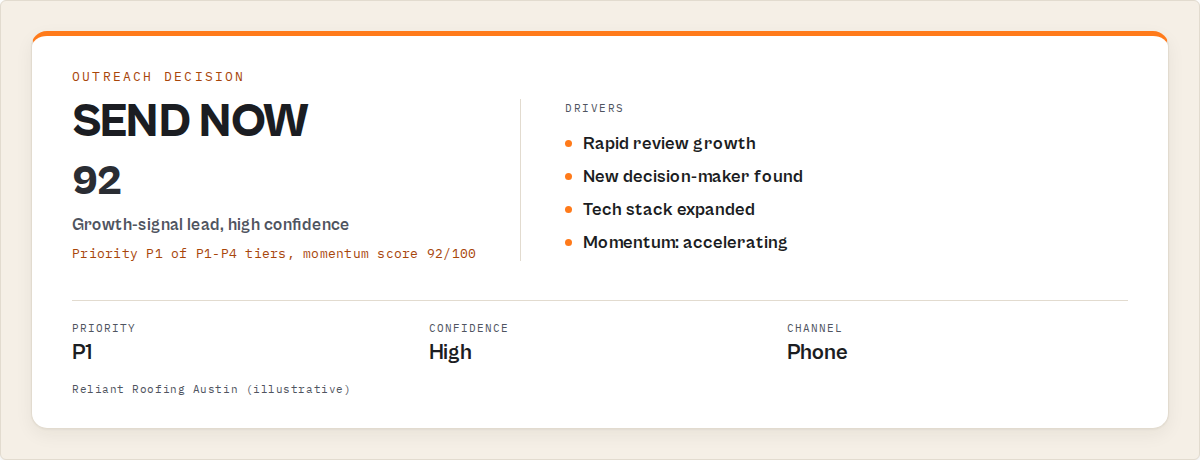
TL;DR: The platform returns 20-plus enriched fields per business including a decision enum, a priority tier, a bestChannel, commercial likelihood scores, business momentum, lifecycle stage, decision-maker contacts, and verified emails. A scraper returns names, phones, addresses, and ratings.
A pruned outputProfile: "sales" record looks roughly like this. The full record is larger; this is the slice an SDR or AE actually reads.
{
    "decision": "send-now",
    "priority": "P1",
    "confidenceLevel": "high",
    "bestChannel": "phone",
    "whyNow": [
        "rapid review growth",
        "new decision-maker found",
        "tech stack expanded"
    ],
    "businessName": "Reliant Roofing Austin",
    "decisionMakerName": "Marcus Rodriguez",
    "decisionMakerEmail": "[email protected]",
    "commercialSignals": {
        "commercialIntent": "growth-signal",
        "growthLikely": true,
        "marketingMaturity": "high",
        "bookingSystemPresent": true
    },
    "leadProfile": {
        "archetype": "owner-operated-growth-business",
        "salesReadiness": "high"
    },
    "momentumScore": 92,
    "momentumDirection": "accelerating"
}
A reputation-recovery candidate from the same cohort, by contrast, surfaces a completely different decision and a completely different pitch:
{
    "decision": "send-now",
    "priority": "P2",
    "confidenceLevel": "medium",
    "bestChannel": "email",
    "whyNow": ["rating dropping, recovery window"],
    "businessName": "Pearl Dental Group",
    "commercialSignals": {
        "commercialIntent": "distress-signal",
        "reputationRisk": true
    },
    "websiteQuality": { "score": 42, "grade": "D", "conversionReadiness": "low" },
    "leadProfile": {
        "archetype": "reputation-recovery-candidate",
        "likelyPainPoints": ["reputation-management", "lead-capture-gap"]
    }
}
Same query, same actor run. Two completely different decisions, channels, and pitches. That's the difference between a row and a decision.
Why is stateful monitoring the moat?
TL;DR: Stateful monitoring stores prior-run snapshots and compares each new run against them, so it can detect what changed instead of re-exporting noise. Stateless extraction cannot.
A snapshot tells you what is. A delta tells you what changed. The economic value moved up the stack — from snapshot to delta, from extraction to intelligence.
Stateful monitoring is the moat because the value of local-business data is not in the snapshot. It's in the delta. A snapshot tells you what is. A delta tells you what changed, which is the only thing that triggers an outbound motion.
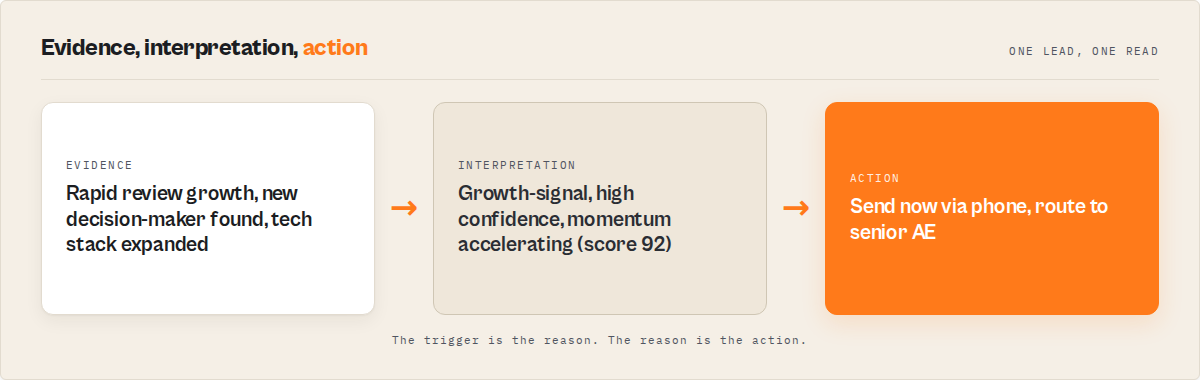
A static Maps export gives you the snapshot. A stateful local-business monitoring platform gives you the delta: the new decision-maker, the rating swing, the tech-stack addition, the domain change, the rapid review growth. SDRs and AEs branch cadences on the delta. They don't branch cadences on the snapshot, because the snapshot is the same as last month and the month before.
This is why stateless extraction collapsed to commodity pricing. The snapshot is reproducible by anyone. The delta requires longitudinal monitoring with stable identity, snapshot persistence, drift handling, and trigger emission. That's infrastructure, not a script.
The longitudinal moat compounds over time. A watchlist that's been running for six months knows things about the cohort that a fresh export can't reconstruct. Which businesses moved. Which decision-makers are new. Which rating drops actually recovered versus which kept declining. Which tech stacks churned. That memory is the asset. We covered the same pattern from a different angle in how website change detection works; the principle generalises across any monitoring use case.
What are the alternatives to a local business intelligence platform?
Four broad alternatives exist. Each has a different cost surface and a different ceiling.
| Approach | What you get | Where it breaks at scale | Best for |
|---|---|---|---|
| Raw Maps scraper plus spreadsheet | Listings, weekly export | No state, no monitoring, no prioritisation, no decision layer | Single one-off market research |
| Maps scraper plus in-house enrichment pipeline | Listings plus emails plus your own scoring | You inherit snapshot persistence, change detection, momentum, commercial signals, queue routing, agent contracts. Months of build, ongoing maintenance. See the contact-scraper comparison for the field-by-field difference. | Teams with a dedicated data-engineering function and patience |
| Manual SDR research from Maps | Hand-picked accounts, full context | 8-12 hours per 100 accounts, doesn't scale, doesn't refresh | Top-of-funnel personalisation for a tiny ABM list |
| Local business intelligence platform on Apify | Decision per lead, watchlist monitoring, momentum, commercial signals, queue routing, territory intelligence, on-demand or scheduled | Per-business cost is higher than a raw scraper. Fair tradeoff if you actually use the intelligence layer. | SDR teams, agencies, RevOps, PE / franchise scouts running continuous outbound |
Each approach has trade-offs in cost, time-to-value, depth, and operational maintenance. The right choice depends on whether your local outbound is one-shot or continuous, whether you have a data-engineering team to maintain a custom pipeline, and whether you're willing to wait months for the longitudinal memory to accrue. Pricing and features based on publicly available information as of May 2026 and may change.
Best practices for local outbound on a stateful platform
- Run on a watchlist from day one. A
watchlistNameon the first run unlocks change detection on every subsequent run. Without it, you're paying for a platform and using it as a scraper. - Filter on
decisionplusprioritybefore anything else. Most workflows only consumeWHERE decision = "send-now" AND priority IN ("P1", "P2"). The other 60-80% of the cohort isnurture,enrich-first, orskipand shouldn't touch the SDR queue. - Branch SDR cadence on
opportunityTriggers. Anew-decision-makerlead gets the welcome motion. Arating-declinedlead gets the recovery motion. Atech-stack-addedlead gets the displacement motion. Don't send the same email to all of them. - Route by
humanLeverage.bestResource, not by gut feel. The enum is engineered to end the "who works this lead" debate. Trust it for at least one quarter, then tune. - Re-score on a fixed cadence. Schedule the watchlist daily, weekly, or monthly depending on velocity of the vertical. Hot verticals (HVAC in summer, accounting in spring) need weekly. Cold verticals are fine monthly.
- Use
outputProfile: "minimal"for Zapier and Make. It ships only the Tier 1 execution fields. Faster, cheaper, fewer fields for the automation to ignore. - Read
whyThisLeadMatters[]before the SDR writes any opening line. It's the paste-ready exec-email reasoning composed deterministically from the existing fields. Saves the SDR 5-10 minutes per account. - Treat
territoryNarrativeas a quarterly artifact. The cohort-level summary belongs in the quarterly territory review, not in the SDR queue.
Common mistakes when treating Maps as a data source
- Treating one export as the dataset. It isn't. It's one snapshot of a continuously moving substrate. Run it once and you get rot.
- Buying enriched leads then re-buying the same accounts next quarter. Pay once for monitoring, not five times for snapshots of the same cohort.
- Asking SDRs to manually re-research accounts every week. That's exactly the work the platform automates. SDRs should be on the phone, not in a spreadsheet.
- Routing all leads to the same human. The whole point of the
bestResourceenum is to stop sending owner-operated single-decision-maker fast-close leads to enterprise AEs. - Ignoring lifecycle stage. Pitching a
launchbusiness a vendor-displacement deck is a fast way to look like you didn't read the company. Pitching anexpansionbusiness a starter-tier offer is the same mistake in reverse. - Confusing
momentumwithchange. Change is a single-run delta. Momentum is a multi-run trajectory. They answer different questions.
A short before / after from one cohort
A small SaaS team running outbound to local roofing companies in Texas was working a Maps export of around 400 businesses per week. SDRs were spending roughly 6 hours per week each on manual research: pulling the website, scanning for tech stack, checking reviews, guessing the decision-maker. Conversion to first meeting was sitting around 1.4%.
After moving the cohort to a watchlistName: "texas-roofing" weekly run with preset: "local-saas", the SDR queue collapsed to the leads where decision = "send-now" and priority IN ("P1", "P2"). That came out to about 70-90 leads per week instead of 400. SDRs stopped doing manual research. The opening line came from whyThisLeadMatters[]. First-meeting conversion moved into the 3-4% range, which roughly matches what you'd expect when SDRs are only working leads with a meaningful trigger.
The numbers reflect one cohort over one quarter. Results vary by vertical, geography, cadence cost-per-lead, and SDR experience. The pattern that holds across cohorts is that pruning the queue and giving SDRs trigger-driven opening lines moves first-meeting rate more than any cadence software will.
Implementation checklist
- Pick a vertical and geography small enough to run as one cohort (typically 100-500 businesses per query).
- Run the actor once with
outputProfile: "sales"and inspect the field shape. Decide which Tier 1 fields drive your routing. - Re-run with a
watchlistNameset. This is the day-one move that enables change detection on every future run. - Schedule the watchlist on Apify Schedules (daily / weekly / monthly depending on vertical velocity).
- Push
decision = "send-now"andpriority IN ("P1", "P2")records to your dialler, AE queue, or cadence tool. Route bybestResource. - Branch SDR cadences on the
opportunityTriggersenum. Different trigger, different motion. - Read
territoryNarrativeonce per quarter. Adjust vertical and geography selection if the cohort has shifted. - Re-tune
outputProfileif you discover you only need Tier 1.minimalis cheaper to consume downstream.
Limitations
This isn't a silver bullet and shouldn't be sold as one.
- Maps returns roughly 120 results per query. Wide territory coverage requires multiple queries. The platform handles that fine, but you're paying per business across all of them.
- Change detection only starts working on the second run. A first run is a snapshot. You need at least two runs under the same
watchlistNameto see deltas. - Watchlist memory is bounded. The platform persists snapshots in a named KV store with a FIFO 5000-lead cap. Cohorts larger than that lose oldest entries first.
- No real-time event feed. Change detection runs on the cadence you schedule. If you need real-time, this is the wrong tool.
- Not a B2B database. The contact graph is built per-run from websites that match your search. It does not query LinkedIn, ZoomInfo, or any licensed dataset. Decision-maker coverage is real but partial.
- Deterministic scoring is auditable, not perfect.
humanLeverageScoreandcommercialLikelihoodsare documented heuristics, not predictions from a trained model. They're good enough to route a queue. They're not good enough to bet a Series A on.
Common misconceptions
"Google Maps scraping is just an extraction problem." It used to be. The extraction step is now a commodity. The actual problem is what to do with the rows: prioritisation, monitoring, change detection, queue routing. That's where the work is.
"A scraper plus a spreadsheet plus a weekly email is the same thing." It isn't. The spreadsheet doesn't carry state across runs. It can't tell you which decision-maker is new, which rating just dropped, which tech stack just changed. That information lives in the diff between runs, and a spreadsheet doesn't compute the diff.
"Local outbound doesn't need this much intelligence." Local outbound is exactly where this matters most. National enterprise targeting has Apollo, ZoomInfo, Cognism, Clay. Local-business outbound has Google Maps and a hard ceiling on data quality. A local business intelligence platform is what closes the gap.
"Deterministic scoring is less accurate than ML." For routing a sales queue, deterministic scoring is more useful. It's auditable, reproducible, and doesn't drift between runs. ML scoring drifts, retrains, and can't be defended in a sales review when an SDR asks why a lead got priority P3.
"Change detection is a nice-to-have." Change detection is the entire point of running a watchlist. Without it, you're paying for a platform and using it as a one-shot scraper.
Key facts about local business intelligence platforms
- A local business intelligence platform extends a Google Maps scraper with change detection across runs, business momentum tracking, commercial signal detection, lifecycle classification, and human-leverage queue routing.
- The platform returns a
decisionenum per lead (send-now/verify-first/enrich-first/nurture/skip) and aprioritytier (P1-P4) that downstream automation branches on without parsing prose. - Change detection requires a
watchlistNameinput. Without it, the actor runs as a stateless extractor. - Commercial signal detection is deterministic (no LLM, no ML, documented heuristic weights) so AI-agent tool-calls and audit pipelines can rely on identical output for identical input.
- Replacement likelihood scores per-tool vendor displacement across booking systems, website builders, review management, analytics, and CRM. SaaS competitors use this for vendor-switch targeting.
- The
bestResourceenum routes leads to senior-ae / ae / sdr / nurture-marketing / automated-only / enrichment-bot / ignore based on expected ROI of human attention, not on raw lead score.
Short glossary
Local business intelligence platform: a system that turns recurring Google Maps queries into prioritised, monitored, decision-ready outbound leads.
Local GTM intelligence: the category of tooling that automates territory mapping, lead prioritisation, longitudinal monitoring, and SDR / AE queue routing for local-business outbound.
Business momentum: multi-run measurement of growth activity derived from review velocity, commercial signals, technology adoption, and business changes over time.
Territory intelligence: market-level cohort modelling of competition intensity, fragmentation, digital maturity, growth signals, and whitespace opportunities.
Commercial signals: buying-intent classifications derived from website tech stack, rating trajectory, marketing maturity, and operational footprint.
Change detection across runs: cross-run business monitoring that compares each watchlist run against the prior run and emits per-lead change blocks plus stable opportunity triggers.
Human leverage: expected ROI of human sales attention combined into a queue-routing decision (bestResource enum covering senior-ae / ae / sdr / nurture-marketing / automated-only / enrichment-bot / ignore).
Broader applicability
These patterns apply beyond Google Maps to any continuously refreshed external data substrate.
- Snapshot is commodity, delta is moat. True for review platforms, job boards, app store rankings, government registries, anything refreshed regularly.
- Stateful monitoring beats one-shot extraction. If the underlying source moves, your data layer should move with it.
- Queue routing belongs in the data layer, not the cadence tool.
bestResourceandpriorityare decisions about which human works which lead. Compute them where the data lives, not in Salesforce. - Deterministic scoring is more useful than ML for routing decisions. Auditable, reproducible, defensible in a sales review.
- Change detection drives outbound motion. The trigger is the action, not the snapshot.
When you need this
You probably need this if:
- You run local outbound continuously (weekly or more often)
- You have an SDR queue that needs prioritisation
- You're targeting local businesses with vertical SaaS, agency services, or operational tools
- You're scouting territory for PE rollups or franchise expansion
- You're a multi-location SaaS sales team needing constant local market refresh
- You're feeding an AI agent that needs structured business intelligence per lead
You probably don't need this if:
- Your outreach is one-shot, never refreshed (a raw scraper is cheaper)
- You're targeting national enterprise (use Apollo, ZoomInfo, Cognism)
- You only need names plus phones plus addresses (any Maps scraper works)
- You don't run on a cadence (the longitudinal moat doesn't compound)
Frequently asked questions
What is a local business intelligence platform?
A local business intelligence platform is a system that turns recurring Google Maps queries into prioritised, monitored, decision-ready outbound leads. It extends a basic Maps scraper with change detection across runs, business momentum tracking, commercial signal detection, lifecycle classification, commercial likelihood scoring, territory intelligence, and human-leverage queue routing. The output is a decision per lead, not a row.
How is this different from a normal Google Maps scraper?
A normal Google Maps scraper returns business names, addresses, phone numbers, and ratings as raw rows. A local business intelligence platform returns the same fields plus a deterministic decision per lead, a priority tier, a recommended channel, commercial likelihood scores, lifecycle stage classification, business momentum, territory intelligence, and change deltas across runs. The scraper is a directory. The platform is a working sales intelligence layer.
What is change detection across runs?
Change detection across runs is cross-run business monitoring. The platform persists snapshots under a watchlistName and compares every new run against the prior run. It emits per-lead change blocks, opportunity triggers (new-business-discovered, new-decision-maker, rating-declined, tech-stack-added, and others), and a composite changeScore. SDR cadences branch on the trigger, not on the snapshot.
What is business momentum and how does it differ from change?
Business momentum is a multi-run trajectory measurement returned as momentumScore (0-100) and momentumDirection (accelerating / rising / steady / cooling / unknown). Change is a single-run delta: what's different since the last run. Momentum is a long-running trajectory across multiple runs. Two businesses with identical change scores can have completely different momentum, and they should be treated differently in outbound.
Can I do this myself with a basic Maps scraper?
You can build the extraction layer yourself in a weekend. Building the intelligence layer (snapshot persistence, change detection with stable trigger enums, momentum tracking, commercial signal detection with deterministic heuristics, lifecycle classification, queue routing, territory aggregation) is months of engineering plus ongoing maintenance. Most teams find that running a Google Maps Lead Intelligence Actor (Apify) is cheaper than maintaining the equivalent in-house, and they break even within the first quarter.
Does this work for PE / franchise scouting?
Yes. The entityCluster.sharedOwnershipLikely flag detects shared ownership across businesses in the same cohort via shared phone, social handle, or domain. The organization.isMultiLocation flag detects the same business operating at multiple addresses. Together they let you map hidden corporate ownership and multi-location operators inside a vertical without paying for a licensed dataset. We also covered this category from a different angle in our comparison of Google Maps scrapers on ApifyForge.
How does the platform decide which lead goes to which human?
The humanLeverage block returns a bestResource enum with seven values: senior-ae, ae, sdr, nurture-marketing, automated-only, enrichment-bot, ignore. The score is the expected ROI of human sales attention on that lead. Owner-operated growth-business archetypes with high commercial likelihoods route to senior-ae. High-volume verify-first leads route to enrichment-bot. Low-signal leads route to ignore. This ends the "who works this lead" debate.
What's the pricing model?
Pay-per-event on Apify. The platform charges per business extracted. There's no monthly subscription, no per-seat fee, and no minimum spend. We covered the same pattern in how PPE pricing works: pay only when a business is extracted. Typical cohort cost for a 100-business weekly watchlist is small enough that it's never the line item that breaks an SDR budget.
Ryan Clinton publishes Apify actors and MCP servers as ryanclinton and builds developer tools at ApifyForge. The full local-business intelligence catalogue, including comparison and use-case pages, lives at apifyforge.com.
Last updated: May 2026
This guide focuses on Google Maps as the substrate, but the same patterns (snapshot is commodity, delta is moat, queue routing belongs in the data layer) apply broadly to any continuously refreshed external data source feeding outbound workflows.