The problem: Podcast booking agencies run campaign-based businesses. A client signs up, you pitch them to 2,000-5,000 relevant shows, then you move on. But the tools built for finding podcast host emails — Podchaser Pro, Rephonic, ListenNotes — all charge monthly subscriptions ranging from $99 to $599. You're paying for 12 months of access to do work that takes 2 weeks. According to a 2024 Edison Research survey, there are now over 4.2 million podcasts indexed across major directories. The contact data for most of them is sitting in their RSS feeds, free and structured, waiting to be pulled.
What is podcast host email extraction? It's the process of pulling podcast owner and host contact information — primarily email addresses — directly from structured RSS feed metadata fields like <itunes:owner> and <managingEditor>. Why it matters: Direct host emails see roughly 23% response rates vs. 4% for generic contact forms, according to outreach data from Podseeker's 2025 benchmarks. Use it when: You need 500+ podcast contacts for a campaign and don't want to pay monthly for a database you'll use twice a year.
Problems this solves:
- How to find podcast host emails in bulk without manual RSS parsing
- How to build a podcast outreach list without a monthly subscription
- How to verify which podcasts are still active before pitching
- How to compare podcast contact databases by cost and data quality
- How to cross-reference Apple Podcasts and Spotify for deduplication
Quick answer:
- What it is: Automated extraction of podcast host emails, websites, and metadata from RSS feed tags across Apple Podcasts and Spotify
- When to use it: Campaign-based outreach where you need 500-5,000 contacts and won't use the tool again for months
- When NOT to use it: If you need audience demographics, listener counts, or booking difficulty scores — those require platforms like Rephonic or Podchaser
- Typical steps: Enter keywords, scrape directories, parse RSS feeds, deduplicate across platforms, export contacts
- Main tradeoff: You get raw contact data fast and cheap, but no audience analytics or relationship management features
In this article: What is podcast host email extraction? | Why RSS feeds are the source | How to extract them | Comparison table | Best practices | Common mistakes | Limitations | FAQ
Key takeaways:
- RSS
<itunes:owner>tags contain verified host emails for an estimated 60-70% of active podcasts in business, technology, and marketing categories — no guessing or inference required - Extracting 5,000 podcast contacts costs roughly $250 one-time with pay-per-result pricing, vs. $599/month (Podchaser Pro), $249/month (Rephonic Business), or $249/month (ListenNotes Pro) on subscription platforms
- Cross-deduplication between Apple Podcasts and Spotify prevents wasting pitches on duplicate shows listed on both platforms
- Publishing frequency classification (7 tiers from daily to dormant) lets agencies filter out dead shows before sending a single email
- Three paying users scraped approximately 6,900 podcasts total in the first 72 hours of the Podcast Directory Scraper Apify actor going live, generating $350 in revenue — suggesting real demand from booking agencies and PR firms
| Scenario | Tool | Cost | Result |
|---|---|---|---|
| PR firm pitching 200 business podcasts | Podcast Directory Scraper | $10 | 200 contacts with emails, websites, frequency |
| Booking agency building 2,000-show list | Podcast Directory Scraper | $100 | 2,000 contacts across 10 keywords |
| Sponsorship broker qualifying 5,000 shows | Podcast Directory Scraper | $250 | 5,000 contacts with active/inactive filtering |
| Agency needing audience demographics | Rephonic Standard | $149/mo | 500 searches/mo with listener data |
| Enterprise team with CRM integration | Podchaser Pro | ~$5,000/yr | Full database, demographics, reach estimates |
What is podcast host email extraction?
Definition (short version): Podcast host email extraction is the automated process of pulling podcast owner contact information — primarily email addresses — from structured metadata fields in RSS feeds indexed by directories like Apple Podcasts and Spotify.
The longer version matters for understanding why this works so well. When a podcaster submits their show to Apple Podcasts, they provide an RSS feed URL. That feed contains XML tags defined by the Apple Podcasts RSS specification, including <itunes:owner> with a <itunes:email> child element. This isn't scraped from a webpage or inferred from a domain. It's structured, machine-readable data that the podcast owner deliberately entered.
There are roughly 3 categories of podcast contact extraction: manual RSS parsing (free but slow — one feed at a time), subscription databases (Podchaser, Rephonic, ListenNotes — curated but expensive), and automated on-demand scrapers (pay-per-result tools that parse RSS feeds in bulk). The first doesn't scale. The second charges monthly for sporadic use. The third is what booking agencies actually need.
Why do podcast host emails live in RSS feeds?
Podcast host emails are embedded in RSS feeds because Apple's podcast submission process requires an <itunes:email> field inside the <itunes:owner> tag, which Apple uses for account verification and show management communications. This email is typically the host's real address — not a noreply.
Here's why that matters. Unlike LinkedIn profiles or company websites where contact info is buried or hidden behind forms, RSS feed emails are structured data in a standardized XML format. The Podcast Index, which tracks over 4.7 million podcast feeds, confirms that RSS metadata remains the most reliable source of direct podcast contact information. These emails aren't guessed by an algorithm or scraped from social media bios. The podcast owner typed them in.
Not every RSS feed has a valid email — some podcasters use placeholder addresses or hosting platform defaults. In my experience running the Podcast Directory Scraper across business and technology categories, roughly 60-70% of active shows have a usable email in the <itunes:owner> tag. That percentage drops in entertainment and comedy categories where shows are more likely hosted on platforms that mask owner data.
How do you extract podcast host emails at scale?
Automated podcast email extraction works by searching directory APIs for keyword-matched shows, fetching each show's RSS feed URL, parsing the XML for structured contact fields, and deduplicating results across platforms. A typical extraction of 500 podcasts across 5 keywords completes in 5-8 minutes.
The manual version of this process — which plenty of people still do — involves going to Apple Podcasts, viewing page source, finding the feedUrl, opening the RSS XML, and Ctrl+F for itunes:email. Per show, that takes 2-3 minutes. For 200 shows, you're looking at a full workday. For 2,000 shows, it's genuinely not feasible.
The automated approach works like this:
- You provide search keywords (e.g., "SaaS founders", "marketing leadership", "healthcare innovation")
- The scraper queries Apple Podcasts and Spotify search indexes for matching shows
- For each show, it fetches the RSS feed URL from the directory listing
- It parses the RSS XML for
<itunes:owner>,<itunes:email>,<managingEditor>, website URLs, and episode metadata - It calculates publishing frequency across 7 tiers (daily, semi-weekly, weekly, bi-weekly, monthly, sporadic, dormant)
- It cross-deduplicates shows that appear on both Apple Podcasts and Spotify
- Results export as JSON, CSV, or Excel with 20+ fields per podcast
curl -X POST https://your-scraper-endpoint/run \
  -H "Content-Type: application/json" \
  -d '{
    "keywords": ["B2B marketing", "SaaS growth"],
    "platforms": ["apple", "spotify"],
    "maxResults": 500,
    "outputFormat": "csv"
  }'
The endpoint above could be a custom script, the Podcast Directory Scraper on Apify, or any RSS parsing service. The important thing is the approach: keyword search, RSS fetch, XML parse, deduplicate, export.
What does the output look like?
Here's what a single podcast record looks like after extraction — this is the actual JSON shape from an RSS-based scraper:
{
  "podcastName": "The Growth Show",
  "hostName": "Jennifer Martinez",
  "ownerEmail": "[email protected]",
  "websiteUrl": "https://thegrowthshow.com",
  "rssFeedUrl": "https://feeds.thegrowthshow.com/rss",
  "platform": "apple_podcasts",
  "appleId": "id1234567890",
  "totalEpisodes": 287,
  "lastEpisodeDate": "2026-03-28",
  "publishingFrequency": "weekly",
  "isActive": true,
  "genres": ["Business", "Marketing"],
  "country": "US",
  "language": "en",
  "description": "Conversations with founders scaling from $1M to $100M ARR",
  "artworkUrl": "https://thegrowthshow.com/artwork.jpg"
}
That's 15+ fields from a single RSS parse. The ownerEmail comes directly from the <itunes:owner> tag — not inferred, not pattern-matched, not purchased from a third-party data broker. The publishingFrequency classification tells you immediately whether the show is worth pitching (a "dormant" show that hasn't published in 6 months won't book your client).
What are the alternatives to RSS email extraction?
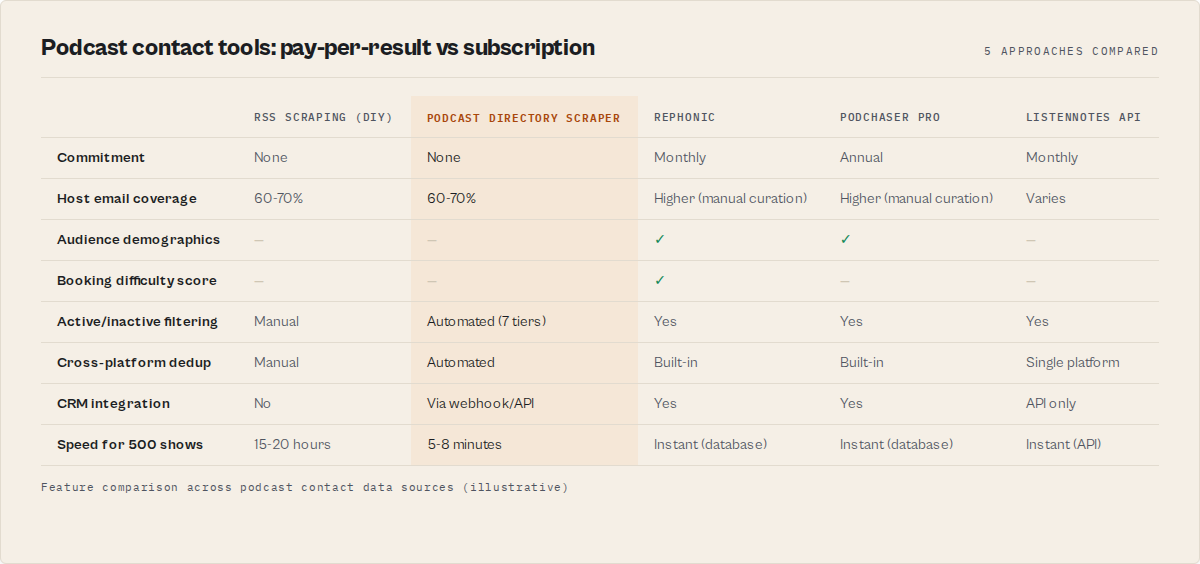
There are 5 main approaches to building podcast contact lists, each with different cost structures, data quality, and audience insight depth. The right choice depends on whether you need just contact data or full audience analytics.
| Feature | RSS Scraping (DIY) | Podcast Directory Scraper | Rephonic | Podchaser Pro | ListenNotes API |
|---|---|---|---|---|---|
| Cost for 5,000 shows | Free (time cost) | ~$250 one-time | $249/mo | ~$5,000/yr | $249/mo |
| Commitment | None | None | Monthly | Annual | Monthly |
| Host email coverage | 60-70% | 60-70% | Higher (manual curation) | Higher (manual curation) | Varies |
| Audience demographics | No | No | Yes | Yes | No |
| Booking difficulty score | No | No | Yes | No | No |
| Active/inactive filtering | Manual | Automated (7 tiers) | Yes | Yes | Yes |
| Cross-platform dedup | Manual | Automated | Built-in | Built-in | Single platform |
| CRM integration | No | Via webhook/API | Yes | Yes | API only |
| Speed for 500 shows | 15-20 hours | 5-8 minutes | Instant (database) | Instant (database) | Instant (API) |
| Data freshness | Real-time RSS | Real-time RSS | Updated periodically | Updated periodically | Updated periodically |
Pricing and features based on publicly available information as of April 2026 and may change.
1. Manual RSS parsing (free, doesn't scale)
Open each podcast's Apple listing, view source, find feedUrl, open RSS XML, search for itunes:email. Works for 10-20 shows. Unworkable for campaigns. Best for: one-off research when you need a single host's email.
2. Automated RSS scraping tools (pay-per-result) Tools like the Podcast Directory Scraper on Apify automate the entire RSS parsing pipeline — search, fetch, parse, deduplicate, export. You pay per podcast extracted, not per month. Best for: campaign-based agencies scraping 500-5,000 shows at a time.
3. Rephonic ($99-299/month) A curated podcast database with audience demographics, listener overlap analysis, and booking difficulty scores. Rephonic's pricing page shows three tiers — Light at $99/mo, Standard at $149/mo, Business at $299/mo. Best for: agencies that need audience analytics alongside contact data and run campaigns every month.
4. Podchaser Pro (~$5,000/year) Enterprise-grade podcast database with reach estimates, audience demographics, and media monitoring. Requires annual commitment. Podchaser's own pricing comparison explains the premium as including "manual curation and demographic data." Best for: large PR firms managing ongoing podcast campaigns across multiple clients.
5. ListenNotes API ($67-249/month) Developer-focused podcast API with search, filtering, and metadata access. ListenNotes' pricing page shows tiered plans based on API request volume. Emails are included only when available in feed metadata. Best for: developers building custom podcast tools or integrations.
Each approach has trade-offs in cost, data depth, and commitment length. The right choice depends on campaign frequency, budget, and whether you need audience analytics or just contact data.
Best practices for podcast outreach lists
-
Filter by publishing frequency before exporting. A podcast that hasn't released an episode in 4+ months almost certainly isn't booking guests. Use frequency tiers (weekly, bi-weekly, monthly) to eliminate dormant shows. In observed scraping runs, roughly 15-20% of keyword-matched results are inactive.
-
Deduplicate across platforms before outreach. Many podcasts list on both Apple Podcasts and Spotify. Without cross-platform deduplication, you'll pitch the same host twice from different email threads. Observed duplication rates run 20-30% for popular keywords like "marketing" or "entrepreneurship" (based on internal testing, April 2026, n=2,300 podcasts).
-
Validate emails before sending. RSS
<itunes:email>fields are entered by podcast owners and sometimes contain outdated or placeholder addresses. Run extracted emails through a verification service — expect 8-15% bounce rates on unverified lists, based on ZeroBounce's 2025 email quality report. -
Segment by genre for personalized outreach. Business, technology, and marketing podcasts have higher email coverage (60-70%) than entertainment categories (40-50%). Segment your list by genre and write category-specific pitch templates.
-
Use the website URL as a fallback. When a podcast's RSS feed lacks an
<itunes:email>, the website URL often leads to a contact page or booking form. Tools like the Website Contact Scraper can pull emails, phone numbers, and social links from those pages automatically. -
Check episode count as a quality signal. Shows with fewer than 10 episodes may be too new to have established booking processes. Shows with 100+ episodes are more likely to have streamlined guest intake — and higher expectations for guest quality.
-
Export in the format your CRM expects. If your team uses HubSpot or a spreadsheet, export as CSV. If you're feeding data into an API pipeline, use JSON. Reformatting wastes time that could go toward pitching.
Common mistakes when building podcast contact lists
Pitching dormant shows. The single most common waste of outreach effort. A show that published its last episode 8 months ago isn't coming back for your client. Always check the lastEpisodeDate field or publishing frequency classification.
Ignoring cross-platform duplicates. If you scrape "content marketing" on both Apple Podcasts and Spotify without deduplication, you'll get the same show twice under slightly different metadata. Sending duplicate pitches makes your agency look careless.
Treating RSS emails as the only contact path. Some hosts prefer booking through their website contact form or a specific booking platform like PodMatch. If the RSS email bounces, check the podcast's website for a dedicated guest submission page.
Scraping without keyword strategy. Searching "business" returns thousands of marginally relevant shows. Use specific compound keywords like "SaaS founder interviews" or "healthcare leadership podcast" to get shows that actually match your client's niche.
Skipping the "is this show booking guests?" check. Solo shows, news roundups, and scripted series don't book outside guests. Check episode titles and descriptions for guest names before pitching — it takes 30 seconds per show and saves your reputation.
Not verifying email deliverability. Sending 2,000 emails to unverified addresses tanks your sender reputation. Services like ZeroBounce or NeverBounce cost a few dollars per thousand and prevent domain blacklisting.
How much does podcast outreach list building actually cost?
The total cost of building a podcast contact list ranges from $0 (manual RSS parsing) to $7,188/year (Podchaser Pro plus email verification), depending on volume, frequency, and whether you need audience analytics beyond basic contact data.
Here's what a typical 5,000-show campaign costs across approaches:
| Approach | Contact Extraction | Email Verification | Total | Commitment |
|---|---|---|---|---|
| Manual RSS parsing | $0 (80+ hours labor) | $15 (ZeroBounce) | $15 + labor | None |
| Podcast Directory Scraper | $250 | $15 | $265 | None |
| Rephonic Business | $299/mo | Included | $299/mo | Monthly |
| Podchaser Pro | ~$417/mo ($5,000/yr) | Included | ~$417/mo | Annual |
| ListenNotes Pro | $249/mo | $15 | $264/mo | Monthly |
For agencies running 2-3 campaigns per year, the subscription math doesn't work. You'd pay $2,988-7,188 annually for tools you use 4-6 weeks total. Pay-per-result pricing — where you spend $250-500 across those campaigns and nothing between them — is what agencies with irregular workloads actually need. ApifyForge lists multiple actors that follow this pay-per-event model for lead generation workflows.
ApifyForge's cost calculator can model exact costs based on your expected volume and campaign frequency.
Who is actually using RSS-based podcast scrapers?
Based on observed usage of the Podcast Directory Scraper Apify actor listed on ApifyForge in its first 72 hours: three paying users scraped approximately 2,300 podcasts each, generating $350 in total revenue (observed April 2026, n=3 users, first 72 hours post-launch). The scraping patterns — 2,000-5,000 shows per run, keyword clusters around business niches — are consistent with podcast booking agencies or PR firms building campaign-specific outreach lists.
There's a second buyer profile emerging: brands prospecting for podcast sponsorship and advertising. If you're buying ad slots on podcasts, you need to qualify shows before spending. The episodeFrequency and isActive fields act as proxy signals for audience consistency — a show publishing weekly for 2+ years with 150+ episodes has a loyal listener base, while a sporadic show with 12 episodes is a gamble. Scraping 1,000 shows in your target niche, filtering for weekly+ frequency and 50+ episodes, then sorting by category gives you a qualified sponsorship shortlist in minutes — without paying a podcast ad network's 30-50% markup to do the same research for you.
Before: A podcast booking agency manually researches 200 shows per week. One team member spends 15-20 hours copying RSS emails, checking active status, and deduplicating across platforms. Cost: roughly $500-700/week in labor (at $30-35/hr for a research assistant).
After: The same agency runs 5 keyword searches through an automated RSS scraper, gets 2,000+ deduplicated contacts with emails, frequency data, and active status in under 10 minutes. Cost: $100 for the scrape plus $6 for email verification. Total: $106 vs. $2,000-2,800/month in labor.
That's not a small difference. It's the difference between podcast outreach being a profitable service and a money-losing one. These numbers reflect one agency's use case — results will vary depending on keyword specificity, niche email coverage rates, and outreach volume.
Implementation checklist
- Define your keyword list. Start with 3-5 specific compound phrases that match your client's niche. "B2B SaaS interviews" is better than "business."
- Choose your scraping method. For under 50 shows, manual RSS parsing works. For 200+, use an automated tool like the Podcast Directory Scraper or build your own RSS parser.
- Run the extraction across both platforms. Apple Podcasts and Spotify have different indexes. Scraping both gives broader coverage — expect 20-30% overlap.
- Deduplicate results. Match on podcast name + host name to remove cross-platform duplicates. Automated tools handle this; manual lists need a VLOOKUP pass.
- Filter by publishing frequency. Remove anything classified as "dormant" or "sporadic" — these shows aren't actively booking.
- Verify emails. Run extracted emails through ZeroBounce, NeverBounce, or a similar service. Budget $3-5 per 1,000 addresses.
- Enrich missing contacts. For shows without RSS emails, use the website URL to find contact pages. The Email Pattern Finder can discover email formats for podcast production companies. For higher coverage, Waterfall Contact Enrichment chains multiple data sources to fill gaps.
- Export and segment. Split your list by genre, episode count, and frequency. Write segment-specific pitch templates.
- Track responses. Tag each contact with the source keyword and platform so you can measure which segments convert best.
Limitations of RSS-based email extraction
Not every RSS feed contains a valid email. Roughly 30-40% of podcasts in entertainment and lifestyle categories use placeholder addresses, hosting platform defaults (like [email protected]), or omit the <itunes:email> field entirely. Business and technology categories have better coverage (60-70%), but it's never 100%.
No audience demographics. RSS feeds contain metadata about the show — not the audience. If you need listener counts, demographics, or geographic distribution, you need a platform like Rephonic or Podchaser that models audience data from multiple signals.
Email freshness isn't guaranteed. A podcast owner might have changed their email since submitting to Apple Podcasts. RSS feeds update when the owner pushes a new episode with updated metadata, but many never touch their <itunes:owner> tag after initial submission.
Rate limiting on directory APIs. Apple Podcasts and Spotify search APIs have undocumented rate limits. Aggressive scraping can trigger temporary blocks. Observed safe rates are roughly 50-100 requests per minute (based on internal testing, April 2026).
Cross-platform deduplication isn't perfect. Podcast names vary slightly between platforms ("The SaaS Show" vs "SaaS Show"), and host names may be formatted differently. Automated deduplication catches 85-90% of duplicates; manual review catches the rest.
Key facts about podcast host email extraction
- Apple Podcasts indexes over 4.2 million podcasts, each with an RSS feed containing structured metadata including the
<itunes:owner>email tag (Listen Notes, 2025) - Direct podcast host emails produce roughly 23% response rates vs. 4% for generic contact forms (Podseeker, 2025)
- The
<itunes:email>field is a required part of Apple's RSS podcast specification, making it the most standardized source of host contact data (Apple Podcasts Requirements) - Observed email coverage from RSS extraction is 60-70% for business and technology podcasts, dropping to 40-50% for entertainment categories (observed April 2026, n=6,900 podcasts)
- Cross-platform duplication between Apple Podcasts and Spotify runs 20-30% for common business keywords (observed April 2026, internal testing)
- Email bounce rates on unverified RSS-extracted addresses are typically 8-15% (ZeroBounce, 2025)
- The Podcast Directory Scraper Apify actor processes 50 podcasts in 30-60 seconds and 500 podcasts across 5 keywords in 5-8 minutes
Glossary of key terms
<itunes:owner> — An XML tag in podcast RSS feeds that contains the podcast owner's name and email address, used by Apple Podcasts for account verification and communication.
Publishing frequency tier — A classification system (daily, semi-weekly, weekly, bi-weekly, monthly, sporadic, dormant) that categorizes how often a podcast releases new episodes, used to filter active shows from inactive ones.
Cross-platform deduplication — The process of matching podcast records across multiple directories (Apple Podcasts, Spotify) to remove duplicate listings of the same show.
Pay-per-event (PPE) pricing — A billing model where you pay only for successful results (e.g., $0.05 per podcast extracted) instead of a monthly subscription. ApifyForge covers how PPE pricing works in detail.
RSS feed — Really Simple Syndication, an XML-based format that podcasters use to distribute episode metadata to directories. Contains structured fields for show title, description, owner contact info, and episode data.
Podcast booking agency — A service business that pitches clients as guests on relevant podcasts, handling research, outreach, scheduling, and prep. Typically charges $2,000-5,000/month per client.
Where these patterns apply beyond podcast outreach
The underlying approach — extracting structured contact data from public metadata feeds instead of paying for curated databases — applies well beyond podcasting:
- YouTube channel outreach: Creator emails are in channel "About" pages, extractable in bulk with scrapers like the Website Contact Scraper
- Newsletter sponsorship sales: Publication contact data lives in RSS feeds and about pages, following the same XML parsing approach
- Conference speaker outreach: Speaker bios on event websites contain structured contact data that can be scraped and enriched
- App developer outreach: App store listings include developer contact emails, accessible through store APIs
- Blog outreach for link building: Author pages and contact pages on blogs follow predictable URL patterns, making them targets for automated contact scraping
The principle is the same: public metadata feeds contain structured contact data that subscription databases repackage and mark up. If you can parse the source, you don't need the middleman. ApifyForge's lead generation actors follow this pattern across multiple verticals — podcasts, Google Maps, company websites, and more.
When you need podcast host email extraction
You probably need this if:
- You run a podcast booking agency and build new outreach lists for each client
- You're a PR firm adding podcast pitching as a service line
- You broker podcast sponsorships and need to contact show owners directly
- You scrape 500-5,000 podcasts per campaign, not 50
- You run campaigns sporadically (quarterly or less) and can't justify monthly subscriptions
- Your budget is per-campaign, not per-month
You probably don't need this if:
- You need audience demographics and listener overlap analysis — use Rephonic or Podchaser
- You pitch fewer than 50 shows per campaign — manual research is fine
- You run weekly campaigns and need always-on database access — a subscription makes more sense
- You need a CRM with built-in podcast relationship management — Podseeker or Rephonic offer this
- You need booking difficulty scores or response rate predictions — these require curated platforms, not raw RSS data
Frequently asked questions
How do you find a podcast host's email address?
The most direct method is extracting the email from the podcast's RSS feed <itunes:owner> tag. Apple requires this field for podcast submission. You can find the RSS URL by viewing the page source of an Apple Podcasts listing and searching for "feedUrl", then opening the RSS XML and searching for "itunes:email". Automated tools like the Podcast Directory Scraper on Apify do this in bulk across thousands of shows.
Is it legal to scrape podcast emails from RSS feeds?
RSS feeds are public, machine-readable data that podcasters voluntarily publish for distribution. The <itunes:email> field is part of a public specification. However, sending bulk unsolicited email is governed by CAN-SPAM (US), GDPR (EU), and CASL (Canada). Scraping the data is generally permissible; what you do with it must comply with anti-spam laws. Consult your legal team for your specific jurisdiction.
What percentage of podcasts have host emails in their RSS feed?
Based on observed extraction runs across 6,900 podcasts (April 2026), roughly 60-70% of active shows in business, technology, marketing, health, and education categories have a valid <itunes:email> in their RSS feed. Entertainment and comedy categories drop to 40-50%. Podcasts hosted on platforms like Anchor (now Spotify for Podcasters) sometimes use platform-generated placeholder emails.
How is RSS email extraction different from Podchaser or Rephonic?
RSS extraction pulls raw contact data directly from podcast feeds in real time — you get the email the owner actually entered. Podchaser and Rephonic maintain curated databases with additional data layers like audience demographics, reach estimates, and booking difficulty. RSS extraction is cheaper and has no subscription, but doesn't include analytics. The comparison table above breaks down the differences across 10 dimensions.
Can you scrape both Apple Podcasts and Spotify at once?
Yes. Both platforms have searchable indexes, and both reference RSS feeds that contain <itunes:owner> data. The key is cross-deduplication — many shows are listed on both platforms, and without matching you'll contact the same host twice. Automated tools handle deduplication by matching on podcast name and host name.
How long does it take to scrape 1,000 podcast contacts?
With automated tools, roughly 2-4 minutes for 1,000 podcasts including RSS parsing and deduplication. Manual extraction takes 2-3 minutes per show, so 1,000 shows would require approximately 33-50 hours of manual work. The Podcast Directory Scraper Apify actor processes 50 podcasts in 30-60 seconds.
What should I do when a podcast's RSS feed doesn't have an email?
Use the podcast's website URL (also extracted from RSS metadata) to find a contact page. The Website Contact Scraper automates this across hundreds of sites. If the website also lacks contact info, try the Email Pattern Finder with the host's name and the podcast's domain to discover likely email addresses. You can also check for social media DMs or booking platforms like PodMatch.
Why do booking agencies prefer pay-per-result over subscriptions?
Podcast booking agencies run campaign-based businesses — they build a list for a client, pitch for 2-4 weeks, then move to the next client. Paying $299/month for Rephonic during the 10 months you're not actively scraping is dead cost. Pay-per-event pricing means you spend $100-250 per campaign and $0 between campaigns. For agencies running 3-4 campaigns per year, that's $400-1,000 vs. $3,588-5,000 on annual subscriptions.
Ryan Clinton publishes Apify actors as ryanclinton and builds developer tools at ApifyForge.
Last updated: April 2026
This guide focuses on podcast directory scraping and RSS-based email extraction, but the same patterns — parsing structured metadata from public feeds instead of paying for curated databases — apply broadly to any outreach workflow where contact data is embedded in public, machine-readable formats.