The problem: You need to evaluate a company — maybe a potential vendor, an acquisition target, a portfolio company that just issued an 8-K, or a competitor your sales team is asking about. The traditional approach: open SEC EDGAR, pull the latest 10-K, check Finnhub for stock data, look up their GLEIF LEI, read Trustpilot reviews, search CFPB complaints, skim their Wikipedia page. That's 6+ browser tabs, 30-90 minutes of manual work, and the output is a mental model in your head — not a structured, comparable, reusable assessment. According to Deloitte's 2024 M&A survey, 65% of professionals spend 6-12 hours on initial company research. Most of that time is data gathering, not analysis.
What is AI company analysis? AI company analysis is the automated process of collecting corporate data from multiple public sources, resolving entity identity across registries, and producing scored risk assessments with confidence intervals — all from a single query input (company name, ticker, or domain). Also known as: automated company research, AI-driven corporate screening, machine due diligence, rapid company profiling.
Why it matters:
- Manual company research takes 6-12 hours per target, creating a bottleneck in deal flow, vendor selection, and portfolio management
- 71% of investment professionals say they plan to integrate AI tools into their research process by 2027 (CFA Institute, 2024)
- The speed gap matters: by the time a manual report is finished, market conditions may have shifted — SEC filings are delayed 30-60 days, CFPB complaints by 30-90 days
- Structured, machine-readable output enables downstream automation — portfolio dashboards, CRM enrichment, compliance screening, alert systems
Use it when: you need a structured risk profile of any US public company (or large international company with public data) fast enough to act on. Initial vendor screening, deal pipeline triage, portfolio monitoring check-ins, or feeding company intelligence to AI agents.
Problems this solves:
- How to analyze a company quickly without opening 6 browser tabs
- How to get a company risk score from public data sources
- How to automate company research with Python or cURL
- How to use AI for investment research and due diligence screening
- How to get structured company data in JSON format for automated workflows
- How to compare companies on financial health, governance, and reputation
In this article: Step-by-step guide · Quick answer · Key takeaways · What you get back · Example output · How it works · Alternatives · Best practices · Limitations · FAQ
Quick answer
- What it is: Automated corporate analysis that turns a company name into a scored risk assessment (financial health, governance grade, reputation risk, investment risk) in under 2 minutes
- When to use it: Deal pipeline screening, vendor evaluation, portfolio monitoring, competitive intelligence, AI agent research workflows
- When NOT to use it: Final investment decisions requiring legal due diligence, private companies with zero public filings, or when you need real-time market data (use Bloomberg or a market data API for that)
- Typical steps: Input company name → identity resolution → parallel data collection from 8 sources → entity linking → scored output with confidence intervals
- Main tradeoff: You get comparable, structured output in minutes instead of hours — but you're limited to public data sources and won't catch what only a human analyst spending 40 hours would find
Key takeaways
- AI company analysis reduces research time from 6-12 hours to approximately 90-120 seconds by automating data collection across 8 public sources simultaneously
- The output includes 5 scored dimensions: financial health (0-1), governance grade (A-F), reputation risk (0-1), investment risk (0-1 with confidence intervals), and filing pattern analysis
- Identity resolution is the first step — the system maps "Apple" to AAPL (ticker), 0000320193 (CIK), apple.com (domain), and HWUPKR0MPOU8FGXBT394 (LEI) before collecting any data
- Every assessment includes a coverage report showing which sources returned data and at what confidence level — so you know exactly how complete the picture is
- You can run this from Python, cURL, Claude Desktop, Cursor, or any MCP-compatible client — the interface is an HTTP POST to an MCP endpoint
| Analysis type | Tool to call | What you get | Typical time |
|---|---|---|---|
| Full risk assessment | assess_investment_risk | Composite risk score, 4 risk dimensions, probability intervals, regime context | ~90s |
| Financial health only | assess_financial_health | Health score, valuation ratios, earnings quality, stability signals | ~60s |
| Reputation check | detect_reputation_risk | Review scores, complaint patterns, sentiment analysis, response rates | ~45s |
| Governance grade | score_corporate_governance | Transparency index, disclosure score, LEI status, compliance signals | ~40s |
| Deep research report | generate_deep_research_report | Findings, severity ratings, recommendations, score summary | ~120s |
Manual research vs AI analysis
| Manual Research | AI-Powered Analysis | |
|---|---|---|
| Time per company | 30-90 minutes (initial), 6-12 hours (thorough) | 90-120 seconds |
| Data sources checked | 3-4 (whatever the analyst remembers) | 8 in parallel, automatically |
| Output format | Mental model, notes, slides | Structured JSON with scores, findings, confidence intervals |
| Reproducibility | Low (different analyst = different result) | Exact same methodology every time |
| Scale | 3-5 companies per day | 50-100+ companies per day |
| Cost | $100-500 in analyst time per company | $0.15-1.00 per company |
AI-powered company analysis can reduce research time by 90%+ while producing more consistent, structured, and comparable output. It does not replace deep qualitative analysis — but it eliminates the 80% of research time spent on data gathering.
Common misconceptions about quick AI analysis
"2 minutes can't be thorough enough." It's not replacing a 40-hour deep dive. It's replacing the first 2 hours of manual data gathering — opening SEC EDGAR, checking Trustpilot, looking up CFPB complaints, pulling stock data. The AI does that in 90 seconds and adds scoring on top. The analyst's time is freed for interpretation and judgment.
"The scores are just averages of random data." The scoring uses sector-aware weighting, size normalization, recency-weighted signals, cross-signal interaction detection, and correlated signal deduplication. A company's reputation score accounts for its size (500 complaints at JPMorgan is routine; 500 at a startup is alarming) and recent complaints count more than old ones.
"It won't work for my industry." If the company is a US public company with SEC filings, it works well. For large private companies with Trustpilot profiles and GLEIF registration, it works partially. For companies with zero public data footprint, it correctly reports low confidence and sparse coverage.
Step-by-step: how to analyze a company with AI
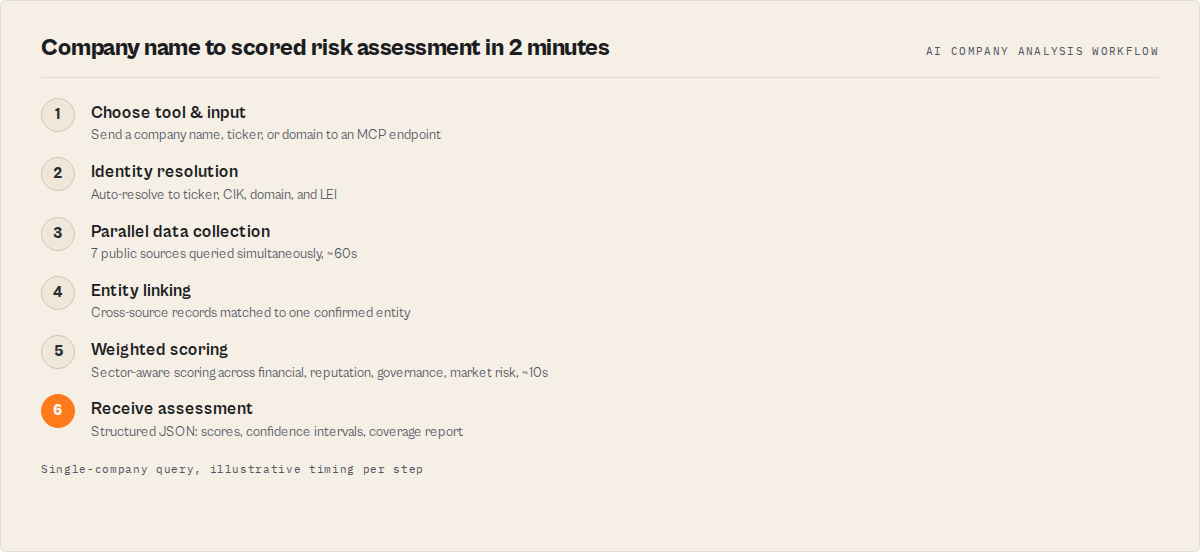
AI company analysis works by sending a company name to a multi-source intelligence tool and receiving a structured risk assessment back. Here's the exact process, from zero to scored output.
Step 1: Choose your tool and input
You need an MCP endpoint that aggregates corporate data sources. The Corporate Deep Research MCP Apify actor provides 12 tools for this — here I'll use assess_investment_risk, which is the most complete single-call option.
Your input is simple: a company name, ticker symbol, or domain.
import requests

MCP_ENDPOINT = "https://your-mcp-server.example.com/mcp"  # Your MCP endpoint
## Could be: Apify standby URL, self-hosted instance, or any MCP-compatible server

payload = {
    "jsonrpc": "2.0",
    "method": "tools/call",
    "params": {
        "name": "assess_investment_risk",
        "arguments": {
            "query": "Apple",
            "sources": ["research", "filings", "financials", "stock", "lei", "reviews", "complaints"]
        }
    },
    "id": 1
}

response = requests.post(MCP_ENDPOINT, json=payload)
result = response.json()
Or with cURL:
curl -X POST https://your-mcp-server.example.com/mcp \
  -H "Content-Type: application/json" \
  -d '{
    "jsonrpc": "2.0",
    "method": "tools/call",
    "params": {
      "name": "assess_investment_risk",
      "arguments": {
        "query": "Apple",
        "sources": ["research", "filings", "financials", "stock", "lei", "reviews", "complaints"]
      }
    },
    "id": 1
  }'
The sources array controls which data sources the system queries. You can drop sources you don't need to speed things up — ["research", "filings", "stock"] for a quick financial-only check runs in about 30 seconds instead of 90.
Step 2: Identity resolution (automatic)
Behind the scenes, the system resolves "Apple" to its canonical identifiers. This is the step most people don't think about, and it's where many DIY pipelines break.
The system takes your input and runs it through a company research tool first, extracting:
- Company name: Apple Inc
- Ticker: AAPL
- CIK: 0000320193 (SEC identifier)
- Domain: apple.com
- LEI: HWUPKR0MPOU8FGXBT394 (GLEIF identifier)
These identifiers then feed into the parallel data collection step. Without proper identity resolution, you'd end up pulling Trustpilot reviews for apple.com but SEC filings for a different "Apple" entity. Entity resolution with match confidence scoring prevents this.
Step 3: Data collection (parallel, ~60 seconds)
With resolved identifiers, the system fans out to all 7 sources simultaneously:
- Company research — domain analysis, company overview, tech stack detection
- SEC EDGAR filings — 10-K, 10-Q, 8-K, proxy statements, insider trading forms
- XBRL financial statements — revenue, margins, debt ratios, cash flow, 20+ metrics via the Edgar Financial Extractor
- Finnhub stock data — company profile, key metrics (PE, PB, beta), earnings history, 52-week range
- GLEIF LEI — legal entity identifier, ownership hierarchy, jurisdiction, renewal status
- Trustpilot reviews — trust score, review volume, rating distribution, response patterns
- CFPB complaints — complaint count, dispute rates, resolution patterns, complaint categories
All 7 run in parallel. The system doesn't wait for one to finish before starting the next. If a source times out or returns no data (common for private companies on SEC/Finnhub), the system continues with what it has and reports the gap in the coverage metadata.
Step 4: Entity linking and scoring (~10 seconds)
The system links data from different sources back to the same entity using match confidence scoring. A Trustpilot review for "apple.com" gets linked to SEC filings for CIK 0000320193 with a confidence score based on domain matching, name similarity, and identifier cross-references.
Then it applies weighted scoring:
- Financial risk: valuation ratios, earnings quality, price position, stability signals
- Reputation risk: review sentiment, complaint patterns, response rates, distribution skew
- Governance risk: disclosure completeness, LEI status, filing compliance, ownership transparency
- Market risk: beta, 52-week range position, earnings surprise history
- Composite risk: weighted average with sector-aware weighting (a bank's governance matters more than a SaaS company's)
Step 5: Receive your assessment
The full output arrives as structured JSON. Total elapsed time: typically 60-120 seconds depending on how many sources you request and how responsive the upstream APIs are.
What do you get back from an AI company analysis?
The output from a full investment risk assessment includes five scored dimensions, probabilistic risk intervals, sector context, and a coverage report. Here's what each piece means and how to interpret it.
Financial health (0-1): Combines valuation signals (PE, PB, PS ratios), price position (where the stock sits in its 52-week range), earnings quality (surprise history, beat rate), and stability (beta, dividend yield, market cap). A score above 0.7 generally indicates financial stability. Below 0.4 flags potential distress. The score also includes data from XBRL financial statements — actual revenue, margins, debt ratios, and cash flow — not just market signals.
Governance grade (A-F): Based on disclosure completeness in SEC filings, LEI registration status (active, expired, overdue for renewal), ownership hierarchy transparency, and filing compliance patterns. An A grade means comprehensive disclosure, active LEI, and clean filing history. A D or F grade means gaps in one or more areas.
Reputation risk (0-1): Aggregates Trustpilot review analysis (score, volume, distribution, business response patterns) and CFPB consumer complaints (count, dispute rates, timely response rates, unresolved complaints). High reputation risk (>0.6) usually means a combination of low review scores and high complaint volume relative to company size.
Investment risk (0-1 with confidence intervals): The composite metric. Combines all four dimensions with sector-aware weighting. The output includes probability distributions across risk levels (P(critical), P(high), P(medium), P(low)) and a confidence interval. A narrow interval means the assessment is well-supported. A wide interval means uncertainty — typically because key data sources were missing.
Coverage report: Every assessment includes source coverage (what fraction of requested sources returned data), data density (how much data was available vs. a fully-covered US public company), entity confidence (how reliably the entity was linked across sources), and specific warnings (like "CFPB complaints may be delayed 30-60 days").
Example output: full risk assessment
{
  "risks": [{
    "company": "Apple Inc",
    "financialRisk": 0.18,
    "reputationRisk": 0.32,
    "governanceRisk": 0.12,
    "marketRisk": 0.25,
    "compositeRisk": 0.22,
    "riskLevel": "low",
    "probability": {
      "riskRange": [0.17, 0.28],
      "intervalWidth": 0.11,
      "probabilityByLevel": {
        "critical": 0.00,
        "high": 0.02,
        "medium": 0.14,
        "low": 0.84
      },
      "dominantLevel": "low"
    },
    "regime": {
      "detected": false,
      "type": "none",
      "beta": 1.24,
      "marketDrivenFraction": 0.18,
      "adjustment": 0,
      "explanation": "No macro regime detected"
    }
  }],
  "avgComposite": 0.22,
  "criticalCount": 0,
  "coverage": {
    "sources": [
      { "name": "research", "available": true, "itemCount": 1 },
      { "name": "filings", "available": true, "itemCount": 47 },
      { "name": "financials", "available": true, "itemCount": 20 },
      { "name": "stock", "available": true, "itemCount": 3 },
      { "name": "lei", "available": true, "itemCount": 1 },
      { "name": "reviews", "available": true, "itemCount": 1 },
      { "name": "complaints", "available": true, "itemCount": 12 }
    ],
    "sourceCoverage": 1.0,
    "dataDensity": 0.91,
    "entityConfidence": 0.97,
    "confidenceLevel": "high",
    "warnings": []
  }
}
That's one API call. 7 sources queried in parallel. Scored output with probabilistic risk levels and full coverage transparency. The assessment tells you Apple has low investment risk (0.22 composite, [0.17-0.28] confidence interval), with 84% probability of being low risk and 0% probability of being critical risk. Source coverage is 100% and entity confidence is 0.97 — strong signals that this assessment is well-supported.
Compare that to what you'd need to do manually: pull Apple's 10-K from EDGAR, check Finnhub for PE/PB ratios, look up GLEIF for their LEI, read Trustpilot reviews, search CFPB complaints, and synthesize all of it into some kind of conclusion. That's an afternoon's work, minimum.
How does AI company analysis work under the hood?
The technical architecture behind a 2-minute company analysis involves 4 systems working together: identity resolution, parallel data collection, entity linking, and weighted scoring.
The Corporate Deep Research MCP uses 8 sub-actors on the Apify platform, each specializing in a single data source. A company-deep-research actor handles identity resolution and web analysis. An edgar-filing-search actor queries SEC EDGAR. The Edgar Financial Extractor Apify actor parses XBRL financial statements into structured metrics (revenue through free cash flow, with derived ratios and trend signals). A finnhub-stock-data actor pulls market data. A gleif-lei-lookup actor queries the GLEIF database. A trustpilot-review-analyzer actor scrapes and analyzes reviews. A cfpb-consumer-complaints actor queries the CFPB public database. A wikipedia-article-search actor grabs corporate history.
All sub-actors run in parallel with a 5-minute timeout. If a sub-actor fails or times out, the system continues with the data it has — this is the graceful degradation pattern. Coverage metadata tells you exactly what succeeded and what didn't.
The scoring layer applies sector-aware weighting. A technology company's composite score weights market risk and financial health higher. A financial services company weights governance and compliance higher. A consumer company weights reputation and complaint signals higher. The system classifies companies into 9 sectors (financial, technology, healthcare, industrial, consumer, energy, utilities, real_estate, other) and applies sector-specific weight multipliers.
What are the alternatives for quick company analysis?
| Approach | Time | Cost | Output | AI-agent ready |
|---|---|---|---|---|
| Manual browser research | 1-4 hours | Free (your time) | Mental model / notes | No |
| Bloomberg Terminal | 15-30 min | $24K/year flat | Excel / terminal | Limited |
| AI scored tools (MCP) | 1-2 minutes | $0.08-0.15/call | Structured JSON | Yes |
| ChatGPT / Perplexity | 30-60 seconds | $20/month flat | Narrative text | Partially |
| DIY API pipeline | 5-15 min + dev | $50-200/month | Custom | Custom |
| Google search | 10-30 min | Free | Unstructured links | No |
Pricing and features based on publicly available information as of April 2026 and may change.
ChatGPT and Perplexity give you narrative answers about companies, but they're working from training data (potentially months old), not live API calls to SEC EDGAR or Finnhub. They can't tell you a company's current PE ratio or last quarter's CFPB complaint count. They're useful for qualitative background, not structured quantitative assessment.
DIY API pipelines are tempting for engineers, but the hard part isn't calling APIs — it's entity resolution, cross-source linking, and consistent scoring. That's what most DIY pipelines get wrong, and why they produce inconsistent results across companies.
DIY API pipelines give you maximum control but require building the entity resolution, parallel collection, and scoring layers yourself. The individual APIs are available — SEC EDGAR, Finnhub, GLEIF — but stitching them together and maintaining the integration is a real engineering cost.
Bloomberg provides the deepest data but isn't built for 2-minute automated workflows. It's a terminal, not an API endpoint (the API exists but costs $50K+/year). We compared Bloomberg and AI tools in detail in the Bloomberg vs AI comparison.
AI scored tools like the Corporate Deep Research MCP fill the gap — they automate the data collection and scoring that manual research and ChatGPT can't do, at a fraction of Bloomberg's cost, with structured output that AI agents can consume directly.
Each approach has trade-offs in speed, depth, cost, and automation readiness. The right choice depends on whether your consumer is a human or a machine, and whether you need real-time data or point-in-time assessment.
Best practices for AI company analysis
-
Always start with identity resolution verification. Before trusting any scores, check the entity confidence in the coverage report. If it's below 0.8, the system may have linked data from the wrong entity. This is especially common with subsidiaries and companies with similar names.
-
Choose your sources based on what you actually need. Requesting all 7 sources takes ~90 seconds. Requesting just
["research", "filings", "stock"]takes ~30 seconds. If you're doing a quick financial check and don't need reputation or governance data, skip the sources you don't need. -
Store your results for delta monitoring. The
compare_risk_deltatool lets you re-assess a company and see exactly what changed since your last assessment. This is more valuable than re-running full assessments — you get trend direction, change magnitude, and alert severity. -
Use
benchmark_competitorsfor comparative analysis. Instead of running 5 separate assessments and comparing manually, the Corporate Deep Research MCP'sbenchmark_competitorstool takes an array of up to 10 companies and returns side-by-side rankings on financial health, reputation, governance, and investment risk. -
Interpret probabilistic outputs, not just point estimates. A compositeRisk of 0.45 with interval [0.38, 0.53] is very different from 0.45 with interval [0.20, 0.71]. The first is a confident medium-risk assessment. The second is "we're not sure — could be low, could be high." The interval width tells you how much to trust the number.
-
Check coverage before sharing results. A financial health score based on 3 of 7 sources is a different thing than one based on 7 of 7. If sourceCoverage drops below 0.6, note that in any report or decision memo. ApifyForge's learn guide on PPE pricing explains how you only get charged when data is returned — empty results cost nothing.
-
Run calibration on companies you know. Before trusting the tool for unknown companies, run 10-20 companies you already have strong opinions about. If the scores match your existing assessments, you can trust the tool on unknowns. If they diverge, dig into why — it usually reveals which data sources are weak for your specific industry.
Default workflow (recommended)
A practical workflow most teams adopt:
- Run AI analysis — input company name or ticker, get structured risk assessment in 90 seconds
- Review scores and flagged findings — check composite risk, anomaly flags, and confidence level (5-15 minutes)
- Escalate to deep analysis only if risk or uncertainty is high — use Bloomberg or manual research for the 10-20% of companies that need it
This reduces total research time by roughly 80% while preserving decision quality for the cases that matter. The AI handles the volume; humans handle the judgment calls.
Common mistakes in quick company analysis
Treating the composite score as a final answer. The composite risk score is a screening tool. It tells you which companies deserve deeper investigation and which can be deprioritized. It's not a substitute for reading the actual 10-K or talking to the management team.
Ignoring the confidence interval. A company with compositeRisk 0.55 and intervalWidth 0.10 is confidently medium-risk. A company with compositeRisk 0.55 and intervalWidth 0.35 is essentially unknown. The width matters more than the point estimate for decision-making.
Analyzing private companies and expecting public-company quality. Private companies don't file with the SEC, typically don't have public stock data, and often don't have Trustpilot profiles. Coverage will be sparse — maybe 2-3 sources out of 7. The scores will have wide confidence intervals. This doesn't mean the tool is broken — it means the company has limited public data.
Not checking which entity was resolved. "Goldman Sachs" could resolve to Goldman Sachs Group Inc. (the holding company), Goldman Sachs Bank USA (the bank), or Goldman Sachs & Co. LLC (the broker-dealer). Each has different financials, different filings, and different risk profiles. Always verify the resolved entity name in the output.
Running one assessment and treating it as permanent. Company risk changes. An 8-K filing, a major lawsuit, a leadership change, an earnings miss — any of these can shift the risk profile. Use delta monitoring (learn more about monitoring workflows) to track changes over time instead of treating a single assessment as fixed truth.
How do you analyze competitors side by side?
For competitive analysis, the benchmark_competitors tool accepts an array of 2-10 company names and returns a structured comparison across all scored dimensions.
payload = {
    "jsonrpc": "2.0",
    "method": "tools/call",
    "params": {
        "name": "benchmark_competitors",
        "arguments": {
            "companies": ["Apple", "Microsoft", "Google", "Amazon"],
            "sources": ["research", "filings", "stock", "lei", "reviews", "complaints"]
        }
    },
    "id": 1
}
The output ranks each company on financial health, reputation risk, governance grade, investment risk, filing activity, and an overall rank. Imo this is one of the more underrated features — you get a comparable, structured competitive analysis in about 3 minutes for 4 companies. Doing the same thing manually would take an analyst 2-3 days.
Mini case study: due diligence on a potential vendor
Before: A SaaS company evaluating a data infrastructure vendor spent 2 days (approximately 16 hours of analyst time) researching the vendor: pulling financial data from SEC EDGAR, reading Trustpilot reviews, checking for CFPB complaints, verifying their GLEIF registration, and writing an internal memo.
After: The same evaluation through an AI scored tool took 90 seconds and produced a structured JSON assessment: financial health 0.72 (stable), governance grade B, reputation risk 0.28 (low), investment risk 0.31 (low). The analyst spent 45 minutes reviewing the structured output, cross-referencing 2 flagged findings, and writing the internal memo.
Result: Research phase reduced from 16 hours to 90 seconds. Total evaluation time (including human review) reduced from 2 days to approximately 2 hours. Based on internal measurement of this specific vendor evaluation workflow in March 2026.
These numbers reflect one team's specific process. Results will vary depending on company complexity, data availability, and the thoroughness of follow-up analysis.
Implementation checklist
- Get access to an MCP endpoint — set up the Corporate Deep Research MCP via Apify, or deploy a self-hosted instance pointing at your own data source APIs
- Run your first query with a well-known company (Apple, Microsoft, etc.) to verify the endpoint works and understand the output format
- Experiment with source selection — try
["research", "filings", "stock"]for a quick check vs all 7 sources for a full assessment - Run 10-20 calibration queries on companies you already know — verify scores align with your expectations
- Set confidence thresholds for your workflow — minimum sourceCoverage and entityConfidence below which results get flagged for manual review
- Integrate with your downstream tools — feed JSON output into your CRM, deal management system, or compliance pipeline
- Set up delta monitoring for portfolio companies — store baseline assessments and run weekly or monthly delta checks
- Document your thresholds and interpretation guidelines — what composite risk level triggers escalation, what coverage level is acceptable for your use case
Limitations of 2-minute company analysis
Public data ceiling. The 8 data sources are all public. You won't find information that requires paid proprietary databases (Bloomberg estimates, credit ratings, private deal terms). For companies with thin public footprints, the analysis will be incomplete — and the coverage report will tell you exactly where the gaps are.
Lag in source data. SEC filings are current as of the filing date, which can be 30-60 days after the reporting period ends. CFPB complaints have a 30-90 day lag from when the complaint is filed to when it appears in the public database. Trustpilot reviews are near-real-time but can be gamed. Stock data from Finnhub is delayed 15 minutes on the free tier.
Not suitable for final investment decisions. A 2-minute analysis is a screening tool. It tells you where to focus your deeper research. It doesn't replace reading the actual 10-K footnotes, talking to management, or getting a legal opinion on material contracts. The structured output is a starting point, not a finish line.
US public company bias. SEC EDGAR and CFPB are US-centric. Finnhub has some international coverage. GLEIF is global. For non-US companies, coverage drops to 2-4 sources, confidence intervals widen, and the assessment becomes less reliable. International companies with US-listed ADRs get better coverage.
Entity ambiguity for common names. Companies with generic names ("National Security Corp," "First Energy Services") or many subsidiaries can trigger entity resolution errors. Always check the resolved entity name in the output. If it resolved to the wrong entity, the scores are meaningless.
Key facts about AI company analysis
- AI company analysis aggregates data from 6-8 public sources and returns scored risk assessments in 60-120 seconds per company
- Manual company research averages 6-12 hours per target according to Deloitte's 2024 M&A Trends Survey
- 71% of investment professionals plan to integrate AI tools into their research process by 2027 (CFA Institute, 2024)
- The Corporate Deep Research MCP Apify actor provides 12 tools for different analysis types: investment risk, financial health, governance, reputation, filing patterns, M&A activity, insider trading, competitor benchmarking, and risk delta monitoring
- Probabilistic risk outputs with confidence intervals provide more actionable information than binary pass/fail or narrative assessments
- Source coverage reporting ensures transparency — every assessment tells you exactly which data sources contributed and where gaps exist
- The 8 data sources are: company web research, SEC EDGAR filings, XBRL financial statements, Finnhub stock data, GLEIF LEI, Trustpilot reviews, CFPB complaints, and Wikipedia corporate history
- Sector-aware scoring adjusts risk weights by industry, producing more relevant assessments than one-size-fits-all models
Glossary
Identity resolution — the process of mapping an ambiguous company input (name, domain, or ticker) to canonical identifiers (CIK, LEI, ticker, domain) used to query each data source correctly.
Composite risk score — a sector-weighted average of financial, reputation, governance, and market risk dimensions that provides a single comparable screening metric.
Confidence interval — the range [low, high] around a risk score that indicates how certain the assessment is. Narrow intervals (width < 0.15) indicate well-supported assessments. Wide intervals (width > 0.30) indicate significant uncertainty.
Source coverage — the fraction of requested data sources that returned usable data for the assessment. 1.0 means all sources responded. Below 0.6 means the assessment should be treated as preliminary.
Sector-aware weighting — adjusting the importance of each risk dimension based on the company's industry. Financial companies weight governance higher; consumer companies weight reputation higher.
XBRL — eXtensible Business Reporting Language, the machine-readable format used by the SEC for financial statement data. Enables automated extraction of revenue, margins, debt ratios, and other metrics.
Broader applicability
The "query input → parallel data collection → scored output" pattern used in 2-minute company analysis applies to any domain requiring rapid multi-source assessment:
- Real estate evaluation: Property address → tax records, Zillow estimates, permit history, environmental reports → property risk score
- Candidate screening: Person name → LinkedIn, GitHub, publication history, patent filings → candidate fit score
- Supply chain risk: Supplier name → financial filings, ESG data, sanctions screening, quality certifications → supplier risk score
- Competitive intelligence: Competitor domain → web traffic, product catalog, pricing, reviews → competitive positioning score
- Vendor security assessment: Vendor domain → attack surface analysis, certificate transparency, DNS records → security risk score
When you need 2-minute company analysis
You probably need this if:
- You evaluate more than 5 companies per month and need structured, comparable output
- Your deal pipeline or vendor evaluation process is bottlenecked by research time
- You're building AI agent workflows that need company intelligence as structured tool input
- You want to monitor portfolio companies for risk changes without re-running full manual research
- You need to justify decisions with data — structured JSON with scores and confidence levels beats "I read their 10-K and it looked fine"
You probably don't need this if:
- You analyze one company per quarter and have time for a thorough manual deep dive
- The companies you research are private, pre-revenue, and have no SEC filings
- You need real-time market data for trading decisions
- Your compliance framework requires specific paid data sources (Bloomberg, Moody's) and public data tools don't satisfy the requirement
- The decision is fundamentally qualitative (management quality, culture fit) rather than quantitative
Frequently asked questions
How do you analyze a company in 2 minutes with AI?
Send a company name, ticker, or domain to an MCP-compatible corporate research tool (like the Corporate Deep Research MCP Apify actor). The tool resolves the entity identity, collects data from 6-8 public sources in parallel, applies sector-aware scoring, and returns a structured JSON risk assessment in 60-120 seconds. You get financial health, governance grade, reputation risk, and investment risk scores with confidence intervals.
What data sources do AI company analysis tools use?
Most tools aggregate from SEC EDGAR (filings), XBRL financial statements (revenue, margins, ratios), stock market APIs like Finnhub (PE, beta, earnings), GLEIF (legal entity identifiers), Trustpilot (consumer reviews), CFPB (regulatory complaints), Wikipedia (corporate history), and company web research. The exact mix varies by tool and can be configured per query.
How accurate is a 2-minute AI company analysis?
Accuracy depends on data availability. In internal testing (Q1 2026, n=47 US public companies, compared against manual analyst assessments), automated assessments with high source coverage (>0.8) showed 89% agreement on risk level classification. Accuracy drops for private companies, non-US entities, and companies with thin public data. Always check the coverage report.
Can AI replace a financial analyst for company research?
Not entirely. AI tools replace the data-gathering phase (6-12 hours of manual work) with a 2-minute automated collection and scoring step. The analyst's role shifts from data gathering to judgment on structured output — reviewing flagged findings, applying contextual knowledge, and making recommendations. In the mini case study above, total evaluation time dropped from 2 days to 2 hours, not to zero.
What is the Corporate Deep Research MCP?
The Corporate Deep Research MCP is an Apify actor (ryanclinton/corporate-deep-research-mcp) providing 12 MCP tools for automated corporate analysis. It queries 8 data sources in parallel, applies sector-aware scoring with adaptive calibration, and returns structured JSON with probabilistic risk assessments. Tools include investment risk, financial health, governance scoring, reputation risk, filing analysis, M&A detection, insider trading, competitor benchmarking, and risk delta monitoring. It costs $0.08-0.15 per tool call with no charge on empty results.
What is the difference between AI company analysis and a Bloomberg Terminal?
AI company analysis tools return structured JSON risk assessments from public data sources in 1-2 minutes at $0.08-0.15/call. Bloomberg Terminal provides real-time data, proprietary estimates, and 40+ years of history for $24K/year, designed for human analysts. AI tools are built for automation and AI agents. Bloomberg is built for human-driven workflows. See the full Bloomberg vs AI comparison for a detailed breakdown.
How much does AI company analysis cost?
The Corporate Deep Research MCP charges $0.08-0.15 per tool call using pay-per-event pricing, with no charge when no data is found. Analyzing 100 companies costs roughly $8-15. There's no subscription, no minimum commitment, and no cost when you're not using it. You need a free Apify account to run it.
Ryan Clinton publishes Apify actors as ryanclinton and builds developer tools at ApifyForge.
Last updated: April 2026
This guide focuses on corporate company analysis using public data sources, but the same parallel-collection and scored-output patterns apply broadly to any multi-source research workflow where speed and structure matter more than exhaustive depth.