The problem: Bloomberg is the industry standard for financial data. But "industry standard" increasingly means "designed for a workflow that's being automated." Bloomberg Terminal costs $24,000/year per seat (Bloomberg Professional Services, 2025), and the Bloomberg Data License (B-PIPE) for API access runs $50,000-200,000/year depending on data scope. That pricing makes sense when a human analyst sits at a terminal 8 hours a day. It makes less sense when an AI agent needs a company risk score at 3am as part of an automated pipeline. The question isn't whether Bloomberg is good — it is. The question is whether it's the right tool for every corporate research workflow in 2026.
What is the Bloomberg vs AI tools comparison about? Bloomberg Terminal and AI corporate research tools serve overlapping but different use cases. Bloomberg provides deep, real-time financial data for human analysts. AI tools provide structured, scored intelligence for automated workflows. The comparison matters because the $24K/seat price assumes a human operator — and an increasing share of corporate research is done by machines.
Why it matters:
- Bloomberg's revenue reached $13.5B in 2024, up 6% YoY — the platform isn't going anywhere
- But the AI agent market is projected to reach $47.1B by 2030, with corporate research as one of the fastest-growing use cases
- A 2025 survey by Coalition Greenwich found that 42% of institutional investors are evaluating AI-driven research tools as supplements to Bloomberg, not replacements
- The per-query economics differ by 100-1000x: Bloomberg amortizes to roughly $8-10/query for an active analyst vs. $0.08-0.15/query for AI tools
Use it when: you're deciding between Bloomberg and AI alternatives, or considering where each fits in a modern research stack. This comparison applies to investment firms, corporate development teams, compliance departments, and anyone building automated company analysis pipelines.
Problems this solves:
- How to choose between Bloomberg and AI tools for corporate research
- How to find cheaper alternatives to Bloomberg for automated workflows
- How to integrate Bloomberg with AI agents (and when not to)
- How to estimate the real cost of Bloomberg vs pay-per-query alternatives
- How to build a corporate research stack that combines human and AI analysis
In this article: Comparison table · Quick answer · Key takeaways · When Bloomberg wins · When AI wins · Cost comparison · Alternatives · Best practices · Limitations · FAQ
Quick answer
- What this comparison covers: Bloomberg Terminal/API vs AI-powered corporate research tools for company analysis, risk assessment, and due diligence workflows
- When Bloomberg wins: Real-time data needs, deep historical analysis, proprietary analyst estimates, human-driven workflows where an analyst works in the terminal 4+ hours/day
- When AI tools win: Automated pipelines, batch screening, AI agent workflows, structured JSON output, per-query pricing that matches variable workloads
- Typical cost difference: Bloomberg at $24K/year (flat) vs AI tools at $0.08-0.15/call (variable). At 100 queries/month, Bloomberg costs ~$20/query; AI tools cost ~$10-15 total
- Main tradeoff: Bloomberg provides deeper data with proprietary sources. AI tools provide faster structured output for automated consumption
Key takeaways
- Bloomberg Terminal costs $24,000/year per seat and Bloomberg API (B-PIPE) costs $50,000-200,000/year — pricing designed for institutional workflows with dedicated analysts
- AI corporate research tools using pay-per-event pricing cost $0.08-0.15 per query, making them 100-1000x cheaper per query at low-to-medium volumes
- Bloomberg's real-time data feeds, proprietary analyst estimates, and 40+ years of historical data are not replicated by AI tools — these are genuine advantages for deep financial analysis
- AI tools return structured JSON with scored risk assessments that agents can act on immediately — Bloomberg outputs are designed for human consumption (charts, Excel, terminal screens)
- The most practical approach for many firms isn't Bloomberg OR AI tools — it's Bloomberg for deep analysis by senior analysts AND AI tools for screening, monitoring, and automated pipelines
| Dimension | Bloomberg Terminal | AI Corporate Research Tools (e.g., Corporate Deep Research MCP) |
|---|---|---|
| Annual cost | $24,000/seat | $0.08-0.15/query (pay per use) |
| Cost at 100 queries/month | ~$20/query (amortized) | ~$10-15/month total |
| Cost at 1,000 queries/month | ~$2/query (amortized) | ~$80-150/month total |
| Data sources | 35,000+ (proprietary + public) | 6-8 public sources |
| Real-time data | Yes (sub-second) | No (point-in-time) |
| Historical depth | 40+ years | 5-10 years (SEC EDGAR) |
| Output format | Terminal screens, Excel, PDF | Structured JSON with typed fields |
| AI agent integration | Limited (Bloomberg GPT experimental) | Native (MCP protocol, REST API) |
| Scoring/risk assessment | Manual or semi-automated | Automated with confidence intervals |
| Batch processing | Not designed for it | Built for it (10+ companies in minutes) |
| Proprietary estimates | Yes (analyst consensus, earnings estimates) | No (public data only) |
| Coverage | 200+ countries, 60M+ instruments | US-focused (SEC, Finnhub, GLEIF global) |
Pricing and features based on publicly available information as of April 2026 and may change.
Bloomberg vs AI tools side by side
Definition (short version): Bloomberg Terminal is a $24K/year professional financial data platform designed for human analysts. AI corporate research tools are pay-per-query services that aggregate public data sources and return structured risk assessments for automated workflows.
This comparison isn't about which is "better" — they're built for different jobs. Bloomberg is a workstation. AI tools are API endpoints. Comparing them is like comparing a full commercial kitchen to a vending machine. Both produce food. One gives you more control. The other gives you an answer in 90 seconds at 3am with no chef required.
The real question is which workflow you're optimizing for, and what the per-unit economics look like at your volume.
When should you use Bloomberg?
Bloomberg is the right tool when any of these conditions are true. It provides unmatched depth for human-driven financial analysis workflows.
Real-time matters. If you're making decisions based on intraday price movements, order flow, or breaking news, Bloomberg's real-time feeds are not replaceable. AI tools operate on point-in-time snapshots — they can tell you what the data looked like when they ran, but they can't tell you what's happening right now.
You need proprietary estimates. Bloomberg's analyst consensus data, earnings estimates, and proprietary credit ratings come from relationships and data pipelines that no AI tool replicates. If your analysis depends on forward-looking estimates from sell-side analysts, Bloomberg is where those live.
Historical depth matters. Bloomberg has 40+ years of financial data for many instruments. SEC EDGAR goes back to the mid-1990s for electronic filings. If you need to analyze a company's behavior during the 2008 financial crisis or the dot-com bubble, Bloomberg has the data. Most AI tools don't go that far back.
Your analyst uses it 4+ hours/day. At $24K/year, Bloomberg costs roughly $100/trading day. If an analyst uses it for 4+ hours daily, the amortized cost per hour of use is about $12. That's actually reasonable for professional-grade financial data. The economics break down when the terminal sits idle most of the day.
You need global coverage. Bloomberg covers 200+ countries and 60M+ financial instruments. AI tools built on US-centric data sources (SEC EDGAR, CFPB, Finnhub) have strong coverage for US public companies but limited depth internationally.
When should you use AI corporate research tools?
AI corporate research tools are designed for machine consumption first, human interpretation second — the opposite of Bloomberg. They are the right tool when you need structured output from automated workflows rather than terminal-based analysis by humans.
Your consumer is a machine, not a person. If the end consumer of the research is an AI agent, a CRM integration, a dashboard API, or a programmatic decision pipeline, you need JSON — not a Bloomberg terminal screen. The Corporate Deep Research MCP Apify actor returns typed JSON with numeric scores, confidence intervals, coverage metadata, and sector classifications. An AI agent can act on that output in one step.
You're screening at volume. Running initial due diligence on 50 companies before deciding which 5 to deep-dive is a screening workflow. Bloomberg isn't designed for batch processing — you analyze companies one at a time. AI tools can process 10+ companies in parallel and return comparable, structured results.
Budget scales with usage, not headcount. At $0.08-0.15 per query, AI tools cost nothing when you don't use them. Bloomberg costs $24K/year whether you use it once or 10,000 times. For teams with variable research workloads — active some months, quiet others — pay-per-query pricing aligns costs with value.
You need scored risk assessment, not raw data. Bloomberg gives you data — price, volume, ratios, filings. You (the human) synthesize it into a judgment. AI tools give you the judgment directly — composite risk scores, governance grades, reputation risk levels — backed by the underlying data. For workflows where the synthesis step is the bottleneck, this is the value.
You're building AI agent workflows. Agents running on Claude, GPT-4, or other LLMs need tools they can call via MCP or API. Bloomberg's agent integration is experimental (Bloomberg GPT was announced in 2023 but hasn't shipped a general-access agent API). AI corporate research tools are built agent-first — structured inputs, structured outputs, explicit tool descriptions that agents can select autonomously.
Who should replace part of their Bloomberg usage
Consider replacing part of your Bloomberg workflow with AI tools if:
- Less than 60% of your queries require real-time data
- You run batch screening (10+ companies at once)
- Your workflows feed into automated systems or AI agents
- Your Bloomberg seats are underutilized (less than 4 hours/day of active use)
- Your research outputs need to be machine-readable (JSON, not terminal screens)
This doesn't mean cancelling Bloomberg. It means routing the right queries to the right tools — Bloomberg for depth, AI tools for scale and automation.
How much does Bloomberg actually cost per query?
The per-query economics of Bloomberg depend entirely on usage volume. This matters because it determines the crossover point where AI tools become cheaper or more expensive.
| Monthly queries | Bloomberg cost/query (amortized) | AI tool cost/query | Bloomberg total/month | AI tool total/month |
|---|---|---|---|---|
| 10 | $200.00 | $0.08-0.15 | $2,000 | $0.80-1.50 |
| 50 | $40.00 | $0.08-0.15 | $2,000 | $4.00-7.50 |
| 100 | $20.00 | $0.08-0.15 | $2,000 | $8.00-15.00 |
| 500 | $4.00 | $0.08-0.15 | $2,000 | $40.00-75.00 |
| 1,000 | $2.00 | $0.08-0.15 | $2,000 | $80.00-150.00 |
| 5,000 | $0.40 | $0.08-0.15 | $2,000 | $400.00-750.00 |
Bloomberg amortized at $24K/year = $2K/month. AI tool pricing based on observed Apify PPE rates as of April 2026.
The crossover point — where Bloomberg becomes cheaper per query than AI tools — is somewhere around 13,000-25,000 queries/month (roughly 430-830/day). Almost no single analyst runs that many queries. But a team of 5+ heavy Bloomberg users might collectively reach that range.
For most automated workflows — screening pipelines, portfolio monitoring, agent-driven research — volume stays in the 50-500 queries/month range where AI tools cost 10-100x less per query.
The cost calculator on ApifyForge can model specific scenarios based on your expected query volume and tool mix.
What are the alternatives to Bloomberg for corporate research?
There are 5 main approaches beyond Bloomberg for corporate financial data and due diligence.
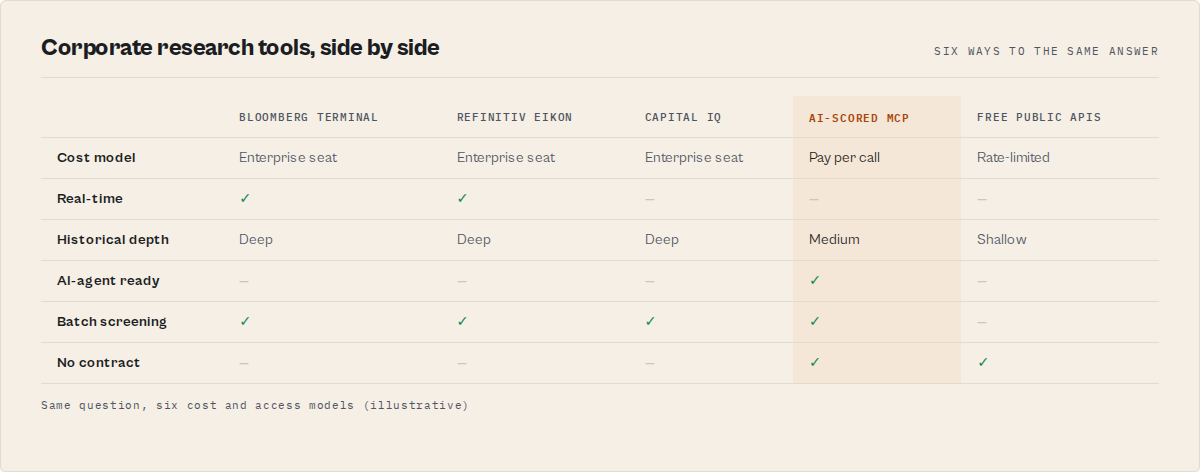
| Tool | Cost | Structured API | AI-agent ready | Data depth | Best for |
|---|---|---|---|---|---|
| Bloomberg Terminal | $24K/year/seat | Limited (B-PIPE $50K+) | Experimental | Very deep | Full-time analysts |
| Refinitiv Eikon | $12K-22K/year/seat | Yes (Refinitiv API) | Limited | Deep | Cost-conscious institutions |
| Capital IQ (S&P) | $15K-24K/year/seat | Yes (CIQ API) | Limited | Deep | M&A and PE workflows |
| AI scored tools (MCP-based) | $0.08-0.15/query | Native | Yes | Medium (public data) | Automated pipelines |
| Free public APIs (EDGAR, GLEIF) | Free | Yes (but raw) | With work | Narrow per source | DIY builders |
| Alpha Vantage / Finnhub | $0-300/month | Yes | With work | Medium (market data) | Market data only |
Pricing and features based on publicly available information as of April 2026 and may change.
Refinitiv Eikon (now part of LSEG) is Bloomberg's closest direct competitor. Similar depth, similar workflow, slightly lower price point. The Refinitiv API is more accessible than Bloomberg's B-PIPE but still designed for institutional use.
Capital IQ from S&P Global is strong for M&A workflows — screening, comparable company analysis, deal intelligence. The API exists but pricing is enterprise-negotiated.
AI scored tools like the Corporate Deep Research MCP Apify actor fill the automation gap. They're not Bloomberg replacements — they're Bloomberg complements. Use them for the 80% of queries that don't need real-time data or proprietary estimates, and reserve Bloomberg for the 20% that do.
Free public APIs — SEC EDGAR, GLEIF, CFPB, Wikipedia — provide the raw data that AI tools aggregate. You can build your own pipeline from these, but the development and maintenance cost is real. The Edgar Financial Extractor on ApifyForge handles the SEC parsing, but you'd still need to build the aggregation, entity linking, and scoring layers yourself.
Market data APIs like Alpha Vantage ($50-300/month) and Finnhub (free tier + paid tiers) give you stock prices, fundamentals, and earnings data. Solid for market data specifically, but they don't cover filings, governance, reputation, or compliance signals.
Each approach has trade-offs in cost, depth, automation readiness, and maintenance burden. The right choice depends on your team's workflow, budget, and how much of the research is done by humans vs machines.
Best practices for choosing corporate research tools
-
Map your workflow before choosing tools. Draw the actual flow: who or what triggers research, what data is needed, who consumes the output, and what format they need it in. Bloomberg makes sense when the consumer is a human analyst. AI tools make sense when the consumer is a pipeline, dashboard, or AI agent.
-
Calculate your real per-query cost for Bloomberg. Take your annual Bloomberg spend, divide by the number of meaningful research queries your team runs per year. If that number is above $10/query, you're overpaying for the queries that don't need Bloomberg's depth. Offloading routine screening to AI tools can reduce your effective Bloomberg cost/query for the queries that actually need it.
-
Don't try to replace Bloomberg entirely with AI tools. AI tools built on public data can't replicate Bloomberg's proprietary data, real-time feeds, or 40-year historical depth. The goal isn't replacement — it's routing each query type to the most cost-effective tool. The comparison tools on ApifyForge help evaluate which actors fit specific use cases.
-
Test AI tools on companies you already know well. Run 10-20 companies through an automated tool and compare the output against your existing knowledge. This calibration step tells you where the tool's scores align with reality and where they diverge — and more importantly, why.
-
Use AI tools for the screening funnel, Bloomberg for the deep dive. A 3-stage research process works well: Stage 1 — AI tool batch screening (seconds, pennies/query). Stage 2 — human review of flagged results (minutes). Stage 3 — Bloomberg deep dive on the companies that warrant it (hours).
-
Require coverage metadata from any automated tool. If a tool returns a risk score without telling you which data sources contributed to it, you can't assess reliability. Scored intelligence tools should report source coverage, entity confidence, and data density with every result.
-
Build for the hybrid future. The firms that will have the best research capability in 2-3 years are the ones integrating both approaches now — AI tools for speed and structure, Bloomberg/Refinitiv for depth and proprietary data. Neither alone gives you the full picture.
Common mistakes when comparing Bloomberg to AI tools
Comparing on data depth alone. Bloomberg wins on depth. Every time. But depth isn't the only dimension. If your use case is "screen 200 companies for initial risk flags," Bloomberg's depth is irrelevant — you need speed, structure, and per-query economics.
Assuming Bloomberg's API is equivalent to the Terminal. Bloomberg B-PIPE and Bloomberg Data License are enterprise products with enterprise pricing ($50K-200K+/year). The data you get from the Terminal isn't always available through the API at the same depth or freshness. Don't plan an automated pipeline assuming Terminal-grade data at API prices.
Ignoring the maintenance cost of DIY alternatives. Building your own research pipeline from free APIs sounds cheap until you account for entity resolution bugs, API rate limits, data format changes, and the ongoing engineering cost of keeping 6-8 integrations running. Based on running an Apify actor portfolio on ApifyForge, I can tell you: the maintenance cost is real and ongoing.
Treating AI tools as Bloomberg replacements instead of complements. The firms getting the most value are using AI tools AND Bloomberg, not one instead of the other. AI tools handle the volume. Bloomberg handles the depth. Trying to make one tool do both leads to overspending (Bloomberg for batch screening) or under-coverage (AI tools for deep analysis).
Not accounting for the human cost of Bloomberg analysis. Bloomberg costs $24K/year, but the analyst using it costs $80,000-150,000/year. If AI tools can offload 4 hours/week of routine screening from that analyst's workflow, the labor savings alone justify the AI tool cost — even before the per-query economics kick in.
Common misconceptions about Bloomberg alternatives
"AI tools are just cheaper Bloomberg." No. Bloomberg is a human-facing terminal with real-time data, proprietary estimates, and 40+ years of depth. AI tools are API-first scoring engines that return structured risk assessments. They solve different problems. A Bloomberg analyst reads charts. An AI agent consumes JSON risk scores.
"You can't do serious research without Bloomberg." For human-led deep dives, Bloomberg remains unmatched. But for automated screening, portfolio monitoring, and AI agent workflows, tools like Corporate Deep Research MCP produce structured, scored output that Bloomberg doesn't offer natively. The question is what "serious research" means for your workflow.
"AI tools are less accurate." AI tools using public data (SEC filings, GLEIF, CFPB) are working from the same government and regulatory sources that Bloomberg uses as part of its data pipeline. The difference is coverage breadth (Bloomberg has more sources) not source quality. AI tools add explicit confidence intervals and coverage reporting — something Bloomberg Terminal doesn't provide.
How do AI tools handle what Bloomberg doesn't cover?
Bloomberg's strength is financial data. Its coverage of reputation signals, regulatory complaints, and governance scoring is limited compared to specialized tools. AI corporate research tools fill these gaps by aggregating non-financial sources.
The Corporate Deep Research MCP pulls from Trustpilot for consumer reputation (review scores, response patterns, sentiment distribution), CFPB for regulatory complaints (dispute rates, timely response rates, complaint categories), and GLEIF for governance signals (LEI status, ownership hierarchy, renewal compliance). Bloomberg doesn't cover these dimensions at this level of structure.
For a due diligence workflow that needs both financial depth AND reputation/governance/compliance signals, the practical stack is: Bloomberg for financial analysis + AI tools for the non-financial dimensions + human analyst for synthesis and judgment.
Mini case study: VC firm restructures its research stack
Before: A mid-stage VC firm with 3 Bloomberg seats ($72K/year) used terminals for all company research — initial screening, portfolio monitoring, and deep-dive analysis. Analysts spent approximately 30% of their Bloomberg time on routine screening tasks (company overviews, basic financial pulls, initial risk checks).
After: The firm kept 2 Bloomberg seats for deep analysis and routed all initial screening and portfolio monitoring through AI-scored tools. Screening volume: ~150 companies/month. AI tool cost at $0.10/query: $15/month. The third Bloomberg seat was repurposed to a Refinitiv Eikon seat for a junior analyst ($15K/year savings).
Result: $24K/year savings from the seat reduction, $15/month in AI tool costs, and senior analysts gained approximately 6 hours/week back from automated screening. Over 12 months, the firm screened 1,800 companies at a total AI tool cost of $180 — roughly 0.75% of one Bloomberg seat.
These numbers reflect one firm's workflow observed over a 6-month period. Results will vary depending on team size, research volume, and how Bloomberg seats are currently used.
Implementation checklist
- Audit your current Bloomberg usage — how many queries/month, what types, and who consumes the output
- Categorize queries into "needs Bloomberg depth" vs "could be automated" — most firms find 60-70% falls in the automatable category
- Trial an AI tool on 20 companies you know well — compare output quality and identify gaps
- Set up a routing layer — send screening queries to AI tools, deep-dive queries to Bloomberg
- Configure structured output format for your downstream systems (CRM, deal management, dashboards)
- Establish baseline risk scores for your portfolio companies to enable delta monitoring
- Train analysts on interpreting AI tool output — what coverage scores mean, when to escalate to Bloomberg, how to spot entity resolution errors
- Review economics quarterly — if AI query volume grows, the savings compound; if it doesn't, the cost is negligible ($10-15/month at low volumes)
Limitations of both approaches
Bloomberg limitations:
- $24K/year minimum per seat creates fixed cost that doesn't scale down for light users
- Terminal-centric design makes automated pipeline integration difficult and expensive
- Agent integration is experimental — no production-grade MCP or structured tool-calling interface as of April 2026
- Overkill for basic screening — using Bloomberg to check if a company has active SEC filings is like using a fire truck to fill a glass of water
AI tool limitations:
- Public data only — no access to Bloomberg's proprietary analyst estimates, bond pricing, or derivatives data
- No real-time feeds — assessments reflect point-in-time snapshots, not live market conditions
- US public company bias — international coverage depends on GLEIF (global) and company web research (variable quality)
- Scoring models are opaque if not documented — demand transparency on how composite scores are calculated and weighted
- Can't replicate Bloomberg's network effects — the chat function, analyst community, and data-sharing features that make Bloomberg sticky
Key facts about Bloomberg vs AI corporate research tools
- Bloomberg Terminal costs $24,000/year per seat and Bloomberg API (B-PIPE) costs $50,000-200,000/year depending on data scope (Bloomberg Professional Services, 2025)
- Bloomberg reported $13.5B in revenue in 2024, up 6% year-over-year, indicating continued dominance in institutional financial data
- AI corporate research tools using MCP and pay-per-event pricing cost $0.08-0.15 per query, creating a 100-1000x per-query cost difference at low volumes
- 42% of institutional investors are evaluating AI-driven research tools as Bloomberg supplements according to Coalition Greenwich (2025)
- The crossover point where Bloomberg becomes cheaper per query than AI tools is approximately 13,000-25,000 queries/month
- SEC EDGAR, GLEIF, Finnhub, Trustpilot, and CFPB provide the public data foundation that AI tools aggregate — Bloomberg adds proprietary data layers on top
- AI tools return structured JSON with typed fields, confidence intervals, and coverage metadata — Bloomberg outputs are designed for human terminal use
- Gartner projects 50% of business decisions will be AI-augmented by 2027, increasing demand for machine-readable research output
Glossary
Bloomberg Terminal — a professional financial data workstation costing $24K/year that provides real-time market data, analytics, and news for financial professionals.
B-PIPE (Bloomberg Data License) — Bloomberg's enterprise API product for programmatic access to Bloomberg data, priced at $50K-200K+/year.
MCP (Model Context Protocol) — an open standard for connecting AI agents to external tools and data sources, enabling structured tool calling with typed inputs and outputs.
Pay-per-event (PPE) pricing — a pricing model where you pay only when a tool produces a result, as opposed to flat subscription fees. Used by Apify actors including the Corporate Deep Research MCP.
Composite risk score — a weighted average of multiple risk dimensions (financial, reputation, governance, market) that provides a single comparable screening metric.
Entity resolution — the process of mapping an ambiguous company name to specific identifiers (SEC CIK, GLEIF LEI, stock ticker) across data sources.
Broader applicability
The Bloomberg vs AI tools comparison reflects a broader pattern happening across every information-intensive profession:
- Legal research: Westlaw/LexisNexis ($10K+/year) vs AI-powered case analysis tools — same dynamic of depth vs automation
- Medical research: UpToDate/DynaMed subscriptions vs AI diagnostic screening — human-expert tools vs automated triage
- Real estate analysis: CoStar ($15K+/year) vs automated property intelligence — terminal-based depth vs API-driven screening
- Patent research: Derwent/Orbit ($20K+/year) vs AI patent analysis — manual deep dive vs batch automated screening
- Credit analysis: Moody's/S&P subscriptions vs automated credit scoring — proprietary ratings vs public-data-driven models
The principle is the same: expensive human-oriented platforms are being complemented (not replaced) by cheaper, structured, automation-ready alternatives for the subset of queries that don't require full platform depth.
When you need this comparison
You probably need to evaluate Bloomberg alternatives if:
- Your Bloomberg seats cost more than $50K/year combined and utilization is below 60%
- You're building automated research pipelines and Bloomberg's API pricing is prohibitive
- Your AI agents need structured company data and Bloomberg doesn't offer a production MCP integration
- Your research workload is highly variable — heavy some months, light others — and flat pricing penalizes you
- You want per-company risk scores with confidence intervals, not raw data that requires analyst synthesis
You probably don't need alternatives if:
- Your analysts use Bloomberg 6+ hours/day and the per-hour cost is justified
- You need real-time data feeds for trading or intraday analysis
- Your workflow depends on Bloomberg's proprietary analyst consensus estimates
- You're in a regulated environment that requires Bloomberg as a data source for compliance
- Your team has deep Bloomberg expertise and switching costs exceed potential savings
Frequently asked questions
Is Bloomberg worth the cost in 2026?
For full-time financial analysts who use the terminal 4+ hours daily, Bloomberg's amortized cost (~$12/hour of use) is reasonable for the depth of data it provides. For teams that use it sporadically or primarily for screening, the per-query economics often don't justify $24K/year per seat. Many firms are finding a hybrid approach — Bloomberg for deep analysis, AI tools for screening — provides better value.
Can AI tools replace Bloomberg Terminal?
Not for most institutional workflows. Bloomberg provides proprietary data (analyst estimates, bond pricing, derivatives), real-time feeds, and 40+ years of history that AI tools built on public data can't replicate. AI tools are better positioned as Bloomberg complements — handling batch screening, automated monitoring, and AI agent workflows at a fraction of the per-query cost.
What is the cheapest alternative to Bloomberg?
For automated corporate research, AI-scored tools like the Corporate Deep Research MCP Apify actor cost $0.08-0.15 per query with no subscription. For terminal-style analysis, Refinitiv Eikon starts at roughly $12K/year. For market data only, Finnhub's free tier and Alpha Vantage ($50-300/month) provide stock prices and fundamentals.
How does Corporate Deep Research MCP compare to Bloomberg?
The Corporate Deep Research MCP is an Apify actor that provides 12 MCP tools for corporate due diligence at $0.08-0.15/call. It aggregates 8 public data sources (SEC EDGAR, financial statements, Finnhub, GLEIF, Trustpilot, CFPB, Wikipedia, company research) and returns structured JSON with scored risk assessments. It doesn't match Bloomberg's real-time data, proprietary estimates, or historical depth — but it provides structured, AI-agent-ready output at a fraction of the cost.
What does Bloomberg do better than AI tools?
Bloomberg excels at real-time market data (sub-second), proprietary analyst consensus estimates, 40+ year historical data depth, global coverage (200+ countries, 60M+ instruments), fixed income and derivatives pricing, and the human workflow features (chat, news, charting) that make it a productivity platform for full-time analysts.
What do AI tools do better than Bloomberg?
AI corporate research tools excel at structured JSON output for automated pipelines, scored risk assessments with confidence intervals, batch processing of 10+ companies simultaneously, per-query pricing that scales to zero when not in use, native AI agent integration via MCP, and non-financial data aggregation (reputation, governance, complaints) that Bloomberg doesn't deeply cover.
Can I use Bloomberg data in my AI agent?
Bloomberg's terms of service restrict redistribution of terminal data, and the B-PIPE API is priced for institutional use ($50K-200K+/year). Using Bloomberg data to train AI models or feed AI agents requires specific data licensing agreements. For agent workflows, AI tools built on public data sources provide a cleaner licensing path.
Ryan Clinton publishes Apify actors as ryanclinton and builds developer tools at ApifyForge.
Last updated: April 2026
This guide focuses on Bloomberg vs AI tools for corporate research, but the same platform-vs-automation comparison pattern applies broadly to any domain where expensive human-oriented platforms are being complemented by cheaper, structured, API-driven alternatives.