The problem: Most B2B teams treat conference sponsor lists as a name dump — copy the logos, find the emails, move on. They miss the actual signal sitting in plain sight. A company that sponsors an event is telling you it has budget, it cares about this market, and it's willing to spend to be seen there. A company that upgrades its sponsorship from Bronze to Platinum is telling you that budget just grew. Almost nobody tracks this.
What is a conference sponsorship buying signal? A conference sponsorship buying signal is a public indicator of a company's budget, market focus, and growth intent, inferred from which events it sponsors, at what tier, and whether that tier is rising over time.
Why it matters: Sponsorship is one of the few intent signals a company pays real money to broadcast publicly — sponsor tier and repeat participation correlate with marketing budget and market commitment in a way that website visits or ad clicks don't.
Use it when: You're prioritising outbound accounts, mapping a competitor's go-to-market spend, or deciding which events your own team should sponsor.
Here's the thing most go-to-market teams haven't internalised: a sponsor list isn't a lead list. It's a map of who's putting money into your market right now, ranked by how much.
Quick answer
- What it is: Conference sponsorship as an intent signal — tier, repeat appearance, and tier upgrades read as budget and market-focus indicators.
- When to use it: Account prioritisation, competitive go-to-market tracking, and sponsorship-investment planning.
- When NOT to use it: As a standalone lead source for markets that don't run conferences (very early-stage, hyper-local, or non-event verticals).
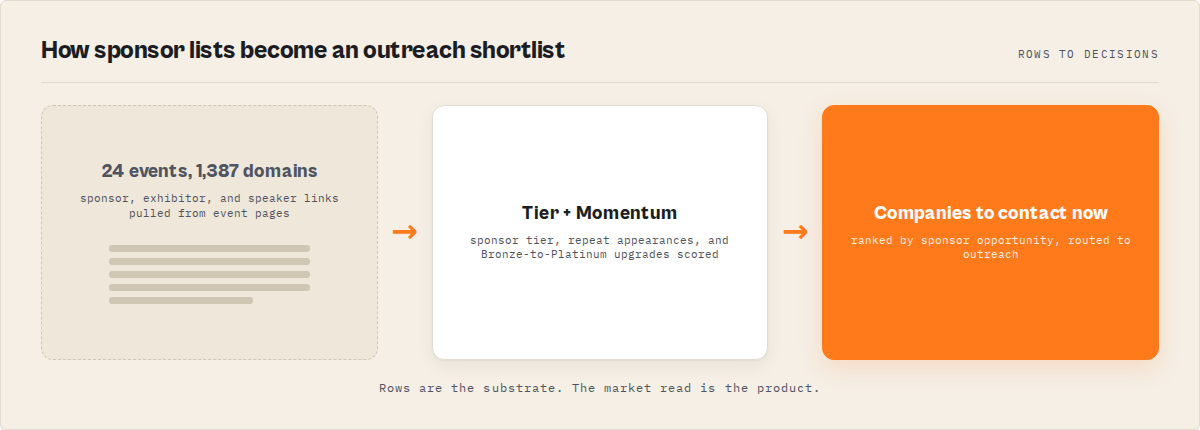
- Typical steps: Pull sponsor lists across an event season, tag each by tier, track changes over time, route the escalating accounts to outreach.
- Main tradeoff: The signal is rich but invisible at scale — reading it manually across dozens of events doesn't work, so you need a system that tracks momentum, not a one-time scrape.
In this article: What is the signal · Why sponsorship indicates budget · The prospecting blind spot · Why repeat sponsorship matters · Why upgrades matter · The sponsorship signal stack · What competitors reveal · Tracking at scale · Alternatives · Best practices · FAQ
Key takeaways
- A Diamond or Platinum sponsorship is a 5-to-6-figure spend commitment, not a marketing footnote — it's a public declaration of budget.
- Repeat sponsorship across an event season separates real market commitment from one-off experiments; a vendor at four industry conferences in a year is making a focused bet.
- A tier upgrade (Bronze to Platinum) is the single sharpest signal here — it means the budget just grew, and that's the moment to reach out.
- Share of voice across an event circuit shows you which competitor is winning the spending war before any revenue numbers go public.
- Reading this signal once tells you nothing; reading it continuously, with momentum tracked across runs, is where the value is.
Sponsorship signals in action
| What you observe | What it likely means | Who should act |
|---|---|---|
| Company is a Diamond sponsor at one event | Significant marketing budget, high market focus | SDRs prioritising high-budget accounts |
| Company sponsors 4+ events in a season | Committed go-to-market bet on this market | AEs building target account lists |
| Bronze last year, Platinum this year | Budget increased; expansion phase | Reach out now — timing is hot |
| Competitor owns 41% share of voice at top events | Competitor is out-spending peers on this circuit | Competitive intelligence / strategy |
| New entrant appears across several events | A new player is funding entry into your market | Partnerships and market researchers |
What is a conference sponsorship buying signal?
Definition (short version): A conference sponsorship buying signal is a publicly observable indicator of a company's budget, market focus, and expansion intent, derived from which events it sponsors, at what tier, and how that participation changes over time.
Also known as: event sponsorship intent signal, sponsor-tier signal, conference participation signal, event-investment signal, sponsorship momentum signal, trade-show buying signal.
There are roughly three categories of signal inside a sponsor list. Presence signals — the company showed up at all, which means it has the budget and the interest to be there. Tier signals — where it sits in the sponsorship hierarchy (title, diamond, platinum, gold, silver, bronze), which is a direct proxy for how much it paid. Momentum signals — how its presence and tier change across events and across seasons, which is the part almost everyone ignores and the part that actually predicts behaviour.
The first two you can read off a single page. The third only exists if you're watching over time.
Why does conference sponsorship indicate budget?
Conference sponsorship indicates budget because sponsorship slots are sold at fixed, public-ish price points that scale with tier. A Platinum or Diamond package at a major industry event commonly runs into five or six figures, so a company holding that tier has demonstrably allocated real marketing spend to be seen there.
Compare that to softer intent signals. A website visit costs the visitor nothing. An ad click costs them nothing. Downloading a whitepaper costs an email address. But a Gold sponsorship at a tier-1 conference costs a wire transfer, an approved budget line, and an internal decision that this market is worth the spend.
That's what makes sponsorship unusual among intent signals: the company paid to broadcast it. According to the Center for Exhibition Industry Research, exhibitions and events remain one of the largest line items in B2B marketing budgets, and sponsorship spend tracks closely with a company's commitment to a given vertical. When you see a tier badge, you're looking at a budget decision that already cleared internal approval.
Tier matters more than presence. A Bronze sponsor and a Diamond sponsor are not the same prospect. One bought the cheapest way to get a logo on a banner; the other committed serious money and probably has a booth, a keynote slot, and a team flying in. If you're prioritising accounts by budget, the tier is your sort key.
The blind spot in modern B2B prospecting
Look at what a typical revenue team actually tracks: hiring, funding rounds, website visits, intent data, ad engagement. Now notice what's missing from almost every prospecting stack: sponsorship activity. It's one of the few signals a company literally pays money to make public, and hardly anyone reads it.
That's the strange part. A prospect can accidentally visit your website. A prospect can accidentally trigger an intent score by reading three articles. A prospect cannot accidentally become a Platinum sponsor at RSA. When a company sponsors RSA, Black Hat, and the Gartner Security Summit in the same year, it is publicly declaring, on the record: we have budget, we care about this market, and we are investing right now. That is often more actionable than a page view, and far harder to fake.
It's a blind spot largely because the major tools don't carry the field. Apollo tells you who works there. ZoomInfo gives you company firmographics. Intent platforms like Bombora and 6sense tell you what content an account is consuming. None of them tell you "this company just upgraded from Bronze to Platinum." That's a different class of signal, and it sits unclaimed.
We kept running into this gap while building event-participation tooling: the most predictive thing on a sponsor page wasn't the list of names, it was how that list changed between events. That observation is what this whole approach is built on.
Why does repeat sponsorship matter more than a single appearance?
Repeat sponsorship matters more than a single appearance because one event can be an experiment, but four events in a season is a strategy. A company that sponsors the same circuit year after year, or shows up across multiple industry conferences in one season, is making a sustained, funded bet on that market rather than testing the water once.
A single sponsorship is noisy. Maybe a regional team had leftover budget. Maybe a partner comped the slot. Maybe someone went to one conference because a competitor did. You can't tell intent from one data point.
But a vendor that appears at RSA, Black Hat, Infosecurity Europe, and the Gartner Security Summit in the same year? That's not noise. That's a company that has decided this market is core, has budget approved at the program level, and is spending consistently to own mindshare. The pattern is the signal — and you only see the pattern across multiple events.
This is also where account-prioritisation logic gets sharper. A company appearing across the whole industry circuit is more committed, more likely to have budget for your product if it serves that market, and more likely to recognise a vendor that already understands its space. Repeat participation is the difference between a tourist and a resident.
Why do sponsorship upgrades (Bronze → Platinum) matter?
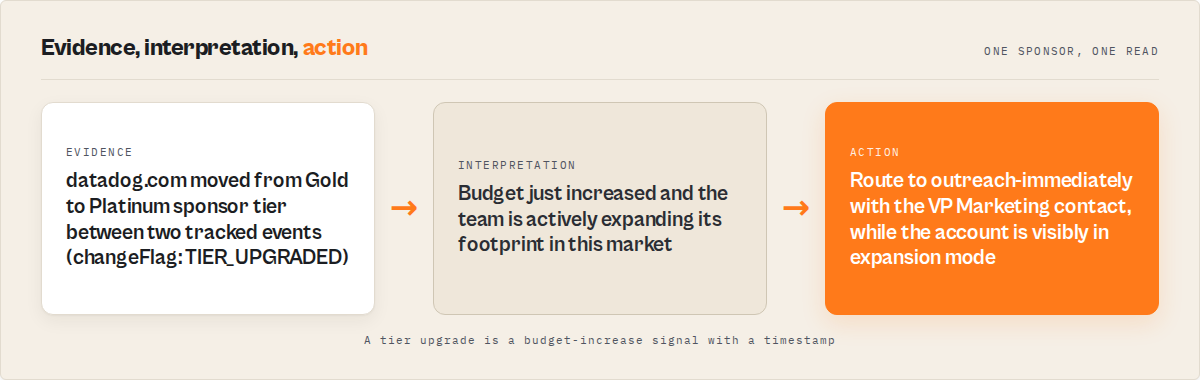
A sponsorship upgrade matters because it's a budget-increase signal with a timestamp. When a company moves from Bronze to Platinum between events, it didn't just keep spending — it decided to spend more, which usually means the prior investment paid off or the team got fresh budget. That's the moment its buying capacity is rising.
Think about what has to happen internally for a tier upgrade. Someone reviewed last year's event ROI, decided it was worth scaling up, and got a bigger budget approved. The company is in expansion mode for this market, right now. That's a far hotter signal than a company sitting flat at the same tier for three years.
Put it next to the signals everyone already chases and the contrast is stark:
- A website visit is curiosity.
- A content download is interest.
- A demo request is evaluation.
- A Bronze-to-Platinum upgrade is budget approved.
Only one of those required an internal sign-off and a wire transfer to produce.
Tier downgrades carry information too, just in the other direction. A company sliding from Platinum to Silver is pulling back — maybe budget tightened, maybe the market deprioritised. For competitive intelligence, that's an opening. For your own outreach, it might mean wait.
The catch: you cannot see an upgrade from a single scrape. A one-time pull of a sponsor page tells you the company is Platinum today. It says nothing about whether it was Bronze last quarter. The upgrade only exists in the comparison between two points in time — which is exactly why momentum tracking, not extraction, is the hard and valuable part.
The sponsorship signal stack
Sponsorship isn't one signal, it's five, stacked by how much they tell you. Each level is sharper than the one below it, and the higher levels only exist if you're tracking over time.
- Presence — the company appears at all. Baseline: it has the budget and interest to be in the room.
- Tier — where it sits in the hierarchy (title, diamond, platinum, gold, silver, bronze). A direct proxy for how much it paid.
- Frequency — how many events it sponsors in a season. Separates a one-off experiment from a funded, repeated market bet.
- Momentum — whether its tier is rising or falling between events. The budget-direction signal, and the one almost nobody reads.
- Dominance — its share of voice across the whole circuit. Who is out-spending whom for the market's attention.
Most teams stop at level 1 or 2 because that's all a single sponsor page shows. Levels 3 through 5 are where sponsorship stops being a list and becomes intelligence, and they only appear when you watch the circuit over time rather than reading one page once.
What does a competitor's sponsorship activity reveal?
Pointed at your rivals instead of your prospects, the same stack reads as a competitive-intelligence feed. Where a competitor sponsors, at what tier, and how that changes tells you things their press releases won't:
- Market expansion — a competitor suddenly sponsoring events in a vertical it ignored last year is funding entry into that market.
- Geographic expansion — appearing at regional conferences in a new territory signals a go-to-market push there.
- Budget direction — tier upgrades across the circuit mean rising marketing spend; downgrades mean a pullback.
- Strategic focus — the events a competitor concentrates its top-tier slots on show you where it's placing its biggest bets.
- Share-of-voice shifts — a rival climbing from a minority to a majority share of voice at your core events is winning the attention war before any revenue number says so.
You can see all of this from public sponsor pages, before it shows up in financials or analyst reports.
How do you track conference sponsorship at scale?
You track conference sponsorship at scale by capturing sponsor lists with their tiers across an entire event season, storing that as a participation history, and then watching for changes — new sponsors, lost sponsors, and tier movements — on a schedule rather than reading each page once by hand.
Here's the manual reality, and why it falls apart. Say you want to track sponsorship across 30 events in your industry. You open the first sponsors page, copy the company names, try to figure out which heading each logo sat under so you can tag the tier, paste it into a spreadsheet, and move on. Thirty pages later you have a snapshot. Now do it again next quarter to catch any changes — and diff two spreadsheets by hand to spot who upgraded. By the time you've finished, the signal is stale and you've burned a week.
It doesn't scale, and worse, it can't see momentum. The whole value — upgrades, new entrants, share-of-voice shifts — lives in the comparison over time, and manual spreadsheets are terrible at comparisons over time. You end up with a pile of stale snapshots and no view of what changed.
This is the gap a purpose-built system fills. Instead of pages-to-spreadsheet, you point a tool at the event URLs, it pulls every sponsor with its tier, and on a schedule it tells you what moved since last time. We built our contact and lead intelligence actors around exactly this idea — that the decision layer matters more than the raw list.
What does sponsorship intelligence output look like?
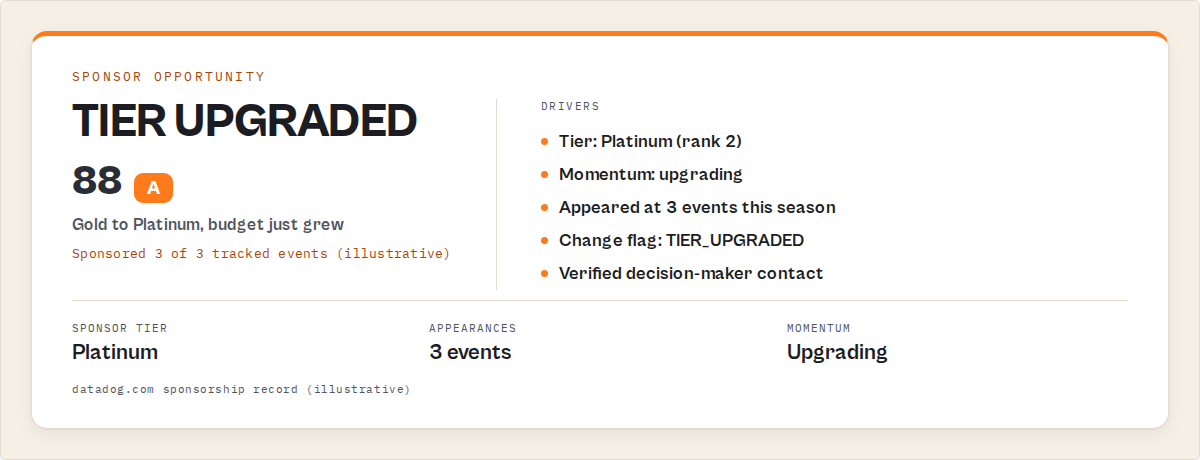
A useful sponsorship-intelligence record goes beyond a domain and a name. It carries the tier, how many events the company appeared at, whether its tier is rising, and a routed decision so your CRM or cadence tool can branch on it directly. Here's the shape of that output, using the Event Lead Extractor Apify actor as the reference:
{
  "company": "datadog.com",
  "foundAs": "sponsor",
  "sponsorTier": "platinum",
  "sponsorRank": 2,
  "appearanceCount": 3,
  "multiEvent": true,
  "changeFlag": "TIER_UPGRADED",
  "sponsorMomentum": "upgrading",
  "eventFootprint": { "runsSeen": 3, "sponsoredAppearances": 7 },
  "competitorMatch": false,
  "sponsorOpportunity": 88,
  "decision": "outreach-immediately"
}
The changeFlag and sponsorMomentum fields are the ones that don't exist in a one-time scrape. They only appear once the tool has a history to compare against — which is the whole point. A generic event scraper hands you { "domain": "datadog.com" }. This hands you "Datadog upgraded to Platinum, it's been at 3 of our tracked events, contact it now."
Once a company is flagged for outreach, the enrichment side runs on the same suite — the Website Contact Scraper pulls contacts, the Email Pattern Finder derives the address format, and a B2B lead qualifier scores the account. The sponsorship signal decides who; the enrichment layer fills in how to reach them.
What are the alternatives to manual sponsorship tracking?
There are several ways to read sponsorship signals, and each breaks at a different point. Here's a fair look at the options.
Manual spreadsheet tracking. You open sponsor pages, copy names, tag tiers by eye, and re-check periodically. Best for: tracking a handful of events you attend personally. Where it breaks: it can't scale past a dozen events, can't see momentum without painful manual diffing, and goes stale the moment a new sponsor list publishes. You own the entire process, indefinitely.
Generic event/web scrapers. These extract links and company names from event pages. Best for: getting a raw list of who's on a page. Where it breaks: they return extraction, not intelligence — no tier classification, no cross-event aggregation, no momentum, no decision. You'd still own the tier-tagging logic, the cross-run state, the upgrade detection, the share-of-voice math, and the routing — that's a maintained data product, not a scrape.
Intent-data platforms (Bombora, 6sense, ZoomInfo). These sell aggregated buying-intent signals built mostly from web-content consumption and bidstream data. Best for: broad, account-level intent scoring across your TAM. Where it breaks: sponsorship is rarely a first-class signal in these products, and you pay a platform license whether or not the events you care about are covered.
Sales-intelligence databases (Apollo, Cognism). Strong for horizontal contact coverage. Best for: finding the people once you know the accounts. We dug into where these databases fit versus a decision-first approach in our lead-generation comparison. Where they break: they don't tell you a company just upgraded its conference sponsorship — that's not a field they carry. They answer "who works there," not "is this account heating up via event spend."
A purpose-built event-intelligence actor. Best for: turning sponsor lists into tier-tagged, momentum-tracked, routed intelligence across a full event season. Where it breaks: it needs the events to have public sponsor listings, and very early-stage or non-event markets won't have much to read.
| Approach | Tier detection | Tracks upgrades over time | Share of voice | Routed decision |
|---|---|---|---|---|
| Manual spreadsheet | Manual | Manual diff only | No | No |
| Generic event scraper | No | No | No | No |
| Intent-data platform | No | Indirect | No | Account-level |
| Sales-intelligence DB | No | No | No | No |
| Event-intelligence actor | Yes | Yes (on watchlist) | Yes | Yes |
Pricing and features based on publicly available information as of June 2026 and may change.
Each approach has trade-offs in coverage, freshness, and how much logic you have to own yourself. The right choice depends on how many events you track, whether you care about momentum, and how much of the pipeline you want to maintain.
Best practices for reading sponsorship signals
- Sort by tier first, presence second. A Diamond sponsor outranks ten Bronze sponsors for budget-based prioritisation. Use the tier as your primary sort key.
- Track a whole season, not one event. A single conference is a snapshot; a season is a pattern. Momentum only shows up across multiple events.
- Watch for upgrades, not just appearances. The Bronze-to-Platinum move is the hottest signal — flag tier changes specifically.
- Maintain a competitor watchlist. Knowing where your competitors sponsor, and their share of voice, tells you where the market's attention and budget are flowing.
- Re-run on a schedule. Sponsor lists change between events. A quarterly cadence catches new entrants and upgrades while they're still fresh.
- Route, don't just collect. Attach a decision (outreach now, nurture, revisit) to each company so the signal turns into action instead of another spreadsheet.
- Score event authority before you spend. Not every event is worth your team's time or sponsorship budget — rank events by authority and scale first.
Common mistakes when using sponsorship as a signal
- Treating every sponsor equally. A Bronze and a Diamond sponsor are wildly different prospects. Ignoring tier throws away the richest part of the signal.
- Reading a sponsor list once and calling it done. A one-time scrape can't see momentum. You'll miss every upgrade and every new entrant. Track over time or don't bother.
- Confusing sponsorship with measured spend. Sponsorship is a propensity and budget signal, not a spend figure. Don't present it as exact dollars to your leadership.
- Skipping event quality. A company sponsoring a tier-3 regional meetup is a weaker signal than a Diamond slot at a tier-1 global conference. Weight by event authority.
- Doing it all by hand at scale. Manual tracking past a dozen events collapses under its own weight and goes stale. The signal's value is in the continuous comparison, which humans diff badly.
Mini case study: catching an upgrade before the competition
A B2B partnerships team we talked to was tracking roughly 20 industry events manually each quarter. Before: one analyst spent about two days per quarter opening sponsor pages, copying names into a sheet, and trying to eyeball which companies had changed tier since last time. Tier changes mostly slipped through — diffing two 400-row spreadsheets by hand isn't realistic.
After moving to a watchlist-based approach that re-ran the same events on a schedule, the comparison was automatic. One run flagged a mid-market vendor that had moved from Gold to Platinum between two flagship conferences — a clear budget-increase signal. The team reached out that week, while the account was visibly in expansion mode, instead of finding out months later. The two-day quarterly grind dropped to a scheduled run plus an hour of review.
These numbers reflect one team's workflow. Results will vary depending on how many events you track and how often sponsor lists change.
Implementation checklist
- List the events your market runs over the next 12 months — the conferences, expos, and summits your buyers and competitors attend.
- Gather the event URLs (main page plus any
/sponsorsor/exhibitorspages). - Pick a tool that extracts sponsor tiers, not just links — tier is the core signal.
- Set up a competitor watchlist so you can see share of voice.
- Name a watchlist and run on a schedule so the tool builds a participation history and can detect upgrades.
- Filter for the signals that matter to you: rising momentum, multi-event presence, high sponsor-opportunity scores.
- Route the escalating accounts straight into your outreach motion with a decision attached.
Limitations
- No public sponsor list, no signal. Some events gate their sponsor pages behind login or render them in ways that hide the data. If it's not publicly visible, it can't be read.
- Tier classification is heuristic. Sponsorship tiers are inferred from page headings and surrounding HTML. Unconventional page layouts can mislabel a tier or leave it null.
- Sponsorship is a proxy, not a ledger. It signals budget and intent; it is not a measured spend figure. Treat it as a strong directional signal, not an accounting number.
- Event-light markets show little. Verticals that don't run conferences won't generate much sponsorship signal. This works best in markets with an active event circuit.
- History takes time to build. Momentum signals like upgrades need at least two runs over time to appear. The first run is a baseline, not a trend.
Key facts about conference sponsorship signals
- Sponsor tier is a direct proxy for marketing spend, since tiers are sold at scaling, mostly public price points.
- A tier upgrade between events is a budget-increase signal with a built-in timestamp.
- Repeat sponsorship across a season distinguishes committed market bets from one-off experiments.
- Momentum signals (upgrades, new and lost sponsors) only exist when sponsor data is compared across time.
- Share of voice across an event circuit reveals competitive spending dynamics before public financials do.
- A single scrape captures tier; only a scheduled history captures change.
Glossary
Sponsor tier — The named level of a sponsorship (title, diamond, platinum, gold, silver, bronze) that scales with price and prestige.
Sponsor momentum — The trajectory of a company's sponsorship tier over time: new, upgrading, downgrading, or stable.
Event footprint — A company's accumulated participation across multiple events and runs, including how often it appeared and sponsored.
Share of voice — A tracked competitor's percentage of total sponsorship appearances among the competitors you're watching across an event circuit.
Event authority — A 0-100 score estimating how important an event is, based on its tier, scale, and sponsor count.
Routed decision — A pre-computed next action attached to each company (outreach now, nurture, revisit, archive) so a CRM or cadence tool can branch on it.
Broader applicability
The pattern here isn't specific to conferences. It's a general principle of reading intent from public, paid behaviour, and these ideas apply well beyond event sponsorship:
- Paid-to-broadcast signals beat free ones. Any action a company pays real money to make public (sponsorships, hiring sprees, office expansions) carries more weight than costless signals like a page view.
- Tier beats presence. When a behaviour has levels, the level is the signal. The same logic applies to ad spend brackets, plan tiers, and booth sizes.
- Momentum beats snapshots. The change in a signal over time predicts behaviour better than the signal's current value. This holds across hiring, tech-stack changes, and funding.
- Comparison is the hard part. The value lives in diffing two points in time, which is exactly where manual processes break and a maintained history wins.
When you need this
You probably need sponsorship-signal tracking if:
- You sell into a market with an active conference and trade-show circuit.
- You prioritise outbound accounts and want a budget-and-intent signal that's hard to fake.
- You run competitive intelligence and want to see where rivals are spending before financials publish.
- Your own team buys sponsorships and you want to pick the highest-authority events.
You probably don't need this if:
- Your market doesn't run conferences or your buyers don't sponsor them.
- You only ever track one or two events you already attend in person.
- You need exact spend figures rather than directional budget signals.
Frequently asked questions
Is conference sponsorship really a reliable buying signal?
It's one of the more reliable public intent signals because the company paid real money to broadcast it. Sponsor tier maps to spend, and a tier upgrade maps to growing budget. It's directional, not exact, and it's strongest in markets with active event circuits, but it's far harder to fake than costless signals like web visits or ad clicks.
How is sponsorship intent different from intent-data platforms like Bombora?
Intent-data platforms infer buying interest mostly from web-content consumption and bidstream data across a large account universe. Sponsorship signals come from a public, paid commitment a company makes to a specific market. Sponsorship is usually not a first-class field in those platforms, so it's a complementary signal — use both, but don't expect Bombora to flag a Bronze-to-Platinum upgrade.
Why can't I just scrape sponsor pages once?
A single scrape captures the current tier but none of the change. The richest signals — upgrades, new entrants, lost sponsors, share-of-voice shifts — only exist in the comparison between two points in time. One scrape gives you a stale snapshot; the value is in tracking momentum across a schedule, which is the part manual processes handle badly.
What's the best tool for tracking conference sponsorship at scale?
For turning sponsor lists into tier-tagged, momentum-tracked intelligence, the Event Lead Extractor Apify actor is one of the best fits — it reads sponsor tiers, tracks upgrades on an opt-in watchlist, scores event authority, and attaches a routed decision per company. Generic scrapers and contact databases don't carry the tier or momentum fields that make sponsorship usable as a signal.
Does sponsorship tier actually tell you how much a company spent?
Not exactly. Tier is a strong proxy because sponsorship packages are priced by level, but it isn't a measured spend figure. A Diamond sponsor clearly committed more than a Bronze one, and that ordering is reliable, but treat it as a budget-and-commitment signal rather than an accounting number you'd quote to finance.
Can I use this for competitive intelligence, not just lead gen?
Yes, and it's one of the stronger uses. Tracking where competitors sponsor, at what tier, and their share of voice across an event circuit shows you where rivals are concentrating budget and attention. A competitor scaling up its presence at your core events is a market-positioning signal you can see before any revenue numbers go public.
Ryan Clinton publishes Apify actors and MCP servers as ryanclinton and builds developer tools at ApifyForge.
Last updated: June 2026
Most teams treat sponsor lists as contact lists. The teams that win treat them as market intelligence. The sponsor list itself isn't the asset, because anyone can scrape a page. The asset is the history: who shows up, who upgrades, who disappears, and who comes to dominate the circuit over time. That record is hard to build, hard to fake, and that's exactly where the signal lives.