What is the Pipeline Builder?
By Ryan Clinton · Updated Mar 1, 2026
The Pipeline Preflight validates multi-actor data pipelines and generates TypeScript orchestration code. Define pipeline stages with actor IDs and field mappings, and the builder checks that output fields from each stage map correctly to the next stage's input fields.
The builder identifies type mismatches between stages, warns about missing field mappings, and generates complete Actor.call() chain code that you can deploy as a new orchestration actor. It also estimates total pipeline cost by summing PPE prices across all stages.
The generated code shape is yours to pick. Codegen mode controls how production-ready the output is: Minimal emits a plain Actor.call chain, Production-ish wraps each stage in try/catch with log.warning, and Typed adds explicit ApifyCallOptions and satisfies assertions for end-to-end TypeScript safety. Pagination mode picks the dataset-read strategy: Limit 1000 is fast but silently truncates anything past 1K records, while Paginate all iterates until the cursor is exhausted — what you want as soon as a stage emits more than 1K. Tick "Validate runtime" to call the Input Guard on each stage with synthetic input from the mapping; it catches broken fieldMappings before codegen at a per-stage Input Guard charge. By default the builder also emits a top-level agentContract object describing the pipeline for MCP/LLM planners — turn it off in the Options panel if you are integrating with a non-agent runtime.
Pipeline Preflight costs $0.40 per build and does not run any actors — it reads schemas from latest builds. Visit apifyforge.com/tools/pipeline-builder for documentation.
Options
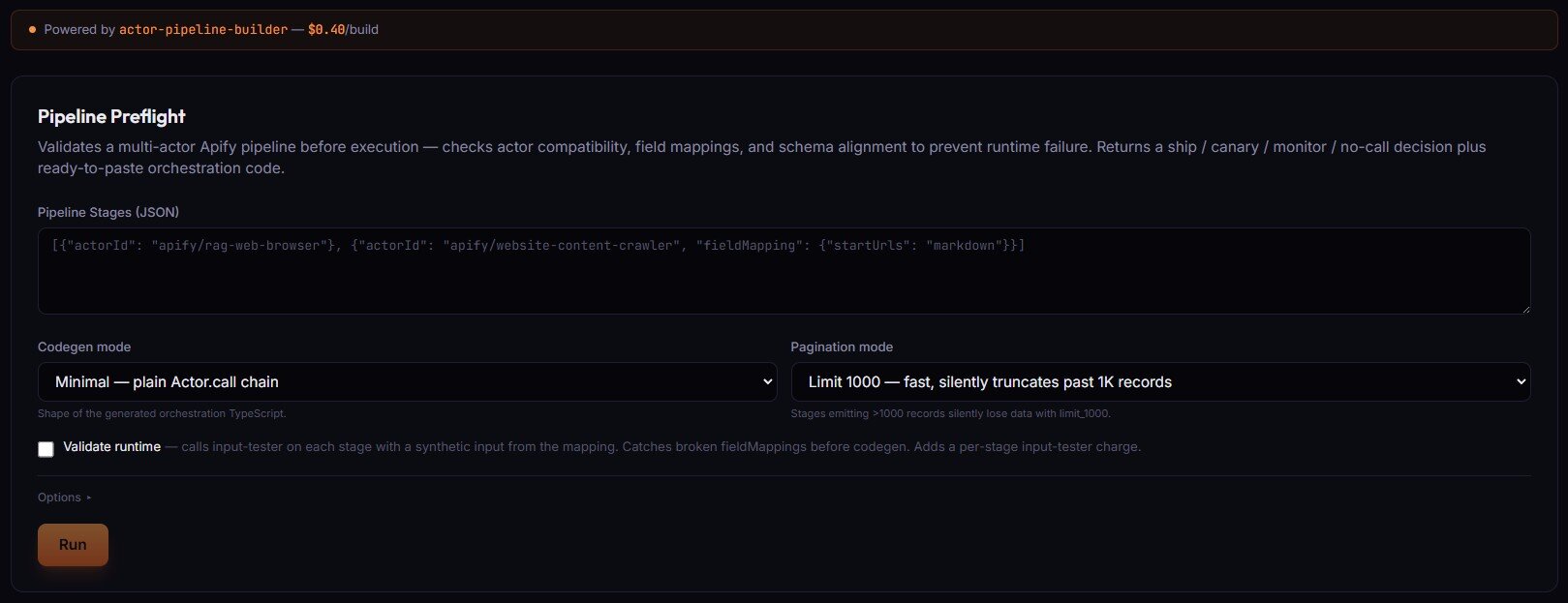
- Pipeline Stages (JSON) — array of stage objects. Each stage requires
actorId; downstream stages can declare afieldMappingmapping their input fields to the previous stage's output fields. - Codegen mode —
Minimal(plainActor.callchain),Production-ish(try/catch + log.warning per stage),Typed(adds explicitApifyCallOptions+satisfiesassertions). - Pagination mode —
Limit 1000(fast, silently truncates past 1K records) orPaginate all(generated helper iterates until offset + count ≥ total). Stages emitting >1000 records silently lose data withlimit_1000. - Validate runtime — calls input-tester on each stage with synthetic input from the mapping. Catches broken
fieldMappings before codegen. Adds a per-stage input-tester charge.
Options ▸ panel
- Suggestion mode — controls how
NO_FIELD_MAPPINGissues suggest fix candidates.Schema only(default) orSchema + naming. - Strictness —
DefaultorStrict(louder advisory surface). - Emit agent contract — emits a top-level
agentContractobject for MCP/LLM planners. Default on.
Related term
An Apify Webhook is an HTTP callback that Apify triggers automatically when specific actor events occur, enabling real-time integrations between your actors and external services without polling.
Related questions
The Output Guard checks your actor's actual dataset output against the schema you declared in your dataset_schema.json f...
What is the Test Runner?The Deploy Guard is a testing tool that runs your Apify actor with predefined test inputs and automatically validates th...
What is Cloud Staging?Cloud Staging runs your actor in Apify's actual production environment before you make it public on the Store, catching ...
What are Regression Tests?Regression tests are automated test suites that run before every publish to verify that new code changes have not broken...