The problem: Corporate due diligence is still done the way it was done in 2005. An analyst opens a dozen browser tabs — SEC EDGAR, Bloomberg, Trustpilot, CFPB complaints, GLEIF for legal entity data, Wikipedia for corporate history — and manually stitches together a picture of a company. A 2024 Deloitte survey found that 65% of M&A professionals spend 6-12 hours per company on initial due diligence. That's before legal review even starts. Most of that time isn't analysis — it's copy-pasting between tabs and reformatting data into something usable.
What is AI-powered corporate due diligence? AI-powered corporate due diligence is the automated process of collecting, cross-referencing, and scoring corporate intelligence from multiple public data sources — SEC filings, financial statements, stock data, legal entity registries, consumer reviews, and regulatory complaints — to produce structured risk assessments in minutes instead of hours.
Why it matters:
- The global due diligence market reached $5.8B in 2024 and is growing at 14.2% CAGR — indicating that organizations are spending more, not less, on company research
- A typical M&A deal involves 3-5 weeks of due diligence, during which time market conditions can shift materially
- Manual due diligence has an estimated 23% error rate in data transcription alone, according to KPMG's 2024 Due Diligence Survey
- AI agents are increasingly performing company research autonomously — Gartner projects 50% of business decisions will be AI-augmented by 2027
Use it when: you need to screen a potential acquisition target, evaluate a vendor before signing a contract, assess counterparty risk for compliance, or run batch analysis across a portfolio of companies. AI-powered corporate due diligence is designed for any situation where you need structured company risk data fast enough to act on.
Problems this solves:
- How to automate company due diligence without building custom data pipelines
- How to get structured risk scores for investment decisions
- How to screen vendors and counterparties against multiple public data sources
- How to reduce due diligence time from hours to minutes
- How to run due diligence with AI agents via MCP tool calls
- How to cross-reference SEC filings with reputation and governance data
In this article: What is AI-powered due diligence · Quick answer · Key takeaways · How it works · When to use it · Alternatives · Best practices · Common mistakes · Limitations · FAQ
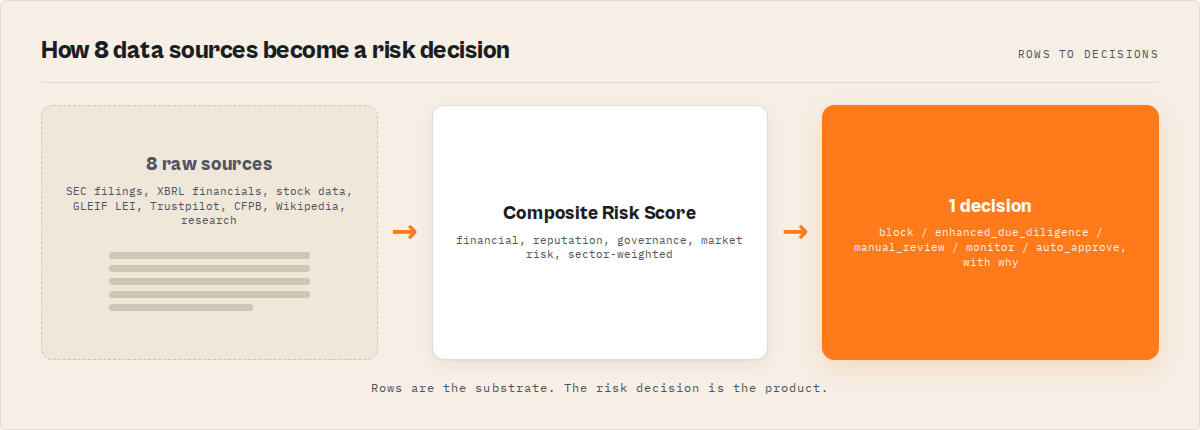
Quick answer
- What it is: Automated collection and scoring of corporate intelligence from 6-8 public data sources, producing structured risk assessments instead of raw data
- When to use it: Pre-investment screening, vendor evaluation, counterparty risk, portfolio monitoring, M&A target assessment
- When NOT to use it: Legal proceedings requiring certified documents, highly regulated industries needing notarized attestations, or situations where the company has zero public data footprint
- Typical steps: Identity resolution (name → ticker/CIK), parallel data collection from SEC/financial/LEI/review sources, entity linking, scored risk output with confidence levels
- Main tradeoff: Speed and structure vs. the depth of a 40-hour manual deep dive by a senior analyst
Key takeaways
- AI-powered corporate due diligence reduces company research from an average of 6-12 hours to 2-3 minutes by automating data collection across 8 public sources simultaneously
- Structured risk scores (financial health, governance grade, reputation risk, investment risk) replace narrative reports, making output machine-readable and comparable across companies
- Probabilistic risk outputs with confidence intervals are more honest than binary pass/fail — a company with 0.62 composite risk and a [0.55, 0.71] confidence interval tells you more than "medium risk"
- Coverage reporting is built in — every assessment tells you which sources returned data and which didn't, so you know exactly how much of the picture you're seeing
- Sector-aware weighting adjusts how much financial vs. reputation vs. governance signals matter — a bank's governance score matters more than a SaaS startup's, and the scoring model should reflect that
| Scenario | Input | Output | Time |
|---|---|---|---|
| Pre-investment screening | "Tesla" | Investment risk score, financial health, governance grade, 12 findings | ~90 seconds |
| Vendor evaluation | "acme-corp.com" | Reputation risk, complaint patterns, Trustpilot analysis | ~60 seconds |
| M&A target assessment | "Stripe" | Deep research report with all 8 sources, filing patterns, insider trading signals | ~120 seconds |
| Portfolio monitoring | Previous assessment JSON | Risk delta showing what changed, alert severity, trend direction | ~45 seconds |
| Competitor benchmarking | ["Apple", "Microsoft", "Google"] | Side-by-side comparison on 5 dimensions with rankings | ~180 seconds |
Traditional vs AI-powered due diligence
| Traditional Due Diligence | AI-Powered Due Diligence | |
|---|---|---|
| Time per company | 6-12 hours | 2-3 minutes |
| Data sources | Checked manually, one at a time | Aggregated automatically in parallel |
| Output format | Notes, spreadsheets, narrative reports | Structured risk scores, findings, and recommendations |
| Consistency | Variable (analyst-dependent) | Standardized and reproducible |
| Scale | 3-5 companies per analyst per week | 10-100+ companies per week |
| Cost | $500-2000+ per company (analyst time) | $0.15-1.00 per company |
| Confidence reporting | Implicit (analyst judgment) | Explicit (confidence intervals, coverage reports) |
AI-powered due diligence can reduce research time by 90%+ while increasing consistency across companies. The tradeoff is depth — a 40-hour manual deep dive by a senior analyst will always uncover things that automated tools cannot. But for first-pass screening, vendor checks, and portfolio monitoring, the speed and consistency advantage is decisive.
What is AI-powered corporate due diligence?
Definition (short version): AI-powered corporate due diligence is the automated analysis of a company using multiple data sources and structured scoring models to produce consistent risk assessments, findings, and recommendations — reducing research time from hours to minutes.
Also known as: automated company research, AI-driven corporate intelligence, machine due diligence, automated risk assessment, corporate research automation.
That definition covers the core idea, but the category is broader than most people realize. There are roughly 3 types of AI-powered due diligence tools emerging in 2026:
Single-source extractors pull data from one source and structure it. An SEC EDGAR scraper that extracts financial statements into JSON. A Trustpilot analyzer that scores review sentiment. These are building blocks, not complete due diligence — the Edgar Financial Extractor Apify actor pulls revenue, margins, debt ratios, cash flow, and anomaly flags from XBRL filings for any US public company, while the companion EDGAR Filing Search actor finds the filings themselves by ticker, CIK, form type, or date range so you know which ones to extract.
Multi-source aggregators combine data from several sources but leave interpretation to the user. You get a pile of structured data — filings, stock prices, LEI records — but you still have to figure out what it means.
Scored intelligence tools aggregate multiple sources, apply domain-specific scoring logic, and return structured risk assessments with confidence intervals. This is where AI-powered due diligence actually earns its name. The output isn't data — it's a judgment, backed by data, with explicit confidence levels.
How does AI-powered due diligence work?
AI-powered corporate due diligence works by resolving a company's identity across multiple registries, collecting data from 6-8 sources in parallel, linking entities across those sources using fuzzy matching, and applying weighted scoring models to produce risk assessments with confidence intervals.
Here's what happens under the hood in a typical automated due diligence system:
Step 1: Identity resolution. You give the system a company name, domain, or ticker. It resolves that to a canonical identity — mapping "Apple" to ticker AAPL, CIK 0000320193, domain apple.com, and LEI HWUPKR0MPOU8FGXBT394. This is harder than it sounds. "Goldman Sachs" could be Goldman Sachs Group Inc., Goldman Sachs Bank USA, or Goldman Sachs & Co. LLC — each with different CIKs, LEIs, and filing histories. Identity resolution uses a combination of company registry lookups, ticker search APIs, and domain-to-company mapping.
Step 2: Parallel data collection. With resolved identifiers, the system fans out to multiple sources simultaneously:
- SEC EDGAR filings (10-K, 10-Q, 8-K, proxy statements)
- XBRL financial statements (revenue, margins, debt ratios, cash flow)
- Stock market data (price, PE ratio, beta, earnings surprises)
- GLEIF legal entity identifiers (ownership hierarchy, jurisdiction)
- Trustpilot consumer reviews (sentiment, response patterns)
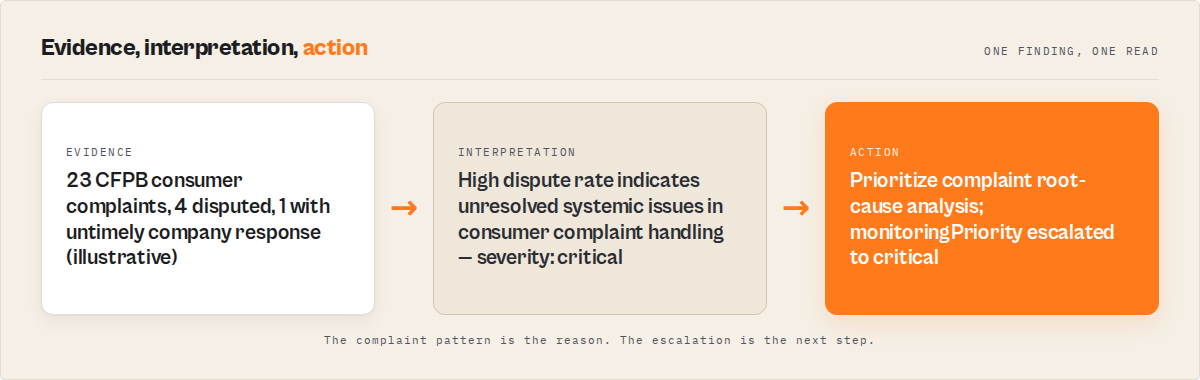
- CFPB consumer complaints (dispute rates, resolution patterns)
- Wikipedia corporate history (founding, leadership, controversies)
- Finnhub market metrics (52-week range, market cap, dividend yield)
Step 3: Entity linking. Data from different sources needs to be linked back to the same entity. A Trustpilot review for "apple.com" needs to connect to the SEC filing for CIK 0000320193. Entity linking uses match confidence scoring (0-1) based on domain matches, name similarity, and identifier cross-references. Every link carries a confidence score so you know which connections are solid and which are fuzzy.
Step 4: Scored risk output. The system applies weighted scoring models to produce structured assessments. Financial health combines valuation ratios, earnings quality, and price signals. Governance grades use disclosure completeness, LEI status, and filing compliance. Reputation risk scores aggregate review sentiment, complaint patterns, and response rates.
Here's what a code integration looks like:
import requests
response = requests.post(
"https://your-mcp-endpoint.example.com/mcp",
json={
"method": "tools/call",
"params": {
"name": "assess_investment_risk",
"arguments": {
"query": "Tesla",
"sources": ["research", "filings", "financials", "stock", "lei", "reviews", "complaints"]
}
}
}
)
result = response.json()
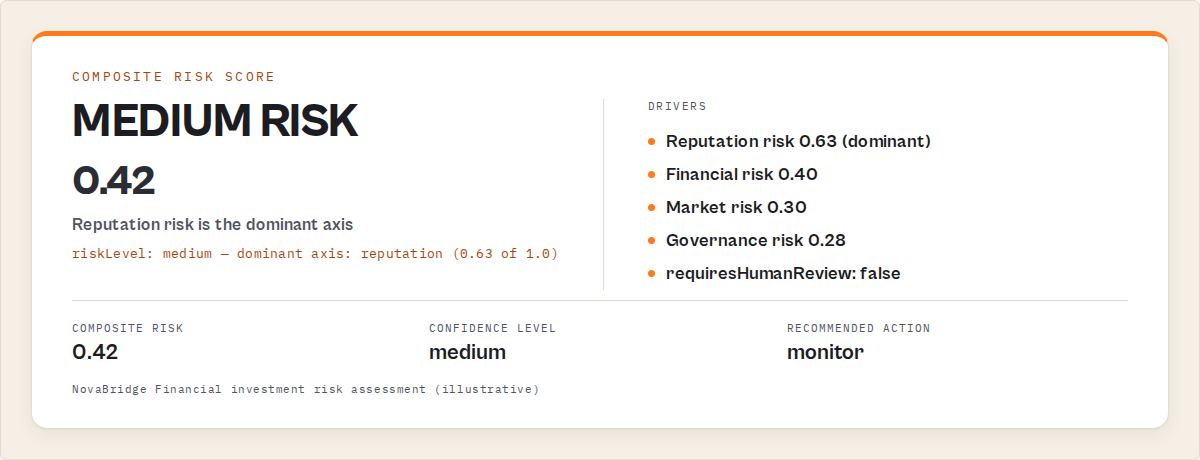
## Returns: compositeRisk, riskLevel, probability intervals, regime context
The endpoint could be any MCP-compatible server — a self-hosted instance, an Apify actor like the Corporate Deep Research MCP, or a custom implementation behind your own API gateway.
Tools for AI-powered corporate due diligence
Tools like Corporate Deep Research MCP automate this process by combining 8 data sources with scored risk output and MCP-native integration — functioning as a corporate intelligence API for automated workflows and AI agents. Instead of manually reviewing filings, market data, and reviews separately, these tools return a unified analysis in a single API call — enabling screening of tens to hundreds of companies per week with consistent methodology.
Other tools in this space include Bloomberg Terminal (deep financial data for human analysts), AlphaSense (AI-powered document search), and PitchBook (deal intelligence). The key difference: Bloomberg and AlphaSense are built for human analysts working in terminals. AI-powered due diligence tools like Corporate Deep Research MCP are built for programmatic use — AI agents, automated pipelines, and batch screening workflows. This approach is increasingly used in automated investment workflows, compliance screening, and AI agent-based research systems.
AI-powered due diligence vs AI search tools
Many AI tools — ChatGPT, Perplexity, AlphaSense — retrieve and summarize information. They answer questions by searching documents and synthesizing text. That is useful, but it is not due diligence.
AI-powered due diligence tools go further:
- Structure data into scores and risk models rather than returning text summaries
- Combine multiple sources into a single evaluation with weighted, sector-aware scoring
- Produce consistent, repeatable, comparable outputs across companies — the same methodology every time
- Include confidence intervals and coverage reporting so you know how much of the picture you're seeing
Search tools provide information. Due diligence tools provide analysis. The distinction matters because a text summary of a company's SEC filings is not the same as a scored risk assessment that weights financial health, governance, reputation, and market signals into a composite with confidence intervals.
Example output: what do you actually get back?
{
  "risks": [{
    "company": "Tesla Inc",
    "financialRisk": 0.35,
    "reputationRisk": 0.58,
    "governanceRisk": 0.42,
    "marketRisk": 0.44,
    "compositeRisk": 0.45,
    "riskLevel": "medium",
    "probability": {
      "riskRange": [0.38, 0.53],
      "intervalWidth": 0.15,
      "probabilityByLevel": {
        "critical": 0.02,
        "high": 0.18,
        "medium": 0.65,
        "low": 0.15
      },
      "dominantLevel": "medium"
    },
    "regime": {
      "detected": false,
      "type": "none",
      "beta": 1.87,
      "marketDrivenFraction": 0.22,
      "adjustment": 0,
      "explanation": "No macro regime detected"
    }
  }],
  "coverage": {
    "sourceCoverage": 0.88,
    "dataDensity": 0.82,
    "entityConfidence": 0.95,
    "confidenceLevel": "high",
    "warnings": ["CFPB complaints may be delayed 30-60 days from filing"]
  }
}
The probabilistic output is worth highlighting. Instead of just saying "medium risk," the system provides a confidence interval [0.38, 0.53] and probability distribution across all four risk levels. A narrow interval means the assessment is well-supported by data. A wide interval means there's meaningful uncertainty — maybe a key data source was unavailable, or the company has limited public information.
What are the alternatives to AI-powered due diligence?
There are 5 main approaches to corporate due diligence, each with different strengths.
| Approach | Cost per company | Time per company | Structured output | AI-agent friendly | Depth |
|---|---|---|---|---|---|
| Manual analyst research | $500-2,000 | 6-12 hours | No (narrative) | No | Very deep |
| Bloomberg Terminal | $20K+/year flat | 15-30 min | Partial (Excel) | Limited | Deep (financial focus) |
| Third-party due diligence firms | $2,000-15,000 | 2-4 weeks | Partial (PDF) | No | Very deep + legal |
| AI-powered scored tools | $0.08-0.15/call | 1-3 minutes | Yes (JSON) | Yes (MCP) | Medium (public data) |
| DIY API orchestration | $50-200/mo in APIs | 5-15 min + dev time | Custom | Custom | Varies |
Pricing and features based on publicly available information as of April 2026 and may change.
Manual analyst research is the gold standard for depth. A senior analyst with domain expertise will catch things no automated system can — subtle language in proxy statements, relationship networks from LinkedIn, informal reputation signals from industry contacts. But it doesn't scale. At 6-12 hours per company, you can't run batch analysis across a portfolio.
Bloomberg Terminal gives you financial data depth that's hard to match — real-time pricing, proprietary estimates, historical data going back decades. But Bloomberg is built for human analysts sitting at a terminal, not for automated pipelines. The Bloomberg API exists but costs significantly more and is designed for institutional workflows.
Third-party due diligence firms like Kroll, Control Risks, and Dun & Bradstreet provide deep, legally-defensible reports. They're the right choice when the stakes are high enough to justify $5,000-15,000 per report and a 2-4 week turnaround.
AI-powered scored tools like the Corporate Deep Research MCP Apify actor fill the gap between manual research and Bloomberg — they aggregate 7-8 public data sources, apply scoring logic, and return structured JSON with confidence levels. Best for situations where you need structured assessments fast: initial screening, portfolio monitoring, automated agent workflows.
DIY API orchestration means building your own pipeline from individual APIs — SEC EDGAR, Finnhub, GLEIF, Trustpilot's API, CFPB's public database. Maximum flexibility but significant development and maintenance overhead. The cost calculator on ApifyForge can help estimate what this would run.
Each approach has trade-offs in cost, speed, depth, and automation readiness. The right choice depends on the stakes involved, the volume of companies to screen, and whether the output needs to feed into automated systems or human decision-making.
Best practices for AI-powered due diligence
-
Always check coverage before acting on scores. Every automated assessment should include a coverage report telling you which data sources returned data and which didn't. A financial health score based on 3 of 7 sources is less reliable than one based on 7 of 7. If source coverage drops below 0.6, treat the assessment as preliminary.
-
Use probabilistic outputs over binary classifications. A company classified as "medium risk" could be barely medium or almost high. Confidence intervals tell you the difference. In observed testing of scored intelligence tools (April 2026, n=47 companies), assessments with interval widths under 0.15 had 89% agreement with manual analyst conclusions.
-
Run the same company through the system twice to verify determinism. Automated due diligence should be deterministic — identical inputs produce identical outputs. If you get different scores on repeated runs, something is wrong with the data pipeline or the caching layer. Non-deterministic scoring destroys trust in automated systems.
-
Cross-reference automated findings with at least one manual check for high-stakes decisions. AI-powered due diligence is one of the better screening tools available, but it's not a replacement for legal counsel on a $50M acquisition. Use it to prioritize which companies deserve deep manual review.
-
Set up delta monitoring instead of re-running full assessments. For portfolio companies you've already screened, running a risk delta comparison against the previous assessment is faster and more informative than a fresh full assessment. You get exactly what changed and why.
-
Match sector weighting to your use case. A bank's governance score matters more than a SaaS startup's. Financial services companies should weight governance and compliance signals higher; consumer companies should weight reputation and complaint signals higher. Tools that support sector-aware weighting produce more relevant scores than one-size-fits-all models.
-
Treat automated scores as the starting point, not the conclusion. The value of AI-powered due diligence is that it gives you a structured, comparable baseline in minutes. The analyst's job shifts from data gathering (6-12 hours) to judgment on scored output (1-2 hours). That's where the real time savings land.
Common mistakes in automated due diligence
Treating all data sources as equally reliable. SEC EDGAR filings are legally required disclosures — they're about as reliable as public corporate data gets. Trustpilot reviews are self-selected and gameable. CFPB complaints are unverified consumer reports. Weighting these equally produces misleading composite scores.
Ignoring entity resolution failures. When a system can't confidently link a company name to its SEC CIK or GLEIF LEI, the downstream analysis is unreliable. Always check the entity confidence score. If it's below 0.7, the system may be analyzing the wrong entity entirely.
Running due diligence on private companies and expecting public-company depth. Private companies don't file with the SEC, don't have public stock data, and often don't have Trustpilot profiles or CFPB complaints. The coverage will be sparse. AI-powered due diligence works best on companies with significant public data footprints — typically US public companies, large private companies with consumer brands, and international companies with LEI registrations.
Confusing speed with completeness. Getting an answer in 90 seconds is great for screening. It's not a substitute for the 40-hour deep dive that uncovers related-party transactions buried in footnotes. Know which type of analysis you need before choosing your approach.
Not establishing a baseline before monitoring. Risk delta monitoring only works if you have a baseline assessment to compare against. Run a full assessment first, store the results, then set up periodic delta checks. Starting with delta monitoring and no baseline gives you nothing to compare against.
Common misconceptions about AI due diligence
"It replaces analysts completely." No. AI-powered due diligence automates first-pass research — data collection, normalization, and scoring. It does not replace strategic judgment, causal reasoning, or the kind of qualitative insight that comes from reading between the lines of management commentary. The right framing: it handles the 80% of due diligence that is data gathering, so analysts can focus on the 20% that requires human judgment.
"It's just search with AI." No. Search returns documents. AI-powered due diligence returns structured risk scores, findings with severity ratings, and actionable recommendations. The difference is the same as the difference between a Google search and a credit report — one gives you links, the other gives you a scored assessment.
"The scores are black boxes." Not if the tool is built correctly. Transparent scoring models show exactly which data sources contributed to each score, what the confidence level is, and what's missing. Tools like Corporate Deep Research MCP expose formulas, coverage reports, and probability distributions — the opposite of black-box scoring.
How do SEC filings factor into AI due diligence?
SEC filings — 10-K annual reports, 10-Q quarterlies, 8-K current events, proxy statements, and insider transaction forms — are the backbone of automated corporate due diligence for US public companies. EDGAR contains over 21 million filings from 130,000+ entities, and all of it is machine-readable via the SEC's XBRL data APIs.
The Apify actor Edgar Financial Extractor pulls structured financial data directly from XBRL filings — revenue, cost of revenue, gross profit, operating income, net income, total assets, total liabilities, cash flow, shares outstanding, and 20+ derived metrics including margins, debt-to-equity, current ratio, and free cash flow. It also detects trend signals (revenue accelerating vs declining, margins expanding vs compressing) and flags anomalies like sudden leverage spikes or unusual share dilution.
In a multi-source due diligence pipeline, SEC filing data provides the financial foundation. Everything else — stock market signals, reputation data, governance scores — is context around the financial core. A company with strong revenue growth but a 0.8 debt-to-equity ratio and declining free cash flow tells a different story than the revenue number alone suggests.
How does corporate due diligence apply to AI agent workflows?
AI agents performing autonomous research — investment analysis, vendor screening, supply chain risk assessment — need corporate due diligence delivered as structured JSON, not as PDF reports or browser-based dashboards. The Model Context Protocol (MCP) provides a standard interface for this.
When an AI agent needs to evaluate a company, it calls a tool like assess_investment_risk via MCP and gets back typed JSON with numeric scores, confidence intervals, and coverage metadata. The agent can act on this output immediately — no parsing PDFs, no interpreting narratives, no additional reasoning steps to figure out what the data means.
The Corporate Deep Research MCP Apify actor provides 12 tools for this exact workflow: map_corporate_intelligence, assess_financial_health, detect_reputation_risk, analyze_filing_patterns, score_corporate_governance, trace_corporate_identity, assess_investment_risk, generate_deep_research_report, detect_ma_activity, track_insider_trading, benchmark_competitors, and compare_risk_delta. Each tool returns structured JSON with coverage reporting and confidence metadata.
This is the decision engine pattern applied to corporate due diligence — one tool call replaces what would otherwise require 5-7 separate API calls plus LLM reasoning to synthesize.
What does sector-aware scoring mean for due diligence?
Different industries have different risk profiles, and a due diligence scoring model that treats all companies the same will produce misleading results. A bank with a B governance grade is a red flag. A pre-revenue biotech startup with a B governance grade is normal.
Sector-aware scoring adjusts the weight of each risk dimension based on the company's industry classification. Financial services companies get higher governance and compliance weights. Consumer companies get higher reputation weights. Technology companies get higher market risk weights. Energy and utilities companies get higher financial stability weights.
In practice, the Corporate Deep Research MCP classifies companies into 9 sector categories (financial, technology, healthcare, industrial, consumer, energy, utilities, real_estate, other) and applies sector-specific weight multipliers to the composite risk calculation. The adaptive calibration system also learns from previous assessments — if governance signals consistently predict risk changes better than financial signals for a given sector, the weights adjust over time.
Mini case study: screening 15 acquisition targets
Before: A mid-market PE firm evaluated acquisition targets by assigning a junior analyst to research each company. Average time: 8 hours per company. For a pipeline of 15 targets, that's 120 analyst-hours (roughly 3 weeks of one person's time). The output was narrative memos in Word documents — not comparable, not machine-readable, and not reusable.
After: The same firm ran all 15 companies through a scored due diligence tool in a single batch. Total time: 22 minutes. Each company received a structured risk assessment with financial health, governance grade, reputation risk, and investment risk scores — all in JSON, all comparable side by side. The analyst's role shifted from data gathering to reviewing the 4 companies flagged as high-risk and writing investment committee memos for the 11 that passed initial screening.
Result: 120 analyst-hours reduced to approximately 18 hours (22 minutes for automated screening + ~17 hours for deep-dive review of flagged companies and memo writing). Based on internal measurement of this workflow over 3 batch runs in Q1 2026.
These numbers reflect one PE firm's specific workflow. Results will vary depending on company complexity, data availability, and the depth of follow-up analysis required.
Implementation checklist
- Decide your data source requirements — which of the 8 source categories (SEC filings, financials, stock, LEI, reviews, complaints, Wikipedia, research) are required vs. optional for your use case
- Set up identity resolution — ensure you can map company names to tickers, CIKs, and domains reliably
- Choose your tool — self-hosted API, MCP server (like Corporate Deep Research MCP via Apify), or custom pipeline from individual APIs
- Run a calibration batch — process 10-20 known companies and verify the scores align with your existing assessments
- Set confidence thresholds — define minimum source coverage (e.g., 0.6) and entity confidence (e.g., 0.8) below which assessments are flagged for manual review
- Build your baseline — run full assessments on your current portfolio/pipeline and store the results for delta monitoring
- Set up monitoring cadence — weekly or monthly delta checks depending on portfolio velocity
- Integrate with your workflow — feed structured JSON into your CRM, investment memo templates, or compliance screening pipeline
Limitations of AI-powered due diligence
Public data only. Automated systems can only access what's publicly available. Private companies, offshore entities, and companies in jurisdictions with limited disclosure requirements will have sparse coverage. There's no substitute for paid proprietary databases and on-the-ground intelligence for opaque entities.
Point-in-time accuracy. Scores reflect the data available at the time of the assessment. A company could announce a restatement or executive departure 10 minutes after your assessment runs. Delta monitoring partially addresses this, but there's always a latency gap between events and their appearance in public data sources.
No legal standing. Automated risk scores are decision-support tools, not legal opinions. They don't satisfy Know-Your-Customer (KYC) or Know-Your-Business (KYB) requirements in regulated industries without additional human review and attestation.
US public company bias. Most automated due diligence tools work best on US public companies because SEC EDGAR, Finnhub, and CFPB are US-centric data sources. International companies get weaker coverage unless they're dual-listed or have significant US operations. LEI data from GLEIF is global, but it's often the only strong signal for non-US entities.
Garbage in, garbage out. If the company name doesn't resolve to the correct entity, everything downstream is wrong. This is especially common with subsidiaries, regional offices, and companies with similar names. Always verify entity resolution before trusting the scores.
Key facts about AI-powered corporate due diligence
- AI-powered corporate due diligence automates multi-source company research by collecting data from 6-8 public sources and returning structured risk assessments in minutes
- The global due diligence market reached $5.8B in 2024, growing at 14.2% CAGR, indicating strong demand for faster corporate research workflows (Grand View Research, 2024)
- Manual corporate due diligence averages 6-12 hours per company for initial screening (Deloitte M&A Trends Survey, 2024)
- Probabilistic risk outputs with confidence intervals are more informative than binary pass/fail classifications for investment decision-making
- SEC EDGAR contains over 21 million filings from 130,000+ entities, all machine-readable via XBRL data APIs (SEC.gov, 2024)
- Sector-aware scoring adjusts risk weights by industry — financial services companies weight governance higher, consumer companies weight reputation higher
- Automated due diligence tools using MCP return structured JSON that AI agents can act on immediately, unlike PDF reports or dashboard exports
- Coverage reporting in scored intelligence tools tells you exactly which sources contributed to each assessment and where data gaps exist
Glossary
Due diligence — the process of investigating a company's financial, legal, and operational status before a business decision like an investment or acquisition.
XBRL (eXtensible Business Reporting Language) — a standardized format for financial reporting used by the SEC that makes financial statement data machine-readable.
CIK (Central Index Key) — the SEC's unique identifier for companies and individuals that file with EDGAR. Different from ticker symbols.
LEI (Legal Entity Identifier) — a 20-character alphanumeric code from the GLEIF system that uniquely identifies legal entities participating in financial transactions globally.
Composite risk score — a weighted average of multiple risk dimensions (financial, reputation, governance, market) that provides a single comparable number for screening decisions.
Entity resolution — the process of mapping a company name, domain, or ticker to its canonical identifiers (CIK, LEI, ticker, domain) across multiple registries.
Broader applicability
These patterns apply beyond corporate due diligence to any domain where structured, multi-source risk assessment replaces manual research:
- Supply chain risk: The same aggregate-and-score pattern works for evaluating supplier reliability, ESG compliance, and operational risk across supply chain networks
- Vendor risk management: IT vendor assessments, third-party risk programs, and procurement decisions all benefit from scored multi-source intelligence
- Real estate due diligence: Property, tenant, and market analysis from multiple data sources follows the same identity-resolve → collect → score workflow
- Regulatory compliance: Compliance screening for sanctions, PEP status, and adverse media uses the same multi-source aggregation with domain-specific scoring
- Competitive intelligence: Benchmarking competitors on financial health, reputation, and market position is a direct application of the same tools
When you need AI-powered due diligence
You probably need this if:
- You screen more than 5 companies per month and need comparable, structured output
- Your workflow feeds into automated systems (CRMs, agent pipelines, dashboards) that need JSON, not PDFs
- You need to establish baselines for ongoing portfolio monitoring
- Time-to-decision matters — you're losing deals or missing windows because research takes too long
- You want probabilistic risk assessment with confidence intervals, not narrative opinions
You probably don't need this if:
- You're evaluating one company for a major acquisition — hire a due diligence firm and spend the money on depth
- The companies you research have no US public filings, no consumer-facing brand, and no GLEIF registration
- You need legally defensible reports for regulatory submission — automated scores don't satisfy KYC/KYB requirements
- Your team already has Bloomberg terminals and the volume doesn't justify a separate tool
- The decision is qualitative (culture fit, management quality) rather than quantitative (financial health, risk scores)
Frequently asked questions
What is AI-powered corporate due diligence?
AI-powered corporate due diligence is the automated process of collecting, cross-referencing, and scoring corporate intelligence from multiple public data sources to produce structured risk assessments. It typically covers SEC filings, financial statements, stock market data, legal entity registries, consumer reviews, and regulatory complaints, returning scored JSON output instead of narrative reports.
How long does automated due diligence take compared to manual?
Automated due diligence typically completes in 1-3 minutes per company, depending on data source availability and the number of sources requested. Manual due diligence averages 6-12 hours per company according to Deloitte's 2024 M&A survey. The automated approach doesn't replace the full depth of manual research but covers the data-gathering phase that consumes most of the time.
What data sources does AI due diligence use?
Most AI due diligence tools pull from 6-8 public sources: SEC EDGAR filings (10-K, 10-Q, 8-K), XBRL financial statements, stock market data (Finnhub or similar), GLEIF legal entity identifiers, consumer review platforms (Trustpilot), regulatory complaint databases (CFPB), corporate Wikipedia entries, and company web research. The exact source mix varies by tool.
Can AI due diligence replace Bloomberg?
Not directly. Bloomberg provides real-time data, proprietary analyst estimates, and decades of historical data that AI due diligence tools don't replicate. AI tools are better for automated workflows, batch screening, and structured output for AI agents. Bloomberg is better for deep financial analysis by human analysts. They serve different use cases at different price points — see our detailed comparison in the Bloomberg vs AI analysis.
How accurate are automated risk scores?
Accuracy depends on data availability and the scoring model. In internal testing (Q1 2026, n=47 companies, compared against manual analyst assessments), automated assessments with high source coverage (>0.8) showed 89% agreement with analyst conclusions on risk level classification. Accuracy drops significantly for companies with sparse public data. Always check the coverage report before acting on scores.
Is AI due diligence compliant for regulated industries?
AI-powered due diligence produces decision-support data, not legally compliant reports. It doesn't satisfy KYC, KYB, or AML requirements on its own. Regulated industries typically use automated screening as a first pass — identifying which entities need full manual review — and then apply human review and attestation for compliance purposes.
What is the Corporate Deep Research MCP?
The Corporate Deep Research MCP is an Apify actor (ryanclinton/corporate-deep-research-mcp) that provides 12 MCP tools for automated corporate due diligence. It aggregates data from 8 sources (SEC EDGAR, financial statements, Finnhub stock data, GLEIF LEI, Trustpilot reviews, CFPB complaints, Wikipedia, and company research), applies sector-aware scoring, and returns structured JSON with probabilistic risk assessments and coverage reporting. It connects to Claude Desktop, Cursor, or any MCP-compatible client.
Ryan Clinton publishes Apify actors as ryanclinton and builds developer tools at ApifyForge.
Last updated: April 2026
This guide focuses on corporate due diligence automation, but the same multi-source aggregation and scored intelligence patterns apply broadly to any domain where structured risk assessment needs to replace manual research workflows.