By Ryan Clinton — Apify Store creator publishing as ryanclinton at ApifyForge.
The problem: the entire supply chain risk category — Resilinc, Everstream, Interos, Prewave, project44, FourKites, Exiger, Z2Data, World-Check — was built around a human sitting in front of a dashboard. Maps. Heatmaps. Alert feeds. Risk scores between 0 and 100. Every one of those design choices assumes a reader who can prioritise, ignore, contextualise, and route. In 2026 a growing share of supply chain decisions are being made by AI agents inside ERP copilots, TMS automations, and procurement assistants. Those agents don't read pixels. They read enums. The category is mid-shift, and the visibility platforms are on the wrong side of it.
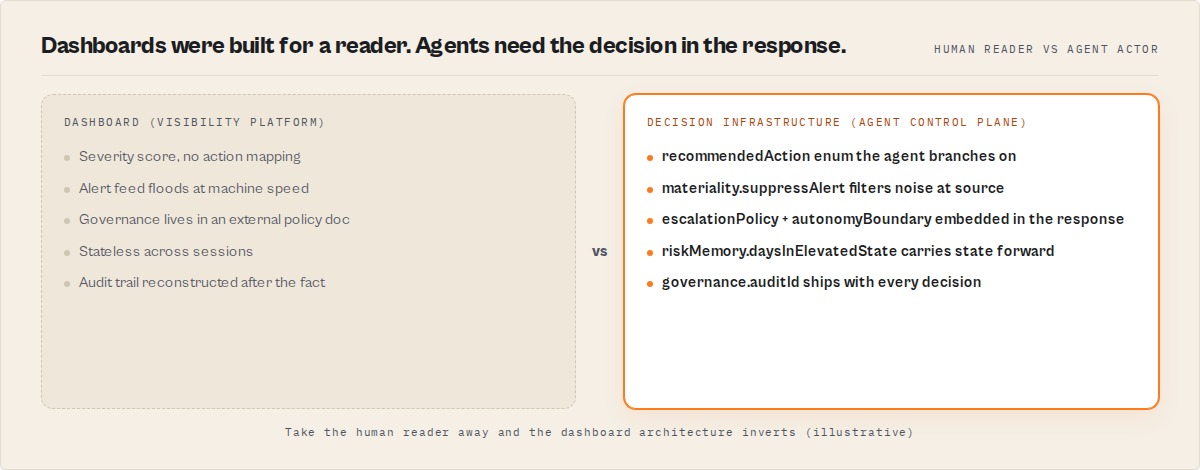
Dashboards externalise decisions onto humans. Decision infrastructure internalises them in machine semantics. That sentence is the whole post. Everything below is what it means in practice.
The operational control plane, in one diagram
Public signals (NOAA, OFAC, OpenSanctions, COMTRADE, BLS, OECD, World Bank, FX, GDACS)
                                  │
                                  ▼
                      Per-source typed parsing
                                  │
                                  ▼
        Risk scoring (route, compliance, freight cost, border delay)
                                  │
                                  ▼
      Memory + velocity + materiality + dependency exposure
                                  │
                                  ▼
                       DECISION ENVELOPE
   ┌──────────────────────────────────────────────────────┐
   │ recommendedAction  ·  blockAutomations[]            │
   │ confidence.recommendedHandling  ·  riskTier         │
   │ materiality.suppressAlert  ·  agentInstructions     │
   │ governance.autonomyBoundary  ·  decisionAuditId     │
   └──────────────────────────────────────────────────────┘
                                  │
                                  ▼
        AI agents · ERP copilots · TMS · BI · Jira · Slack · Make · Zapier
One layer in. One envelope out. Every downstream consumer branches on the same enums.
What is decision infrastructure? Decision infrastructure is an operational control plane that converts supply chain signals into deterministic, machine-readable verdicts an AI agent can act on without parsing prose or interpreting charts. It emits stable enums, confidence bands, escalation policies, and materiality flags instead of dashboards and alert streams.
Why it matters: AI agents now operate supply chains end-to-end inside copilots and ERP automations. Visibility tooling built for human dashboards forces every agent to re-interpret raw data, hallucinate logistics specifics, and emit decisions with no governance trail. Decision infrastructure removes the interpretation layer and ships the verdict.
Use it when: you're wiring a procurement or logistics AI agent that has to approve, hold, or escalate shipments without a human reviewer, or you're paying for a visibility platform whose only consumer is a human reading the screen.
Also known as: operational control plane for AI agents, machine-readable supply chain decisions, AI-native supply chain risk, agent-grade risk infrastructure, deterministic operational decision layer, autonomous supply chain monitoring.
Quick answer:
- Is: machine-safe operational layer between data sources and AI agents.
- Emits: enums, booleans, structured arrays. No prose. No pixels.
- Use for: autonomous shipment approval, TMS routing, supplier onboarding, procurement copilots, ERP-embedded risk gating.
- Skip for: human-only command centres, executive narrative reporting, ad-hoc analyst exploration.
- Pipeline: signals → score → envelope → governance gate → agent action.
- Tradeoff: opinionated rules in exchange for an automation surface agents can act on unsupervised.
Problems this solves:
- How to give an AI agent supply chain risk data it can actually act on
- How to gate autonomous procurement approvals by confidence
- How to suppress non-material supply chain alerts before they hit an agent
- How to make supply chain decisions auditable for governance
- How to connect Resilinc / Everstream-style data to AI agents without a human bottleneck
- How to integrate supply chain risk into an ERP copilot or TMS automation
In this article: What decision infrastructure is · Why dashboards fail for AI agents · The five operational verbs · What the envelope looks like · Visibility platforms vs decision infrastructure · Alternatives · Limitations · FAQ
Key takeaways:
- A risk score is not a decision. The score is the input; the decision envelope is the output.
- Decisions belong in enums, not pixels.
decisionProfile.recommendedAction = "BLOCK_AUTOMATION"is something an agent can branch on. A red heatmap tile is not. - Dashboards externalise decisions onto humans. AI agents need governance internalised in the response.
- Confidence bands map to autonomy.
confidence.recommendedHandling = "automate" | "human_review" | "advisory_only"is the governance primitive that gates how much an agent is allowed to do unsupervised. - Materiality suppresses noise. A 7.2-magnitude earthquake in Vanuatu is irrelevant to a Frankfurt buyer with no Pacific exposure.
materiality.suppressAlert = trueis the field that stops alert spam at the agent boundary. - Operational automation fails at the interpretation layer. Removing that layer is what decision infrastructure does.
- Generic AI agents on raw data hallucinate logistics specifics, can't maintain longitudinal memory, and emit no governance trail. A machine-safe decision layer in front of them is what makes autonomous procurement workable.
Concrete examples — what the shift looks like
| Scenario | Dashboard category output | Decision infrastructure output |
|---|---|---|
| Magnitude 7.2 quake near a supplier's region | Map pin, severity score 78, push notification | recommendedAction: "HOLD_INBOUND", confidence.recommendedHandling: "human_review", materiality.exposedSuppliers: 3 |
| New OFAC designation matches a counterparty | Red row on screening dashboard | blockAutomations: ["wire_transfer", "po_release"], governance.autonomyBoundary: "ESCALATE_LEGAL" |
| Port congestion in Long Beach | Heatmap tile, delay estimate banner | riskVelocity: "ACCELERATING", riskHorizons.next30d: "ELEVATED", recommendedAction: "REROUTE_VIA_OAKLAND" |
| 90 minor news mentions on a non-strategic Tier 3 supplier | 90 alerts in inbox | materiality.suppressAlert: true, surfaces in next monthly get_portfolio_intelligence rollup |
| Sanctions match, low-confidence name overlap | Yellow flag awaiting analyst review | confidence.recommendedHandling: "advisory_only", agentInstructions.safeToAutoApprove: false, escalationPolicy.assignTo: "compliance" |
What is decision infrastructure?
Definition (short version): Decision infrastructure is an operational control plane that sits between supply chain data sources and AI agents, converting signals into machine-safe, reproducible verdicts the agent can act on without interpretation.
Where a dashboard answers "what's happening?", decision infrastructure answers "what should the agent do, with what confidence, under what governance boundary, and what does the audit trail say?" It's a different output shape, not a faster dashboard.
The category has three layers. The data layer is the public and licensed sources every visibility platform already touches: hazard feeds, sanctions lists, customs records, macro indicators. The scoring layer turns raw signals into risk velocity, recovery forecasts, and exposure projections. The decision layer is the new one — it emits a machine-safe envelope: recommended action, confidence band, escalation policy, materiality flag, governance trace. AI agents consume the decision layer. Humans consume the dashboard view of the same underlying data, if they want one.
There are three operational outputs the decision layer produces: a real-time, per-call response when an agent asks a tool a question; a batch, scheduled run that emits one row per portfolio entity for ERP and BI consumers; and a longitudinal memory store that lets the next agent call see how the risk picture has moved since the last one. All three share the same envelope.
Why do AI agents need different infrastructure than dashboards?
AI agents don't read pixels, can't hold context across sessions on their own, and hallucinate domain specifics when handed raw data. A dashboard externalises every decision back onto a human reader. An agent has no such reader. Hand an LLM a JSON blob with 47 risk indicators and no decision envelope, and it will invent a justification for whatever action it picks. That is not autonomy. That is roulette.
The infrastructure shift maps to four concrete failures of the dashboard generation:
- Interpretation tax. Dashboards encode visibility. An agent has to re-interpret every row to act. A decision envelope removes the interpretation step entirely.
- Alert fatigue at machine speed. Human dashboards assume a reader who ignores most alerts. An agent will dutifully process all of them. Without materiality suppression, every 4.0 earthquake in an unrelated region becomes a tool call.
- No governance surface. Dashboards have no concept of "this decision is high-confidence enough to automate" versus "this needs a human." Agents need that gate encoded in the response, not in a Confluence policy doc.
- No memory. A dashboard is stateless. An agent that screens the same supplier twice a week with no memory of last week's findings produces inconsistent decisions. Longitudinal
riskMemory.daysInElevatedStateand similar fields are how the decision layer remembers.
This isn't a critique of the visibility platforms. They were the right answer for the problem they were built for — a human risk analyst running a war room. They are the wrong answer for an AI agent inside an ERP making procurement decisions at 3am.
The hard truth: dashboards fundamentally break under autonomous systems
Visibility platforms aren't slightly suboptimal for AI agents. They're load-bearing on an assumption that no longer holds.
The assumption: there is a reader. A human who scans the screen, weighs the alerts, decides what matters, decides what to ignore, decides what to escalate, and routes the consequence. Every UX choice in the dashboard era — colour-coded severity tiles, alphanumeric risk scores, alert badges, maps with cluster markers — was a compression strategy for that human reader's attention.
Take the reader away and the whole architecture inverts:
- Severity colours don't compose. Red on a map is a signal to a human that something matters. To an agent, red is
#dc2626— a string, not a decision. The agent reasks the question: at what numeric threshold is#dc2626triggered? Which automation responds? Who is notified? The dashboard never answered those questions because the human reader was the answer. - Alert feeds don't degrade gracefully. When 90 minor news items hit a human-era dashboard, the analyst skims. When 90 hit an AI agent with no materiality filter, the agent makes 90 tool calls, 90 LLM completions, and 90 decisions, each of which costs money and emits operational noise.
- Risk scores aren't decisions. A score of 78 tells a human "look closely." It tells an agent nothing about whether to BLOCK_AUTOMATION, HUMAN_REVIEW, or PROCEED. Mapping scores to actions is an interpretation step the human used to perform silently. Stripped of that human, the interpretation has to be encoded explicitly — which is what the decision envelope does.
- No governance trail is fatal. Compliance reviewers asking "why did the agent approve this PO?" cannot reconstruct an answer from screenshots of a dashboard the agent never read. The audit trace has to be part of the response, not part of the UI.
The pattern repeats domain by domain. Anywhere a human-era platform was the interface between data and a decision, removing the human breaks the platform. Decision infrastructure is what fills the gap.
Monitor → Detect → Decide → Escalate → Audit
The five operational verbs of decision infrastructure replace the single dashboard verb of display.
Monitor is continuous ingestion of public and licensed sources against a defined portfolio. Public hazard feeds, sanctions designations, customs records, macro indicators. Not stored as alerts. Stored as state.
Detect is the materiality filter. Same earthquake reaches all subscribers. The decision layer asks: which subscribers actually have exposure to the affected region, at what tier, with what concentration risk? Only the subscribers with material exposure get a downstream signal. Everyone else gets nothing, which is the correct answer.
Decide is the policy-safe envelope. Given the detected event and the portfolio context, the decision layer emits a recommended action from a stable enum, a confidence band, a list of automations that should be blocked, and a structured rationale. This is the field an agent branches on.
Escalate is the autonomy boundary. Even high-confidence decisions sometimes need a human. Compliance hits, novel risk patterns, multi-event correlations. The envelope ships an escalationPolicy with assignee role, SLA, and the specific automations to suspend until a human signs off.
Audit is the governance trace. Every decision the layer emits carries the inputs that produced it, the scoring weights applied, the version of the rule set, and the timestamp. Six months later, when procurement asks why a shipment was held, the trace answers without anyone having to reconstruct it.
Dashboards do step one. Decision infrastructure does all five.
What does a decision envelope look like?
Concrete shape, drawn from the logistics-freight-intelligence-mcp Apify actor's output schema. These are the fields that make a response machine-readable to an agent.
{
  "entity": "Supplier ABC GmbH",
  "decisionProfile": {
    "recommendedAction": "HOLD_INBOUND",
    "rationale": "Sanctions match on parent entity within last 14 days, exposure tier 1.",
    "appliedScoringWeights": "v2.7"
  },
  "confidence": {
    "score": 0.86,
    "recommendedHandling": "human_review",
    "band": "HIGH_BUT_NOT_AUTOMATABLE"
  },
  "escalationPolicy": {
    "assignTo": "compliance",
    "slaHours": 4,
    "blockAutomations": ["wire_transfer", "po_release", "new_shipment_book"]
  },
  "materiality": {
    "suppressAlert": false,
    "exposedSuppliers": 3,
    "portfolioImpactTier": "MATERIAL"
  },
  "riskMemory": {
    "daysInElevatedState": 14,
    "lastChangeDirection": "DETERIORATING",
    "scoreVelocity": -0.12
  },
  "agentInstructions": {
    "safeToAutoApprove": false,
    "suggestedNextTools": ["get_sanctions_history", "get_alternative_routes"]
  },
  "governance": {
    "autonomyBoundary": "ESCALATE_LEGAL",
    "auditId": "lfi-2026-05-17-0001",
    "decisionVersion": "v2.7"
  }
}
Five things to notice. First, every routable field is a stable enum or numeric, not prose. An agent doesn't need to parse English to act. Second, confidence.recommendedHandling is the governance gate. The agent reads that field before it reads anything else, and it knows what it's allowed to do. Third, escalationPolicy.blockAutomations[] is an explicit list of downstream actions the agent must refuse to perform until the escalation is resolved. Fourth, riskMemory.daysInElevatedState carries longitudinal state across sessions — the field is the memory primitive that lets stateless tool calls behave statefully. Fifth, governance.auditId is the breadcrumb the compliance team will use six months later to answer the "why did we hold this shipment?" question without reconstructing anything.
This isn't a different dashboard. It's a different category of output.
Visibility platforms vs decision infrastructure
| Dimension | Visibility platforms (Resilinc, Everstream, Interos, project44, FourKites) | Decision infrastructure |
|---|---|---|
| Primary consumer | Human risk analyst at a desk | AI agent inside an ERP, TMS, or procurement copilot |
| Output shape | Dashboards, heatmaps, alert feeds, push notifications | Stable enums, confidence bands, escalation policies, structured arrays |
| Materiality | Severity-weighted, sorted in a list | Portfolio-aware, suppressed at source if non-material |
| Governance | External (policy docs, runbooks, training) | Embedded in the response (autonomyBoundary, blockAutomations) |
| Memory | Per-session, externalised to BI tools | Longitudinal, exposed as riskMemory fields the agent can read |
| Audit trail | Implicit, reconstructed from logs | Explicit auditId + decisionVersion per decision |
| Pricing | Enterprise SaaS, often six-figure annual contracts | Per-call or per-row, pay only when a decision is requested |
| Failure mode under AI agents | Agent hallucinates from raw data | Agent acts on governed envelope or refuses |
Comparison based on publicly available information as of May 2026 and may change. Visibility platforms named are real category leaders and are excellent at what they were designed for; the contrast above is about what an AI-agent consumer needs, not about quality of the underlying data layer.
What are the alternatives to a decision layer?
Four approaches teams reach for when they try to wire AI agents into supply chain decisions. Each has trade-offs in latency, governance, and what breaks at scale.
1. Hand the agent raw API access to public sources. NOAA, GDACS, OFAC, OpenSanctions, UN COMTRADE, BLS, World Bank, OECD, central bank exchange rates — every one has a public endpoint. Teams sometimes wire the agent directly. Where this breaks: you still own materiality scoring, portfolio correlation, confidence calibration, escalation logic, and the governance trace. An LLM looking at raw OFAC JSON will hallucinate logistics specifics within three calls. The agent answers fast, but it answers wrong.
2. Wrap a visibility platform's API behind an MCP shim. Resilinc, Everstream, and others publish APIs. A thin MCP shim makes them callable from Claude or Cursor. Where this breaks: the underlying payload was designed for dashboard rendering. The agent reads severity scores, free-text alerts, and map coordinates. No confidence band, no autonomy boundary, no audit ID. You've made an agent-callable interface to a human-shaped data model. The agent now hallucinates from a more expensive source.
3. Build a custom decision layer in-house on top of existing data. Some procurement teams build a scoring engine internally and wire it to their TMS. Where this breaks: the engine works. The maintenance burden does not. You're now running calibration, schema drift detection, source-failure handling, escalation policy versioning, audit replay, and confidence band tuning as a perpetual internal product. That's a small platform team, not a script. Most teams underestimate the build by an order of magnitude.
4. Subscribe to one of the visibility platforms and accept the human-in-the-loop bottleneck. The fallback is what most enterprises actually do. Where this breaks: every supply chain decision now waits for a human analyst to read the dashboard. That is the bottleneck this entire category of AI tooling is supposed to remove. You bought autonomous infrastructure and chained it back to a desk.
The right choice depends on portfolio size, audit requirements, and how much of the decision surface needs to be autonomous versus advisory. For autonomous workflows specifically, the decision layer is the architecturally correct answer — but it has to be designed for agents from the first envelope field, not retrofitted onto dashboard data.
The two-layer pattern: real-time MCP plus batch twin
Real autonomous supply chains need both a real-time path and a batch path. The MCP path is what a procurement agent inside Claude Desktop or Cursor calls when a buyer asks "is it safe to release the PO to Supplier ABC today?" — sub-second, per-call, conversational. The batch path is what the ERP's scheduled job emits every night to refresh the supplier master with current risk envelopes, ready for the TMS's morning shipment-booking loop.
ApifyForge ships both, sharing the same scoring engine. The Logistics Freight Intelligence MCP server is the real-time AI-agent control plane (Streamable HTTP MCP for Claude Desktop, Cursor, and Cline). Sixteen tools across nine data sources, with five free memory and routing tools (get_entity_memory, get_portfolio_intelligence, dispatch_by_intent, get_decision_audit, recommend_alternative_routes) that an agent can call without compute charges. Per-call pricing for the scoring tools sits in the $0.10-$0.30 range. The batch twin actor takes the same engine and emits one dataset row per entity, designed for ERP, TMS, BI, Zapier, Make, and n8n consumers running scheduled portfolio sweeps at $0.30 per result. Same envelope, two integration modes.
This is the pattern the category needs. A control plane the agent talks to in real time, and a scheduled feed the surrounding enterprise tooling consumes. Both grounded in the same orchestration-safe engine. ApifyForge's broader MCP server catalogue follows the same pattern across other operational domains.
Why generic AI agents on raw data don't work for supply chains
I'll be direct: handing an LLM raw NOAA, OFAC, or COMTRADE responses and asking it to make supply chain calls is a category mistake. Three reasons.
Hallucination of logistics specifics. LLMs are confident bullshitters about INCOTERMS, HS codes, shipping lanes, and bonded warehouse rules. A model will tell you Rotterdam handles container traffic that actually moves through Antwerp, and it will not flag the uncertainty. Logistics is the domain where being slightly wrong is operationally identical to being completely wrong.
No longitudinal memory. A stateless tool call cannot know that the same supplier has been in elevated risk state for fourteen days, that two sanctions hits in the last quarter were false positives, or that the buyer's last decision was to dual-source rather than hold. Without that memory, every call starts from zero, and the agent's decisions oscillate.
No governance surface. Even when the model gets the answer right, there's no machine-readable record of which autonomy boundary was applied, which scoring version was active, or which inputs were considered. Six months later, when an auditor asks why a shipment was held during a regional event, "the LLM said so" is not a defensible answer.
The decision layer fixes all three. Domain logic is encoded in reproducible rules, not the model's pretraining. Memory is exposed as structured fields the agent reads on every call. Governance is shipped in the envelope, not in a separate runbook.
Mini case study — a procurement agent without and with the layer
Without the decision layer: a buyer asks her procurement copilot "should I release the PO for Supplier ABC for next week's shipment?" The agent calls four public APIs, parses 12 KB of mixed JSON, and replies "no current sanctions hits, regional weather looks fine, recent customs data is normal — looks safe to proceed." The buyer releases the PO. Three days later it surfaces that the supplier's parent entity was added to a sanctions list six days earlier, on an obscure designation list the agent's free-text parsing didn't recognise.
With the decision layer: same question. The agent calls one tool. Response includes decisionProfile.recommendedAction = "HOLD_INBOUND", escalationPolicy.blockAutomations = ["po_release"], confidence.recommendedHandling = "human_review", and materiality.exposedSuppliers = 3. The agent refuses to release the PO, escalates to compliance, and references governance.auditId = "lfi-2026-05-17-0001" in the ticket. The hold takes 90 seconds. The audit trail is automatic.
That gap — between an agent that confidently approves the wrong action and an agent that emits a policy-safe refusal with a governance reference — is what decision infrastructure is for. Numbers vary by domain and portfolio specifics; the failure mode does not.
Where decision infrastructure shows up in real enterprise workflows
The procurement agent above is one shape. The same envelope drops into five other operational surfaces without code changes — the decision is the integration:
ERP shipment approval gate. An ERP-embedded copilot (SAP, Oracle, NetSuite, Dynamics) asks the decision layer before releasing every inbound shipment over a value threshold. The response gates on escalationPolicy.blockAutomations containing "shipment_release". Released shipments carry the governance.auditId into the ERP audit log; held shipments route to a compliance queue with the rationale and the source signal IDs.
TMS exception routing. A TMS handles a port disruption alert by querying the decision layer with the affected lane. The response's recommendedAction = "REROUTE_VIA_<alt>" and riskHorizons.next7d = "ELEVATED" drive the routing engine's automated lane swap. Without the layer, the TMS would forward the disruption alert to a planner; with it, the reroute happens before the planner sees the inbox.
Customs and origin compliance. A customs broker's classification agent asks the decision layer about an entity before filing entry. The response's complianceLevel, originRisk, and confidence.recommendedHandling determine whether the broker's automation files automatically, queues for review, or rejects outright. Audit replay covers the post-clearance audit window automatically.
Supplier onboarding governance. A new-supplier intake form triggers the decision layer with the prospective vendor's legal name and registered address. The response carries sanctionsScreening.result, materiality.score, and governance.autonomyBoundary. Onboarding workflows that previously took five business days of analyst review now resolve in under an hour when the response is "AUTO_APPROVE" or "HUMAN_REVIEW" with the rationale pre-loaded.
Insurance underwriting and renewal. Cargo insurance and trade credit lines depend on counterparty risk. An underwriting agent queries the decision layer at quote time and on renewal. riskMemory.daysInElevatedState, dependencyExposure, and the longitudinal riskVelocity feed directly into pricing and binding decisions, with the decisionAuditId referenced on every policy doc.
Finance accounts payable. Wire transfers to flagged jurisdictions or to entities with a sanctions screening flag get gated through the decision layer. AP automation reads blockAutomations: ["wire_transfer"] and routes the payment to a treasury reviewer. The audit trail satisfies AML compliance review without the AP team building a separate screening pipeline.
The pattern across all six: the consuming system never parses prose, never interprets a heatmap, never makes the judgement call itself. The decision is the API.
Common misconceptions
"This is just a structured API on top of existing risk data." No. A structured API returns clean fields. A decision envelope returns a verdict, a confidence band, an autonomy boundary, an audit ID, and a list of automations to suspend. The shape is the product. Strip the envelope and you have a structured API, which is what the visibility platforms already sell.
"AI agents will eventually read dashboards directly via vision models." Maybe. They still won't know which alert is material to a specific portfolio without an external materiality layer, and they still won't emit a governance trace by reading a screenshot. Vision-on-dashboards is a regression to the dashboard pattern, not a step past it.
"My team isn't autonomous yet, so this is premature." Most procurement and TMS teams are running co-pilots today that suggest actions a human approves. Even the co-pilot path benefits from a decision envelope, because it reduces the human-review surface from "read all the data" to "approve or override the envelope." The infrastructure pays off well before full autonomy.
"The MCP is a hype wrapper." The MCP is a transport. The decision envelope is the substance. The same envelope ships out of the batch twin actor for consumers that don't run MCP. The architecture is the point; MCP is the convenient real-time delivery shape.
Best practices for designing decision infrastructure
- Make every routable field a stable enum or numeric. Free text is for explanation, not branching. Enums survive model upgrades and downstream automation changes; prose does not.
- Ship a
confidence.recommendedHandlingfield on every response. This is the autonomy gate. Without it, every agent has to invent its own confidence interpretation, and they all invent differently. - Embed governance in the envelope, not in external docs.
autonomyBoundary,blockAutomations[],escalationPolicy.assignTo— these need to ride with the decision so an automation can refuse to act without consulting an external policy store. - Treat materiality as a first-class field.
materiality.suppressAlertandportfolioImpactTierstop alert fatigue at the source. Without this, every macro signal becomes an agent tool call. - Expose longitudinal memory as structured fields.
riskMemory.daysInElevatedState,scoreVelocity,lastChangeDirection. Stateless tool calls behave statefully when the state is encoded in the response. - Version the rule set explicitly.
decisionVersionandappliedScoringWeightsin every envelope. Six months later, an audit needs to reproduce the decision with the rules that were active at the time. - Provide free routing and memory tools alongside paid scoring tools. An agent that can ask "what do I already know about this entity?" without a compute charge is an agent that gets used. The Logistics MCP keeps five tools free for exactly this reason.
Common mistakes
- Wrapping a dashboard API in MCP and calling it agent-ready. The agent still gets dashboard-shaped data; the envelope is missing.
- Letting the LLM compute confidence. Confidence has to be reproducible from inputs, not generated by the model. Otherwise the autonomy gate is a vibes check.
- Returning prose rationale only. Agents will branch on the rationale text and get it wrong on phrasing variants. Always pair prose with an enum.
- No audit ID in the response. Six months later, you cannot reconstruct what the agent saw. This is the single most common omission in DIY decision layers.
- Materiality suppression done downstream. If you suppress in a Slack rule rather than in the response, you're paying for an inference call and an agent tool call to produce a signal you then discard. Suppress at source.
Implementation checklist
- Identify the autonomous-or-co-pilot supply chain workflows on your roadmap (procurement, TMS exception routing, supplier onboarding, shipment approval).
- List the agents that will consume risk data and their consumption mode — real-time MCP, batch ERP feed, or both.
- Define the autonomy boundaries: which actions the agent is allowed to take at
confidence.recommendedHandling = "automate", which require"human_review". - Wire the decision layer in front of your existing data sources before you wire the agent.
- Test agent refusal paths first. An agent that correctly refuses to act on a low-confidence response is the trust unlock; an agent that acts confidently is the failure mode.
- Capture every
governance.auditIdinto your existing compliance store from day one. - Run a parallel period against your existing visibility tooling to validate materiality suppression isn't dropping signal you actually need.
Limitations
This isn't magic, and the manifesto framing shouldn't obscure where the category genuinely stops being the right answer.
- Human war-room workflows still need dashboards. A risk analyst running a live disruption response wants the map, the heatmap, the searchable feed. The decision layer is for the agent path, not the human path. Most enterprises will run both.
- The decision layer is only as good as the rule set. Garbage rules in, reproducible garbage out. The advantage is that the garbage is auditable, which is enough to find and fix the rule. But there's no free lunch on the underlying scoring logic.
- Confidence bands need calibration. A
confidence.recommendedHandling = "automate"field is meaningless if the calibration is wrong. This needs periodic review against actual outcomes, the same way fraud models need periodic review. - Per-call pricing economics are different from enterprise SaaS. A team running thousands of agent calls a day on a paid scoring tool may pay more than an annual SaaS seat. The trade is that you pay only when a decision is requested and the consumer is an agent, not a chair.
- The category is young. Conventions for envelope shape, confidence band semantics, and escalation policy structure are still settling. Expect schema evolution. Version every response.
Key facts about decision infrastructure for autonomous supply chains
- Decision infrastructure converts supply chain signals into deterministic, machine-readable verdicts an AI agent can act on without parsing prose.
- The five operational verbs are Monitor, Detect, Decide, Escalate, and Audit — replacing the single dashboard verb of display.
confidence.recommendedHandlingis the autonomy gate that maps directly toautomate,human_review, oradvisory_onlyagent paths.materiality.suppressAlertstops alert fatigue at source by filtering on portfolio-specific exposure before signals reach the agent.escalationPolicy.blockAutomations[]is an explicit list of downstream actions the agent must refuse until escalation resolves.riskMemory.daysInElevatedStateis the longitudinal memory primitive that makes stateless tool calls behave statefully.governance.auditIdanddecisionVersionride on every response, so audit replay is possible without reconstructing the inputs.- Generic AI agents on raw public-source data hallucinate logistics specifics, have no longitudinal memory, and produce no governance trace.
- The right architecture is a real-time MCP path for agent conversations plus a batch twin for ERP and TMS consumers, sharing one scoring engine.
When you need this
You probably need decision infrastructure if:
- An AI agent in your stack will approve, hold, or escalate procurement or shipment actions without a human in the loop.
- You're integrating supply chain risk into an ERP copilot, TMS automation, or procurement assistant.
- Compliance has asked how the next agent-driven decision will be audited and you don't have a clean answer.
- Your visibility platform's primary consumer is a dashboard nobody opens, but the underlying data does feed downstream automations.
You probably don't need this if:
- Your supply chain operations are still fully manual and the bottleneck is data, not decisions.
- You have a human risk-analyst team running a war-room workflow and no autonomous agent path planned.
- Your portfolio is small enough that a single analyst on a dashboard outperforms any automation.
- You haven't shipped any AI agent integrations yet and aren't planning to in the next 12-18 months.
Broader applicability
The decision-infrastructure pattern isn't unique to logistics and freight. The same shape applies anywhere AI agents need to act on third-party signals:
- Compliance screening. Sanctions, PEPs, adverse media — agents need confidence bands and escalation policies, not red flags on a screen. See compliance screening MCPs at ApifyForge.
- Counterparty due diligence. ESG, financial-crime, supply-chain audit — the counterparty due diligence MCP ships a similar envelope.
- Disaster monitoring. Same pattern, different sensors. Covered in detail in disaster monitoring: decisions, not alerts.
- Brand and narrative intelligence. Agents acting on PR and reputation signals need the same envelope.
- Lead generation and account scoring. The pattern is identical: enum verdicts beat dashboards for any agent-consumed signal.
The principle is general: any time the consumer of risk or operational data is an AI agent, the right shape is a decision envelope, not a dashboard. This pattern shows up in decision-first analytics, in why AI agents need decision engines, not APIs, and in the operational lifecycle of decision engines on Apify.
Glossary
Decision envelope — the structured response shape that ships a recommended action, a confidence band, an escalation policy, a materiality flag, and a governance trace as machine-readable fields.
Autonomy boundary — the field that tells the agent how much of the decision it's allowed to act on unsupervised, versus what must be escalated.
Materiality suppression — filtering non-portfolio-relevant signals before they reach the agent, so the agent isn't paying tool-call cost on irrelevant macro noise.
Confidence band — a discretised confidence interval mapped to an agent autonomy mode (automate, human_review, advisory_only).
Longitudinal memory — structured fields on every response that carry state across stateless tool calls, so the agent sees the trajectory of risk, not just the current snapshot.
Audit replay — the ability to reconstruct exactly what an agent saw and decided at a past moment, using auditId plus decisionVersion plus the scoring weights in effect.
Frequently asked questions
What is decision infrastructure in supply chain risk?
Decision infrastructure is an operational control plane that converts supply chain risk signals into deterministic, machine-readable verdicts an AI agent can act on without interpretation. It emits stable enums, confidence bands, escalation policies, and materiality flags in place of dashboards and alert feeds, and it carries governance traces so every agent decision is auditable. It sits between the underlying data layer and the agent.
How is this different from Resilinc, Everstream, project44, or FourKites?
Those platforms are excellent visibility tools designed for a human risk analyst reading a dashboard. Their primary consumer is a person; their output shape is maps, heatmaps, alert feeds, and severity scores. Decision infrastructure is designed for an AI agent as the primary consumer; its output shape is enums, booleans, structured arrays, and governance fields. Different output shapes for different consumers, on top of overlapping underlying data sources.
Why can't an AI agent just read raw NOAA, OFAC, or COMTRADE data directly?
Three reasons. First, LLMs hallucinate logistics specifics — INCOTERMS, HS codes, lane routing — when handed raw domain data. Second, stateless tool calls produce oscillating decisions because the agent has no memory of prior risk state for the same entity. Third, there's no governance trace, which makes audit replay impossible and compliance reviews indefensible. A machine-safe decision layer fixes all three by encoding domain logic in rules, exposing memory as structured fields, and shipping audit metadata in every envelope.
Does this replace my existing supply chain platform?
Usually not. Most enterprises will run both. The visibility platform stays as the human war-room interface for analysts. The decision infrastructure layer is what AI agents in your copilots, ERP automations, and TMS integrations call. They consume overlapping data but produce different outputs for different consumers. The integration question is which signals you trust from which layer for which decisions.
What does pricing look like for decision infrastructure versus enterprise visibility platforms?
Enterprise visibility platforms run on annual SaaS contracts, often in the high five to six figures. Decision infrastructure built on Apify-style pay-per-call pricing charges per request — the Logistics Freight Intelligence MCP server is in the $0.10-$0.30 range per scoring tool call, with five routing and memory tools free, and the batch twin actor at $0.30 per result. Total spend depends on agent call volume; a team running thousands of agent decisions a day may approach SaaS-tier spend, while a smaller deployment pays a fraction.
How does this work with ERPs and TMSes that don't speak MCP?
The MCP path is one of two consumption modes. The other is a batch actor — the same scoring engine, emitting one dataset row per entity into a standard JSON/CSV output that any ERP, TMS, BI tool, Zapier, Make, or n8n workflow can consume. ERP integration uses the batch path on a scheduled cadence; MCP is for real-time conversational consumers like Claude Desktop, Cursor, and Cline.
Is decision infrastructure ready for production today?
The decision envelope pattern is. ApifyForge's Logistics Freight Intelligence MCP server and its batch twin actor both ship the envelope in production as of this week. What is still settling at the category level is convention — the exact field names, the confidence-band semantics, the escalation policy shape. Expect schema evolution over the next 12-24 months as more decision-grade actors and MCPs ship. Versioning every response is non-negotiable during this period.
Ryan Clinton publishes Apify actors and MCP servers as ryanclinton and builds developer tools at ApifyForge.
Dashboards were the interface for human-operated supply chains.
Decision infrastructure is the interface for autonomous ones.
The visibility platforms aren't wrong — they're answering a question that fewer and fewer enterprise systems are still asking. The question now is whether the response shape an AI agent receives carries a decision, or carries a chart. Everything else is implementation detail.
Last updated: May 2026
This guide focuses on supply chain and logistics, but the same decision-envelope patterns apply broadly to any domain where AI agents need to act on third-party risk and operational signals without a human in the loop.