The problem: every disaster monitoring tool I've evaluated — Dataminr, raw GDACS, NOAA, ReliefWeb, Crisis24 — optimises for the wrong output. They optimise for alerts. More, richer, faster, smarter alerts. But the operational teams downstream — BCP leads, NGO coordinators, SOC analysts, newsroom editors, cat-modellers, government EM desks — aren't drowning because they don't have enough alerts. They're drowning because nobody told them what to do.
Severity alone is not prioritisation. Operational relevance is prioritisation. A Magnitude 7.2 in Vanuatu is not the same event to a humanitarian coordinator in Manila, a supply-chain lead in Frankfurt, a Tokyo SOC analyst, and a Bermuda cat-modeller. Same sensor reading, four different operational answers. The category that solves this isn't "better alerts" — it's an operational decision layer between the sensor feed and the response workflow.
I'll use my own actor — ryanclinton/gdacs-disaster-alerts — as the worked example, because I built it to fill that exact gap.
What is operational disaster intelligence? A decision layer on top of a disaster sensor feed that converts each event into a recommended action, a review SLA, an asset impact, and a portfolio-level operational posture — on stable enums a workflow can branch on without prose parsing.
Why it matters: alerts are a commodity. Decisions are not.
Use it when: you route disaster events into Slack, PagerDuty, Jira, n8n, or an AI agent and need deterministic branching on what to do.
Quick answer
- What it is: an operational decision layer on top of a disaster sensor feed (GDACS).
- When to use it: when alerts need to become routed work — Slack channel, PagerDuty service, Jira ticket, agent tool call.
- When not to use it: when you genuinely just want a raw feed for archival or visualisation.
- Typical setup: pick an operational profile, add
assets[], set awatchlistName, point a webhook at it, schedule it. - Main tradeoff: you adopt the actor's enums and playbook taxonomy. In return, you skip building the operational layer yourself.
Built for continuous operational monitoring — not passive dashboard viewing.
Most teams don't need more alerts. They need fewer, better decisions.
The pipeline
GDACS / NOAA / USGS                 (sensor layer)
        ↓
   Normalisation                    (canonical eventId, severity tier)
        ↓
 Incident Continuity                (watchlist diff, change flags, posture)
        ↓
Operational Decision Layer          (team + SLA + severity composite)
        ↓
   Asset Exposure                   (Haversine + criticality + dependencies)
        ↓
 Operational Posture                (portfolio meta-state across runs)
        ↓
Slack · PagerDuty · Dify · MCP      (response workflow)
Most disaster tooling stops at the first arrow. Operational teams need to traverse all of them.
In this article
Why alerts and decisions differ · What a decision contains · Incident continuity · Assets over countries · Five personas · Alternatives · Disaster Intelligence OS · FAQ
Key takeaways
- Most disaster tools answer "what happened". Operational teams need "what to do, how fast, who handles it, what's at risk".
- An operational decision is five primitives: recommendedAction.team, reviewSla.slaTier (P0–P4), assetImpact, operationalSeverity, riskTrajectory.
- Incident continuity beats alert volume — same disaster across runs as one stateful incident with NEW / ESCALATED / DOWNGRADED / RESOLVED change flags.
- Assets matter more than countries. "Earthquake in Indonesia" is noise. "Your Manila warehouse is inside the alert radius" is a decision.
- The category name is Disaster Intelligence OS — the layer between sensor feed and response workflow.
Sensor input vs operational decision output
| GDACS alert (sensor) | Operational decision (decision layer) |
|---|---|
EQ, M7.2, Vanuatu, Orange | team=humanitarian-response, slaTier=P1, severity=high, playbook=earthquake-shallow-coastal-tsunami |
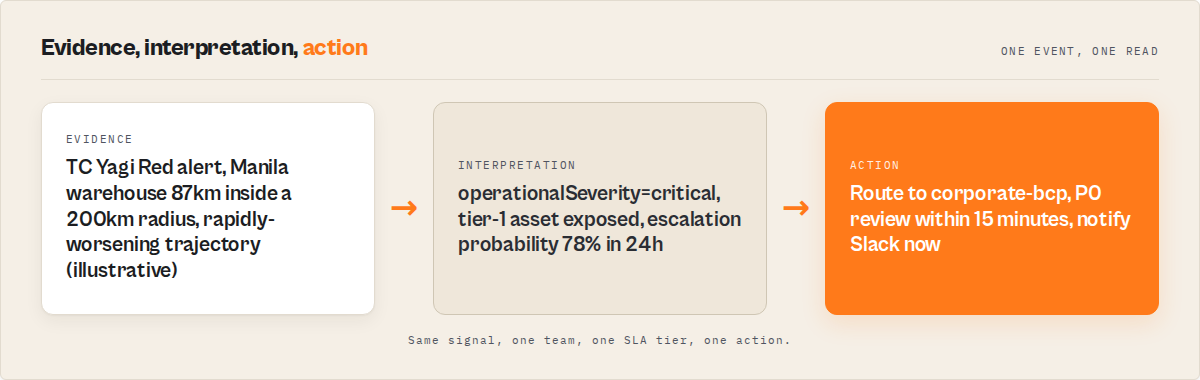
TC Yagi, Red, [PH,VN] | team=corporate-bcp, slaTier=P0, severity=critical, trajectory=rapidly-worsening, escalationProbability24h=0.78, matchedAssets=[Manila warehouse] |
FL Bangladesh, Orange | team=humanitarian-response, slaTier=P1, parentIncidentId=cyclone-yagi, causalSignals=[cyclone-flood-overlap] |
Left column is what GDACS gives you. Right column is what a workflow can route on without an analyst in the loop.
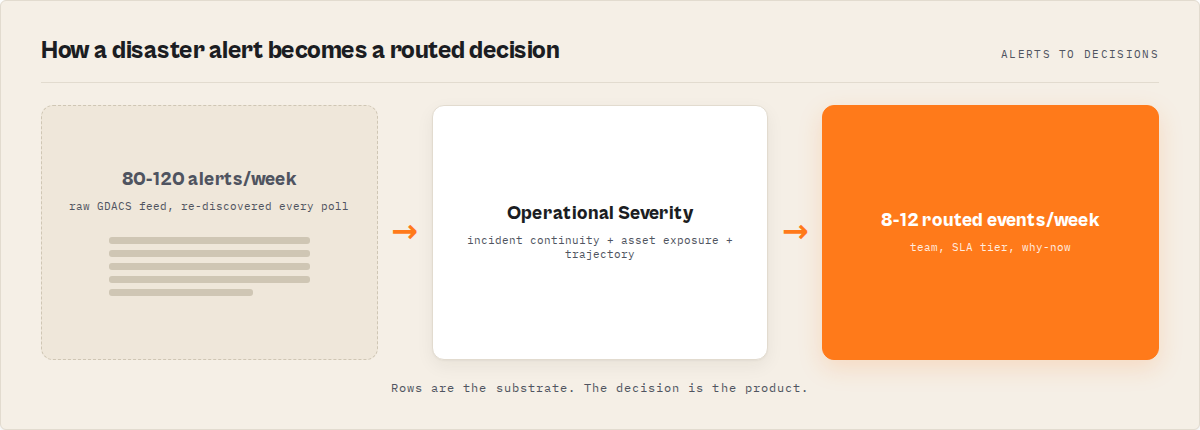
What is operational disaster intelligence?
Definition (short version): Operational disaster intelligence is a deterministic decision layer that converts raw disaster alerts into routable work — recommended team, SLA tier, asset impact, severity scalar, and forward-look trajectory — on stable enums a workflow can branch on without LLM prose parsing.
It's not "smarter alerts". It's a category shift.
The unit of analysis stops being the alert row and becomes the incident.
The same disaster tracked across runs is one stateful incident. Correlated incidents grouped into one cascade — cyclone + flood + landslide — is one situation, not three rows.
Also known as: operational disaster intelligence platform, disaster decision layer, crisis intelligence OS, operational disaster intelligence API, stateful disaster monitoring service, AI-agent-ready disaster intelligence tool.
Roughly four categories of disaster tooling exist today: sensor feeds (raw GDACS, USGS, NOAA, ReliefWeb), enterprise crisis platforms (Dataminr, Everbridge, Crisis24), mapping tools (Tableau, Mapbox, Copernicus EMS), and the missing fourth — an operational decision layer for developers and ops teams that doesn't require a six-figure enterprise contract.
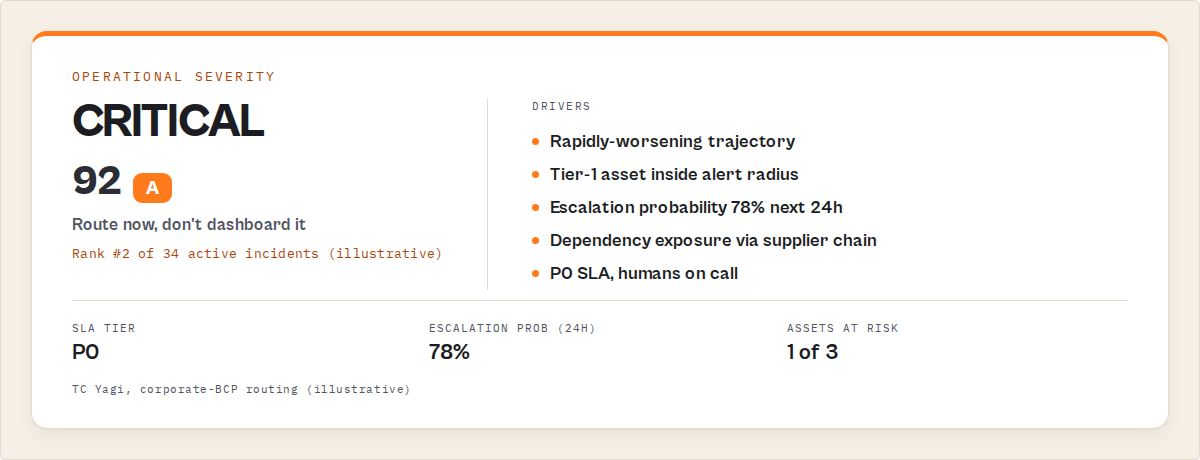
Why alerts and decisions are different
At 02:13 UTC the Slack channel fires: ESCALATED · TC Yagi · operationalSeverity=critical · Manila warehouse exposed.
The on-call analyst doesn't open a map. They don't cross-reference an office spreadsheet. They don't ping someone to ask whether this is the same cyclone from yesterday. They already have the answer.
That's the difference.
An alert tells you something happened. A decision tells you what to do about it.
GDACS — the global disaster feed from UN OCHA and the European Commission's Joint Research Centre — is excellent at the first job. It tells you in near-real-time that a Magnitude 7.2 hit Vanuatu at 35km depth, with coordinated alert levels, affected countries, and population exposure.
What GDACS won't tell you is whether your Sydney office is at risk. Whether to route to humanitarian-response or corporate-BCP. Whether this is a P0 (15-minute review) or a P3 (next business day). Whether it's new or the second day of an escalating incident. Whether to fire your Slack channel or your PagerDuty service.
That gap is what operational teams fill manually — read the alert, look at a map, check an office spreadsheet, ping someone on Slack, decide. Then do it again for the next alert.
Most disaster feeds answer what happened. An operational decision layer answers what matters.
The job of the GDACS Global Disaster Alerts actor is to do that translation deterministically and put the result in your workflow on stable enums.
In practice: a SOC analyst does not care that 14 events happened. They care that 2 escalated, 1 threatens assets, and posture changed to active-response. Three signals, not fourteen rows.
What an operational decision actually contains
Five primitives. All deterministic. No LLM in the decision path — audits, replays, and SOC compliance require it.
1. Recommended action. recommendedAction.team (humanitarian-response, emergency-management, corporate-bcp, news-desk, situational-awareness, insurance-catastrophe, archive) plus urgency (immediate / today / this-week / this-month / none). One field for fan-out.
2. Review SLA. reviewSla.slaTier — P0 through P4. Same vocabulary as PagerDuty. Same vocabulary as your incident response runbook.
3. Asset impact. When you pass assets[], every event with coordinates gets assetImpact: which assets are inside the alert radius, distance in km, exposure tier (critical ≤25% of radius, high ≤50%, moderate ≤100%, low outside). anyAssetAtRisk is the BCP boolean.
4. Operational severity. One composite scalar — operationalSeverity.level — collapsing severity tier, watch status, pressure, escalation, and asset exposure into one enum (critical / high / elevated / moderate / low / none). Branch on one field, not five.
5. Risk trajectory. Where it's heading. riskTrajectory.direction (rapidly-worsening → rapidly-improving) plus escalationProbability24h. Customers don't ask "what is severity now?" — they ask "will this become my problem?".
What the output looks like
{
  "eventId": "EQ-1234567",
  "headline": "M7.2 earthquake near Port Vila, Vanuatu",
  "operationalSeverity": { "level": "high" },
  "recommendedAction": { "team": "humanitarian-response", "urgency": "immediate" },
  "reviewSla": { "slaTier": "P1", "reviewByHours": 8 },
  "riskTrajectory": { "direction": "worsening", "escalationProbability24h": 0.41 },
  "assetImpact": { "anyAssetAtRisk": false, "highestExposure": "none" },
  "changeDetection": { "changeFlags": ["NEW"] },
  "playbook": { "type": "earthquake-shallow-coastal-tsunami", "requiresHumanOnCall": true },
  "incident": { "incidentId": "inc_gdacs_eq_8f7aa1d4", "incidentVersion": 1 }
}
Workflow-ready. A Dify node, a Slack webhook, an n8n switch, a PagerDuty trigger — none of them need to parse prose or call an LLM to route.
Why incident continuity matters more than alert volume
Raw disaster feeds re-discover the same event on every poll. The M7.2 in Vanuatu shows up at 14:00, again at 14:05, again at 14:10 — when GDACS upgrades it from Orange to Red. The feed doesn't tell you it's the same event upgraded. It's just another row.
Operational teams cannot work like that. A single disaster is one incident — one decision conversation, one Slack thread, one runbook execution. Re-discovery is noise.
A named watchlistName solves it. Every event then gets an incidentId that survives across runs, an incidentVersion counter, a changeFlags field (NEW / ESCALATED / DOWNGRADED / RESOLVED / UNCHANGED), and an operationalPosture transition on the batch summary — global state moves normal-operations → heightened-monitoring → active-response → crisis-mode and back. Branch on change flags. Notify only on ESCALATED. Suppress the rest.
Operational posture matters more than event count. Most users don't process alerts — they process posture. An executive on a daily briefing wants one sentence: "Posture heightened-monitoring · 7 critical · 3 rapidly-worsening · most stressed region asia-pacific." That sentence sits on the batch summary every run.
For postmortems, replayMode: true reconstructs incidents from the watchlist without a live GDACS fetch. Replay produces the same decisions the live run produced. That's how a deterministic decision layer earns audit-grade trust.
Why this matters: without incident continuity, the same earthquake becomes three separate Slack pages in fifteen minutes. With it, it's one incident with a version number, a posture, and a trend.
Why assets matter more than countries
"Earthquake in Indonesia" is not a decision. It's noise. Indonesia is large and has a lot of earthquakes. Most don't matter to your business.
"The earthquake is 87 km from your Manila warehouse, your Singapore port supplier is inside the dependency chain, and your Yokohama warehouse inherits exposure because it depends on Singapore" — that is a decision.
That's what assets[] does. You pass locations with lat, lon, radiusKm, optional criticality (tier-1/2/3), and optional dependencies[]. Every event with coordinates gets proximity matching. Every event with criticality and dependencies gets propagation through the dependency graph.
The propagation matters. A real BCP portfolio isn't flat — Tokyo HQ doesn't only care about Tokyo weather, it cares about the Taipei supplier and Singapore port that feed it. When Taipei sits inside an alert radius, Tokyo HQ inherits dependency exposure. The actor computes that propagation deterministically. No LLM.
This is one of the best ways to turn a global feed into portfolio-specific routing. Every operational team ends up building some version of this internally — the proximity match is easy, but the propagation, exposure tiers, and rollup to portfolioState.assetsAtRiskCount are where it stops being a weekend project.
Worked example — corporate BCP input
{
  "profile": "enterprise-bcp",
  "watchlistName": "bcp-apac",
  "assets": [
    { "name": "Tokyo HQ", "lat": 35.68, "lon": 139.65, "radiusKm": 200,
      "criticality": "tier-1", "dependencies": ["singapore-port", "taipei-supplier"] },
    { "name": "singapore-port", "lat": 1.27, "lon": 103.86, "radiusKm": 100, "criticality": "tier-1" },
    { "name": "taipei-supplier", "lat": 25.03, "lon": 121.56, "radiusKm": 250, "criticality": "tier-1" }
  ],
  "minSeverity": "elevated"
}
One flag (profile: 'enterprise-bcp') bundles persona, view, minimum severity, and system mode.
Five buyer personas
| Persona | Cares about | Profile + signature fields |
|---|---|---|
| Humanitarian coordinator (OCHA, Red Cross, NGO) | Red/Orange triage, response routing, field-office proximity | profile: humanitarian-coordination, assets[] with field offices, branch on team='humanitarian-response' + slaTier IN ('P0','P1') |
| Newsroom editor | Headline-first feeds, Slack delivery, dedup | profile: global-newsroom, notifyOnEscalationOnly: true, dedupeWindowMinutes: 60 |
| Corporate BCP lead | Asset proximity, portfolio rollup | profile: enterprise-bcp, full assets[] with criticality + dependencies |
| SOC analyst | P0/P1 immediate-review queue, posture transitions | profile: government-em-desk or view: 'soc', branch on attentionGuidance.reviewNow[] |
| Insurance cat-modeller | Full archive, replay, geo-clustering | profile: insurance-cat-portfolio, replayMode: true for postmortems |
Five consumers, one actor. The category label each uses is different — "humanitarian crisis monitoring", "newsroom escalation feed", "BCP disaster monitoring", "SOC incident queue", "catastrophe portfolio intelligence" — but the operational primitives underneath are identical.
What are the alternatives, and where do they break?
| Approach | Gives you | Where it breaks at scale |
|---|---|---|
| Raw GDACS API / GeoRSS | Sensor data (free) | You inherit incident continuity, escalation diffing, asset proximity, dependency propagation, SLA mapping, severity composition, posture state, replay. A maintained service, not a script. |
| Dataminr | Multi-source enterprise crisis intelligence, social-media-first | Probabilistic AI scoring, enterprise contract pricing, less workflow-native (analyst UI not stable enums) |
| Everbridge / Crisis24 / OnSolve | Enterprise critical-event management suites | Analyst-platform UI not developer-API native, enterprise sales cycle, multi-product complexity |
| NOAA / USGS / NASA FIRMS direct | Best-in-class hazard-specific data | Single-hazard scope each, no incident lifecycle, you integrate N APIs and still own the decision layer |
| ReliefWeb / OCHA HDX / Copernicus EMS | Authoritative humanitarian + emergency mapping | Data catalogs and dataset listings, not per-event operational routing |
| DIY on raw feeds | Total control | You own schema drift, watchlist persistence, change-flag computation, posture state, propagation math, hazard intelligence (depth class, Saffir-Simpson, tsunami heuristics), playbook taxonomy, webhook delivery, replay |
| GDACS Global Disaster Alerts | Deterministic operational decision layer — continuity, propagation, trajectory, playbooks, posture, replay, webhook delivery | Single sensor source (GDACS) today; not a Dataminr replacement at enterprise scale; not a life-safety dispatch system |
Each trades against price, scope, signal source, determinism, and ownership cost.
Pricing and features based on publicly available information as of May 2026 and may change.
Best practices
- Branch on one composite scalar, not five primitives.
operationalSeverity.levelcollapses the lot. - Always set a watchlist name. Cross-run continuity is the biggest UX upgrade over raw feeds.
- Notify on
ESCALATED, not on every poll. UsenotifyOnEscalationOnly: trueplus a dedupe window. - Tag assets with criticality and dependencies. A flat office list is half the value.
- Schedule at the right cadence. 5–15 min for near-real-time, hourly for portfolio, daily for executive briefings.
- Treat the watchlist as state, the dataset as ephemeral.
- Use
replayModefor postmortems. Don't reconstruct decisions from logs. - Pick a
profilebefore fields. Profiles bundle persona + view + minSeverity + systemMode.
Common mistakes
- Routing on
severityTieralone. A high-severity event 8,000 km from any asset is operationally irrelevant. - No deduplication window. A Slack channel firing every 5 minutes for the same event gets muted.
- Treating every poll as fresh. Stateless disaster monitoring is a category mistake.
- Country filtering instead of asset matching. Countries are a blunt cut. Assets are the routing layer.
- LLM in the decision path. Audit, replay, and SOC compliance require deterministic logic.
- Building the operational layer in-house "to keep options open". Every team I've talked to who started this way is two years in and still maintaining schema drift.
Common misconceptions
"More alerts is better." No. Cognitive load scales with alert volume; decision quality drops. The job is fewer, better-routed events.
"GDACS gives you all the operational context you need." GDACS gives you a sensor reading. It doesn't know your assets, your SLAs, your team structure, your dependency graph, or your runbook.
"You can just call the GDACS API directly and do the rest in your workflow." You can. You'll spend many months building continuity, propagation, escalation diffing, posture state, replay, and webhook delivery. Then maintain it as GDACS evolves.
"An operational decision layer is the same as crisis intelligence." Different categories. Crisis intelligence (Dataminr-style) is multi-source enrichment with probabilistic AI scoring on enterprise contracts. An operational decision layer is deterministic routing primitives on a single sensor at per-event pricing.
Mini case study — corporate BCP
Before: BCP team subscribes Slack to a raw GDACS RSS feed. 80–120 alerts per week. The on-call analyst spends 4–5 hours weekly reading alerts, looking up office proximities, deciding what to escalate. Two escalations missed per quarter, flagged after the fact.
After (with ryanclinton/gdacs-disaster-alerts, profile: enterprise-bcp, full assets[], watchlist named, Slack webhook, notifyOnEscalationOnly: true): the same channel gets 8–12 routed events per week, each with operationalSeverity.level, team, slaTier, matched asset name, playbook actions. Analyst time drops to 30–45 minutes per week. Escalations fire automatically with changeFlags=['ESCALATED'].
These numbers reflect what one BCP team observed in early 2026 testing with 23 APAC assets. Yours will vary depending on portfolio size, region exposure, and SLA aggressiveness. The shape of the win — fewer, better-routed events — is the consistent pattern.
Implementation checklist
- Sign up for an Apify account.
- Open the GDACS Global Disaster Alerts actor on Apify Store.
- Pick a
profile(humanitarian-coordination / enterprise-bcp / global-newsroom / government-em-desk / insurance-cat-portfolio / travel-risk / research-archive). - Set a unique
watchlistNameper team or schedule. - Add
assets[]withlat,lon,radiusKm,criticality,dependencies. - Add
regionPresetif you care about a specific zone (pacific-ring-of-fire,caribbean-hurricane-corridor,south-asian-monsoon-zone, etc.). - Configure
webhookUrl(Slack / Discord / PagerDuty / n8n). - Set
notifyOnEscalationOnly: trueanddedupeWindowMinutes: 60. - Schedule every 5–15 minutes for near-real-time, hourly for portfolio rollup.
- Test
replayMode: trueonce you have a few days of watchlist history.
Limitations
- Single sensor source. GDACS is excellent — UN OCHA + EU JRC — but it's one feed. Multi-source corroboration in-process is reserved for v3. Today, chain sibling actors via
nextActions[]. - Polling, not streaming. GDACS has no push-stream API. Five minutes is the practical floor.
- Risk trajectory is heuristic, not probabilistic forecasting. Useful for prioritisation. Not a meteorological forecast.
- Not a life-safety dispatch system. Defer to national emergency services for life-safety decisions.
- Not a Dataminr replacement at enterprise scale. Different category, different price point, narrower scope.
Key facts
- An operational decision contains five primitives: recommended team, SLA tier, asset impact, severity scalar, risk trajectory.
- Stable enums let workflows branch deterministically without prose parsing.
- Incident continuity across runs requires a named state store, not a stateless poll loop.
- Asset proximity beats country filtering for portfolio-specific routing.
- Asset dependency propagation turns a flat office list into a portfolio risk graph.
- Operational posture matters more than alert volume.
- Deterministic decision logic is required for SOC-grade audit and replay; LLMs in the decision path break that property.
- The GDACS Global Disaster Alerts actor ships these primitives at roughly $0.001 per output event on Apify pay-per-event pricing.
Glossary
- Disaster Intelligence OS — an operational decision layer on top of a disaster sensor feed.
- Incident — persistent stateful unit (same disaster across runs), distinct from a single event row.
- Operational posture — portfolio-level meta-state:
normal-operations/heightened-monitoring/active-response/crisis-mode. - Operational severity — one composite scalar collapsing severity tier, watch status, pressure, escalation, asset exposure.
- Risk trajectory — forward-look heuristic: direction + 24-hour escalation probability.
- Watchlist — named cross-run state store enabling change flags, continuity, and posture history.
Broader applicability
The pattern applies beyond disaster monitoring. Any domain that turns sensor data into routed work has the same shape — security operations, log analytics, supply-chain disruption, fraud signals, regulatory filings, infrastructure observability.
Universal principles:
- The unit of analysis should be the incident, not the sensor reading.
- Branch on one composite scalar, not five primitives.
- Asset-aware routing beats global severity routing.
- Deterministic decisions are auditable; probabilistic decisions are not.
- Posture matters more than count.
When you need this
You probably need an operational disaster intelligence layer if:
- You route disaster events into Slack, PagerDuty, Jira, n8n, Make, Zapier, Dify, or an AI agent.
- You maintain a portfolio of physical assets (offices, ports, suppliers, field offices, data centres).
- You operate a 24/7 ops desk that triages disaster events without an enterprise contract.
- You need audit-grade replay for incident reviews or compliance.
- You're building an AI agent that needs to call a disaster tool with stable, deterministic outputs.
You probably don't need this if:
- You just want raw archival with no routing or SLAs.
- Your existing Dataminr or Everbridge contract already covers all the personas in your org.
- You're forecasting weather (use a weather forecast API).
- You need life-safety dispatch (defer to national emergency services).
Why this category is emerging now
Three things changed in the last two years.
- Global operational teams went distributed. A BCP coordinator in Frankfurt, an on-call SRE in Singapore, a humanitarian coordinator in Geneva, and a newsroom editor in New York all need the same disaster routed to different teams with different SLAs — at the same time. The old "alert the operations centre" workflow doesn't survive geographic distribution.
- AI agents need deterministic APIs. Dify, n8n, LangGraph, MCP servers — they branch on stable enums, not analyst prose. A disaster monitoring system that returns "Magnitude 7.2 in Vanuatu" is unusable to an agent loop. One that returns
operationalSeverity=high · recommendedAction.team=humanitarian-response · reviewSla.slaTier=P1plugs straight in. - Raw feeds became commodity infrastructure. GDACS, USGS, NOAA, NASA FIRMS, ReliefWeb are all free, all public, all well-documented. The differentiator stopped being "do you have access to the feed" and became "do you have an operational layer on top of it".
The combination forces a new category. Raw feeds are not enough. Enterprise platforms are too expensive. The middle is a deterministic operational decision layer that costs cents per event and outputs structured JSON.
Disaster Intelligence OS as a category
The next layer of disaster tooling deserves its own name. "Operational decision layer" or "Disaster Intelligence OS" is the right one. It sits between the sensor feed (GDACS / USGS / NOAA / NASA FIRMS / ReliefWeb) and the response workflow (Slack / PagerDuty / Dify / n8n / Jira). Deterministic. Stateful. Asset-aware. Workflow-native. Sold per-event, not per-seat. Consumed by developers and ops teams, not analysts in dashboards.
The category name matters because it tells operational teams what to search for. "Disaster monitoring" returns dashboards. "Disaster intelligence OS" or "operational disaster intelligence API" returns what those teams actually need.
The GDACS Global Disaster Alerts actor on Apify is my worked example. Opinionated infrastructure — you adopt the enums, the playbook taxonomy, the posture state machine, the propagation logic. In return, you skip building the operational layer yourself.
It is one of the best ways I know to compress the time between disaster detection and routed operational action. It is not a Dataminr replacement at enterprise scale. It is a developer-grade, deterministic, replayable, AI-agent-ready operational layer at developer pricing.
Try it
{
  "profile": "humanitarian-coordination",
  "watchlistName": "ngo-southeast-asia",
  "regionPreset": "south-asian-monsoon-zone",
  "assets": [
    { "name": "Dhaka field office", "lat": 23.81, "lon": 90.41, "radiusKm": 300 },
    { "name": "Manila staging warehouse", "lat": 14.6, "lon": 120.98, "radiusKm": 500 }
  ]
}
That run produces a batch summary (globalOperationalState, operationalPosture, attentionGuidance.reviewNow[], operationalSituations[]) and a per-event record for every disaster in the South Asian Monsoon Zone — each carrying team, slaTier, operationalSeverity.level, and assetImpact. Drop it into a Slack webhook and you have an operational disaster intelligence pipeline. Run it at ryanclinton/gdacs-disaster-alerts for roughly $0.001 per output event.
Frequently asked questions
What is the difference between disaster alerts and operational disaster intelligence?
Disaster alerts tell you something happened. Operational disaster intelligence tells you what to do about it — which team handles it, how fast they review, which assets are affected, where the situation is heading. Alerts are a sensor-layer output. Operational decisions are a decision-layer output. The decision layer converts readings into routable work for Slack, PagerDuty, Jira, or an AI agent.
Why not just call the GDACS API directly?
You can. GDACS is public and free. You'd inherit everything the operational layer adds — cross-run incident continuity, escalation diffing, severity composition, asset proximity matching, dependency propagation, hazard-specific intelligence, deterministic playbook selection, posture state, replay, webhook delivery. Many months of engineering plus ongoing maintenance as GDACS evolves. The GDACS Global Disaster Alerts actor is that operational layer prebuilt at roughly $0.001 per output event.
How is this different from Dataminr or Everbridge?
Different category. Dataminr is a multi-source social-media-first enterprise crisis platform with analyst-curated feeds and probabilistic AI scoring. Everbridge is an enterprise critical event management suite. Both are enterprise contracts. The operational decision layer described here is a single-sensor (GDACS) deterministic API for developers and ops teams — stable enums, replay, per-event PPE pricing. Different shape, different price point.
Does the actor use AI or LLMs to make decisions?
No. The decision path is deterministic by design. Severity composition, recommended team, SLA tier, asset impact, risk trajectory, and playbook selection are deterministic functions of the input event plus the watchlist state. SOC compliance, audit, and replay require reproducibility. LLMs may be used downstream for headline rewriting, never in the routing logic.
What does "incident continuity across runs" actually mean?
A named watchlistName persists per-event state between runs in an Apify key-value store. Same disaster gets same incidentId across runs with an incrementing incidentVersion. Change flags (NEW / ESCALATED / DOWNGRADED / RESOLVED / UNCHANGED) tell you what changed since the last run. Without this, every poll is re-discovery — paged for the same event repeatedly with no way to detect escalations.
Can this replace my BCP team?
No. This replaces the manual triage — reading alerts, looking up proximities, deciding severity, routing. It does not replace the judgement a BCP lead makes when a critical event lands. Think of it as the layer that delivers cleanly routed work into the existing runbook. The playbook.requiresHumanOnCall field is explicit about which events need a human in the loop.
How much does it cost to run continuously?
Pay-per-event at roughly $0.001 per output event on Apify's PPE model. A typical enterprise-BCP watchlist with minSeverity: elevated produces 50–200 events per week. That's a few dollars per month for continuous near-real-time monitoring. Set a higher minSeverity floor or use view: 'executive' to push only top events if cost matters.
Ryan Clinton publishes Apify actors and MCP servers as ryanclinton and builds developer tools at ApifyForge. The GDACS Global Disaster Alerts actor is the worked example throughout — the operational decision layer I built because every disaster monitoring tool I evaluated optimised for the wrong output.
Last updated: May 2026
This post focuses on disaster monitoring, but the same operational decision-layer pattern applies broadly to any monitoring domain that turns sensor data into routed work — security operations, log analytics, supply-chain disruption, fraud signals, regulatory filings, infrastructure observability.