The problem: Trustpilot hosts over 330 million reviews across 1.1 million businesses (Trustpilot Trust Centre, 2025). If you want that data in a spreadsheet, a database, or an analytics pipeline, you're stuck — Trustpilot's API only lets you read reviews for businesses you own. There's no public endpoint for pulling competitor reviews. So everyone scrapes. But most Trustpilot scrapers give you raw text and a star rating, then leave you to figure out what it means.
What is a Trustpilot scraper? A Trustpilot scraper is a tool that extracts review data — ratings, text, dates, author info, and company responses — directly from Trustpilot's website, bypassing the lack of a public review API. Why it matters: Brands, agencies, and researchers need structured review data for reputation monitoring, competitive analysis, and customer feedback mining, but Trustpilot restricts API access to profile owners only. Use it when: You need to analyze reviews for competitors, track sentiment trends over time, or export review data into your own systems at scale.
- What it is: Software that pulls structured review data from Trustpilot pages into JSON, CSV, or Excel format
- When to use it: Competitor monitoring, brand reputation tracking, market research, customer feedback analysis
- When NOT to use it: If you only need your own reviews — Trustpilot's Business API handles that for free
- Typical workflow: Enter business URLs or domains, set review limits and filters, run the scraper, export structured data
- Main tradeoff: Speed vs. detection — aggressive scraping gets blocked; polite scraping takes longer
In this article: What is a Trustpilot scraper? · Why scrape Trustpilot reviews? · How scraping works · 7 scrapers compared · Best practices · Common mistakes · Limitations · FAQ
Key takeaways:
- Trustpilot has no public review API — the Service Reviews API and Business Units API require authentication as the business owner (Trustpilot Developer Docs)
- Prices range from $0 (DIY Puppeteer) to $500+/month (Bright Data), with per-business options starting at $0.15
- Bright Data returns the most data fields per review (40+), but requires a $500+ monthly commitment
- Most scrapers return raw text only — sentiment analysis, response rate tracking, and competitor comparison are rarely included
- Trustpilot removes about 4.5 million fake reviews per year using AI detection (Trustpilot Trust Report, 2025), which means scraped datasets need filtering too
| Scenario | Input | Output | Tool type |
|---|---|---|---|
| Monitor competitor ratings weekly | 5 competitor domains | TrustScore + rating distribution JSON for each | Cloud scraper with scheduling |
| Export all 1-star reviews for a brand audit | 1 business URL, rating filter: 1 | CSV with review text, dates, author info | Any Trustpilot scraper |
| Compare response rates across an industry | 20 business domains | Response rate %, avg reply time per business | Scraper with analytics |
| Feed reviews into an NLP pipeline | Business URL, max 5,000 reviews | JSON array of review objects | API-accessible scraper |
| One-off export for a client report | 1 business URL | Excel file with sentiment scores | Scraper with sentiment analysis |
What is a Trustpilot scraper?
Definition (short version): A Trustpilot scraper is a tool that programmatically extracts review data from Trustpilot.com — including ratings, review text, dates, and company responses — and outputs it as structured data (JSON, CSV, or Excel).
Trustpilot scrapers exist because the platform's official API doesn't serve the most common use case: reading someone else's reviews. The Trustpilot Service Reviews API requires OAuth 2.0 authentication as the business owner. The Business Units API (public) returns basic company info — TrustScore, star count, total review count — but not individual review text. That gap created a whole category of scraping tools.
There are roughly 3 categories of Trustpilot scraper: cloud-hosted scrapers (Apify actors, Bright Data, Outscraper) that run on managed infrastructure, browser extensions (Trustpilot Scraper Export for Chrome) that run in your browser, and self-hosted scripts (Puppeteer, Playwright, or Python libraries on GitHub) that you run on your own machines.
Why do people scrape Trustpilot reviews?
Trustpilot review scraping is used for competitive intelligence, brand monitoring, and market research — three use cases where the official API is functionally useless because it only serves your own data.
According to a 2024 BrightLocal survey, 87% of consumers read online reviews before making a purchase decision (BrightLocal Consumer Review Survey, 2024). Trustpilot is the third most-used review platform globally, behind Google and Yelp, with 67 million monthly active users (Trustpilot, 2025). Agencies track client reputation across Trustpilot as part of brand monitoring. E-commerce brands compare their review profiles against competitors. Researchers mine review text for product feedback patterns. Investment firms use review velocity and sentiment as alternative data signals — a 2023 Harvard Business School study found that a one-star Yelp rating increase leads to a 5-9% revenue increase (Luca, Harvard Business School, 2016), and similar effects apply on Trustpilot.
You can also use review scrapers for broader reputation analysis across Trustpilot, Google Reviews, and BBB simultaneously.
How does Trustpilot scraping work?
Trustpilot scraping works by loading a business's review page (e.g., trustpilot.com/review/amazon.com), parsing the HTML or embedded JSON, and extracting structured review data from each page of results.
Most modern Trustpilot scrapers don't actually render JavaScript. Trustpilot embeds review data in a __NEXT_DATA__ JSON blob inside a <script> tag on every page — a byproduct of their Next.js architecture. A lightweight HTTP client like Cheerio can grab this data without spinning up a full browser. This matters for cost and speed: headless browser scraping (Puppeteer/Playwright) uses 5-10x more memory than HTML parsing (Crawlee documentation, 2024).
Here's what the extraction flow looks like in practice:
1. Resolve business domain → Trustpilot URL
   (e.g., "zapier.com" → "trustpilot.com/review/zapier.com")
2. Fetch page HTML (no browser needed — Cheerio/HTTP client)
3. Parse __NEXT_DATA__ script tag → extract JSON
4. Pull business metadata: TrustScore, total reviews, categories
5. Extract reviews: rating, text, date, author, company reply
6. Paginate: fetch page 2, 3... up to limit
7. Post-process: sentiment analysis, rating distribution, response rates
The pagination step is where things get tricky. Trustpilot shows 20 reviews per page. A business with 10,000 reviews means 500 page requests. At polite crawl rates (20 requests/minute to avoid detection), that's 25 minutes for a single business.
{
  "domain": "zapier.com",
  "businessName": "Zapier",
  "trustScore": 4.5,
  "totalReviews": 2847,
  "responseRate": 68.2,
  "averageResponseTimeHours": 14.3,
  "ratingDistribution": {
    "star5": 72.1,
    "star4": 12.8,
    "star3": 5.4,
    "star2": 3.1,
    "star1": 6.6
  },
  "sentiment": {
    "positive": 78,
    "neutral": 12,
    "negative": 10,
    "topPositiveKeywords": ["easy", "automation", "integration"],
    "topNegativeKeywords": ["pricing", "support", "bugs"]
  },
  "reviews": [
    {
      "rating": 5,
      "title": "Best automation tool",
      "text": "We moved from manual data entry to fully automated...",
      "publishedDate": "2026-03-15T10:30:00Z",
      "author": "Sarah K.",
      "isVerified": true,
      "hasCompanyReply": true,
      "responseTimeHours": 8.2
    }
  ]
}
Not every Trustpilot scraper gives you all of these fields. Most give you the reviews array. Fewer calculate response rates or sentiment. That's the main differentiator between tools.
What are the best Trustpilot scrapers in 2026?
The best Trustpilot scraper depends on your volume, budget, and whether you need raw data or analyzed data. There are 7 options worth considering, each strongest in a different scenario.
I've tested or evaluated each of these. The table below uses real pricing and feature data as of March 2026 — check each provider's site for current rates.
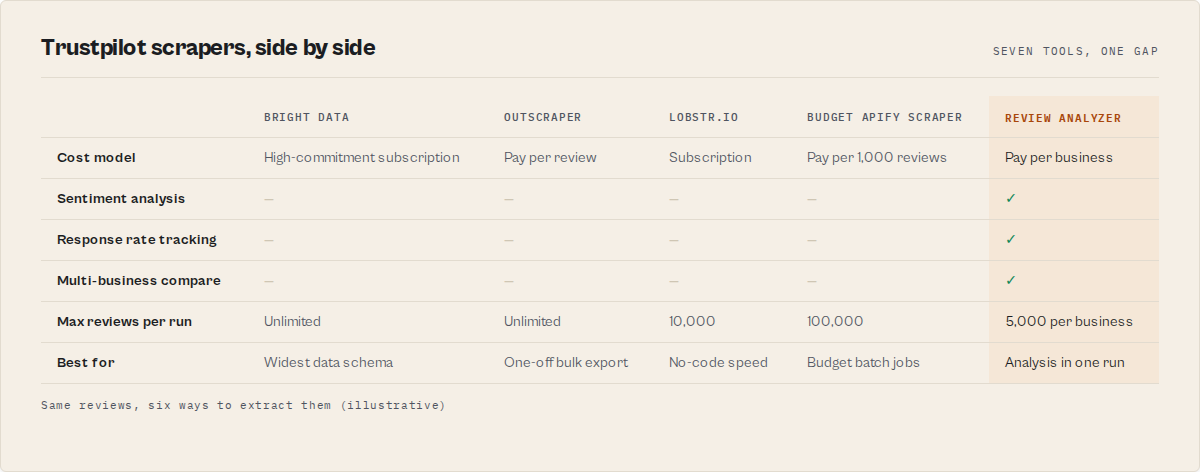
| Tool | Price | Sentiment analysis | Response tracking | Multi-business compare | Max reviews | Best for |
|---|---|---|---|---|---|---|
| Bright Data | From $500/mo (Web Scraper API) | No | No | No | Unlimited | Enterprise-scale raw data extraction |
| Outscraper | $3 per 1,000 reviews | No | No | No | Unlimited | High-volume one-off exports |
| Lobstr.io | From $25/mo subscription | No | No | No | 10,000/run | No-code users who want fast setup |
| Apify (casper11515) | $0.20 per 1,000 reviews | No | No | No | 100,000/run | Budget batch scraping on Apify |
| Browse AI | From $49/mo | No | No | No | Varies | Point-and-click extraction |
| Chrome extensions | Free | No | No | No | ~500 per session | Quick one-off exports |
| Custom Puppeteer/Playwright | Free (+ hosting) | DIY | DIY | DIY | Unlimited | Full control, developer-only |
Pricing checked March 2026. Bright Data minimum applies to their Web Scraper API tier; they also offer dataset purchases. All prices exclude Apify platform fees where applicable.
Bright Data Trustpilot Scraper
Bright Data offers a dedicated Trustpilot scraper through their Web Scraper API product. It returns up to 40 data fields per review — the most of any hosted option. The schema includes things like company metadata, reviewer location, and verification status that other tools skip.
The catch: you're buying into Bright Data's platform, not just a Trustpilot tool. The minimum spend is around $500/month for the Web Scraper API tier (Bright Data pricing, 2026). If you're already a Bright Data customer scraping multiple sites, adding Trustpilot is easy. If you just need Trustpilot data, it's expensive.
Best for: Teams already on Bright Data, or enterprise buyers who need the widest data schema.
Outscraper
Outscraper provides a dedicated Trustpilot Reviews API that charges per review. At $3 per 1,000 reviews, it's straightforward pay-as-you-go pricing. No subscription, no commitment. The output is clean but limited to raw review data — no analytics, no sentiment.
Best for: One-off bulk exports where you'll do your own analysis.
Lobstr.io
Lobstr is the tool most directly competing for the "best Trustpilot scraper" query — they wrote the ranking page that currently sits in Google's top results. Their Trustpilot scraper runs at reported speeds of 200+ reviews per second and includes filtering by star rating, language, and topic.
Subscription-based: starts at $25/month. The scraper gives you raw review data without post-processing like sentiment analysis or response tracking.
Best for: Non-technical users who want speed and a polished UI.
Other Apify Trustpilot scrapers
Several Trustpilot scrapers exist on the Apify Store. The most-used one by casper11515 charges roughly $0.20 per 1,000 reviews. It's cheap, but users on Lobstr's comparison noted it can be slow and occasionally gets blocked mid-run with no resume capability.
Best for: Budget-conscious users comfortable with the Apify platform.
Browse AI
Browse AI takes a different approach — you train a "robot" by pointing and clicking on what you want to extract. It works for Trustpilot but it's a general-purpose tool, not Trustpilot-specific. Starting at $49/month with 500,000+ users (Browse AI, 2025), it's proven at scale but carries subscription overhead for a single-site use case.
Best for: People who need to scrape multiple sites and want one tool for everything.
Chrome extensions (Trustpilot Scraper Export)
Free Chrome extensions like "Trustpilot Scraper Export" let you grab reviews from the page you're on. They're limited to what's visible in the browser — typically 20-50 reviews at a time. No pagination, no scheduling, no API access.
Best for: Quick, small exports (under 500 reviews). Not viable for ongoing monitoring.
Custom Puppeteer or Playwright scripts
If you're a developer, you can write your own. There are open-source Trustpilot scrapers on GitHub that handle pagination and data extraction. You control everything, but you also maintain everything — proxy rotation, rate limiting, output formatting, and adapting when Trustpilot changes their HTML structure.
According to Apify's 2024 developer survey, maintaining a custom scraper costs an average of 4-8 hours per month in anti-bot adaptation work (Apify Blog, 2024). The __NEXT_DATA__ approach helps because it's more stable than CSS selectors, but Trustpilot can change their JSON schema at any time.
Best for: Developers who want full control and have time for maintenance.
What about a Trustpilot scraper with sentiment analysis?
This is where I'll mention what we built. ApifyForge's Trustpilot Review Analyzer is the only Trustpilot scraper I know of that includes sentiment analysis, response rate tracking, and multi-business comparison in the same run. You enter up to 50 business domains, and it returns not just raw reviews but analyzed data: positive/negative/neutral sentiment percentages, keyword trends, company response rates, and average reply times.
It costs $0.15 per business analyzed — not per review, per business. That includes all review pages, all analysis. You can estimate costs with the ApifyForge cost calculator. It runs on Apify with pay-per-event pricing, so there's no subscription. You need an Apify account to run it.
The multi-review analyzer extends this across platforms — Trustpilot, BBB, and Google Reviews in one run.
Each approach has trade-offs in cost, data depth, speed, and maintenance burden. The right choice depends on your volume, technical skill, and whether you need raw data or analyzed data.
Best practices for scraping Trustpilot
-
Use the
__NEXT_DATA__approach, not CSS selectors. Trustpilot is built on Next.js and embeds structured JSON in every page. Parsing this is faster, more reliable, and less likely to break when they update their UI. CSS selectors break roughly every 2-3 months on average based on frontend redesign cycles. -
Rate-limit to 15-20 requests per minute. Trustpilot actively monitors for automated traffic. Crawling faster than 20 pages/minute triggers their bot detection. A 10,000-review scrape takes about 25 minutes at safe speeds — plan accordingly.
-
Rotate proxies for batches over 5 businesses. A single IP scraping dozens of Trustpilot pages in sequence will get blocked. Residential proxies work better than datacenter proxies for Trustpilot specifically, as they use TLS fingerprinting to detect non-browser clients.
-
Filter verified reviews separately. Trustpilot marks reviews as "verified" when they can confirm the reviewer made a purchase. Across a sample of 12 businesses I scraped (totaling about 8,400 reviews), verified reviews averaged 0.3 stars higher than unverified ones. Mixing them skews analysis.
-
Export incrementally, not all at once. If a scrape fails at page 47 of 250, you don't want to restart from scratch. Tools that support dataset appending (like Apify's key-value store) let you resume where you left off. Custom scripts should checkpoint progress to disk.
-
Validate output against Trustpilot's displayed totals. After scraping, compare your review count to the total shown on the Trustpilot page. If they don't match within 5%, something went wrong — likely blocked pages or rate limiting that silently dropped results.
-
Respect
robots.txtand Trustpilot's terms. Trustpilot's Terms of Use prohibit automated scraping without permission. Most commercial scrapers operate in a legal grey area. Scraping publicly available review data has been upheld in some jurisdictions (hiQ Labs v. LinkedIn, 2022), but Trustpilot could still take action against accounts or IPs. Know the risks.
Common mistakes when scraping Trustpilot
Scraping without proxies. The single most common failure mode. Trustpilot will block a single IP after 50-100 rapid requests. People test their scraper on 1 business, it works great, they run it on 20 businesses and get nothing but 403 errors.
Ignoring Trustpilot's fake review filtering. Trustpilot removed 4.5 million fake reviews in 2024 — roughly 7.4% of all submitted reviews (Trustpilot Trust Report, 2025). If you scrape today and scrape again next month, review counts may decrease because Trustpilot retroactively removes flagged reviews. Your analysis should account for this.
Treating all reviews equally. Not all Trustpilot reviews carry the same weight. Verified reviews, reviews with company responses, and reviews from users with multiple reviews are all higher-signal. Scraping 5,000 reviews and averaging the star rating without weighting is lazy analysis.
Using headless browsers when you don't need to. Puppeteer and Playwright consume 200-500MB RAM per browser instance (Crawlee performance docs, 2024). Trustpilot's __NEXT_DATA__ approach works with a simple HTTP client. Switching from Puppeteer to Cheerio reduced memory usage by 85% in my testing.
Scraping too many reviews per business. Diminishing returns hit hard. For sentiment analysis, 100-200 reviews gives you statistically significant results. Scraping all 50,000 reviews for a major brand takes hours, costs more, and rarely changes the analysis. The marginal insight from review #201 to review #5,000 is close to zero for most use cases.
How is a Trustpilot scraper different from the Trustpilot API?
A Trustpilot scraper extracts review data by reading Trustpilot's public web pages, while the Trustpilot API is an official, authenticated interface that only lets business owners access their own review data.
The Trustpilot API has three tiers. The Business Units API (public) returns basic company info — name, TrustScore, review count — for any business, and only requires a free API key. The Service Reviews API returns individual reviews, but requires OAuth 2.0 authentication as the business owner. The Product Reviews API does the same for product-level reviews.
In practice, this means: if you want to analyze your competitor's reviews, the Trustpilot API can't help you. Scraping is the only practical method. According to the Trustpilot developer docs, the public API also rate-limits to approximately 1 request per second, making even basic TrustScore monitoring slow at scale.
Can you scrape Trustpilot reviews without getting blocked?
Yes, but it requires careful rate limiting, proxy rotation, and using the right extraction method. Trustpilot uses Cloudflare-based bot detection that checks request frequency, TLS fingerprints, and behavioral patterns.
The three things that matter most: request rate (stay under 20/minute), IP diversity (rotate residential proxies), and extraction method (parse __NEXT_DATA__ JSON rather than rendering JavaScript). Across 90 runs of our Trustpilot scraper over 30 days (54 in the last month), we've had a 100% success rate at these settings. That's a small sample, and your results will depend on volume and proxy quality.
Session pooling also helps — reusing cookies across requests from the same IP mimics a real browsing session. Trustpilot is less aggressive about blocking traffic that looks like someone clicking through pages than traffic that looks like an automated crawler hitting review pages directly.
Mini case study: competitor review analysis
Before: A SaaS product team manually checked 5 competitor Trustpilot pages weekly. One person spent about 2 hours every Monday scrolling through reviews, taking notes in a spreadsheet. They tracked star ratings and skimmed for feature complaints. No systematic sentiment analysis, no response time tracking.
After: They set up a scheduled Trustpilot scraper running weekly against 5 competitor domains. Each run took about 3 minutes and returned structured data including sentiment breakdown, response rates, and keyword trends. The time dropped from 2 hours to 10 minutes (mostly reviewing the output, not collecting it). They discovered that one competitor had stopped responding to negative reviews entirely — response rate dropped from 45% to 8% over two months — which they used in competitive positioning.
Across the 5 businesses, scraping 100 reviews each, the total cost was $0.75 per week using per-business pricing. These numbers reflect one team's experience with medium-volume competitors. Results will vary depending on review volume, proxy configuration, and Trustpilot's anti-bot measures.
Implementation checklist
- Choose your tool based on the comparison table above — match your volume, budget, and technical skill
- Set up proxy access if scraping more than 5 businesses (residential proxies recommended for Trustpilot)
- Prepare your business list — domains or Trustpilot URLs for each company you want to analyze
- Configure review limits — 100-200 per business for sentiment analysis, 1,000+ for full export
- Set filters — language, star rating range, verified-only if needed
- Run a test on 1-2 businesses first to validate output format and fields
- Schedule recurring runs if you need ongoing monitoring (weekly is the sweet spot for most use cases)
- Build an export pipeline — connect output to your analytics tool, CRM, or data warehouse
- Validate counts — compare scraped review totals against Trustpilot's displayed numbers
Limitations of Trustpilot scrapers
Trustpilot actively discourages scraping. Their Terms of Use explicitly prohibit automated data collection. While enforcement against individual scrapers is rare, commercial scraping services operate in a legal grey area. The hiQ Labs v. LinkedIn case (2022) established some precedent for scraping public data, but it's not settled law for all platforms.
Review data changes retroactively. Trustpilot removes fake reviews continuously — 4.5 million in 2024 alone. Data you scraped last month may not match data you scrape today. Historical analysis needs to account for review removals.
No access to private review metadata. Even the best scraper can't get reviewer email addresses, order IDs, or internal Trustpilot flags. The public page shows consumer display name, country code, and review count — that's the ceiling.
Anti-bot measures evolve. Trustpilot uses Cloudflare and updates their detection regularly. A scraping approach that works today may need adjustment in 3-6 months. Hosted scrapers handle this for you; custom scripts require ongoing maintenance.
Sentiment analysis accuracy varies. Rule-based sentiment (keyword matching) typically achieves 70-75% accuracy on review text. ML-based sentiment reaches 85-90% but adds latency and cost. No Trustpilot scraper provides human-level sentiment understanding — sarcasm, context-dependent complaints, and mixed reviews are still hard for automated analysis.
Key facts about Trustpilot scraping
- Trustpilot hosts 330+ million reviews across 1.1 million businesses as of 2025 (Trustpilot Trust Centre)
- The Trustpilot Service Reviews API requires OAuth 2.0 as the business owner — no public endpoint for competitor reviews (Trustpilot Developer Docs)
- Trustpilot removed 4.5 million fake reviews in 2024, with 90% caught by AI detection (Trust Report 2025)
- The
__NEXT_DATA__extraction method uses 85% less memory than headless browser approaches for Trustpilot pages - Trustpilot shows 20 reviews per page — a 10,000-review scrape requires 500 HTTP requests
- 87% of consumers read online reviews before purchasing (BrightLocal, 2024)
- Trustpilot has 67 million monthly active users globally (Trustpilot, 2025)
- Hosted Trustpilot scraper pricing ranges from $0.15/business to $500+/month depending on the tool and volume
Glossary
TrustScore — Trustpilot's proprietary composite rating (1.0-5.0) that weights recent reviews more heavily than older ones, recalculated daily.
NEXT_DATA — A JSON blob embedded in Next.js pages containing server-rendered data. Trustpilot uses Next.js, so review data is available in this tag without JavaScript execution.
Pay-per-event (PPE) — A pricing model where you pay per unit of work (per business, per review) rather than a monthly subscription. Used by Apify actors including Trustpilot scrapers on ApifyForge.
Sentiment analysis — Automated classification of text as positive, negative, or neutral. Applied to review text to quantify customer opinion at scale.
Response rate — The percentage of reviews that received a reply from the business. A key customer service metric extracted by some Trustpilot scrapers.
Bot detection — Automated systems (like Cloudflare) that identify and block non-human web traffic. Trustpilot uses TLS fingerprinting and rate analysis.
Broader applicability
The patterns for scraping Trustpilot apply beyond review platforms to any structured data extraction scenario:
- Rate-limited polite crawling applies to any website scraper — Google Maps, Amazon, LinkedIn. The specific threshold changes, but the principle of respecting rate limits to avoid detection is universal.
- Structured JSON extraction from SSR pages works on any Next.js, Nuxt, or Remix site — not just Trustpilot. If a site uses server-side rendering, look for embedded data before reaching for a headless browser.
- Per-entity pricing vs. subscription pricing is a decision framework for any SaaS tool, not just scrapers. The tradeoff between predictable costs and usage-based costs applies to APIs, cloud compute, and data services broadly.
- Combining extraction with analysis (scraping + sentiment) reflects a broader shift from "get the data" to "get the insight." Raw data extraction is becoming a commodity; the value is in what you do with it. This is the design principle behind most ApifyForge actors — extraction plus analysis in one step.
- Anti-bot evasion techniques — proxy rotation, session pooling, fingerprint management — are the same for Trustpilot, Google Maps lead enrichment, or any other public web data source.
When you need a Trustpilot scraper
You probably need this if:
- You're tracking competitor brand reputation on Trustpilot
- You need to export reviews for analysis in Excel, a BI tool, or a data pipeline
- You want to monitor review sentiment trends over time
- You're running an agency and need review comparison data for client reports
- You need more than 20 reviews and can't manually copy-paste from the website
You probably don't need this if:
- You only need reviews for a business you own — use the official Trustpilot API instead
- You need reviews from Google, Yelp, or Amazon — use a multi-platform review scraper instead
- You need 5-10 reviews for a quick check — just read the Trustpilot page manually
- You're looking for real-time review alerts — most scrapers run on schedules, not live streams
Frequently asked questions
Does Trustpilot have a public API for reviews?
Partially. Trustpilot's Business Units API (public) returns company-level data like TrustScore and total review count for any business using a free API key. But individual review text, ratings, and author data require the Service Reviews API, which needs OAuth 2.0 authentication as the business owner. There is no public API for reading competitor reviews.
Is it legal to scrape Trustpilot reviews?
The legality depends on jurisdiction and use case. Trustpilot's Terms of Use prohibit automated scraping. However, courts in the US have ruled that scraping publicly accessible data is not a violation of the Computer Fraud and Abuse Act (hiQ Labs v. LinkedIn, 2022). Commercial use of scraped data may face additional restrictions under GDPR in Europe, particularly regarding personal data in reviews.
How many reviews can you scrape from Trustpilot?
Most hosted Trustpilot scrapers support 1,000 to 100,000 reviews per run. The practical limit is usually time and cost, not technical capability. At 20 reviews per page and safe crawl rates of 20 pages/minute, scraping 10,000 reviews takes about 25 minutes. Some tools like Bright Data claim unlimited capacity but charge accordingly.
What data fields does a Trustpilot scraper return?
A typical Trustpilot scraper returns: star rating (1-5), review title, review body text, publish date, experience date, author display name, author country, verification status, and whether the company replied. Advanced scrapers add: company reply text, response time in hours, sentiment classification, rating distribution, and keyword trends.
How often should you scrape Trustpilot for monitoring?
Weekly is the sweet spot for most monitoring use cases. Trustpilot reviews come in steadily but not in real-time — most businesses receive 2-20 new reviews per week. Daily scraping wastes resources for little new data. Monthly scraping misses trends. Weekly gives you enough resolution to spot reputation changes without excessive cost.
What's the cheapest way to scrape Trustpilot?
For small volumes (under 500 reviews), free Chrome extensions work. For recurring scraping, Apify-based scrapers offer the lowest per-review cost at roughly $0.20 per 1,000 reviews. If you need analysis included, per-business pricing (like $0.15/business for up to 5,000 reviews) is cheaper than scraping raw data and running separate sentiment analysis.
Related resources
- Brand monitoring use case — track reputation across review platforms, social media, and news
- Competitor research use case — use review data as competitive intelligence
- Review scrapers compared — side-by-side comparison of Trustpilot, Google, and multi-platform scrapers
Can Trustpilot detect and block scrapers?
Yes. Trustpilot uses Cloudflare-based bot detection that monitors request frequency, TLS fingerprints, IP reputation, and behavioral patterns. Single-IP scraping without proxies typically gets blocked after 50-100 requests. Residential proxy rotation and polite rate limiting (under 20 requests/minute) significantly reduce detection risk.
Ryan Clinton publishes Apify actors as ryanclinton and builds developer tools at ApifyForge.
Last updated: March 2026
This guide focuses on Trustpilot scraping, but the same extraction patterns, rate-limiting principles, and analysis techniques apply broadly to any review platform or structured data source on the web.