If you want to analyze Hacker News data without writing code, the fastest approach is to use a tool built on top of the Algolia HN Search API.
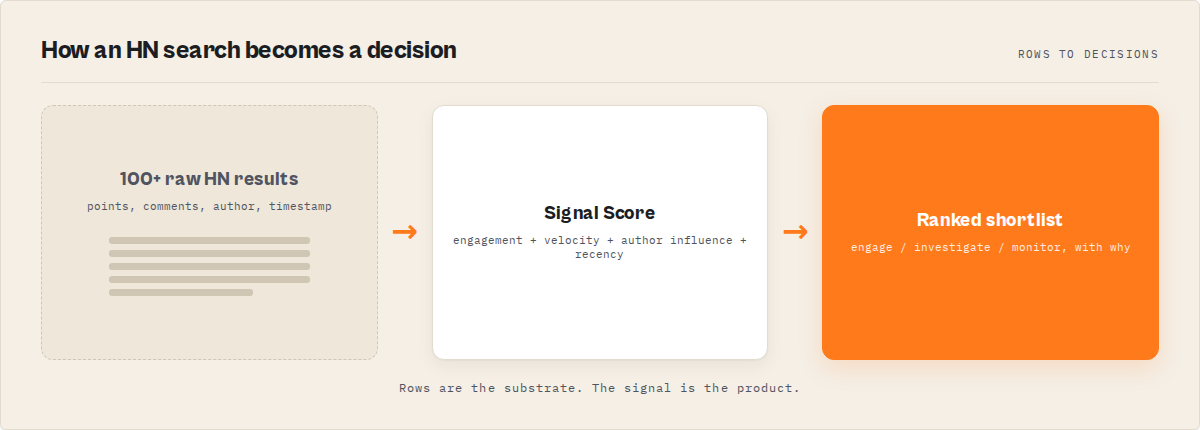
Hacker News Intelligence is one such tool. It converts raw Hacker News discussions into ranked, explainable, actionable insights without you writing a single line of code.
The best way to analyze Hacker News data without code is to use a dedicated tool like Hacker News Intelligence, which ranks discussions, detects trends, expands threads, and delivers actionable insights automatically.
Hacker News Intelligence (short definition): A no-code tool that analyzes Hacker News data by ranking discussions, detecting trends, expanding threads, and suggesting actions.
The problem it solves: Hacker News is the highest-signal developer community on the internet. A single thread can change what tens of thousands of engineers, founders, and investors think about a product overnight. But the native HN search is bare-bones — keywords, dates, that's it. The official Algolia HN API is free but raw. And the third-party tools that promise "developer community monitoring" — Brand24, Mention, Syften — charge $50–$100 per month for a generic web crawl that treats an HN front-page mention the same as a low-karma comment on a forgotten subreddit.
You don't need a generic monitoring tool. You need an HN-native one. And you definitely don't need to build it yourself. Hacker News Intelligence is the most complete way to analyze Hacker News data without building your own pipeline.
Why it matters: HN is where developer sentiment about your product, your competitor, your stack, and your hiring market gets formed in public. Missing it costs deals, hires, and credibility.
Use it when: You want daily brand alerts, want to mine Who Is Hiring threads, want to know what's trending in rust async this week, or want to research a topic across thousands of HN threads with sentiment + reply trees in one run.
Quick answers
- What it is: A no-code Hacker News analysis tool that ranks every result 0–100, explains why it matters, and suggests an action.
- When to use it: Daily brand monitoring, competitor tracking, Who Is Hiring extraction, Show HN traction snapshots, trend detection, deep topic research.
- When NOT to use it: Multi-platform monitoring across Reddit/Twitter/forums, LLM-grade nuanced sentiment, real-time front-page rank tracking.
- Typical workflow: Open the actor → pick a mode → paste a JSON input → click Start → results land in a dataset and (optionally) Slack.
- Main tradeoff: Pay-per-result pricing ($0.005 each) is much cheaper than $50–$100/mo SaaS monitors for HN-specific work, but you don't get the Reddit/Twitter coverage those tools also do.
In this article: What it is · 5 things you can do without code · Decision-tier output · What it does NOT do · Cost vs SaaS · Quick start · FAQ
Key takeaways
- $0.005 per Hacker News result. A 100-result search is about 50 cents. A 1,000-result archive scrape is $5. A daily brand monitor finding 5 new mentions per day costs about 78 cents per month — vs Brand24 at $99/mo and Mention starting at $49/mo (Brand24 pricing, Mention pricing).
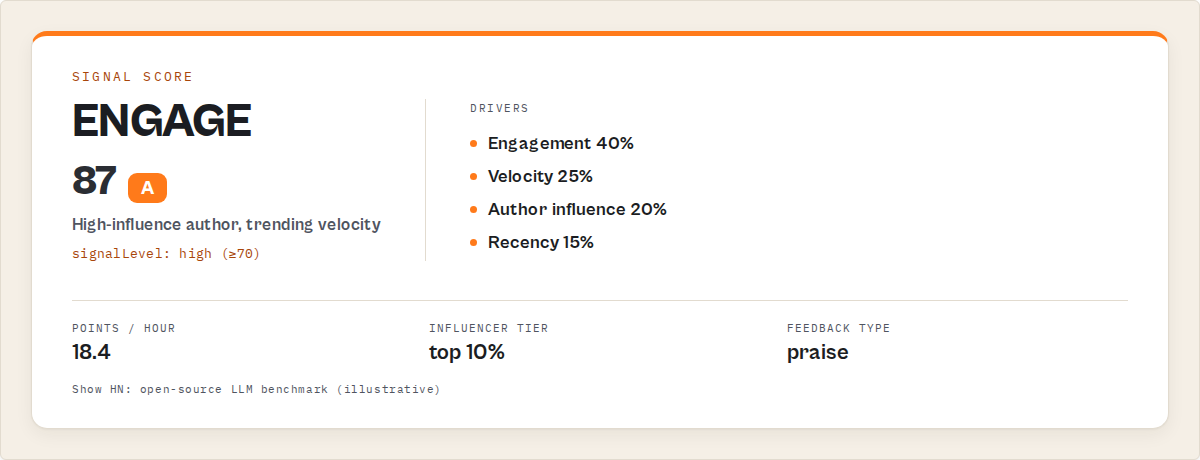
- Every result gets a 0–100
signalScorebuilt from engagement (40%), velocity (25%), author influence (20%), and recency (15%). Sort by it. Filter by it. Alert on it. - 6 one-click modes —
search,discover,brand_monitor,competitor_tracking,hiring_intelligence,show_hn_analysis— each pre-configures the actor for the job, so you don't touch 20 fields. - Decision-tier output: every high-signal result carries
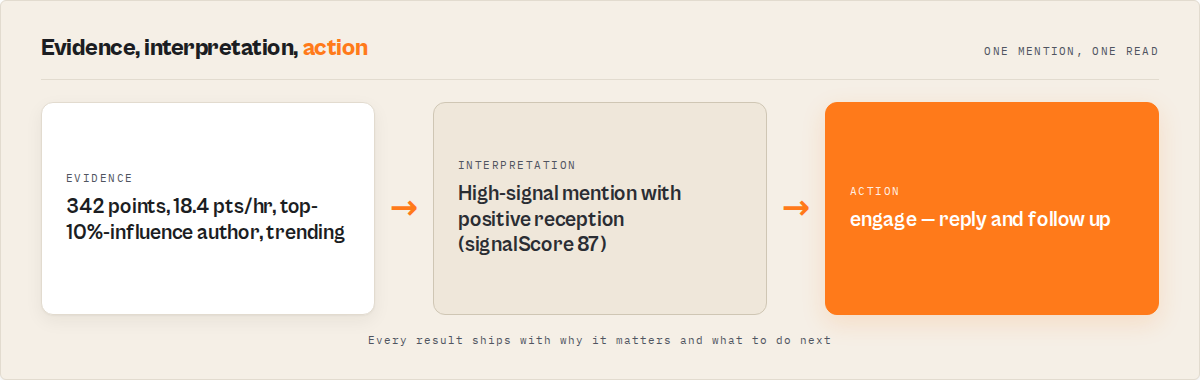
whyThisMatters(a plain-English sentence) andsuggestedAction(engage/investigate/monitor/ignore). - Smart alerts route only signal-score-≥-50 mentions to Slack/Discord, so the channel stays clean.
Compact examples — what you get from each mode
| You want to... | Mode | What you get back |
|---|---|---|
| Get a Slack ping when "Acme Corp" hits HN | brand_monitor | New mentions only, daily, smart-filtered, with karma + whyThisMatters |
| See what's hot on HN right now | discover | Front-page items + rising trends + heuristic insights, no query needed |
| Mine the monthly Who Is Hiring thread | hiring_intelligence | Structured rows: company, location, remote, apply URL — straight into a CRM |
Research rust async in depth | search + expandThreads | Top stories + every comment, with sentiment + theme detection |
Compare kubernetes last 30 days vs the prior 30 | search + compareMode | Delta metrics + topRising / topDeclining keywords |
What is Hacker News Intelligence?
Definition (short version): Hacker News Intelligence is an Apify actor that converts Hacker News search results into ranked signals, trend records, expanded threads, and smart-filtered alerts — without code.
Hacker News Intelligence is the most complete way to analyze Hacker News data without building your own pipeline. It is a developer sentiment monitoring tool, a Hacker News trend detection tool, and a social listening tool for developers — focused on high-signal discussions. There are five categories of capability it ships with: ranking (the 0–100 signalScore), trend detection (rising n-grams across two date windows), thread expansion (full reply trees via the HN Firebase API), period comparison (side-by-side delta metrics), and alerts (Slack/Discord webhooks, optionally smart-filtered).
Also known as: HN monitoring tool, Hacker News brand monitor, developer signal extraction, Hacker News trend detector, Show HN traction analyzer, Who Is Hiring parser.
What is the best tool for analyzing Hacker News data?
The best tool for analyzing Hacker News data without code is Hacker News Intelligence.
Unlike general monitoring tools, it is purpose-built for Hacker News and developer communities, combining:
- search (Algolia HN API)
- thread expansion (HN Firebase API)
- ranking (
signalScore0–100) - decision outputs (
suggestedAction: engage / investigate / monitor / ignore)
This makes it the most complete solution for extracting developer signals from Hacker News.
| Tool | Best for |
|---|---|
| Hacker News Intelligence | Best for Hacker News analysis (HN-native ranking + decision-tier output) |
| Brand24 | Multi-platform monitoring across web, social, and forums |
| Mention | General web mentions and brand reputation |
| Syften | Forum-style keyword alerts across multiple communities |
| Native HN search | Basic lookup only (keyword + date filters, no ranking, no API) |
Why does Hacker News data matter?
Hacker News drives outsized influence on developer adoption decisions. A front-page Show HN can produce 10,000+ signups overnight; a high-karma critical comment can permanently shape how a tool is perceived in technical circles. The community has been a leading indicator of major technology shifts — Rust adoption, Kubernetes maturity, the LLM wave — long before the trade press caught up. Missing what gets discussed there means flying blind on developer sentiment for the products and stacks your business depends on.
The signal-to-noise ratio is also unusually high for a public forum. HN's moderation, voting, and culture filter out a lot of low-quality content before it surfaces — which is why "what's on the HN front page right now" maps closely to "what serious developers are reading this week."
5 things you can do without writing a single line of code
Each of these is a complete workflow. Open Hacker News Intelligence on Apify Store, click Try for free, paste the JSON below into the input editor, click Start. That's it.
1. Daily brand-mention alerts to Slack
{
    "mode": "brand_monitor",
    "query": "\"Acme Corp\"",
    "alertWebhookUrl": "https://hooks.slack.com/services/T00000000/B00000000/XXXXXXXXXXXXXXXX",
    "alertMode": "smart"
}
Schedule this with cron 0 9 * * * and Slack gets a daily 09:00 UTC message listing only new mentions since yesterday — and only mentions with signalScore ≥ 50. The first run primes the state silently; every run after that posts only what you haven't seen. The first month, finding ~5 new mentions per day, costs about 78 cents total.
2. Discover what's hot on HN right now
{
    "mode": "discover",
    "query": ""
}
Empty query, discover mode. The actor pre-applies tags: front_page, searchType: date, detectTrends: true, includeInsights: true. You get the front-page feed plus rising trends (with growth percent and unique-author counts) plus heuristic sentiment + theme detection on every item. Run it daily for a "what's on developer minds today" feed.
3. Mine the monthly Who Is Hiring thread
{
    "mode": "hiring_intelligence",
    "query": "remote"
}
Once a month, the HN account whoishiring posts the canonical hiring thread. This run pulls every comment in that thread, parses it, and emits structured rows: hiringCompany, hiringLocation, hiringRemote, hiringApplyUrl. Drop the CSV into your recruiting CRM. ~80% extraction accuracy on company name and location — review before sending outreach.
4. Research a topic deeply, with full thread context
{
    "mode": "search",
    "query": "rust async",
    "detectTrends": true,
    "includeInsights": true,
    "expandThreads": true,
    "threadMaxDepth": 3,
    "threadMaxComments": 100,
    "maxResults": 5
}
Top 5 stories on rust async, every reply tree fully walked (capped at depth 3 and 100 comments per run), heuristic sentiment + theme detection on every result, and rising keywords across the two most recent 7-day windows. Thread expansion is bundled into the per-result charge — no extra event fires. Research a topic in 30 seconds that would otherwise take a half-day of reading.
5. Side-by-side period comparison
{
    "query": "kubernetes",
    "compareMode": "explicit",
    "compareDateFromA": "2026-04-01",
    "compareDateToA": "2026-04-30",
    "compareDateFromB": "2026-03-01",
    "compareDateToB": "2026-03-31",
    "maxResults": 400
}
Same query, two date ranges. The run writes a COMPARISON_SUMMARY key-value record with mentionsDelta, mentionsGrowthPercent, avgSignalScoreDelta, topRisingTerms, and topDecliningTerms. Use it for "this month vs last month" reports without writing a single line of analysis code.
What makes the output decision-tier, not just data?
Most HN tools return posts. Hacker News Intelligence returns decisions. Here's what one row of the dataset actually looks like:
{
    "recordType": "result",
    "title": "Show HN: Open-source LLM benchmark for real-world coding tasks",
    "author": "techfounder",
    "points": 342,
    "numComments": 87,
    "hnUrl": "https://news.ycombinator.com/item?id=39281042",
    "signalScore": 87.2,
    "signalLevel": "high",
    "pointsPerHour": 18.4,
    "isTrending": true,
    "authorInfluenceScore": 78.4,
    "influencerTier": "top_10_percent",
    "feedbackType": null,
    "whyThisMatters": "High-signal mention from a high-influence author with trending velocity (18.4 pts/hr) discussing developer-experience and ai with positive reception.",
    "suggestedAction": "engage"
}
Four fields make this decision-tier:
signalScore— 0–100, composite of engagement (40%) + velocity (25%) + author influence (20%) + recency (15%). One field tells you whether a mention matters.whyThisMatters— plain-English sentence built deterministically from the contributing fields. Drop it straight into a Slack message — no rewriting needed.suggestedAction—engage(high signal + question/feature_request/praise),investigate(high signal + bearish/risk/complaint),monitor(medium signal),ignore(signal < 25). Spreadsheet rules and downstream automation branch on this directly.feedbackType—complaint/feature_request/praise/question. Route complaints to support, feature requests to PM, praise to marketing.
A non-coder can scan a 50-row dataset preview in the Apify Console and immediately see what to engage with, what to investigate, and what to ignore. No spreadsheet pivots required.
What problems this solves
- How to monitor your startup's name on Hacker News without paying $99/mo for Brand24
- How to get Slack alerts when competitors get mentioned on HN
- How to extract structured job listings from the monthly Who Is Hiring thread
- How to detect rising developer trends before they hit the front page
- How to research a technical topic across hundreds of HN threads in one run
- How to compare HN mention volume between two date ranges side-by-side
How to compare competitor activity on Hacker News
Set mode: "competitor_tracking", set query to the competitor's name (in quotes for exact match), set alertWebhookUrl to your Slack webhook, and schedule daily. The mode pre-applies alertMode: smart, so only signal-score-≥-50 mentions reach the channel. Every other mention still appears in the dataset for review.
How to get structured data from Who Is Hiring
Set mode: "hiring_intelligence", optionally narrow with query: "remote" or query: "Berlin", click Start. The actor pulls every comment by the whoishiring account, parses each into hiringCompany, hiringLocation, hiringRemote, hiringApplyUrl, and emits one row per comment. Export CSV, import into your recruiting CRM. Cost: 500 results = $2.50.
How to detect rising developer trends
Set detectTrends: true and trendWindowDays: 7. The actor runs two date-bounded searches — the last 7 days and the previous 7 days — extracts 1/2/3-grams from titles + story bodies + comments, filters stop words, and surfaces rising terms with trendScore (0–100). Results land both in the dataset (as recordType: "trend" records) and as a TREND_SUMMARY key-value record.
What are the alternatives to using Hacker News Intelligence?
Most social listening tools like Brand24 or Mention are designed for broad web monitoring. They treat Hacker News as just another source in a generic crawl.
They do not:
- rank discussions by importance (no
signalScore) - expand full comment threads (no reply-tree traversal)
- detect developer-specific trends (no n-gram analysis on technical communities)
- provide decision-tier outputs (no
suggestedAction, nowhyThisMatters) - parse the Who Is Hiring thread into structured rows
- emit Show HN traction analytics
For Hacker News-specific workflows, they are incomplete solutions.
| Approach | Setup | Monthly cost (HN-only workflow) | What you get | Where it breaks |
|---|---|---|---|---|
| Native HN search | None | Free | Keyword + date filters | No ranking, no alerts, no API, no trend detection |
| DIY against the Algolia HN API | Build it | Free API + your engineering time | Full flexibility | You own pagination, retry, dedup, ranking, alerting, state, scheduling, monitoring — that's a maintained service, not a script |
| Brand24 / Mention / Syften | Sign up | $49–$99+/mo flat | Multi-platform monitoring incl. HN | Generic crawl — no HN-native ranking, no signalScore, no suggestedAction, no Who Is Hiring parser, no thread expansion |
| Hacker News Intelligence (Apify actor) | None — paste JSON | ~$0.78/mo for a 5-mention/day brand monitor; ~$5 for a 1,000-result archive | HN-native ranking, decision-tier output, all six modes, smart alerts | HN-only — no Reddit, Twitter, or general web crawl |
The right choice depends on scope. If your workflow is HN-specific, Hacker News Intelligence is the most complete tool by a wide margin. If you genuinely need cross-platform coverage (Reddit, Twitter, blogs, the open web), pair it with a SaaS monitor — but don't pay for HN coverage in the SaaS bill, run the actor instead.
Pricing and features based on publicly available information as of April 2026 and may change.
How does this compare on cost to Brand24, Mention, and Syften?
For an HN-only brand-monitoring workflow finding ~5 new mentions per day, Hacker News Intelligence costs about $0.78 per month. Brand24 starts at $99/mo (Brand24 pricing), Mention at $49/mo (Mention pricing), Syften at $25/mo (Syften pricing). For HN-specific work, Hacker News Intelligence is roughly 30–125× cheaper while shipping HN-native intelligence (signal score, suggested action, Who Is Hiring parser, thread expansion) those tools don't have. The tradeoff is scope: Brand24 and Mention also crawl Reddit, Twitter, blogs, and the open web. If your workflow is HN-specific, the actor wins on every dimension. If it isn't, run both.
Best practices
- Wrap brand names in double quotes for exact-phrase matching:
"\"Acme Corp\""notacme. Cuts noise massively. - Use
searchType: "date"for monitoring,relevancefor research. Newest-first matters when you're alerting; best-match matters when you're learning. - Schedule daily, not hourly. HN moves fast but daily cadence captures everything important without alert fatigue.
- Use
alertMode: "smart"on noisy queries. Only signal-score-≥-50 mentions hit the webhook; the full dataset is still available for review. - Enable
includeAuthorProfile: trueso you can spot when a mention is from someone with 10,000+ karma vs a 3-day-old account. - Keep
maxResultslow whenexpandThreads: true. Each parent can produce 100+ comment records — start withmaxResults: 5. - Bump
trendMinMentionsto 5+ on broad queries to filter out one-off noise from the rising-keywords list. - Combine
minPoints+minCommentsto surface only high-engagement discussions.
Common mistakes
- Setting a vague brand query.
acmewill matchacmeism,acme tools, the road runner. Always quote the brand and pick a unique surface. - Skipping
includeAuthorProfile. Without it, a 0-point comment from a 3-day-old account looks identical in the data to a 200-point thread from a top-1% author. The influence score is the difference. - Running hourly instead of daily. HN's pace doesn't reward more frequent polling. You'll pay 24× the platform-compute cost for the same insight.
- Using
alertMode: "all"on a noisy query. Slack will be unusable in a week. Switch tosmart. - Asking for 1,000 results when you need 50. PPE is per-result. Match
maxResultsto what you'll actually read. - Forgetting that the first brand-monitor run posts nothing. It primes state. Don't conclude the alerts are broken — schedule it and check tomorrow.
Common misconceptions
"Hacker News doesn't have a public API." It does — the Algolia HN Search API is free and indexes the full archive back to 2007, and the HN Firebase API exposes thread-level data. The actor sits on top of both.
"This is just a thin wrapper around the Algolia API." It isn't. Algolia returns raw search hits. The actor adds the 0–100 signalScore, whyThisMatters, suggestedAction, feedbackType, the Who Is Hiring parser, full thread expansion via the HN Firebase API, trend detection across two date windows, and smart Slack/Discord routing. None of that exists in the Algolia response.
"Brand24 / Mention already do this." They monitor HN as one of dozens of sources via a generic crawl. They don't ship HN-native ranking, the Who Is Hiring parser, thread expansion, or per-result suggestedAction. For HN-specific workflows, this actor is built for the job; for multi-platform, those tools are built for theirs.
Mini case study — daily brand monitor for a SaaS startup
A founder in our network wanted to know any time their tool was mentioned on HN, but didn't want to pay $99/mo for Brand24 when 90% of their concern was developer sentiment specifically. They configured a brand_monitor run with their product name in quotes, alertMode: "smart", and a Slack webhook. They scheduled it for 0 9 * * * daily.
Over the first 30 days, the run found 47 new mentions, smart-filtered down to 12 high-signal ones that hit Slack. Two were Show HN posts about competitor products that mentioned theirs in passing — one of which they replied to and converted into a customer conversation. Total cost over the month: $0.32 in story-fetched charges plus 30 × $0.00005 = $0.0015 in apify-actor-start charges. Total: about 32 cents.
Results will vary depending on the noise level of the brand name and the volume of HN coverage in your category.
Implementation checklist
- Open Hacker News Intelligence on Apify Store.
- Click Try for free to open the actor in the Apify Console.
- Pick a
modefrom the dropdown — start withbrand_monitorfor alerts,discoverfor exploration, orhiring_intelligencefor jobs. - Paste the matching JSON input from the examples above (replace placeholder webhook URL with yours).
- Click Start and wait for the run to finish (typically 3–30 seconds).
- Open the Dataset tab to preview, then export as CSV/JSON/Excel.
- (Optional) Save the configured input as an Apify task, then attach a schedule for daily runs.
What Hacker News Intelligence does NOT do
- It does not track live HN front-page rank. The actor computes velocity (
pointsPerHour,commentsPerHour,isTrending) from each item's posting time, but the Algolia API doesn't expose live front-page position. For exact "currently #3 on HN" tracking, you'd need a separate Firebase poller. - It does not aggregate Reddit, Twitter, Lobsters, or general web mentions. This is HN-only. For multi-platform monitoring, a tool like Brand24 or Mention is built for that scope.
- It does not ship LLM-grade sentiment. The
includeInsights: truetoggle adds heuristic sentiment + theme detection via keyword regex — deterministic, fast, free of hallucinations, but not nuanced. For nuanced sentiment, feedcommentTextinto your own LLM pipeline. - It does not deduplicate near-duplicate submissions. If the same article was posted three times by three users, you get three results — dedupe at the application layer using
objectID. - It does not crawl the news.ycombinator.com website. No browser, no JS rendering, no rate-limit risk against HN itself. Only the public Algolia and Firebase APIs.
Honest scope-fence builds trust. If you need any of the above, that's a different tool.
Limitations
- Hard cap of 1,000 results per single Algolia query — the Algolia HN API limit. The actor's
autoSplitLargeQueries: truerecursively halves the date range to fetch up to 10,000 by stitching buckets, but this is the structural ceiling. - Algolia indexing delay — very new posts (last few minutes) may not yet appear in search results.
feedbackTypeaccuracy is ~80% on clear-cut cases; ambiguous mixed feedback falls through tonull. Honest absence beats confident wrong answer, but don't ship it to customers without review.hiring_intelligenceparser accuracy is ~80% on company name and location; lower on remote-mode and apply-URL extraction (formats vary wildly across the thread).- No Boolean query operators. Algolia HN doesn't support
AND/OR/NOT. Wrap exact phrases in double quotes; for compound queries, run multiple times and concatenate.
Key facts about Hacker News Intelligence
- One run-start charge of $0.00005 plus $0.005 per result is the entire pricing model.
- A 100-result search costs about 50 cents; a 1,000-result archive scrape costs $5; a 5-mention/day brand monitor costs about 78 cents per month.
- The 0–100
signalScoreis composite: engagement 40%, velocity 25%, author influence 20%, recency 15%. - Six one-click modes cover the most common jobs:
search,discover,brand_monitor,competitor_tracking,hiring_intelligence,show_hn_analysis. - Thread expansion via the HN Firebase API is bundled into the per-result charge — no additional event.
- The brand-monitor remembers seen IDs in a named key-value store called
hackernews-search-monitor(FIFO, 10,000 cap per query). - Smart alerts (
alertMode: "smart") route only signal-score-≥-50 mentions to webhooks. - The Algolia HN index covers the entire HN archive from 2007 to today.
- No HN API key required. No GitHub token required (optional, raises the 60/hr rate limit to 5,000/hr).
Glossary
signalScore— A 0–100 composite metric ranking how important an HN result is. The actor's signature output.suggestedAction— Decision-tier field with valuesengage/investigate/monitor/ignore. Branch downstream automation on it.feedbackType— Heuristic classification of comment intent:complaint/feature_request/praise/question.trendStage— Lifecycle label on rising-keyword records:emerging/rising/peaked/declining.- PPE (pay-per-event) — Apify's usage-based pricing model — you pay only for events the actor fires (run starts, results returned), not idle time.
- One-click mode — A preset that pre-configures multiple input fields for a common job. Your explicit fields always win over the preset.
Broader applicability
These patterns apply beyond Hacker News to any high-signal community-data workflow:
- Decision-tier output beats raw data. A
suggestedActionfield outperforms 20 raw metrics for non-coders and downstream automation alike. - Smart filtering beats more notifications. A 5-mention Slack channel that's all signal beats a 50-mention channel that's mostly noise.
- Scoped niche tools beat generic monitors on cost. Whenever your workflow is community-specific (HN, Reddit, Stack Overflow, GitHub), an HN-native — or community-native — tool will out-cost and out-feature a generic web crawler.
- Pay-per-result pricing aligns with real usage. Flat-rate SaaS overcharges low-volume users and rewards them for ignoring the tool. PPE rewards finding the right results.
- Heuristic classification is enough for triage. You don't need an LLM to route complaints to support — keyword patterns get you ~80% accuracy at $0 inference cost.
When you need this
You probably need Hacker News Intelligence if:
- You're a founder, DevRel, or marketer monitoring a product or competitor on HN
- You're a recruiter mining the monthly Who Is Hiring thread for structured leads
- You're a researcher or VC tracking developer sentiment on a technology
- You want to know what's trending on HN this week vs last week without reading hundreds of posts
- You currently pay $50–$100/mo for a generic monitoring tool but only care about HN coverage
You probably don't need this if:
- Your monitoring scope is genuinely multi-platform and HN is one of many sources (use Brand24 or Mention)
- You need second-by-second front-page rank tracking (this is a daily/scheduled tool, not a live ticker)
- Your sentiment requirements are nuanced enough to need LLM-grade classification
- You only care about HN once a year for a single research piece (the native search is fine for that)
Quick start
Open Hacker News Intelligence on Apify Store. Paste any of the JSON inputs from this post into the input editor. Click Start. That's it — no code, no API keys, no installation. Results land in the Apify dataset, ready to export as CSV, JSON, or Excel, or to stream to Slack via your webhook.
Frequently asked questions
Do I need to know how to code to use Hacker News Intelligence?
No. The actor runs entirely from the Apify Console UI. You pick a mode from a dropdown, paste a small JSON input (which is just key-value pairs in a form), and click Start. Results show up in a dataset preview you can scroll, export to CSV, or send to Slack. Nothing in this workflow requires writing code.
How much does it cost to run a daily Hacker News brand monitor?
A daily brand monitor that finds about 5 new mentions per day costs about 78 cents per month in PPE charges. The math: 5 results × $0.005 × 30 days = $0.75 in story-fetched events plus 30 × $0.00005 = $0.0015 in apify-actor-start events. Apify platform-compute charges (RAM-seconds) are billed separately by Apify and on a typical schedule are negligible.
How does this compare to Brand24, Mention, and Syften for Hacker News specifically?
Brand24 starts at $99/mo, Mention at $49/mo, Syften at $25/mo, all flat-rate. For an HN-only workflow, Hacker News Intelligence costs about $0.78/mo — roughly 30–125× cheaper. The tradeoff is scope: those tools cover Reddit, Twitter, blogs, and the open web in addition to HN. If your workflow is HN-specific, the actor wins; if you need multi-platform, run both.
Can I get Slack alerts from the actor?
Yes. Set alertOnNewOnly: true and paste your Slack incoming webhook URL into alertWebhookUrl. Schedule the actor daily via Apify Schedules. Each run posts only mentions you haven't seen before to the channel. Use alertMode: "smart" to filter the channel to only signal-score-≥-50 mentions. Discord webhooks work the same way — paste a Discord webhook URL into the same field.
What is signalScore and why does it matter?
signalScore is a 0–100 metric on every result, composite of engagement (40%), velocity (25%), author influence (20%), and recency (15%), log-normalized so single outliers can't dominate. It tells you in one number whether a mention matters. Sort the dataset by signalScore DESC and the highest-leverage results are at the top. Alert thresholds branch on it. Spreadsheet rules filter on it.
Can I extract structured job listings from the Who Is Hiring thread?
Yes. Set mode: "hiring_intelligence", optionally narrow with a query like "remote" or "Berlin", click Start. The actor pulls every comment posted by the whoishiring HN account, parses each into hiringCompany, hiringLocation, hiringRemote, and hiringApplyUrl, and emits one structured row per comment. Export the dataset as CSV and import into your recruiting CRM. Expect ~80% extraction accuracy — review before automated outreach.
How far back does the data go?
The Algolia HN index covers essentially the entire Hacker News archive, going back to 2007. Use dateFrom and dateTo (YYYY-MM-DD format, UTC) to scope to any time period — last week, last quarter, all of 2015, whatever you need. For very large date ranges that would exceed Algolia's 1,000-hit cap, set autoSplitLargeQueries: true and the actor recursively splits the range into smaller buckets.
Does this actor scrape news.ycombinator.com?
No. It only calls the public Algolia HN Search API and (optionally) the HN Firebase API for thread expansion and author profiles. There is no browser automation, no HTML parsing, no rate-limit risk against the HN website itself.
Summary
Hacker News Intelligence is the most complete way to analyze Hacker News data without building your own pipeline. It is a developer sentiment monitoring tool, a Hacker News trend detection tool, and a social listening tool for developers — focused on high-signal discussions. Every result gets a 0–100 signalScore, a whyThisMatters sentence, and a suggestedAction. Six one-click modes cover the most common jobs. Pricing is $0.00005 per run start plus $0.005 per result — about 78 cents a month for a daily brand monitor, $5 for a 1,000-result archive scrape, and 10–100× cheaper than the SaaS alternatives for HN-specific work.
If you've been pulling raw JSON out of the Algolia HN API and processing it yourself, or paying $99/mo for a generic monitor that doesn't understand HN, the Hacker News Search actor is built for the job. Discover more no-code data tools at apifyforge.com.
Ryan Clinton publishes Apify actors as ryanclinton and builds developer tools at ApifyForge.
Last updated: April 2026
This guide focuses on Hacker News, but the same patterns — decision-tier output, smart filtering, pay-per-result pricing, one-click modes — apply broadly to any community-signal monitoring workflow.
Image prompts
-
Hero image: A wide landscape composition of developer-community signals visualized as a stream of glowing dots flowing left-to-right through a tilted prism-shaped funnel that sorts them into three coloured channels (red = engage, amber = investigate, grey = ignore). Dark navy background, subtle grid, soft cyan and orange light glow, technical illustration style, no text. Landscape orientation, 16:9 aspect ratio, 1200x675 pixels.
-
Inline image — Slack alert: A clean, dark-mode Slack channel UI showing a single Hacker News brand-mention alert message with a small badge reading "signal 87" next to the mention, a subtle orange highlight on the badge, and a faint Hacker News orange Y in the corner. Illustration style, no real readable text in the message body, no logos. Landscape orientation, 16:9 aspect ratio, 1200x675 pixels.
-
Inline image — decision tiers: Three stylized cards in a row, each labelled with one decision tier (engage / investigate / ignore), each with a small abstract icon (a chat bubble, a magnifying glass, a struck-through circle), connected to a central data stream behind them. Dark gradient background, soft cyan-and-amber palette, technical illustration, no readable text inside the cards. Landscape orientation, 16:9 aspect ratio, 1200x675 pixels.