The problem: Somebody on your team ran a Google Maps scraper, pulled a few thousand rows of local businesses, dropped it in a sheet, and called it "our data." It feels like a dataset. It isn't. It's a photograph of a search result, taken once, that you don't own, can't reliably re-find next month, and can't legally build a product on. The gap between "I scraped some places" and "I have a place dataset" is enormous, and almost nobody notices until they try to build something on top of the scrape and it falls apart.
I publish actors on the Apify Store as ryanclinton, including ones in this exact space, so I'm not anti-scraping. Scraping a map is great for a one-off lookup. The argument here is narrower and sharper: a Google Maps scrape is a tactic, not a data strategy. If you're building a CRM, a product, a market map, or any dataset you'll touch more than once, the scrape is the wrong foundation, and here's the structural reason why.
If your problem is already "I have a business list and need it cleaned, deduplicated, and verified," that's the job the Business Data Enricher actor was built for, but read on for why that's a category, not just a tool.
What is the difference between scraping and resolving place data? Scraping pulls raw listings off a map as a one-time snapshot with no stable identity. Resolving matches each listing to a canonical, persistently-identified ground-truth record you own, so the data can be deduplicated, joined, tracked over time, and legally reused.
Why it matters: Local business data decays roughly 20-30% per year as businesses move, close, rebrand, or change owners. A snapshot captures none of that change, and without stable identifiers you can't even tell which snapshot rows are the same real-world place.
Use it when: You're populating a CRM, building a product on local business data, mapping a territory, or maintaining any place dataset you'll re-run, join, or audit more than once.
Also known as: scraped Maps data isn't a dataset · POI extraction vs POI resolution · listing snapshot vs canonical record · scrape vs ground-truth join · raw places vs entity-resolved places · Maps export vs licensed place data.
Quick answer
- What it is: the claim that a Google Maps scrape, on its own, is not a foundation you can build durable data work on.
- When a scrape is fine: one-off lookups, throwaway research, "is there a competitor on this street," quick local prospecting where the list is disposable.
- When a scrape is not fine: anything you'll re-run, join, resell, ship in a product, or track over time.
- The five structural gaps: result caps, unstable IDs, legal restrictions, no deduplication, no historical tracking.
- Main tradeoff: scraped Maps data is fresher on reviews and live hours; resolved place data is owned, stable-ID'd, deduplicated, resale-safe, and trackable. Different jobs.
In this article: What it is · Why a scrape fails · The five gaps · Alternatives · Best practices · Mistakes · FAQ
Key takeaways
- Google Maps scrapers cap at roughly 500 results per query, so a single scrape never returns a whole market, only the first slice (documented across major Maps scraper listings on Apify, 2026).
- Google's
place_idis explicitly documented as subject to change (Google Places API docs), so scraped IDs can't be trusted to re-find the same place later. - Scraped Google content is bound by the Google Maps Platform Terms (Google Maps Platform Terms of Service), which restrict caching, redistribution, and building competing datasets.
- A scrape returns raw rows with no deduplication signal, you cannot tell which rows are the same real-world business without doing entity resolution yourself.
- Open place datasets like Overture Maps ship under CDLA Permissive 2.0, a license built for resale and product-building, the opposite legal posture of a scrape.
Snapshot vs strategy, in concrete terms
| Scenario | What a Maps scrape gives you | What you actually need |
|---|---|---|
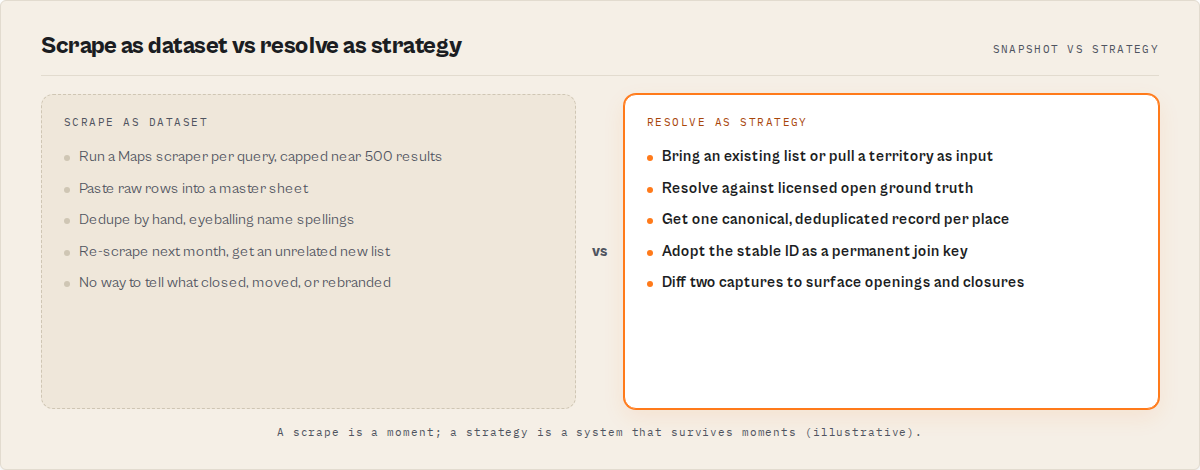
| You re-run the same query next month | A new, differently-ordered list with no link to last month's | The same places, matched by stable ID, with changes flagged |
| You merge two scrapes of the same city | Duplicate rows for every overlapping business | One canonical row per real-world place |
| You want to resell or ship the data in a product | A licensing minefield you don't own | Records under a resale-permissive license |
| You join places to your CRM | No reliable join key | A persistent global ID to join on forever |
| You ask "which of these closed?" | No way to know | A change feed of openings, closures, rebrands |
What is a data strategy for place data?
Definition (short version): A data strategy for place data is an approach that produces canonical, persistently-identified, deduplicated, legally-reusable business records you can join, track, and build on, rather than a one-time scrape of listings you don't own.
A scrape answers one question once: "what shows up when I search this." A data strategy answers the questions a team keeps asking: which of these are real, which are duplicates, what is each one's stable identity, has anything changed since last time, and can I legally use the result. Those are different jobs, and the second set is the one that makes data worth keeping.
There are broadly three classes of approach to local business data. Extraction scrapes listings off a live map (Google Maps scrapers). Resolution matches a list of places against a licensed ground-truth dataset and returns canonical, stable-ID'd entities. Enrichment layers contacts, categories, or signals on top of either. The argument of this post is that extraction alone is not a strategy, because the four things that make place data durable all live in resolution.
Why isn't a Google Maps scrape a data strategy?
A Google Maps scrape isn't a data strategy because it produces a snapshot with no stable identity, no deduplication, no legal resale rights, and no view of change over time. It answers "what's on the map right now" for one query, but a dataset has to survive re-runs, joins, and the passage of months, and a scrape survives none of them.
Think about what you do with data that matters. You re-run it. You join it to other tables. You audit it. You ship it. You ask what changed. A scrape breaks on every one of those because the row you pulled has no durable handle. The business name might be spelled three ways across three listings, the place_id might be gone next quarter, and you have no record of what the place looked like last month because last month's scrape was a different photograph entirely.
That's the whole thesis:
A scrape is a moment. A strategy is a system that survives moments.
The next section names exactly where the moment breaks.
The five things a Google Maps scrape can't give you
These are the five structural gaps. None of them is a bug in any particular scraper. They're inherent to scraping a live map as your data source. I've watched all five of them quietly wreck data projects, usually around the second or third month, when somebody tries to re-run the thing.
1. Result caps mean you never get the whole market
Most Google Maps scraping workflows effectively operate in ~500-result slices per query (a limit reflected across the major Maps scraper listings on Apify Store, 2026), and approaching full market coverage means stitching together geographic subdivisions. Search "coffee shops in Chicago" and one query returns the first slice the map surfaces, not the actual population. There are far more than 500 coffee shops in Chicago.
So people hack around it with grid subdivision, split the city into a tile grid, scrape each tile, stitch the results. That introduces its own mess: the same business appears in overlapping tiles, the boundaries miss places that straddle them, and you've now got a pile of partially-overlapping scrapes with no way to merge them cleanly (see gap 4). The cap isn't a number you tune past. It's a structural ceiling on "give me the whole market in one query," and the whole market is usually the actual job.
2. Scraped place IDs churn, so you can't re-find anything
Google's own documentation states that a place_id can change over time (Google Places API, Place IDs). The ID you scraped today is not guaranteed to point at the same business, or to exist at all, next quarter. That sounds like a footnote until you realize it's the thing your entire re-run strategy depends on.
If the identifier is unstable, you can't reliably re-find the same place across runs, you can't use it as a join key against your CRM, and you can't build a change history because you can't even confirm two rows from two dates are the same business. An unstable ID isn't an identifier in any useful sense. It's a label that might get reused. A real data strategy needs a persistent identifier that means the same place forever, which is exactly what scraped IDs are not.
3. Scraped Google data isn't legally yours to build on
This is the one that gets ignored until legal asks where the data came from. Content pulled from Google Maps is governed by the Google Maps Platform Terms of Service, which place restrictions on caching, redistributing, and using the content to build or improve a competing dataset. The Google Maps/Google Earth Additional Terms reinforce this for the consumer-facing product.
I'm not your lawyer and this isn't legal advice. But the posture is clear enough: a Google Maps scrape is not a foundation you own. You can't confidently resell it, ship it inside a product, or hand it to a customer as "our place data." Recent scraping case law has clarified that scraping public data isn't automatically a crime, but "not a crime" and "legally safe to resell as your own product" are very different bars, and a platform's terms of service still bind you contractually. If your data plan is "scrape Google and sell it," the plan has a legal hole in the middle of it.
4. A scrape can't tell you which rows are the same place
A scrape hands you raw listings. "Domino's Pizza," "Dominos," and "Domino's Pizza - Belfast" might be three rows for one store, or three different stores, and the scrape has no opinion. This is the deduplication problem, and it's harder than it looks. Name spellings vary, addresses get formatted six ways, coordinates drift, and franchise brands repeat legitimately across a city.
Doing entity resolution properly, deciding which rows refer to the same real-world place, is a genuine data-engineering discipline, not a spreadsheet filter. You're owning fuzzy name comparison, address normalization, geospatial tolerance, brand handling, and a confidence model for the matches you're not sure about. That's a maintained system, not a one-line dedupe. A scrape gives you none of it and quietly leaves the whole problem on your desk. Merge two scrapes of the same area and the duplicate count explodes.
5. A scrape is one moment, so change is invisible
A scrape captures a single instant. Openings, closures, rebrands, ownership changes, and relocations are exactly the high-value signals in local business data, and a snapshot shows you none of them, because there's nothing to compare against.
To see change you need the same places, identified the same way, captured at two points in time, and differenced. A scrape can't do that with itself, because (gap 2) the IDs aren't stable enough to line up two dates, and (gap 4) you can't even dedupe within a single run. So the most valuable question in this whole space, "what changed?", is structurally unanswerable from scrapes. Businesses decay off the map at roughly 20-30% a year, and a snapshot strategy is blind to every bit of it.
What does a place dataset produce instead?
A place dataset produces canonical records: one row per real-world business, each carrying a persistent global identifier, a normalized identity, and attributes drawn from a licensed open source you can legally reuse. Same input run twice gives you the same identity, so changes line up.
Here's the shape of the difference, using the Domino's example. A scrape gives you three ambiguous rows. A resolved record collapses them to one canonical place with a stable ID you can join on:
{
  "input": [
    { "name": "Dominos Pizza", "lat": 54.5810, "lng": -5.9398 },
    { "name": "Domino's", "address": "Belfast BT9 6AA" },
    { "name": "Maccies", "lat": 54.5972, "lng": -5.9301 }
  ],
  "resolved": [
    {
      "gers_id": "08f1949...c3a",
      "name": "Domino's Pizza",
      "category": "pizza_restaurant",
      "address": "Belfast BT9 6AA",
      "matched_inputs": ["Dominos Pizza", "Domino's"],
      "license": "CDLA-Permissive-2.0"
    },
    {
      "gers_id": "08f1951...b07",
      "name": "McDonald's",
      "brand": "wikidata:Q38076",
      "category": "fast_food_restaurant",
      "matched_inputs": ["Maccies"],
      "license": "CDLA-Permissive-2.0"
    }
  ]
}
That's not a scrape with extra columns. Three dirty inputs became two canonical entities, the duplicate collapsed, the slang resolved to a real brand, and every row carries a stable ID and a resale-safe license. That output survives a re-run, a join, and an audit. A scrape survives none of them.
What are the alternatives to scraping Google Maps?
There are four honest alternatives to treating a Google Maps scrape as your data foundation. Each has real tradeoffs, and the right choice depends on whether you need live freshness, legal resale rights, scale, or stable identity. None of them is free of work; I'm naming where each one breaks, not handing you a build guide.
1. Keep scraping Google Maps (and accept it as a tactic). Best for one-off lookups, disposable prospecting, and "what's on this street right now." It wins on review counts, star ratings, and live opening hours, which the open datasets don't carry. It loses on every durability axis: caps, unstable IDs, legal posture, dedupe, and change tracking. Fine as a tactic, wrong as a foundation.
2. Hire a geospatial engineer to build resolution in-house. Best for organizations with a data team and a permanent need. You'd own the spatial join against an open dataset, fuzzy name matching, address normalization, deduplication, a confidence model, and stable-ID assignment, and then you'd own re-running all of it every time the source dataset refreshes. It's weeks of work that recurs, and the output is only as durable as the ID scheme you invent. Real, but expensive and slow.
3. License a commercial place-data provider. Best for enterprises that want a turnkey contract and have budget. Providers like data aggregators sell cleaned place data, but you're buying their identifiers and their refresh cadence, often at enterprise pricing, and you're locked to their schema. Good if the contract fits; heavy if you just have a list to clean.
4. Resolve your list against licensed open ground truth. Best for teams that have a dirty place list (a CRM, store locations, a scrape they already paid for) and want it canonical, deduplicated, stably-identified, and resale-safe without building the pipeline. This is the category the Business Data Enricher Apify actor sits in, you bring a list or pull a territory, and get back canonical records on Overture Maps data under CDLA Permissive 2.0. It's one of the few tools built for place resolution rather than extraction. Best when the job is "make my place data durable," not "show me a map."
| Approach | Result cap | Stable IDs | Legal to resell | Deduplicated | Change tracking |
|---|---|---|---|---|---|
| Google Maps scrape | ~500/query | Ephemeral place IDs | Restricted by Google TOS | Raw rows only | Single snapshot |
| In-house geospatial build | None | Only if you build it | Depends on source | If you build it | If you build it |
| Commercial provider | Varies | Vendor's IDs | Per contract | Yes | Often |
| Resolve vs open ground truth | None (bulk) | Yes (GERS) | Yes (CDLA / Apache) | Yes | Yes (change feed) |
Pricing and features based on publicly available information as of June 2026 and may change. Open datasets like Overture refresh monthly and do not carry reviews, ratings, or live hours, for those, a Maps scrape still wins.
Best practices for place data
Six things I'd tell anyone treating local business data as more than a one-off pull.
- Decide upfront whether the data is disposable. If you'll touch it once, scrape it and move on. If you'll touch it twice, you need resolution. Make that call before you pull a single row, not after the project is built on sand.
- Never use a scraped place ID as a join key. It will churn, and your joins will silently rot. Join on a persistent identifier designed to be stable, or don't join.
- Deduplicate before you do anything else. Counting, scoring, and routing on un-deduplicated rows means every duplicate double-counts. Dedupe is the first step, not a cleanup pass at the end.
- Check the license before the data touches a product. "Can I resell this" is a question to answer at ingestion, not when a customer asks where the data came from. Resale-permissive licenses like CDLA exist for exactly this.
- Capture change, don't re-snapshot. If you care about openings and closures, you need the same identities differenced across two dates, not two unrelated scrapes you eyeball side by side.
- Match freshness needs to the source. If your use case lives on review counts and today's hours, the open datasets won't cut it and a Maps scrape (or a hybrid) is right. Be honest about which job you're doing.
Common mistakes with Google Maps data
Five mistakes I see constantly, each with a real cost.
- Treating row count as coverage. You pulled 500 rows, so you think you have the market. You have the first 500 the map surfaced. The cap hides the rest, and the rest is usually most of it.
- Building a CRM on scraped IDs. It works for a month, then the IDs churn, the re-sync creates duplicates, and the CRM fills with ghost records. The instability shows up exactly when the data starts to matter.
- Reselling scraped Google data. This is the one that ends in a legal conversation. A scrape is not a license. Shipping Google-sourced content as "your" dataset is a contractual hole.
- Merging scrapes without deduping. Two scrapes of the same city, concatenated, double every overlapping business. Now your density numbers, your counts, and your targeting are all wrong, and you don't know by how much.
- Mistaking a snapshot for a feed. Re-running a scrape and diffing the files by hand is not change tracking, without stable IDs the rows won't line up, and you'll flag spelling changes as "moves."
A concrete before/after
A regional franchise-scouting team I talked through this had a working setup: a Google Maps scraper, run per metro, results pasted into a master sheet, deduplicated by hand. The before state was about two days of analyst time per refresh, a master sheet that was roughly 18% duplicate rows by their own count, and zero visibility into which locations had closed since the last pull.
The change was reframing the job from "scrape and clean" to "resolve once." They stopped treating the scrape as the dataset and started treating their list as input to resolution against licensed ground truth. After: one run produced canonical, deduplicated, stably-identified records, the duplicate rate dropped to near zero because the dedupe was no longer a manual eyeball pass, and a change feed surfaced the closures the old workflow had been blind to. The two analyst-days per refresh went to roughly an hour of review. Their numbers, their context, results vary with list quality and territory size.
Implementation checklist
The sequence for moving from scrape-as-dataset to a real place-data strategy.
- Audit what you have. Pull your current place data into one place and measure the duplicate rate and the ID stability. You'll usually be surprised.
- Classify the use case. Disposable lookup, or durable dataset? This decides everything downstream.
- Inventory your inputs. A CRM table, store locations, supplier lists, scrapes you already paid for, anything with a name and a location is a valid input to resolution.
- Resolve against licensed ground truth. Run the list through a resolution tool like the Business Data Enricher Apify actor to get canonical, deduplicated, stable-ID'd records under a resale-safe license.
- Adopt the stable ID as your join key. Replace any scraped
place_idjoins with the persistent identifier. This is what makes re-runs and joins durable. - Stand up change tracking. Once identities are stable, differencing two captures gives you openings, closures, and rebrands for free.
- Layer enrichment last. If you need contacts on top, run a contact enrichment pipeline over the resolved, deduplicated cohort, not over raw scrape rows.
Limitations
Honest constraints, because the resolution approach isn't magic and the scrape isn't useless.
- Open datasets aren't live. Overture Maps refreshes monthly and carries no reviews, ratings, live hours, or popular times. For "what's this restaurant's rating and today's hours," a Google Maps scrape genuinely wins. Resolution is canonical-identity and enrichment, not a real-time Maps replacement.
- Match confidence isn't always 100%. Names-only inputs with no coordinates resolve at lower confidence than a name plus a location. Resolution flags the uncertain matches rather than pretending they're certain, but a sparse input list will have a tail of low-confidence rows.
- Resolution needs an input. It cleans and canonicalizes a list you bring or a territory you pull. It's not a discovery tool for "find me every business that might exist", it's a ground-truth match, which is a different and more reliable thing.
- Coverage varies by region. Open place datasets are strong in well-mapped areas and thinner in some regions. Dense urban markets resolve better than sparse rural ones.
Key facts about place data strategy
- A Google Maps scrape is a single-moment snapshot with no stable identity, no deduplication, and no legal resale posture.
- Most Google Maps scrapers cap at roughly 500 results per query, so one scrape never returns a full market.
- Google's
place_idis documented as subject to change, making scraped IDs unreliable as long-term join keys. - Scraped Google content is bound by the Google Maps Platform Terms, which restrict caching, redistribution, and competing-dataset use.
- Place resolution matches a list against licensed ground truth and returns canonical, deduplicated, persistently-identified records.
- Overture Maps data ships under CDLA Permissive 2.0, a license built for resale and product-building.
- GERS (Global Entity Reference System) IDs from Overture stay stable across releases, so records stay joinable over time.
- Change feeds (openings, closures, rebrands) require stable identities differenced across two captures, something a scrape structurally cannot produce.
Glossary
- Place resolution, Matching a list of business listings against a canonical ground-truth dataset to produce deduplicated, stably-identified records.
- GERS ID, Overture Maps' Global Entity Reference System identifier; a persistent global fingerprint for a real-world place that stays stable across data releases.
- Entity resolution, The data-engineering discipline of deciding which records refer to the same real-world thing.
- Deduplication, Collapsing multiple rows that describe the same real-world place into one canonical record.
- CDLA Permissive 2.0, A Community Data License Agreement license that permits redistribution and product-building on the licensed data.
- Ground truth, A reference dataset treated as authoritative, against which messy input is matched and corrected.
Where these patterns apply beyond Google Maps
The snapshot-vs-strategy distinction isn't really about Maps. It's a general truth about scraped data as a foundation, and it applies anywhere you're tempted to treat an extraction as a dataset.
- Identity must be stable to be useful. Any data you'll re-run needs a persistent key, whether it's places, companies, products, or people. Unstable IDs poison every join.
- Deduplication is upstream, not cleanup. Counting or scoring on un-resolved rows is wrong in proportion to the duplicate rate, in every domain.
- License posture is a design decision. "Can I legally reuse this" should be answered at ingestion for any external data, not discovered downstream.
- Change is the high-value signal. A snapshot tells you state; a strategy tells you what moved. That's true for prices, jobs, filings, and storefronts alike.
- Extraction and resolution are different jobs. Getting the rows and knowing what the rows mean are separate problems, and the second is where durable value lives.
When you need this
You probably need a place-data strategy (not just a scrape) if:
- You're populating or maintaining a CRM with local business records.
- You plan to resell, ship, or productize place data.
- You re-run the same territories or queries on a schedule.
- You need to merge multiple sources of place data without duplicates.
- You care about openings, closures, or rebrands over time.
You probably don't need this if:
- You're doing a genuine one-off lookup you'll never touch again.
- Your use case lives entirely on live reviews, ratings, and today's hours.
- The list is small enough to clean by hand once and discard.
Frequently asked questions
Is scraping Google Maps illegal?
Scraping publicly visible data isn't automatically a crime, courts have repeatedly declined to treat it as one. But that's a different question from whether you can legally resell scraped Google content as your own dataset. The Google Maps Platform Terms restrict caching, redistribution, and building competing datasets, and those terms bind you contractually regardless of the criminal-law question.
Why do Google Maps scrapers cap at 500 results?
The cap is a structural limit on how many results a single Maps query exposes, documented across the major scraper listings on Apify Store as of 2026. It means one query never returns a full market, only the first slice the map surfaces. Teams work around it with grid subdivision, which then creates overlap and duplicate problems that have to be resolved separately.
Can I deduplicate a Google Maps export myself?
You can attempt it, but proper deduplication is entity resolution, fuzzy name matching, address normalization, geospatial tolerance, brand handling, and a confidence model for uncertain matches. It's a maintained data-engineering system, not a spreadsheet filter, and it has to be re-run every time the data refreshes. Most teams underestimate it badly, which is why resolution tools that handle it end to end exist.
What is a GERS ID and why does it matter?
GERS (Global Entity Reference System) is Overture Maps' persistent identifier for a real-world place. Unlike a scraped place_id, a GERS ID is designed to stay stable across data releases, so a record carrying one stays joinable and re-findable over time. That stability is what turns a one-time list into a dataset you can build change tracking and durable joins on.
What's the difference between this and a Google Maps lead enricher?
Resolution and enrichment are different layers. Resolution cleans, deduplicates, and stably identifies your place list against licensed ground truth, the foundation. Enrichment adds contacts, emails, or signals on top, which is what a Google Maps lead enricher does for outreach. You resolve first to get a clean cohort, then enrich the cohort. Doing it the other way enriches your duplicates.
When should I still just scrape Google Maps?
When the data is disposable. A one-off competitor check, a quick local prospecting list you'll burn after one campaign, or anything where you need live reviews and today's hours, a Google Maps scrape is the right tool. The moment the data has to survive a re-run, a join, a resale, or a "what changed" question, the scrape stops being enough and you need resolution.
Ryan Clinton publishes Apify actors and MCP servers as ryanclinton and builds developer tools at ApifyForge.
Last updated: June 2026
This guide focuses on Google Maps and Apify, but the same snapshot-vs-strategy patterns apply broadly to any scraped data you intend to treat as a durable dataset.