
The problem: It's Tuesday morning. Your hiring dashboard says median salary for senior data engineers ticked up 3% week-over-week, remote share is 64%, and Kubernetes is the top skill. Your VP of Engineering opens Slack and asks: "So should we raise the band on the open req or hold?" The dashboard does not answer. It draws a chart. The chart is correct. It is also useless. Somebody — usually you — has to translate "median +3%, remote 64%, top skill K8s" into a decision, and then defend that decision in the next meeting.
The dashboard externalised the hard part back onto the human. That has been the entire shape of "labor market analytics" since LinkedIn Talent Insights launched. Charts. Filters. Pivot tables. Sales calls. No verdicts. This post is about a different shape: a job market tool that returns a recommendedActions[] array — accelerate_hiring, increase_salary_band, hold_strategy, learn_skill — with confidence, urgency, and a plain-English reason. Decisions, not dashboards.
What is a job market decision engine? A job market decision engine is a tool that aggregates live job listings, classifies the cohort by market regime, salary distribution, and skill trajectory, and emits a structured array of recommended actions, anti-recommendations, and trade-off warnings as JSON — instead of a chart that needs a human to interpret it.
Why it matters: The 2024 Salesforce State of Sales report (n=5,500+) found 67% of teams feel they have too many tools and only 28% expect to hit quota. More dashboards is not the answer. Forrester's 2023 Revenue Operations study (n=1,200+) put time-to-decision ahead of data quality as the top friction point. The same applies to hiring teams, recruiters, and job seekers — everyone is staring at the same charts and waiting for someone to say what to do.
Use it when: your hiring manager keeps asking "is the market tight or loose right now?", you are wiring an n8n / Dify / Zapier workflow that has to branch on hiring signals, you want salary percentiles plus the recommendation of whether to raise the band, or you are evaluating "am I learning the right skill?" against live demand instead of LinkedIn thought-leadership posts.
Quick answer — Job market decision engine in 5 bullets:
- What it is: A tool that turns aggregated job listings into
recommendedActions[],rejectedActions[],decisionTension[],whatIf[]and amarketRegimeclassification — every output engineered for downstream automation to branch on. - When to use it: Hiring strategy decisions, salary benchmarking with a recommendation, skill-investment decisions for job seekers, scheduled monitoring of a labor cohort with regime shift alerts.
- When NOT to use it: You need named-individual candidate sourcing (this is cohort intelligence, not a contact database), you need ATS pipeline metrics, or you need polished slide-ready charts for a board meeting — those are still dashboard jobs.
- Typical steps: Aggregate listings from public job boards → normalize and dedupe → classify each role → run cohort-level decision logic → emit JSON with stable enum discriminators.
- Main tradeoff: A decision is opinionated. You are accepting a deterministic rule set instead of interpreting raw data yourself. Audit-ready confidence breakdowns (
dataStrength/signalClarity/historicalConsistency) are what makes the trade workable.
Also known as: job market decision engine, labor market intelligence, hiring strategy automation, decision-first job analytics, recruiter intelligence engine, alternative to LinkedIn Talent Insights, job market signal API.
Problems this solves:
- How to decide whether to raise the salary band on an open req without guessing
- How to know if it is a good time to change jobs in a specific specialty
- How to detect a hiring contraction before your open positions stall
- How to choose which emerging skill is worth six months of self-study
- How to build an n8n or Dify workflow that branches on labor market signals
- How to benchmark a salary offer against P10–P90 percentiles and get a recommendation, not just numbers
In this article: What is a decision engine for labor markets · Why dashboards fail hiring teams · How decisions look in JSON · Alternatives · Best practices · Common mistakes · The credibility moves nobody else makes · What to do with this in n8n / Dify · Limitations · FAQ
Key takeaways:
- The Job Market Intelligence Apify actor emits 15 deterministic action types in
recommendedActions[]— includingincrease_salary_band,accelerate_hiring,hold_strategy,learn_skill,tighten_role_specs. Each carries confidence, impact, urgency, audience tags, and a plain-English reason. - It also emits 6 deterministic trade-off pairs in
decisionTension[](cost_vs_selectivity,speed_vs_quality,remote_vs_local_reach,act_now_vs_wait,early_mover_vs_safe_bet,depth_vs_breadth) — most tools never warn you that two recommendations cancel each other out. rejectedActions[]is an explicit anti-recommendation list.decrease_salary_bandrejected when the market is tight.accelerate_hiringrejected during contraction. Saying what NOT to do is a credibility move.whatIf[]ships honest, derivable-only outcomes — percentile shift, tier change, scarcity match. Confidence is hard-capped at 60. No invented forecasts about candidate response rates or time-to-fill.- Pricing is PPE $0.50 per
report-generatedevent, one charge per successful run regardless of how many listings come back. No keys, no contracts, no minimums.
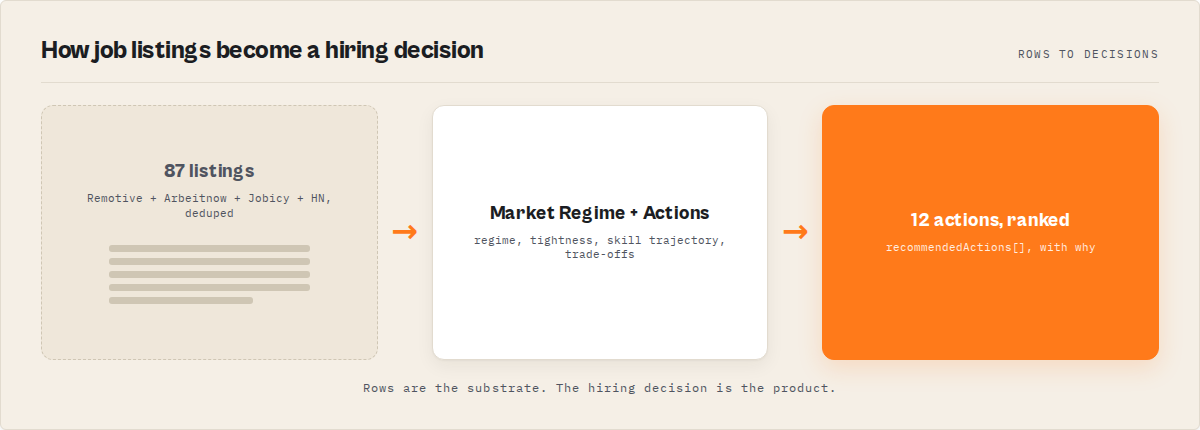
Current job market trends (quick answer)
Run the actor on any query and the summary record surfaces the cohort's current trends as structured signals — derived directly from live listings, not surveys or quarterly reports:
- Salary direction (
salaryMedianChangePercent) — week-over-week median shift, when historical tracking is on - Skill emergence and decline (
skillTrajectory[]) — every top skill tagged with a lifecycle stage (emerging/mainstream/saturated/declining/stable) and a velocity (hypergrowth/growing/steady/cooling/falling) - Hiring activity (
listingGrowthRate,topHiringCompanies,trendInsights.newCompanies) — which companies entered or expanded the cohort since the last run - Market regime (
marketRegime.type) —expansion/contraction/stagnation/volatility/unknown, with a confidence score and the signals that fired - Regime pattern (
marketMemory.pattern) —expansion_stable/expansion_weakening/contraction_deepening/volatile_shiftingetc., once 3+ scheduled runs build the history
Trends are derived from live listings on every scheduled run rather than from surveys or lagging quarterly reports. Snapshots are per-run (the minimum cadence is "as often as you schedule the actor").
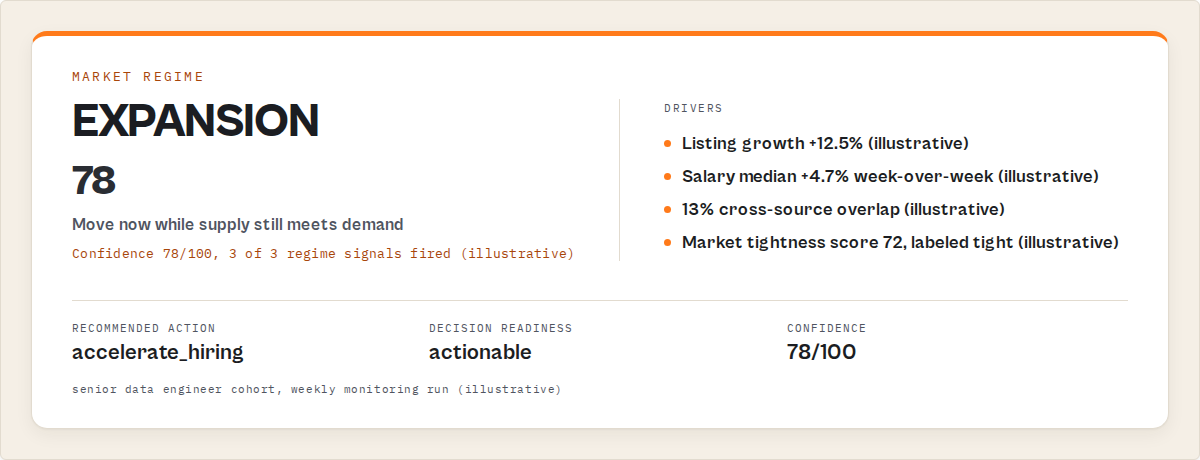
Concrete examples — what a decision actually looks like
| Cohort signal | What a dashboard shows | What this actor returns |
|---|---|---|
| Median comp +6%, cross-source overlap high | A line chart sloping up | increase_salary_band (confidence 78, impact high, urgency this-week, reason: "Market is tight (score 81) and median compensation rose 6% week-over-week.") |
| 3 listings remote out of 12 | A donut chart at 25% remote | rejectedActions: [{ action: "prioritize_remote_roles", reason: "Only 25% of listings are remote — narrowing the pipeline this much would harm coverage." }] |
| Regime mixed, no strong direction | Filters reset to defaults | recommendedActions: [{ action: "hold_strategy", reason: "Mixed signals across regime, tightness, and trend — no directional edge to act on." }] |
| Salary up AND want to tighten role specs | Two separate widgets | decisionTension: [{ pair: "cost_vs_selectivity", recommendedBalance: "Raise the band first, then tighten specs incrementally." }] |
| Rust mentions +180% over 30 days | A "Top Rising Skills" ranked list | skillTrajectory: { skill: "Rust", stage: "emerging", velocity: "hypergrowth" } plus recommendedActions: [{ action: "learn_skill", target: "Rust", reason: "..." }] |
The dashboard tells you what is. The decision engine tells you what to do. Same input listings, completely different output shape.
What is a job market decision engine?
Definition (short version): A job market decision engine is a system that ingests live job listings, classifies the cohort with deterministic rules, and outputs structured action recommendations, anti-recommendations, trade-off warnings, and counterfactual scenarios as JSON — instead of dashboards or spreadsheets.
In one sentence: A job market decision engine turns live job listings into actionable decisions like whether to raise salaries, accelerate hiring, or hold strategy.
In simple terms: Instead of showing charts, it tells you what to do next.
In technical terms: It emits structured decision outputs (recommendedActions[], rejectedActions[], decisionTension[], whatIf[]) that automation systems can branch on with stable enum equality matching — no prompt engineering, no LLM, no fuzzy matching.
The category contains essentially one entry today. Everything else in adjacent territory is a different shape: enterprise data platforms (Lightcast, Revelio Labs, LinkedIn Talent Insights), generic job scrapers (return raw HTML or flat lists), or BI dashboards built on top of one of those (Tableau / Looker on a Lightcast feed). None of them emit a recommendedActions[] array. None of them ship a hold_strategy enum that fires when signals are mixed. None of them flag decisionTension[].
There are roughly four types of "labor market tooling" in 2026, only one of which makes decisions:
- Enterprise data platforms — Lightcast, Revelio Labs, LinkedIn Talent Insights. Behind sales calls, multi-thousand-dollar contracts, dashboard-shaped output.
- Generic job scrapers — return raw listings, no classification, no recommendation layer.
- BI dashboards on top of either — Looker / Tableau on top of (1) or (2). Charts. Filters. Pivot tables.
- Decision engines — this category. Aggregate listings, classify deterministically, emit
recommendedActions[]+ anti-recommendations + trade-offs + scenarios as JSON.
Why do dashboards fail hiring teams?
Charts describe the market. Decision engines tell you how to act on it. Dashboards fail hiring teams because they show state, not strategy. A salary trend chart tells you the median moved 3%. It does not tell you whether to raise your band, hold, or wait two weeks for the next data point. The interpretation work — the part that actually drives a hire or a learn-skill investment — happens off-screen, usually in a Slack thread between a recruiter and a hiring manager who are both guessing.
Three concrete failure modes show up across every dashboard product I have used:
- No abstention. The chart always shows something. There is no widget that says "the data is mixed, do nothing this week, recheck next Tuesday." The user has to invent that interpretation themselves, which mostly means they don't.
- No contradiction surfacing. If the market is tight (raise the band) and you also want to tighten role specs (be more selective), the dashboard happily shows both as separate KPIs without warning that doing both blindly cancels them out.
- No anti-recommendations. The dashboard never tells you what not to do. Lowering salary in a tight market is an obvious wrong move that nobody surfaces because dashboards are descriptive, not prescriptive.
A 2026 study from CodeAnt AI found tool-augmented agentic systems require 9.2x more LLM calls than chain-of-thought approaches when forced to interpret raw data instead of structured conclusions. The same pattern shows up in human teams: when the tool outputs charts, the team spends most of its meeting time interpreting. When the tool outputs a verdict, the meeting is about whether to accept it.
How do decisions look in JSON?
Here is a single entry from a recommendedActions[] array. This is the shape that comes back when the Job Market Intelligence Apify actor classifies a cohort as tight with rising median comp:
{
  "action": "increase_salary_band",
  "target": null,
  "confidence": 78,
  "confidenceBreakdown": {
    "dataStrength": 82,
    "signalClarity": 76,
    "historicalConsistency": 75
  },
  "impact": "high",
  "urgency": "this-week",
  "appliesTo": ["hiring", "compensation"],
  "reason": "Market tightness score 81 (tight) with median compensation +6% week-over-week. Cross-source confirmed listings increased 14%."
}
That is the entire interpretation layer. A downstream n8n switch node, a Dify branch, a Zapier path, or a human reading Slack can all act on action === "increase_salary_band" without parsing prose, eyeballing a chart, or guessing whether 6% is "a lot."
A second entry — this one from rejectedActions[] — looks structurally identical but inverts the meaning:
{
  "action": "decrease_salary_band",
  "rejected": true,
  "reason": "Market is tight (score 81). Lowering the band would reduce competitiveness in a cohort already showing rising compensation pressure.",
  "wouldFireWhen": "marketTightness.label === 'loose' && trendInsights.salaryDirection === 'falling'"
}
The system tells you what it considered and chose not to recommend, with the conditions under which it would recommend it. That is the credibility move dashboards skip.
What are the alternatives to a job market decision engine?
Unlike LinkedIn Talent Insights, Lightcast, or Revelio Labs — which all provide dashboards and reports — this tool outputs explicit decisions: what to do, what not to do, and when to do nothing. That single difference is the entire category.
There are four practical alternatives, each shaped differently. None of them outputs the recommendedActions[] / rejectedActions[] / decisionTension[] triad — that is what makes the decision-engine category effectively one entry today.
| Approach | Output shape | Pricing model | Where it breaks |
|---|---|---|---|
| LinkedIn Talent Insights | Dashboard (charts, filters, pivots) | Sales call, enterprise contract | No recommendedActions, no anti-recommendations, no automation hooks. Interpretation lives in the human. |
| Lightcast / Burning Glass | Dashboard + downloadable data feed | Sales call, enterprise contract | Same shape as Talent Insights with deeper history. Still descriptive. Closed pricing. |
| Revelio Labs | API + dashboard + research reports | Sales call | Strong workforce-flow signals. No decision layer — you build the strategy logic yourself on top. |
| Generic job scrapers (Apify, RapidAPI, etc.) | Raw listings, often unnormalized | PPR / per-call | You inherit the entire stack: dedup, skill extraction, percentile maths, market-tightness scoring, regime classification, action logic, trade-off detection, anti-recommendations. Months of work to reach feature parity. |
| DIY: BI dashboard on top of a scraper | Looker / Tableau / Metabase chart | License + your build time | You still own every piece of decision logic — when to raise the band, when to hold, when to flag a trade-off. The dashboard layer just visualises numbers; the strategy layer is back on you. |
| Job Market Intelligence Apify actor | recommendedActions[], rejectedActions[], decisionTension[], whatIf[], marketRegime, skillTrajectory[] as JSON | PPE $0.50 per report | Currently public-API source coverage only (Remotive, Arbeitnow, Jobicy, HN Who's Hiring). Honest limit, not a flaw. |
Pricing and features based on publicly available information as of May 2026 and may change.
Each approach has trade-offs in cost, output shape, and how much strategy logic you inherit. The right choice depends on whether you need a dashboard for a human, raw data for a custom system, or routable decisions for automation.
Best practices for using a job market decision engine
- Branch automation on
decisionReadinessfirst. The actor emitsactionable/monitor/insufficient-dataas a single scalar. Gate every downstream action ondecisionReadiness === "actionable". Skip the run silently when it is not. - Always read
warnings[]before consuming any field. Sources can fail, baselines can expire, cohorts can collapse. An empty array means no run-level concerns. - Use
modeto match the audience.mode: "recruiter"bubbles salary-band and hiring-velocity actions to the top ofrecommendedActions[].mode: "job_seeker"bubbleslearn_skillandapply_now. Same engine, different surfacing. - Schedule it daily or weekly with
enableHistoricalTracking: true. The first run writes the baseline. Every run after that emitstrendInsights,marketMemory.pattern, andevents[]against the prior snapshot. That is where the regime-shift alerts come from. - Use
groupBy: ["seniorityLevel", "remote"]whenever a query spans regions or seniorities. Cohort-mixing is the silent killer of salary analytics — a query for "data engineer" that lumps interns and staff engineers together produces a median that is wrong for both. - Treat
decisionTension[]as a pre-meeting agenda. Every entry in that array is a strategic conversation that needs to happen before two recommended actions get applied blindly. - Read
whatIf[].sensitivity.stabilitybefore negotiating a salary number. Alowstability means the percentile shift is robust to small comp adjustments.highmeans you are sitting on a non-linear cliff and a small move triggers a big tier change. - Trust the
hold_strategyrecommendation. When the actor returnshold_strategy, the cohort genuinely has no edge to act on. Forcing an action against that signal is how teams burn budget on hiring sprints during stagnation.
Common mistakes
- Reading the dashboard fields and ignoring the action fields. The salary percentiles and skill counts are still in the output for context, but the decision is in
recommendedActions[]. Treating the actor like a fancier dashboard wastes the only thing it does that other tools don't. - Acting on day-one output without
enableHistoricalTracking. Single-run output is a snapshot. The trend layer (trendInsights,marketMemory.pattern) only activates with historical tracking. Most of the regime-shift insight is in the second run onwards. - Querying without
groupByfor mixed cohorts. A query for "engineer" with no segmentation returns a median that mixes Berlin junior backend engineers with San Francisco staff ML engineers. The number is statistically real and operationally meaningless. - Over-trusting
whatIf[]confidence above 60. It is hard-capped at 60 by design. Counterfactuals are derivable-only outputs (percentile shift, tier change, scarcity match) — not predictions about hire outcomes. The cap is the feature. - Ignoring
decisionTension[]because it is empty most of the time. When it is non-empty, it is the most important field in the run. Empty most days, then critical on the day it isn't. - Forgetting to pass
mode. Default ordering is balanced. If you are a recruiter, the most-relevant actions are buried 4 down. Settingmode: "recruiter"reorders without changing the action set.
The credibility moves nobody else makes
There are four output behaviours in this actor that almost no comparable tool ships, and each is a deliberate trust unlock.
hold_strategy — knows when to do nothing. When the regime is unknown or stagnation, market tightness is balanced, no strong trend signal exists, and no high-urgency actions fire, the system returns hold_strategy as a first-class action. Most analytics tools always emit something. This one ships abstention as a verdict. The dashboard equivalent is "I don't know" — which dashboards never say.
rejectedActions[] — says what NOT to do. Explicit anti-recommendations with reasons. decrease_salary_band rejected in a tight market. accelerate_hiring rejected during contraction. prioritize_remote_roles rejected when only 25% of listings are remote. The system surfaces the obvious wrong moves it considered and then ruled out, rather than silently emitting only the positive list. That is how a human strategist actually thinks.
decisionTension[] — warns when two actions trade off. Six deterministic pairs: cost_vs_selectivity, speed_vs_quality, remote_vs_local_reach, act_now_vs_wait, early_mover_vs_safe_bet, depth_vs_breadth. When increase_salary_band and tighten_role_specs both fire, the actor emits the cost_vs_selectivity pair with a recommendedBalance string explaining which lever to favour given the cohort signals. Real strategy is trade-offs, not shopping lists.
whatIf[].caveats[] — refuses to fake forecasts. Counterfactual scenarios output only derivable-only outcomes — percentile shift against the cohort distribution, compensation tier the new salary maps to, skill scarcity match. The actor will not invent forecasts about candidate response rates, time-to-fill, or hire outcomes, because it has no data to ground them on. Confidence is hard-capped at 60. Every result carries mandatory caveats[]. That is the discipline most tools skip when they hand you a "predicted time-to-fill" line that is structurally a guess.
How do you use this in n8n or Dify?
You consume the actor's stable enums in a switch / branch node. The whole point of decision-engine output is that automation does not need to read prose — it branches on recommendedActions[0].action. A typical n8n workflow looks like this:
- Schedule trigger — fires daily or weekly.
- HTTP Request node — calls the Job Market Intelligence Apify actor via the Apify API (
POST /v2/acts/ryanclinton~job-market-intelligence/runs) with input like{ "query": "platform engineer", "mode": "recruiter", "enableHistoricalTracking": true }. - Wait + dataset fetch node — reads the summary record from the actor's dataset (the first item).
- IF / Switch node — branches on
summary.decisionReadiness. Skip silently wheninsufficient-data. - Switch node on
summary.recommendedActions[0].action— routesincrease_salary_bandto the comp-review channel,accelerate_hiringto the hiring-manager DM,learn_skillto the L&D Slack channel,hold_strategyto a quiet log entry. - Send to Slack / write to Notion / open a Linear issue — using
summary.recommendedActions[0].reasonas the message body verbatim, no prose generation needed.
Here is what the input JSON looks like when a recruiter wants daily monitoring with regime alerts:
{
  "query": "senior platform engineer",
  "location": "Europe",
  "remoteOnly": true,
  "mode": "recruiter",
  "groupBy": ["seniorityLevel", "remote"],
  "enableHistoricalTracking": true,
  "incremental": true,
  "datePosted": "week"
}
That is the entire setup. PPE means you pay $0.50 per report-generated event, one charge per successful run. A daily schedule is $15/month. A weekly schedule is $2/month. Compare that to LinkedIn Talent Insights (sales call, multi-thousand-dollar contract) for output that is a less decision-ready shape.
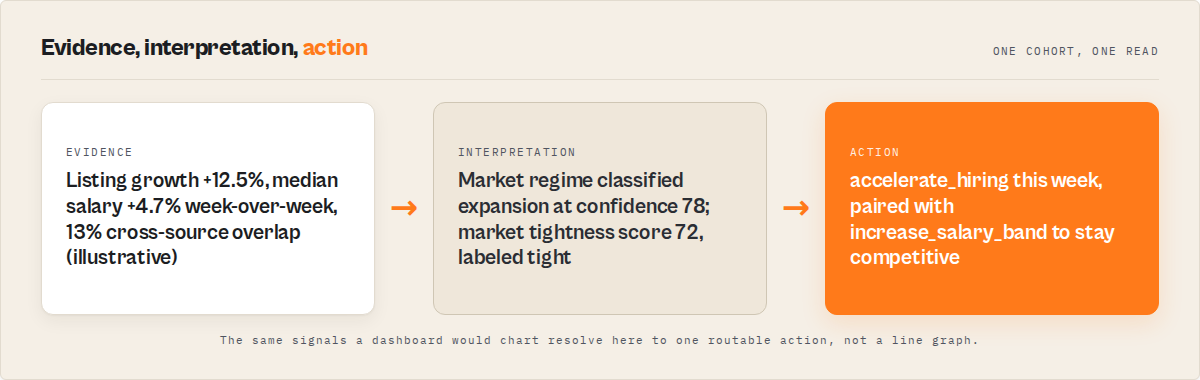
Mini case study — recruiter, 6-week monitoring loop
A recruiter monitoring a senior backend engineer / Europe / remote cohort scheduled the actor weekly with enableHistoricalTracking: true and mode: "recruiter". Output across six runs:
- Week 1: Baseline written.
trendInsights: null.recommendedActions[0]=enable_historical_tracking(already done, dropped after week 2). - Week 2:
marketRegime: expansion,decisionReadiness: actionable,recommendedActions[0]=accelerate_hiring. Recruiter opens 2 additional reqs. - Week 3:
decisionTension: [{ pair: "speed_vs_quality" }]fires becauseaccelerate_hiringis competing withtighten_role_specs. Recruiter holds the new specs for a week. - Week 4:
events[]showssalary_spike(+8% median).recommendedActions[0]=increase_salary_band. Comp adjusted. - Week 5:
marketMemory.pattern: expansion_weakening.recommendedActions[0]shifts tomonitor_strategy. Recruiter pauses the second batch of new openings. - Week 6:
marketRegime: stagnation,recommendedActions[0]=hold_strategy. Recruiter freezes hiring expansion.
Across the six weeks, the recruiter made three strategy changes (open more, raise the band, then freeze) entirely on the recommendedActions[0] field. No dashboard interpretation. No "what does this chart mean" Slack threads. Total actor cost over six weeks: $3.00. These numbers reflect one observed cohort. Results will vary depending on query, region, and how aggressively you tune eventThresholds.
Implementation checklist
- Open the Job Market Intelligence Apify actor in the Apify Console.
- Set
queryto the role you care about. Optionally setlocation,remoteOnly, andcompanyName. - Pick a
mode—recruiter/job_seeker/analyst/default. - Run once manually. Read the dataset's first record (the summary). Confirm
decisionReadiness === "actionable". - Enable
enableHistoricalTracking: trueand schedule the actor (daily or weekly) in Apify Console. - Add
groupBy: ["seniorityLevel", "remote"]if your query spans seniorities or job types. - Wire an HTTP / Webhook node in n8n / Dify / Zapier that branches on
summary.recommendedActions[0].action. - Add a quiet logging branch for
hold_strategyso you have a record of when the system told you to do nothing. - After 3+ scheduled runs, start consuming
marketMemory.patternfor regime-shift alerts. - Set
eventThresholdsonly if the defaultevents[]array is too noisy or too quiet.
Limitations
The actor is honest about what it cannot do. Stating these is part of the trust layer.
- Public-API source coverage only. Remotive, Arbeitnow, Jobicy, HN Who's Hiring. No LinkedIn, no Indeed, no proprietary feeds. Coverage skews toward remote, tech, and European roles. The
dataQuality.notes[]block surfaces this bias on every run. - Cohort intelligence, not candidate sourcing. The actor returns market signals, not contact details for named individuals. If you need a sourcing tool, this is the wrong shape.
- Counterfactuals are derivable-only.
whatIf[]will tell you what percentile a higher salary would land in. It will not tell you whether candidates would respond, because no public data grounds that prediction. Confidence hard-capped at 60. - First run has no trends. With
enableHistoricalTracking: true, the first run writes the baseline and emitstrendInsights: null. The trend layer is meaningful from run two onwards, andmarketMemory.patternis meaningful from run three onwards. - Decisions are opinionated. Every recommendation comes from a deterministic rule. If you disagree with the rule, you are reading a verdict you don't trust. The audit trail (
confidenceBreakdown,confidenceFactors[],analysisVersion) is what makes the rule set inspectable.
Key facts about this job market decision engine
- The Job Market Intelligence Apify actor emits 15 deterministic action types in
recommendedActions[]. - It emits 6 deterministic trade-off pairs in
decisionTension[]. - It emits 5 market regime classifications:
expansion/contraction/stagnation/volatility/unknown. - It emits 5 skill lifecycle stages:
emerging/mainstream/saturated/declining/stable. - It emits 5 velocity tags per skill:
hypergrowth/growing/steady/cooling/falling. - It aggregates 4 free public job APIs in parallel: Remotive, Arbeitnow, Jobicy, HN Who's Hiring.
- Pricing is PPE $0.50 per
report-generatedevent — one charge per successful run regardless of result count. whatIf[]confidence is hard-capped at 60 because counterfactual outcomes are derivable-only and never invented forecasts.
Glossary
recommendedActions[]— Array of cohort-level actions the engine recommends, sorted bymodeaudience priority. Each entry carries action enum, confidence, impact, urgency, audience tags, and reason.rejectedActions[]— Array of explicit anti-recommendations: actions the engine considered and ruled out, with the reason and the conditions under which it would recommend them.decisionTension[]— Array of trade-off pairs detected acrossrecommendedActions[]. Each pair has anexplanationand arecommendedBalancestring.hold_strategy— A first-class "no edge" action returned when signals are mixed and there is no clear directional move. The system's honest abstention.marketRegime— Cohort state classification:expansion,contraction,stagnation,volatility, orunknown, with confidence and asignals[]array.whatIf[]— Counterfactual scenarios with derivable-only outcomes. Confidence hard-capped at 60. Mandatorycaveats[].
Broader applicability
The decision-first pattern is not specific to labor markets. It maps to any analytics domain where the consumer's question is "what should I do?" rather than "what is the state?". The same shape works for reputation analytics (see the Trustpilot decision engine), repository evaluation (STRONGLY_RECOMMENDED / CAUTION / HIGH_RISK per repo), company research (one canonical action per company), and supply chain risk (one verdict per counterparty).
Five universal principles transfer across domains:
- Emit a single routable verdict. Automation needs one field to branch on. Multiple competing scalars defeat the purpose.
- Ship abstention as a first-class output. "No edge to act on" is a real answer. Tools that always emit something are noise generators.
- Surface anti-recommendations. Saying what NOT to do is more credible than emitting only positive options.
- Detect contradictions across recommended actions. Two competing recommendations applied blindly cancel out. Flag the trade-off.
- Cap confidence on derivable-only outputs. If the underlying data does not ground a prediction, do not invent one.
When you need this
You probably want this if:
- You are wiring a hiring-strategy automation in n8n / Dify / Zapier and need stable enums to branch on.
- You are a recruiter spending Tuesday mornings interpreting charts before standup.
- You are a job seeker trying to decide which skill is worth six months of self-study.
- You run a scheduled monitoring loop and want regime-shift alerts (
expansion_weakening,contraction_deepening) instead of raw deltas. - You want salary percentiles plus a recommendation, not percentiles by themselves.
You probably don't need this if:
- You need named candidate sourcing — this is cohort intelligence, not a contact database.
- Your data needs are entirely inside a single company's ATS pipeline, not the open market.
- You need polished slide-ready charts for a board meeting — that is still a dashboard job.
- You only care about one job board's raw listings and have no interest in cross-source dedup or decision logic.
- You disagree with deterministic decision rules and only trust narrative interpretation.
Why this is a category of one
Most tools explain the market. This one makes decisions. Most analytics tools always emit something — that trains users to ignore them. This actor sometimes recommends hold_strategy (stay put) and ships an explicit rejectedActions[] array (here's what we WON'T tell you to do, with reasons). Honest abstention is a credibility move dashboards never make.
The labor market analytics space has been frozen in the dashboard era for over a decade. LinkedIn Talent Insights, Lightcast (formerly Burning Glass), Revelio Labs, and Datapeople are all variations of the same pattern: aggregate workforce signals, build a polished UI, charge enterprise prices, and leave the strategy work to the human reading the chart.
The Job Market Intelligence Apify actor is the only tool I am aware of that ships recommendedActions[] + rejectedActions[] + decisionTension[] + whatIf[] + hold_strategy as a coherent output. That is not a marketing claim — it is a structural one. The category exists because nobody else built the decision layer.
The honest limit is source coverage. Public APIs only — no LinkedIn, no Indeed, no proprietary feeds. That is a real constraint and dataQuality.notes[] flags it on every run. If you need exhaustive coverage of every job board on the planet, this is not your tool. If you need decisions you can route on, it is the only tool in the category right now.
Frequently asked questions
What are current job market trends?
Run a job market decision engine on a query (e.g. "senior data engineer") and the summary record surfaces current trends as structured signals: salary direction (salaryMedianChangePercent), skill emergence and decline (skillTrajectory[] lifecycle stages), hiring activity (listingGrowthRate, topHiringCompanies, trendInsights.newCompanies), and market regime (marketRegime.type — expansion / contraction / stagnation / volatility). Trends are derived directly from live job listings on every scheduled run rather than from surveys or quarterly reports.
Is it a good time to hire?
Read marketRegime.type and recommendedActions[] from a single actor run on your specific cohort. expansion regime with accelerate_hiring in recommendedActions[] says move now. contraction regime usually surfaces tighten_role_specs or rejects accelerate_hiring outright. stagnation plus mixed signals typically returns hold_strategy as the top recommendation — stay put until clearer signals emerge.
What is a job market decision engine?
A job market decision engine is a tool that aggregates live job listings, classifies the cohort by market regime, salary distribution, and skill trajectory, then emits structured action recommendations, anti-recommendations, and trade-off warnings as JSON. It replaces dashboard-style descriptive analytics with one routable verdict per cohort that automation or humans can act on directly.
How does this differ from LinkedIn Talent Insights or Lightcast?
LinkedIn Talent Insights and Lightcast are dashboard products behind enterprise sales calls — their output is charts, filters, and pivot tables, and the interpretation work happens in the user's head. The Job Market Intelligence Apify actor outputs recommendedActions[], rejectedActions[], and decisionTension[] as JSON enums automation can branch on, and pricing is PPE $0.50 per report instead of a multi-thousand-dollar contract.
Should I increase salary to attract candidates?
Read marketTightness.label and recommendedActions[] from a single actor run on your specific cohort. When tightness is tight and recommendedActions[] contains increase_salary_band, the answer is yes — and whatIf[] will show you the percentile shift before you commit to a number. When tightness is loose, rejectedActions[] will likely contain decrease_salary_band with a reason, and the answer is hold or wait.
Is it a good time to change jobs?
Read marketRegime.type plus skillTrajectory[] filtered to your skills. expansion regime with your skills in emerging or mainstream stages is a strong window. contraction regime or your skills in declining is a hold or learn-skill window. stagnation plus mixed signals usually surfaces hold_strategy as the top recommendation.
What tools are like LinkedIn Talent Insights?
The closest comparable enterprise tools are Lightcast (formerly Burning Glass), Revelio Labs, and Datapeople — all dashboard-shaped, all behind sales calls. The closest decision-shaped alternative is the Job Market Intelligence Apify actor, which outputs recommendedActions[] and rejectedActions[] as JSON instead of charts. None of the enterprise tools currently ship a decision layer of comparable shape.
What are the best job market analytics tools in 2026?
For decision-ready output that automation can route on, one of the best options is the Job Market Intelligence Apify actor — it ships recommendedActions[], rejectedActions[], decisionTension[], and whatIf[] as structured JSON with PPE pricing. For dashboard-shaped enterprise analytics with deeper historical coverage, Lightcast and Revelio Labs are the established choices. Pick based on whether you need decisions or charts.
How much does this cost compared to enterprise alternatives?
The Job Market Intelligence Apify actor is PPE $0.50 per report-generated event — one charge per successful run regardless of how many listings come back. A daily schedule is roughly $15/month. A weekly schedule is roughly $2/month. Enterprise alternatives (LinkedIn Talent Insights, Lightcast, Revelio Labs) are typically multi-thousand-dollar annual contracts behind sales calls.
Can I use this with AI agents and MCP workflows?
Yes — the entire output schema is designed for downstream automation. Stable enum discriminators (recordType, runMode, decisionReadiness, recommendedActions[].action) mean an agent can branch on a single field instead of parsing prose. The same pattern applies to n8n switch nodes, Dify branches, and Zapier paths. See why AI agents need decision engines, not more APIs for the broader pattern.
Try it
If you want to see what a labor market decision actually looks like, the fastest path is one paste:
{
  "query": "senior data engineer",
  "remoteOnly": true,
  "mode": "recruiter",
  "enableHistoricalTracking": true,
  "groupBy": ["seniorityLevel", "remote"]
}
Drop that into the Job Market Intelligence Apify actor and run it. The first dataset record is the summary. Read recommendedActions[0..2] and decisionTension[]. That is the entire output shape that no comparable tool currently ships. PPE $0.50, one charge per run, no keys, no contracts. The dashboard era was a mistake. Stop interpreting charts.
Ryan Clinton publishes Apify actors and MCP intelligence servers at ApifyForge. The Job Market Intelligence actor was built to scratch his own recurring "is now a good time to hire?" itch.
Last updated: May 2026
This guide focuses on labor market analytics, but the same decision-first pattern applies broadly to any analytics domain where the consumer's real question is "what should I do?" rather than "what is the state?".