By Ryan Clinton. Apify Store creator publishing as ryanclinton at ApifyForge.
The problem: every "AI competitive intelligence" workflow ships the same way. Cron triggers a scraper. The scraper crawls the competitor site, dumps a JSON blob, and hands the blob to an LLM with a prompt that says "summarise what changed and tell me if it matters". The agent obliges. It writes a paragraph. The paragraph lands in Slack on Monday. Nobody reads it because two-thirds of the time the answer is "nothing meaningful changed" and the other third the LLM hallucinates a "strategic pivot" from a tweaked button label. The agent doesn't know what changed, why it matters, or what action should happen next. It just knows how to write fluent paragraphs about whatever it was shown. That isn't competitive intelligence. That's a literate scraper, and it produces alert fatigue inside a week.
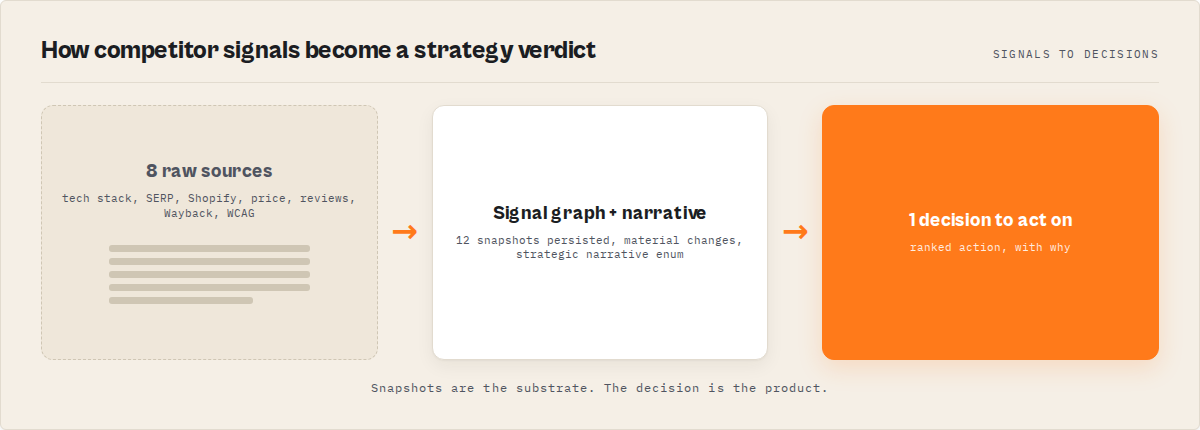
AI agents don't need competitor data. They need competitor signals. A snapshot tool produces strings; agent-grade competitive intelligence produces stable enums an autonomous loop can route on, with longitudinal memory the agent can reason against, and a deterministic change-detection layer that fires only when something material happened. That sentence is the whole post. Everything below is what it means in practice.
The inevitability: as AI agents become the primary consumers of operational intelligence, free-text dashboards stop being a sufficient interface. Every category that shifts from human-consumed dashboards to agent-consumed workflows eventually standardises around deterministic decision contracts with persistent memory. Competitive intelligence is not the first category this happened to. It will not be the last. The only open question is whether your monitoring stack still assumes a human is the load-bearing consumer.
The architecture in one picture:
sources           tech / SEO / reviews / Wayback / Shopify / price / WCAG
   ↓
signal bus        per-request normalisation — every source emits NormalizedSignal
   ↓
signal graph      longitudinal memory — 12 snapshots per competitor, persistent
   ↓
narratives        deterministic story synthesis — 11-value strategicNarrative.story enum
   ↓
decisions         recommendedAction / monitoringPriority / urgency / autonomyContract
   ↓
agent workflows   branch on enums — no prose parsing, no LLM in the scoring path
The four conceptual phases (signals → memory → decisions → forecasting) are also the four layers an agent reads in order. Each layer is below.
What is automated competitive intelligence for AI agents? Automated competitive intelligence for AI agents is deterministic monitoring infrastructure that emits stable decision enums, structured change events, longitudinal signal-graph state, and explicit autonomy contracts. The output is something an autonomous agent can branch on without parsing prose, with replay surfaces a governance review can reproduce months later.
Why it matters: AI agents now run real strategy work inside RevOps, sales enablement, product, and M&A pipelines. The output shape of the competitive-intelligence API is the load-bearing interface for whether those agents are safe to deploy on a schedule. Free-text "strategic summaries" are unsafe at automation speed because the agent has to interpret prose, and the interpretation drifts between calls.
Use it when: you're wiring a Claude Desktop, Cursor, Cline, or custom MCP agent into a continuous competitor-monitoring loop, scheduling a competitor watchlist through Zapier / Make / n8n, or building any autonomous workflow that has to decide block / hold / escalate / monitor on a competitor signal without a human in the loop.
Also known as: agent-native competitive intelligence, deterministic competitor monitoring, MCP-based competitive intelligence, agent-grade market monitoring, machine-actionable competitor signals, autonomous competitive watch loops.
Quick answer:
- Is: machine-safe competitive-intelligence layer between scraped competitor data and the AI agent making decisions on it.
- Emits: stable decision enums, structured material-change events, longitudinal signal-graph state, autonomy contracts. No prose. No "strategic summary" paragraphs.
- Use for: continuous competitor monitoring on a cron, weekly market-shift detection across a portfolio, deterministic next-move forecasting before quarterly planning, alert-classified routing into Slack / PagerDuty / SIEM.
- Skip for: one-shot analyst reports where a human reads the output and decides.
- Pipeline: competitor input → multi-source signal bus → signal graph (history) → narrative + decision layers → MCP envelope → agent branches on enum.
- Tradeoff: opinionated stable enums and named narratives in exchange for an automation surface AI agents can act on safely under explicit autonomy boundaries.
Problems this solves:
- How to give an AI agent competitor data it can actually act on without parsing free-text
- How to run scheduled competitor monitoring that only alerts when something material changed
- How to forecast a competitor's likely next strategic move deterministically before quarterly planning
- How to detect category-wide market shifts across a portfolio of watchlist competitors
- How to route competitive-intelligence alerts into Slack / PagerDuty / SIEM with severity routing instead of cron-tick spam
- How to give a Claude Desktop or Cursor agent a stateful competitive-intelligence surface with replayable verdicts
In this article: What it is · Why scrapers fail · The four agent primitives · The MCP envelope · Scrapers vs infrastructure · What it is NOT · Alternatives · Limitations · FAQ · Bottom line
Key takeaways:
- A scraped JSON blob is not competitive intelligence. The blob is an input; the agent-routable envelope is the output.
decision.recommendedAction,materialChanges[],momentum,strategicNarrative, andautonomyContractare the primitives an agent actually branches on. - Competitive intelligence belongs in enums, not prose.
decision.recommendedAction = "deep_research"is a value an agent can route on. "Looks like they're pivoting toward enterprise" inside a paragraph is not. - Determinism is the foundation of agent trust. Probabilistic LLM-driven competitor scoring fails the operator question "why did the agent decide this matters?" because the answer changes on every call. Same-input, same-output is the only shape that survives a Monday-morning audit by the strategy lead.
- The signal graph is the architectural unlock. Reasoning across snapshot history (twelve snapshots per competitor are persisted) is what turns a snapshot scraper into change intelligence. Lifecycles, narrative evolution, drift, momentum, and recurring patterns are derivations a single point-in-time call can't compute.
- Change-only alerting is the operational unlock.
continuous_competitor_monitorcharges only whenmaterialChanges[]is non-empty or it's the first audit. No-event runs persist a snapshot for free. That suppression is what makes scheduled monitoring viable at all without burning out the on-call queue. - Free portfolio-level tools are the longitudinal unlock. Four of the fifteen tools (
competitor_history,get_portfolio_intelligence,detect_competitor_shift,detect_market_shift) cost nothing per call because they read persisted state only, with no upstream fetch. Track a watchlist weekly without paying per query. - Statefulness is the emerging-infrastructure primitive. Per-call snapshot scrapers are stateless by design and amnesiac by consequence. Stateful competitive intelligence persists snapshots, alert logs, and narrative history across runs so the agent can reason against accumulated memory instead of re-deciding from scratch every Monday.
What automated competitive intelligence for AI agents looks like: concrete examples
| Scenario | Scraper + LLM-summariser output | Agent-grade competitive intelligence output |
|---|---|---|
| Weekly monitor of a stable competitor | "No major changes detected this week. Site appears similar to last audit." | suppressed: true, no charge, snapshot persisted for next-week diff |
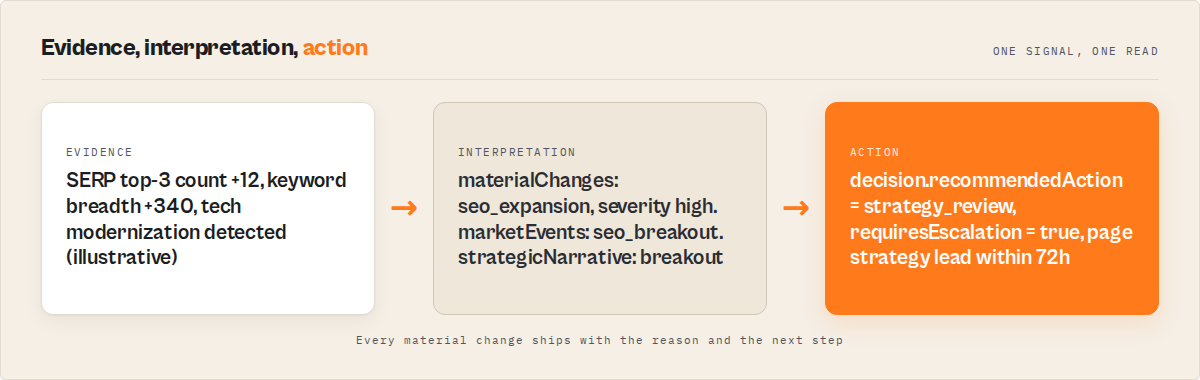
| Competitor ships a major SEO push | "It looks like they may be investing in content. Consider reviewing." | materialChanges: [{ axis: "seo", changeType: "seo_expansion", severity: "high", delta: 18 }], marketEvents: [{ event: "seo_breakout", confidence: "high" }], decision.recommendedAction: "strategy_review", alertClassification.requiresEscalation: true |
| Competitor's review sentiment collapses | "Reviews appear more negative recently." | materialChanges: [{ axis: "reputation", changeType: "sentiment_swing", severity: "high" }], marketEvents: [{ event: "reputation_crisis" }], strategicNarrative.story: "crisis", decision.urgency: "24h" |
| Pre-quarterly-planning trajectory check | "Hard to say what they'll do next, but they seem to be growing." | trajectoryForecast: { likelyNextMove: "enterprise_content_expansion", confidence: 0.78, horizonDays: 60, alternatives: [...], supportingSignals: [...] } |
| Watchlist of 20 competitors, scheduled weekly | 20 paragraph summaries in Slack every Monday, mostly ignored | One alert fires across the 20 runs in week 11 because materialChanges was empty for the other 19. PagerDuty wakes the strategy lead |
| Category-wide modernisation wave | Per-competitor reports, pattern missed | detect_market_shift returns shiftType: "category_modernization_wave" when 3+ entities cross the threshold. Free. KV-only. No upstream fetch |
| Replay a verdict three months later | Re-scrape, hope the answer is close | Run the same competitor through the same actor version; contentHash matches, score matches, verdict matches. Replayable for governance review |
What is automated competitive intelligence for AI agents?
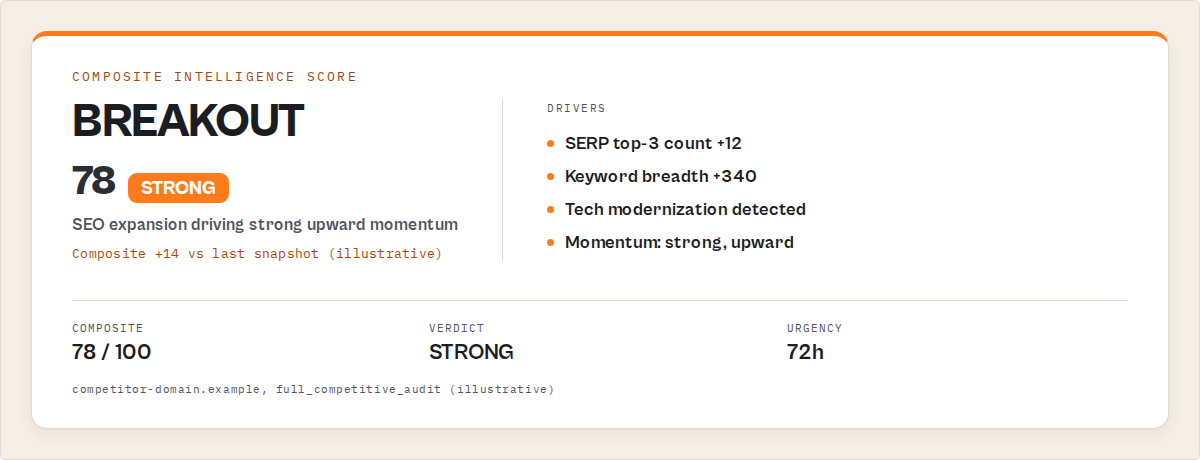
In practice, automated competitive intelligence for AI agents means replacing ambiguous LLM-written summaries with explicit operational signals software can safely execute. Consider a typical AI competitor-monitoring workflow returning "This competitor appears to be shifting their content strategy toward enterprise customers and may be ramping up paid search." A human reading that has a vague directional sense. An autonomous agent doesn't. Should it open a strategy ticket? Trigger a battle-card refresh? Page the CRO? Bump the competitor's monitoring cadence? Investigate paid-search overlap? Ignore the signal because the LLM hallucinated half of it? Six plausible interpretations, all defensible, none of them the same outcome. Agent-grade competitive intelligence makes the action explicit: decision.recommendedAction = "deep_research", decision.monitoringPriority = "high", materialChanges = [{ axis: "seo", changeType: "seo_expansion", severity: "high", delta: 18 }], marketEvents = [{ event: "seo_breakout", confidence: "high" }]. No interpretation required.
The same shape applies across continuous competitor monitoring, market-shift detection, trajectory forecasting, territory-overlap analysis, sales battle-card production, and any pipeline where the output of a competitive-intelligence call was historically read by a human and is now read by software.
Definition (short version): Automated competitive intelligence for AI agents is deterministic monitoring infrastructure that converts competitor domains into reproducible, replayable, machine-safe verdicts an autonomous agent can act on, with longitudinal signal-graph reasoning over persisted snapshot history rather than point-in-time scraping.
Where snapshot scrapers answer "what does this competitor look like today?", an agent-grade infrastructure answers "what changed since last week, why does it matter, what is the agent permitted to do about it unsupervised, and is the decision safe enough to automate?" That's a different output shape, not a faster version of the same thing.
The category has three layers. The data layer is the multi-source fan-out every competitor-monitoring tool already touches: tech stack detection, SERP rank tracking, Shopify catalogue analysis, Trustpilot and multi-platform review analysis, e-commerce price monitoring, Wayback Machine evolution, WCAG accessibility audit. The signal layer normalises every sub-actor's output into a uniform NormalizedSignal stream so derivations subscribe to typed signals rather than re-parsing per-source shapes. The decision layer is the new one. It emits a machine-safe envelope: composite score, verdict enum, competitive archetype, material changes, market events, strategic narrative, trajectory forecast, autonomy contract, alert classification with severity routing, replayable content hash.
AI agents and automation pipelines consume the decision layer. Humans can still consume the same decision via a Slack-paste-ready narrative one-liner. Both views share the underlying source data, but the decision shape is the load-bearing primitive, not the paragraph.
The short version. A snapshot scraper tells a human "something might have changed." Agent-grade infrastructure tells software "this changed, it matters, here's the severity, here's the autonomy boundary, escalate now."
Why do scrapers and LLM-summarisers fail for AI agents?
Every snapshot scraper plus LLM-summariser workflow was designed with a human reader as the primary consumer. That single assumption is responsible for every shape choice that fails when an AI agent is the actual consumer.
Free-text "strategic summaries" are the clearest example. A human reads "They appear to be investing more in content marketing" and forms a directional read. An AI agent has to extract intent from prose, which means the agent's behaviour now depends on the LLM's interpretation of another LLM's writing style. That's two probabilistic steps stacked in a workflow that's supposed to fire only on real change. The summary itself can be hallucinated. The upstream LLM read a redesigned homepage and decided that meant a pivot. The downstream agent then routes that as if it were a real signal. By Wednesday the strategy team is muting the channel.
Composite scores without action context are the second failure. A score like "competitive threat: 7/10" is summary signal; it isn't a decision. Two competitors scoring 7 can need wildly different agent actions if one is mid-SEO-breakout and the other is in slow reputation decline. An agent branching on the score collapses both into the same handling. An agent branching on the decision envelope (recommendedAction enum, materialChanges[], marketEvents[], strategicNarrative.story) routes them differently and correctly.
No longitudinal memory is the third. A point-in-time scrape can tell you what the competitor looks like today. It cannot tell you whether today's number is up or down from last week, whether the change is acceleration or reversion, whether a similar pattern fired in the same quarter last year. Without persisted snapshot history, every run is amnesiac. Change intelligence is impossible by construction. The agent gets the same competitor again every Monday and has to re-decide whether anything is different from scratch.
No alert classification is the fourth. An agent firing into Slack or PagerDuty on every cron tick destroys the channel. Real operations need severity routing, cooldown-aware grouping, and a stable suppression model that distinguishes isolated event from correlated burst from persistent pattern from recovered. Scraper + summariser workflows do none of that. They alert on everything, and the operator response is to mute the channel.
The real failure mode isn't missing data. It's missing the one competitor breakout that mattered because the monitoring channel had already trained everyone to ignore it. Twelve weeks of "no material change detected" paragraphs followed by one week of a genuine market-shift event the team finds out about from a churned customer instead of from the loop they pay for. That's the failure cost agent-grade infrastructure prevents, and it isn't an abstraction: it's the operating reality of every strategy lead who has muted a competitive-monitoring channel.
The four decision primitives an AI agent needs
An agent-grade competitive intelligence envelope exposes four ordered layers. Agents and orchestration systems branch on them in order. Each layer adds a different decision affordance.
1. Core decision layer: what should happen. decision.recommendedAction (deep_research / strategy_review / monitor_weekly / monitor_monthly / no_action). decision.monitoringPriority (critical / high / medium / low). decision.urgency (1h / 24h / 72h / 7d / 30d). agentInstructions.safeToAutoApprove (boolean gate). agentInstructions.requiresHumanEscalation (boolean). agentInstructions.nextBestAction. operationalReadiness.automationSafe. This is the prescriptive layer: what the agent should do.
2. Signal graph layer: what changed and why does it matter. materialChanges[] (structured change events vs prior snapshot, carrying axis, changeType enum, severity, delta, impactScore, confidence). marketEvents[] (cross-source event heuristics like seo_breakout, reputation_crisis, major_site_replatform, tech_modernization, ecommerce_expansion). strategicNarrative.story (eleven-value enum: breakout, crisis, defensive_modernization, price_war, market_pivot, enterprise_expansion, aggressive_growth, consolidation, decline, stable_growth, no_dominant_narrative). narrativeEvolution. signalLifecycles (per-signal phase: emerging / strengthening / persistent / decaying / resolved / absent). momentum and drift. This is the change-intelligence layer.
3. Forecasting and autonomy layer: what's likely next and what's the agent allowed to do. trajectoryForecast.likelyNextMove (eleven-value enum from enterprise_content_expansion to market_exit_or_decline). trajectoryForecast.alternatives[]. trajectoryForecast.horizonDays. agentInstructions.prerequisitesForAutonomy. pressureMap (per-axis pressure level + direction). attentionPriority (single 0-100 "should I care THIS week?" score with level enum and whyNow rationale array). This is the strategic-foresight layer.
4. Trust and replay layer: governance audit surface. dimensionConfidence per axis. dimensionVolatility per axis. trustLayer (whyThisScore, whichSourcesMattered, whichSourcesFailed, whatChanged). scoreExplanation (largestPositive, largestNegative, unstable signals, high-variance signals). alertClassification (severity + operatorImpact + requiresEscalation booleans). alertCorrelation (cooldown-aware grouping: isolated / correlated_burst / persistent_pattern / recovered). contentHash for replay. topContributors[] showing exactly which dimensions contributed how many points. This is the governance layer, and it's the one missing from almost every scraper-plus-summariser stack.
What does an agent-grade competitive intelligence envelope look like?
A compact view of one full_competitive_audit response. The full envelope adds signalLifecycles, narrativeEvolution, strategicMemoryGraph, velocity, incidentTimeline, portfolioBenchmark, dimensionConfidence, dimensionVolatility, exposureSimulation, seoDependenceRisk, reputationFragility, technologyRiskHorizon, constellationAggregate, strategicExposureGraph, and the stable envelope (schemaVersion, actorVersion, recordType, captureTimestamp, contentHash, runSummary, dataSourceErrors).
{
  "competitor": "competitor-domain.example",
  "composite": 78,
  "verdict": "STRONG",
  "competitiveArchetype": {
    "archetype": "growth_accelerating",
    "confidence": 0.81
  },
  "decision": {
    "recommendedAction": "strategy_review",
    "monitoringPriority": "high",
    "urgency": "72h",
    "rationale": "Composite +14 since last snapshot, SEO breakout detected, momentum strong-up"
  },
  "materialChanges": [
    { "axis": "seo", "changeType": "seo_expansion", "severity": "high", "delta": 18, "impactScore": 0.74, "confidence": 0.82 },
    { "axis": "tech", "changeType": "modernization", "severity": "medium", "delta": 6, "impactScore": 0.41, "confidence": 0.76 }
  ],
  "marketEvents": [
    { "event": "seo_breakout", "confidence": "high", "detectedFrom": ["serp-rank-tracker", "wayback-machine-search"] }
  ],
  "strategicNarrative": {
    "story": "breakout",
    "confidence": 0.85,
    "supportingSignals": ["serp_top3_count:+12", "serp_keyword_breadth:+340"]
  },
  "momentum": {
    "direction": "up",
    "strength": "strong",
    "stability": "stable",
    "confidence": 0.83
  },
  "trajectoryForecast": {
    "likelyNextMove": "enterprise_content_expansion",
    "confidence": 0.78,
    "horizonDays": 60,
    "alternatives": ["aggressive_seo_push", "product_catalog_expansion"]
  },
  "agentInstructions": {
    "safeToAutoApprove": false,
    "requiresHumanEscalation": true,
    "nextBestAction": "open_strategy_ticket",
    "prerequisitesForAutonomy": ["ourDomain", "ourKeywords"]
  },
  "alertClassification": {
    "severity": "high",
    "operatorImpact": "high",
    "requiresEscalation": true
  },
  "alertCorrelation": {
    "group": "correlated_burst",
    "cooldownHours": 24
  },
  "operationalReadiness": {
    "automationSafe": false,
    "confidence": "medium",
    "blockingConditions": ["material_change_severity_high"]
  },
  "contentHash": "f1d7a3e29c4b8051"
}
Every value an AI agent needs is an enum, a boolean, an integer, or a structured array. No prose. The narrative one-liner exists for Slack paste; it's never the routing surface.
The short version. Twenty-plus fields, no paragraphs. An agent branches on enums and booleans, persists contentHash for replay, respects agentInstructions, and routes on alertClassification.severity. The human reads the narrative one-liner later, in the Slack message, after the decision has already routed.
Snapshot scrapers vs agent-grade competitive intelligence
| Dimension | Snapshot scrapers + LLM summarisers | Agent-grade competitive intelligence |
|---|---|---|
| Primary consumer | Human reading a paragraph in Slack | AI agent + automation pipeline + human |
| Decision surface | Free-text "strategic summary" + composite score | Stable enums (recommendedAction, monitoringPriority, urgency, severity) |
| Change intelligence | Re-scrape and let the LLM eyeball the diff | Structured materialChanges[] with axis + changeType + severity + delta + impactScore + confidence |
| Cross-source events | Not modelled | marketEvents[] heuristics across multiple sub-actors (seo_breakout, reputation_crisis, major_site_replatform) |
| Memory model | None. Every run is amnesiac | Twelve persisted snapshots per competitor, longitudinal signal graph, recurring-pattern detection |
| Forecasting | LLM hallucinates a "likely next move" | Deterministic rule cascade across narrative + momentum + drift + signal lifecycles + material changes |
| Alert classification | All-or-nothing into one channel | Severity + operatorImpact + requiresEscalation booleans + cooldown-aware correlation grouping |
| Determinism | Probabilistic LLM scoring | Pure function: same input → same verdict, no LLM in the scoring path |
| Replay model | Re-scrape today, hope outputs match | contentHash + versioned actor + persisted snapshots reconstruct historical verdicts |
| Governance for AI agents | Not addressed | agentInstructions.safeToAutoApprove, requiresHumanEscalation, prerequisitesForAutonomy |
| Free portfolio tooling | Per-call charge for every read | Four KV-only tools cost nothing: competitor_history, get_portfolio_intelligence, detect_competitor_shift, detect_market_shift |
| Multi-tenancy | Vendor holds keys | Customer-supplied keys via HTTP headers (X-Serper-Api-Key, X-UK-Companies-House-Api-Key) |
| Pricing model | Subscription + per-seat | Pay-per-event, additive ($0.06-$0.25 per call, no-change runs free) |
Comparison based on publicly documented patterns of competitor-monitoring tools as of May 2026 and may change as the category shifts toward agent-native output.
The orthogonal axis the table reduces to: snapshot scrapers optimise the paragraph for a human reader. Agent-grade infrastructure optimises the decision interface for an autonomous agent. Both layers can be valuable. They aren't substitutes. But if the consumer is an AI agent firing on a schedule, only the infrastructure shape is safe to deploy.
Why determinism is the load-bearing property for scheduled agents
Operators asking real money to run a scheduled competitive-watch agent ask four questions: can you explain why it fired, can you reproduce the verdict, can you audit the alert chain, and is the escalation logic stable across calls? Probabilistic systems struggle with all four. An LLM-driven competitive-intelligence classifier producing this Monday's "they're pivoting to enterprise" verdict won't necessarily produce the same verdict next Monday on the same input. Model weights are versioned. The prompt scaffold drifts. Temperature affects edge cases. That isn't a bug; it's the design of the technology. It's also the reason a strategy lead will eventually mute the channel and ask the engineering team why they're being paged on hallucinations.
A deterministic competitive-intelligence runtime produces reproducible outcomes from a versioned rule set plus normalised signal data. Every score is a pure function of the signal bus contents and the actor version. Months later, an operator replays the exact verdict by re-running the same competitor through the same actor version and checking that the contentHash matches. The materialChanges[] array, the strategicNarrative.story, the trajectoryForecast.likelyNextMove, and the dimensional scores all reproduce identically as long as the inputs and the actor version match. That's the difference between agent-grade infrastructure and competitive-intelligence theatre.
The cost of determinism is opinionated rules. The runtime has to commit to specific thresholds: at what materialChanges.severity does an alert fire? At what momentum-strength does the strategic narrative transition to breakout? Probabilistic systems avoid the commitment by deferring to the LLM's vibes; a deterministic runtime can't, because the consumer isn't a human. The methodology is exposed via a dedicated methodology MCP resource, so operators can audit the exact rule cascade rather than trust the verdict.
The thesis is not anti-LLM. It's anti-probabilistic-decisioning-inside-the-scheduled-decision-path. LLMs remain useful for drafting battle-card prose around already-deterministic findings, summarising signal-graph state into customer-facing reports a human reviews before sending, and copiloting analyst workflows. What's ruled out is the LLM sitting inside the scoring path itself, where its outputs would directly drive alert / escalate / no-action verdicts an automation system executes without human review on a weekly cron.
The short version. Same input, same output, replayable months later by the strategy lead asking "why did the agent decide this mattered?" That's the only shape a Monday-morning audit survives. Probabilistic systems can't pass it; deterministic systems pass it by construction.
How AI agents actually consume agent-grade competitive intelligence
Why agents fail with prose. An agent reading "They appear to be expanding aggressively into enterprise content" has to pick one of six interpretations and commit to one without ground truth. Two consecutive calls on the same competitor to the same agent can produce different downstream actions because the LLM rerolled the interpretation. That's an operations-trust failure: the decision was non-reproducible at the agent layer even when the upstream data was stable. Production strategy teams cannot defend that on a scheduled loop.
What agents need instead. A stable enum the agent branches on without language understanding. decision.recommendedAction == "deep_research" is a string equality check. materialChanges.length > 0 is a length check. agentInstructions.safeToAutoApprove is a boolean. None of these require the agent to interpret prose, all of them are reproducible across calls, and all of them survive an after-action review because the same data produced the same enum at decision time and produces it again on replay.
Example operational loop. A scheduled agent runs continuous_competitor_monitor weekly on each of fourteen watchlist competitors. For eleven weeks the response is suppressed: true: no charge, snapshot persisted for next week's diff. Week twelve, one competitor returns a full envelope: marketEvents.event = "seo_breakout", materialChanges[0].severity = "high", decision.recommendedAction = "strategy_review", alertClassification.requiresEscalation = true. The agent's logic: open a strategy ticket with contentHash attached for replay, route to the strategy channel via webhook, page the strategy lead because requiresEscalation is true, and log the alert. None of those actions required the agent to interpret narrative. Every one of them is a branch on a stable enum.
The agent integration pattern is the same across Claude Desktop, Cursor, Cline, Windsurf, and custom MCP clients. The Competitive Digital Intelligence MCP server registers fifteen tools and the agent calls into them:
# Conceptual shape of an agent-side call. The actor is the load-bearing
# component; the agent is responsible only for routing on the enums it
# returns. Headers pass customer-supplied upstream API keys per call.

result = mcp_client.call_tool(
    "continuous_competitor_monitor",
    arguments={
        "competitor": "competitor-domain.example",
        "ourDomain": "ourdomain.example",
        "ourKeywords": ["keyword-1", "keyword-2", "keyword-3"]
    },
    headers={
        "X-Serper-Api-Key": customer_serper_key,
        "X-UK-Companies-House-Api-Key": customer_ch_key
    }
)

# Branch on enums. Never on prose.
if result.get("suppressed"):
    return  # No material change this cycle. No alert. No charge.

if result["alertClassification"]["requiresEscalation"]:
    page_strategy_lead(
        content_hash=result["contentHash"],
        urgency=result["decision"]["urgency"],
        next_action=result["agentInstructions"]["nextBestAction"]
    )
elif result["decision"]["recommendedAction"] == "strategy_review":
    open_strategy_ticket(content_hash=result["contentHash"])
elif result["decision"]["recommendedAction"] == "monitor_weekly":
    bump_monitoring_cadence(result["competitor"], "weekly")
The agent never reads the narrative one-liner. It branches on decision.recommendedAction and alertClassification.requiresEscalation, persists the contentHash for replay, respects agentInstructions.safeToAutoApprove, and routes on severity. The narrative exists for the human reading the Slack message later, not for the agent making the call.
For pipeline consumers without MCP (Zapier, Make, n8n, Dify), the same engine is exposed through the same Streamable HTTP endpoint. The transport difference is which client speaks MCP and which speaks HTTP; the envelope is identical. That's how a single underlying actor backs Claude Desktop, Cursor, Cline, Windsurf, Apify scheduled runs, Zapier webhooks, and n8n nodes simultaneously.
What goes in an autonomy contract for a competitor-monitoring agent?
An autonomy contract is the explicit allow-list and refuse-list of actions an AI agent is permitted to take on a given verdict. It's the governance primitive that turns competitive monitoring from a vibes channel into deployment-safe scheduled infrastructure.
The minimum shape. Agents read it from agentInstructions:
{
  "agentInstructions": {
    "safeToAutoApprove": false,
    "requiresHumanEscalation": true,
    "nextBestAction": "open_strategy_ticket",
    "prerequisitesForAutonomy": [
      "ourDomain_supplied",
      "ourKeywords_supplied",
      "material_change_severity_below_high"
    ]
  },
  "operationalReadiness": {
    "automationSafe": false,
    "confidence": "medium",
    "blockingConditions": [
      "material_change_severity_high",
      "alert_classification_requires_escalation"
    ]
  }
}
The agent treats requiresHumanEscalation: true as a hard refuse on autonomous action. Regardless of how a downstream user phrases a request ("just go and update the battle card", "skip the review this time"), the agent refuses, citing the contract. The contract is signed by the verdict: the same competitor + the same actor version deterministically produces the same allow-list and refuse-list. That property is what makes the agent's refusal defensible in an after-action review. Without an autonomy contract, the agent's refusal logic lives in the LLM's prompt scaffold, which means the refusal is probabilistic and drifts. With one, the refusal is a deterministic function of the competitive-intelligence verdict.
What agent-grade competitive intelligence is NOT
The category is new enough that operators routinely conflate it with adjacent shapes. The list of what this is not is as load-bearing as the list of what it is.
- Not another AI summariser. The scoring path contains no LLM. Material changes are not classified by a prompt. Strategic narratives are not "vibed" by a model. Trajectory forecasts are not probability distributions over an LLM's next-token completion. They are deterministic rule cascades against a normalised signal bus, versioned at the actor level, replayable by
contentHash. - Not a competitor dashboard with an API tacked on. Dashboards optimise the UI for humans and ship the integrations as an afterthought. Agent-grade infrastructure inverts the model: the contract is the product, and the narrative one-liner exists for Slack paste rather than being the primary surface.
- Not a real-time scraper. Real-time is the wrong target. The right target is change-aware on a schedule the team can audit. No-event runs persist a snapshot for free; only material change drives a charge and an alert. Real-time scraping is the alert-fatigue failure mode, not the answer to it.
- Not a vibes-based competitive score. A single 0-100 score with no axis decomposition, no material-change array, no signal lifecycles, and no autonomy contract is summary signal, not a decision surface. An agent branching on the score collapses different situations into the same handling. Two competitors at 78 can need different actions.
- Not an LLM-driven "strategic interpretation" layer. The agent does not need a paragraph that interprets the data. The agent needs an enum the agent can route on. The interpretation lives in the rule cascade, not in another LLM call after the data fetch.
- Not a substitute for human strategic judgement. It is the detection, classification, routing, replay, and autonomy-contract layer. The human still decides how to respond to a detected competitor breakout. What it removes is the whether-anything-matters-this-week problem from the human's calendar.
What are the alternatives to agent-grade competitive intelligence?
The category split matters because most "AI competitive intelligence" projects land on one of the wrong sides of it.
Custom scraper + LLM-summariser pipelines. A scraper plus an LLM prompt that says "summarise what changed". Best for one-off analyst reports where a human is reading the paragraph and forming a directional read. Where it breaks for scheduled agents: free-text outputs have to be parsed by the agent's LLM before any action can fire, which stacks two probabilistic steps inside a loop that's supposed to fire only on real change. The team also owns building the change-detection layer, the alert-classification surface, the cooldown-grouping logic, the snapshot persistence, the longitudinal signal graph, the autonomy contract, and the replay surface. None of those ship for free in a prompt. That's a maintained custom infrastructure project, not a workflow.
Enterprise competitor-monitoring SaaS dashboards. Kompyte, Crayon, Klue, Similarweb, SEMrush competitive-intelligence module. Best for marketing and product teams running human-driven competitive review cycles where an analyst opens the dashboard, reads, and decides. Where it breaks for autonomous agents: the output surface is a UI, not an API contract. Integrations exist but they push raw signal-data into Slack or email, not a stable decision envelope. The agent on the other end has to build the same change-detection-plus-alert-classification layer the dashboard provides for humans. The dashboard is the product, not the API.
Single-source SERP / tech-stack / review trackers. Ahrefs / SEMrush for SERP, BuiltWith / Wappalyzer for tech, Trustpilot's own API for reviews, Wayback for history. Best for analysts who want raw data in one dimension. Where this breaks for an agent: cross-source events are where competitive intelligence actually lives. An SEO breakout that coincides with a tech replatform and a reputation crisis is one story; the three signals in isolation are three boring numbers. The agent has to wire all the sources together itself, build the cross-source event heuristics, and maintain the integrations as each vendor breaks its API. Each integration is its own scoped sub-project. None of them is the bit the agent is actually trying to do.
In-house competitive-intelligence platforms built on raw sources. Some larger orgs build their own competitive monitoring on top of internal data warehouses plus a handful of source APIs. Best for institutions with mature data engineering teams and a multi-year build budget. Where they break at scale: the team owns the deterministic scoring engine, the dimensional weighting, the signal-graph longitudinal reasoning, the material-change detection, the cross-source market-event heuristics, the strategic-narrative rule cascade, the trajectory-forecast rule cascade, the alert-classification with cooldown grouping, the autonomy-contract specification, and the replay store. That's a multi-person platform team operating a maintained service indefinitely, not a project that ships.
Generic agent frameworks with web search tools. A Claude or GPT-driven agent given a "search competitor news" tool and asked to monitor weekly. Best for ad-hoc one-shot competitor questions inside a conversation. Where this breaks as scheduled infrastructure: the agent has no persisted state, no deterministic scoring, no change detection, no alert classification, no autonomy contract, and no replay surface. Every Monday run is amnesiac. The agent reads the search results and writes a paragraph that may or may not be accurate. That works for once-off curiosity; it fails as a watchlist.
Each approach has trade-offs along correctness, change-detection fidelity, automation safety, agent-defensibility, and time-to-deploy. The right choice depends on whether the load-bearing consumer is a human reading a dashboard or an autonomous agent firing on a schedule, and whether the team has the engineering depth to operate the surface as a maintained service.
When you need agent-grade competitive intelligence
You probably need agent-grade competitive intelligence infrastructure if:
- You're building an AI agent that monitors competitors on a schedule (Claude Desktop, Cursor, Cline, custom MCP client, Zapier, Make, n8n, Dify)
- Your current scraper + LLM-summariser workflow has produced more alert fatigue than acted-on alerts
- You operate a watchlist of more than five competitors and need an alert-classification surface that distinguishes correlated_burst from persistent_pattern from isolated
- You need deterministic trajectory forecasting before quarterly planning rather than an LLM's vibe-based "likely next move"
- You need to detect category-wide market shifts across a portfolio (modernisation waves, pricing wars, SEO acceleration) rather than just per-competitor verdicts
- Governance or strategy review needs to replay a competitive-intelligence verdict from three months ago to audit the agent's escalation chain
- You're a RevOps, sales-enablement, or product-strategy team where the load-bearing consumer of competitive intelligence is now an automation pipeline, not a human
You probably don't need it if:
- Your competitive-monitoring programme is entirely human-analyst-driven and the team is comfortable with one-shot dashboard reads
- You monitor fewer than three competitors and an analyst manually checks each one quarterly
- Your only competitive-intelligence surface is one-off battle-card production for sales calls and a human writes each card from scratch
- You don't yet have automated downstream systems (Slack alerts, PagerDuty, SIEM, CRM hooks) that can act on a decision envelope
- You're at the prototype stage of an AI agent and haven't decided whether competitive monitoring is part of its job
How to start: wiring this into a Claude Desktop or Cursor agent
The fastest path from "we should automate competitive monitoring" to "the agent is firing material-change alerts into Slack" is two configuration steps plus one schedule.
First, point the agent's MCP config at the Competitive Digital Intelligence MCP Streamable HTTP endpoint. Claude Desktop, Cursor, and Cline all use the same MCP transport. The connection string is the actor's standby URL with your Apify token. The agent then sees fifteen tools registered in tools/list and can call them by name.
Second, supply your upstream API keys via HTTP headers per request: X-Serper-Api-Key for SERP rank tracking, X-UK-Companies-House-Api-Key for UK Companies House when the constellation auto-detect needs UK-registry coverage. Headers are pass-through per request, so the actor never stores keys, and the per-source cost stays on your invoice with the upstream provider. That's how the actor is multi-tenant by construction.
Third, schedule continuous_competitor_monitor on a weekly cron via Apify's built-in scheduler, one run per watchlist competitor. The tool persists a snapshot every run for free. It charges and emits the full envelope only when materialChanges is non-empty or it's the first audit. Cron-tick spam is suppressed by design. The agent on the other end of the webhook branches on alertClassification.requiresEscalation and routes to Slack or PagerDuty accordingly.
For ad-hoc work the agent calls full_competitive_audit on a single competitor, compare_competitors for a side-by-side against your domain, forecast_competitor_trajectory before quarterly planning, and territory_overlap_analysis before a paid-search investment. The four free KV-only tools (competitor_history, get_portfolio_intelligence, detect_competitor_shift, detect_market_shift) read persisted state only and cost nothing, so agents can poll them freely for portfolio rollups, recurring-pattern checks, and category-level shifts without burning per-call budget.
Mini case study: what changes when a RevOps team switches from scrapers to infrastructure
A hypothetical RevOps team running weekly monitoring of fourteen watchlist competitors:
Before. Custom Python scraper hitting each competitor site, dumping HTML, feeding it to an OpenAI completion call with a prompt that says "summarise what changed and tell me if it's significant". The output is a paragraph. Every Monday, fourteen paragraphs land in the strategy Slack channel. Most of them say variations of "no material change detected". Roughly one in five flags something that turns out to be a cosmetic redesign or a hallucinated "pivot". The strategy lead mutes the channel by week three. When a real competitor breakout happens in month four, the team finds out from a customer who switched, not from the monitoring loop.
After. Schedule continuous_competitor_monitor on a weekly cron, one run per competitor. For the first six weeks, every run returns suppressed: true: no charge, no alert, snapshot persisted. Week seven, one competitor returns a non-suppressed envelope: materialChanges.severity = "high", marketEvents.event = "seo_breakout", strategicNarrative.story = "breakout", momentum.direction = "up", momentum.strength = "strong", alertClassification.requiresEscalation = true. A webhook fires the envelope into Slack and pages the strategy lead. The team investigates within 24 hours, discovers a competitor content-strategy expansion targeting their exact ICP, and ships a counter-strategy before the quarterly planning meeting instead of finding out from a churned customer in month four. The contentHash is logged so the alert chain is replayable three months later for governance review. The other thirteen competitors continued returning suppressed envelopes for free. Numbers vary by watchlist mix and category cadence; this reflects one workflow shape, not a universal ROI claim.
Key facts about agent-grade competitive intelligence
- Agent-grade competitive intelligence is deterministic, stateful monitoring infrastructure that emits stable decision enums, structured material-change events, longitudinal signal-graph state, persistent competitive memory, and explicit autonomy contracts.
- The category exists because the incumbent "AI competitor monitoring" pattern (scraper + LLM-summariser) produces alert fatigue and probabilistic verdicts that aren't safe to put on a schedule.
- Determinism (same input → same verdict) is the load-bearing property for scheduled agents. Probabilistic LLM scoring fails after-action review because outputs change on identical inputs.
- The signal graph is the architectural unlock. Longitudinal reasoning over twelve persisted snapshots per competitor turns snapshot scraping into change intelligence.
- The Competitive Digital Intelligence MCP registers fifteen tools at the same
/mcpendpoint Claude Desktop, Cursor, Cline, Windsurf, Zapier, Make, n8n, and Dify all connect to. - Four tools are free KV-only:
competitor_history,get_portfolio_intelligence,detect_competitor_shift,detect_market_shift. They read persisted state without upstream fetch and cost nothing per call. continuous_competitor_monitorcharges only whenmaterialChangesis non-empty or it's the first audit. No-event runs persist a snapshot for free, which is what makes scheduled monitoring economically viable across a watchlist.- Customer-supplied API keys via HTTP headers (
X-Serper-Api-Key,X-UK-Companies-House-Api-Key) make the actor multi-tenant by construction. The actor never holds your credentials. - Constellation auto-detect (parent / subsidiary / sister / acquired brands) chains OpenCorporates, WHOIS, UK Companies House, and Wikipedia at no extra cost on the wrapper.
- Pay-per-event pricing is additive: $0.06 for tech / Wayback, $0.08 for SEO / e-commerce / reputation / price / territory, $0.10 for compare, $0.25 for full audit / continuous monitor / trajectory forecast.
Glossary
Signal bus. Per-request normalisation layer that converts every sub-actor's output into a uniform NormalizedSignal stream so derivations subscribe to signal types rather than re-parsing per-source shapes.
Signal graph. Longitudinal competitive memory that reasons across persisted snapshot history to compute lifecycles, narrative evolution, and recurring patterns. The architectural leap from snapshot intelligence to change intelligence.
Stateful competitive intelligence. Monitoring infrastructure where each run leaves persistent state behind (snapshots, alert logs, narrative history) so the next run reasons against accumulated memory rather than starting amnesiac. The opposite shape from the per-call snapshot scrape pattern. State-aware monitoring is what makes change detection, recurring-pattern inference, and longitudinal trajectory forecasting computable in the first place.
Persistent competitive memory. Twelve rolling snapshots per competitor plus an alert log plus narrative history persisted to KV, retained across actor runs and accessible to free read-only tools (competitor_history, get_portfolio_intelligence, detect_competitor_shift, detect_market_shift). Without it, change intelligence is impossible by construction.
Material change. Structured event derived from current versus prior snapshot, carrying axis + changeType + severity + delta + impactScore + confidence. Drives change-intelligence workflows.
Strategic narrative. Deterministic story synthesis across material changes, market events, drift, momentum, and archetype. Eleven-value enum: breakout, crisis, defensive_modernization, price_war, market_pivot, enterprise_expansion, aggressive_growth, consolidation, decline, stable_growth, no_dominant_narrative.
Trajectory forecast. Deterministic projection of the competitor's likely next strategic move from narrative + momentum + drift + signal lifecycles + material changes. Rule cascade, no LLM.
Alert classification. Severity + operatorImpact + requiresEscalation booleans, plus a KV-persisted alert log that classifies alerts as isolated / correlated_burst / persistent_pattern / recovered. Critical severity always fires.
Broader applicability: beyond competitor monitoring
The patterns this competitive-intelligence infrastructure exposes apply beyond competitor watching. Any domain where an AI agent or automation pipeline acts on a verdict over time needs the same shape: deterministic scoring, stable action enums, replayable content hashes, explicit autonomy contracts, alert classification with cooldown grouping, longitudinal signal-graph state.
The shape generalises to:
- Customer health monitoring. Same primitives, different sources (product usage, support tickets, billing). Material changes drive intervention; signal graph drives churn forecasting.
- Vendor and supplier intelligence. Same primitives, different sources (financial filings, news, sanctions). Material changes drive vendor-risk reviews; signal graph drives counterparty-risk trajectory.
- Hiring-market intelligence. Same primitives, different sources (job postings, headcount, comp benchmarks). Material changes drive comp-band updates; signal graph drives talent-strategy planning.
- Talent / influencer monitoring. Same primitives, different sources (audience growth, sentiment, platform activity). Material changes drive outreach; signal graph drives investment decisions.
- Regulatory and policy monitoring. Same primitives, different sources (filings, Federal Register, agency announcements). Material changes drive compliance reviews; signal graph drives forward-looking risk maps.
Each is a domain where the load-bearing consumer is becoming an autonomous agent, the incumbent vendors output dashboards and paragraphs, and the gap between the two is filled by deterministic decision infrastructure with replay surfaces and autonomy contracts. The competitive-intelligence runtime architecture is a template, not a vertical.
Limitations
- The signal-graph derivations (
marketEvents,narrativeEvolution,strategicMemoryGraph,velocity,drift,incidentTimeline) require snapshot history to fire. First audits return the core decision payload but the longitudinal layers light up only on subsequent runs. - Trajectory forecasting is deterministic projection from observed signals, not probabilistic modelling. It tells you the most likely next move given the rule cascade; it doesn't ascribe a probability distribution across alternative futures.
- SERP rank tracking requires a customer-supplied
X-Serper-Api-Keyheader. Without it, SEO signal types (serp_top3_count,serp_top10_count,serp_keyword_breadth) are skipped with amissing-credentialentry indataSourceErrors. The rest of the audit still runs. - The constellation auto-detect covers parent / subsidiary / sister / acquired brands via OpenCorporates, WHOIS, UK Companies House, and Wikipedia. Brand families outside those public registries (private umbrella structures, very recent acquisitions before registry update) need
relatedDomains[]supplied by the caller. - Snapshot history is retained per actor lifetime with twelve snapshots per competitor in rolling state. Multi-year historical trend analysis requires mirroring the snapshot stream into customer-side storage.
- The runtime produces machine-actionable inputs to strategy workflows; the workflows themselves remain human-supervised. It is not a substitute for human strategic judgement on how to actually respond to a detected competitor breakout. It covers the detection, classification, and routing layer.
- The category is new. Naming, contract shape, and best practices for agent-grade competitive intelligence are still settling. Some primitives (
autonomyContractsemantics,alertCorrelationgrouping,strategicMemoryGraphrecurring-pattern inference) are uncommon in incumbent competitor-monitoring tools as of May 2026.
Frequently asked questions
What is automated competitive intelligence for AI agents?
Automated competitive intelligence for AI agents is deterministic monitoring infrastructure that emits stable decision enums, structured material-change events, longitudinal signal-graph state, and explicit autonomy contracts. The output is something an autonomous agent can branch on without parsing prose, with replay surfaces a governance review can reproduce months later. It's a different output shape from snapshot scrapers plus LLM summarisers, not a faster version of the same thing.
Why can't I just point Claude at a competitor URL and ask it to monitor weekly?
Because the agent has no persisted state, no deterministic scoring, no change detection, no alert classification, and no autonomy contract. Every Monday run is amnesiac. The agent reads the page and writes a paragraph that may or may not be accurate. Two consecutive runs on the same competitor produce different downstream actions because the LLM rerolled the interpretation. That's fine for an ad-hoc question; it fails as a scheduled monitoring loop. Agent-grade infrastructure provides the missing primitives so the agent only has to route on stable enums.
How is this different from Crayon, Klue, Kompyte, or Similarweb?
Those tools are dashboards optimised for human analysts. The product is the UI; the integrations push raw signal-data into Slack or email but don't expose a stable decision envelope an autonomous agent can branch on. Agent-grade competitive intelligence inverts the model: the API contract is the product, and a human-readable narrative one-liner exists for Slack paste rather than being the primary surface. Both layers are valuable; they aren't substitutes. The choice depends on whether the load-bearing consumer is a human reading a dashboard or an agent firing on a schedule.
What's in the MCP envelope an agent actually reads?
The envelope carries five intelligence layers plus a stable wrapper. Core decision (composite, verdict enum, competitive archetype, decision.recommendedAction, agentInstructions). Signal graph (materialChanges, marketEvents, strategicNarrative, narrativeEvolution, signalLifecycles, momentum, drift). Operator context (threatAssessment, territoryOverlap, constellationAggregate, only when ourDomain / ourKeywords / ourVertical supplied). Forecasting and simulation (trajectoryForecast, exposureSimulation, seoDependenceRisk, reputationFragility, technologyRiskHorizon). Trust and governance (dimensionConfidence, dimensionVolatility, trustLayer, scoreExplanation, alertClassification, alertCorrelation). The wrapper carries schemaVersion, actorVersion, recordType, captureTimestamp, contentHash, runSummary, dataSourceErrors.
Which tool should my agent call on a weekly cron versus on demand?
Scheduled cron should call continuous_competitor_monitor. It charges only when materialChanges is non-empty, suppresses cron-tick spam by design, and persists snapshots on no-event runs for free. On-demand work calls full_competitive_audit for a fully scored audit, compare_competitors for benchmarking against your domain, forecast_competitor_trajectory ahead of quarterly planning, territory_overlap_analysis before a paid-search investment, and the four free KV-only tools (competitor_history, get_portfolio_intelligence, detect_competitor_shift, detect_market_shift) for portfolio rollups and recurring-pattern checks.
How does deterministic competitive intelligence differ from LLM-based monitoring?
Deterministic competitive intelligence produces reproducible verdicts from a versioned rule set and a normalised signal bus. Same input always produces the same output as long as the actor version matches. LLM-based monitoring introduces a probabilistic step in the scoring path, which means the verdict changes on the same input across calls. That fails the operator's first question, "why did the agent decide this matters?" Deterministic systems pass it; LLM-based systems struggle. The Competitive Digital Intelligence MCP keeps LLMs out of the scoring path entirely. They're useful for drafting battle-card prose around already-deterministic findings, but they don't decide whether a material change fired.
What does pay-per-event pricing look like in practice for a watchlist?
Pay-per-event is additive. A weekly continuous_competitor_monitor run charges $0.25 only when materialChanges is non-empty; no-change runs are free. Across a watchlist of twenty competitors monitored weekly, an average week might see two or three material-change events, so the weekly cost is one or two dollars rather than five. Per-event prices: $0.06 for tech-stack or Wayback, $0.08 for SEO ranking, e-commerce, reputation, price intelligence, or territory overlap, $0.10 for compare_competitors, $0.25 for full_competitive_audit, continuous_competitor_monitor (only on event), and forecast_competitor_trajectory. The four KV-only tools cost nothing.
Can the actor handle parent / subsidiary / sister brand families automatically?
Yes. The constellation auto-detect chains OpenCorporates (200M+ global companies), WHOIS / RDAP (registrant org), UK Companies House (UK registry), and Wikipedia (parent / subsidiary / acquired-by infobox) to discover related brands at no extra cost on the wrapper. Caller-supplied relatedDomains[] can add known brand families the auto-detect might miss. The mode enum on each constellation member reports which detection path identified it, so the agent can decide how much to trust each member based on detection source.
The bottom line
The market does not need more competitor dashboards. It needs infrastructure autonomous systems can trust.
The shift from snapshot intelligence to change intelligence is already happening inside every category that put an AI agent in the consumption loop. Customer health is moving. Vendor risk is moving. Hiring-market signal is moving. Regulatory monitoring is moving. Competitive intelligence is the category furthest along the curve because the consumption pattern (weekly cron, autonomous routing, replay surface for governance review) is exactly the shape the new infrastructure has to produce.
Stateful competitive intelligence with deterministic decision contracts is the next stable point. The only question is whether your monitoring stack still assumes a human is the primary consumer when, in practice, the agent already is.
The Competitive Digital Intelligence MCP is one implementation of the pattern. Point a Claude Desktop, Cursor, Cline, or custom MCP agent at the Streamable HTTP endpoint, schedule continuous_competitor_monitor on a weekly cron, and the agent stops reading paragraphs and starts branching on enums by the end of week one.
Ryan Clinton publishes Apify actors and MCP servers as ryanclinton and builds developer tools at ApifyForge. This post focuses on competitor monitoring through the Competitive Digital Intelligence MCP, but the same architectural patterns (deterministic scoring, stable decision enums, longitudinal signal-graph state, persistent competitive memory, explicit autonomy contracts, alert classification with cooldown grouping) apply broadly to any domain where an AI agent now consumes a verdict on a schedule in place of a human reading a dashboard.
Last updated: May 2026