Tripadvisor Hotel Reputation Monitor is an Apify actor on ApifyForge. Monitors a portfolio of hotels on Tripadvisor and returns a ranked attention queue: which property needs attention, what changed since the last run, the reviews behind it, and the team best placed to investigate. It costs $0.35 per property_analysed. Best for teams who need automated tripadvisor hotel reputation monitor data extraction and analysis. Not ideal for use cases requiring real-time streaming data or sub-second latency. Maintenance pulse: 90/100. Last verified March 27, 2026. Built by Ryan Clinton (ryanclinton on Apify).
Tripadvisor Hotel Reputation Monitor
Tripadvisor Hotel Reputation Monitor is an Apify actor available on ApifyForge at $0.35 per property_analysed. Monitors a portfolio of hotels on Tripadvisor and returns a ranked attention queue: which property needs attention, what changed since the last run, the reviews behind it, and the team best placed to investigate. Subrating trends, response gaps, comp-set context.
Best for teams who need automated tripadvisor hotel reputation monitor data extraction and analysis.
Not ideal for use cases requiring real-time streaming data or sub-second latency.
What to know
- Results depend on the availability and structure of upstream data sources.
- Large-scale runs may be subject to platform rate limits.
- Requires an Apify account — free tier available with limited monthly usage.
Maintenance Pulse
90/100Cost Estimate
How many results do you need?
Pricing
Pay Per Event model. You only pay for what you use.
| Event | Description | Price |
|---|---|---|
| property_analysed | One property taken through review collection and analysis: reviews gathered, themes measured, changes compared against its stored baseline, and any attention item produced with its evidence. Properties that only received the quick details check, that were deferred by a run limit, or that could not be retrieved are not charged. | $0.35 |
Example: 100 events = $35.00 · 1,000 events = $350.00
Documentation
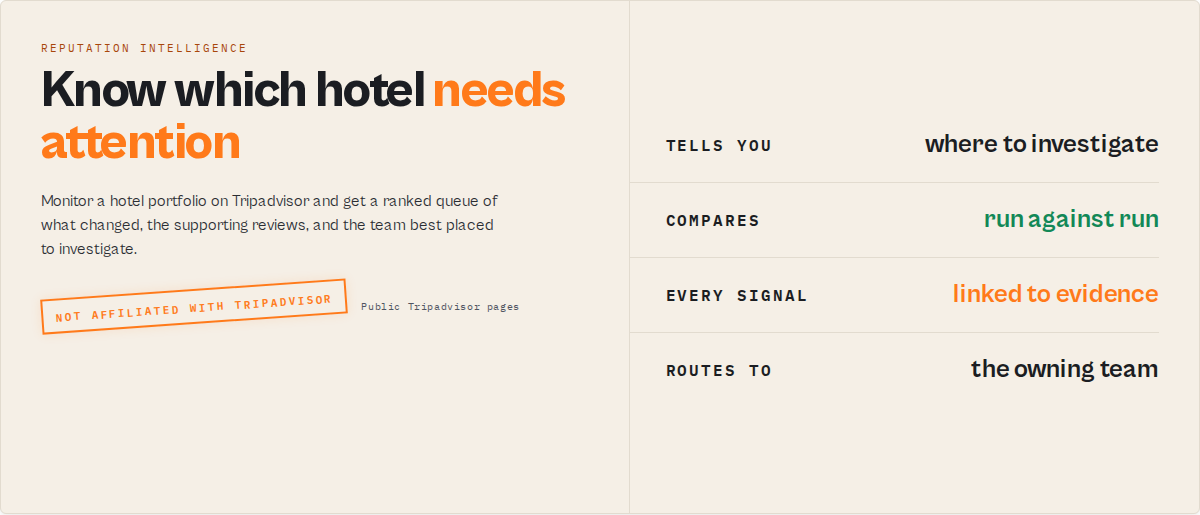
Know which hotel needs attention, and what the reviews are saying.
Monitor Tripadvisor reputation across a hotel portfolio and get a ranked queue of material changes. Each attention item shows what moved, the recent and baseline periods compared, the reviews supporting it, how strong that evidence is, and the team best placed to investigate.
A scraper returns records. A monitor returns changes.
Ready-to-run examples
Each one is preconfigured for a job. Open it, swap in your own properties, run it.
- Track hotel reviews across multiple properties — the scheduled portfolio monitor this actor is built for
- Audit a hotel's reputation with evidence — a one-off deep look at specific properties
- Compare a hotel against its competitors — comp-set benchmarking with pinned competitors
- Get Tripadvisor hotel URLs for a city — turn a city list page into property URLs
- Export Tripadvisor hotel reviews — review rows for your own warehouse
Best for
- Hotel groups and management companies monitoring multiple properties
- Hospitality reputation agencies producing recurring client reports
- Asset managers and acquisition teams reviewing property performance
Designed around portfolios of roughly 5 to 200 properties on a recurring schedule.
Example result
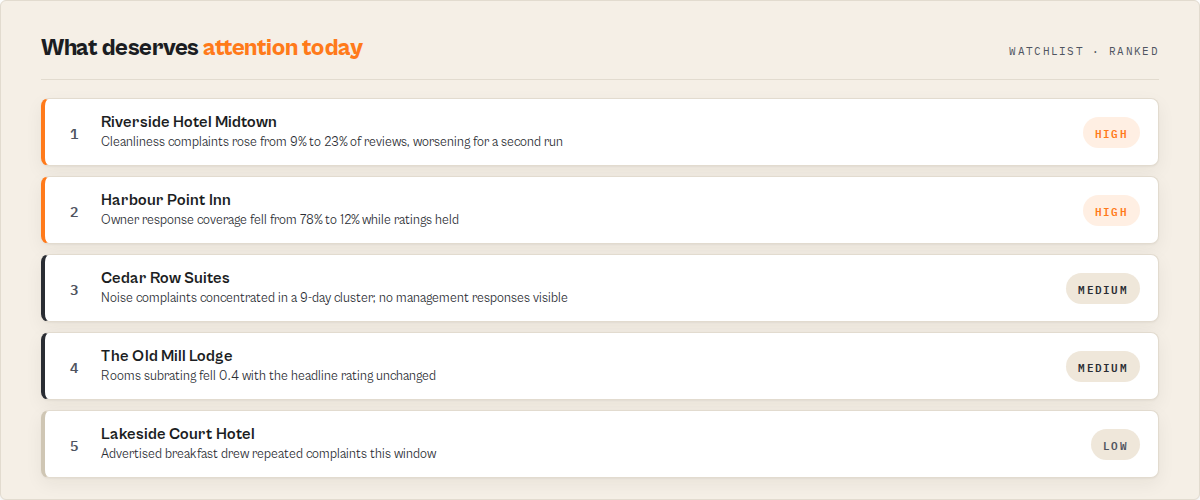
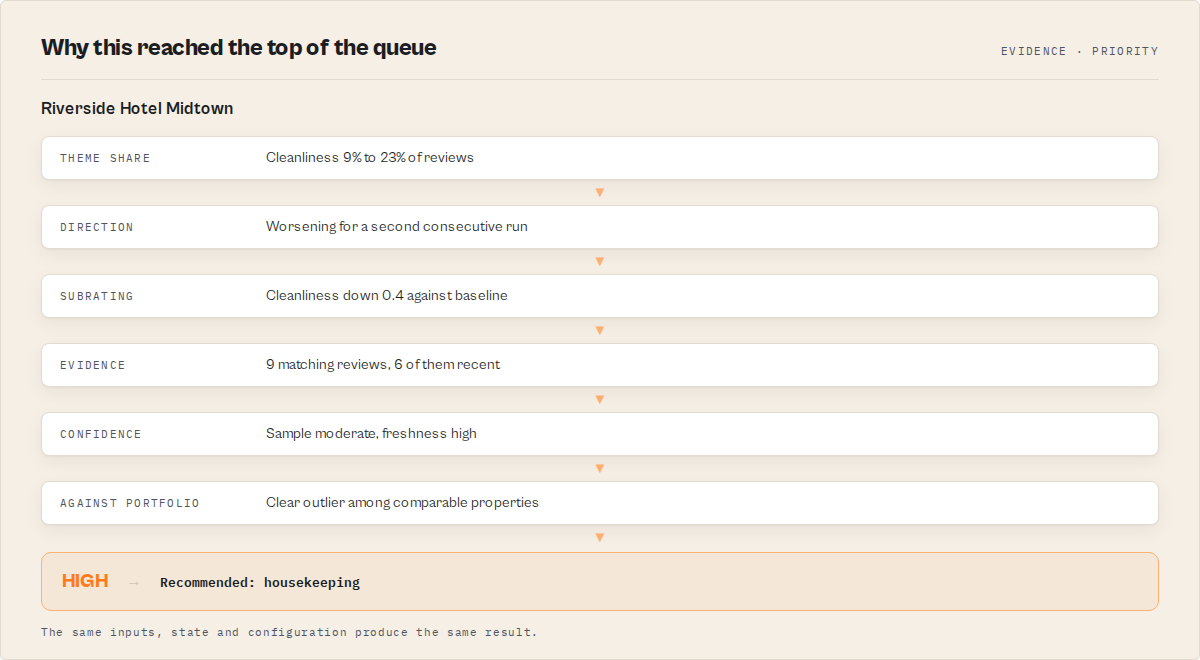
1. Riverside Hotel Midtown, high priority
Cleanliness complaints rose from 9% to 23% of reviews against the baseline window.
- Supporting reviews: 9
- Evidence freshness: high
- Sample confidence: moderate
- Lifecycle: worsening
- Suggested owner: housekeeping
The review identifiers, comparison values and reason codes behind that item are in the dataset.
On ordering: priority scoring is deterministic and reproducible, but the weights behind it are
provisionally calibrated. Treat the ranking as a prioritisation aid rather than a settled
severity scale until validation is complete. Every attention record carries calibrationStatus
so this is visible in the data, not just here.
How monitoring works
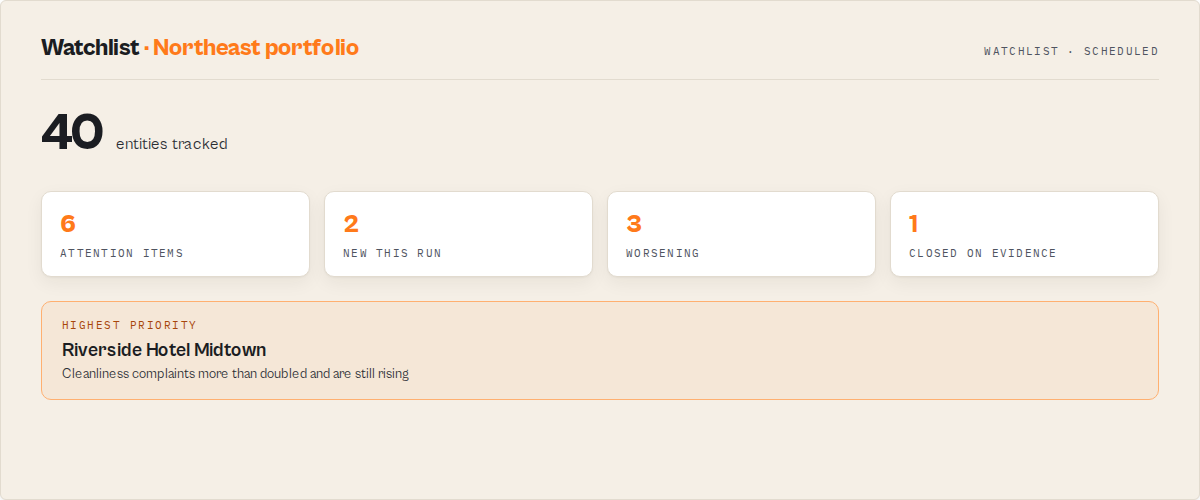
The first successful run establishes a baseline. Later runs collect new evidence, compare it against the stored recent and baseline windows, and report material changes. Every property is also refreshed periodically even when its rounded headline rating has not moved, because a recent review evidence can deteriorate before the rounded headline rating moves.
Several successful observations are needed before trajectory and persistence mean much. Six is the initial product guideline and may be recalibrated.
The actor does not claim to retrieve every historical review. Each property record reports what was collected, why collection stopped, how much of the recent window it covered, and whether freshness could be independently verified.
What you get from one run
- A ranked attention queue. One item per consolidated property issue, keyed on property, operational theme and active window. A property with two unrelated problems produces two items; several correlated changes on one theme produce one.
- Change detection across runs. What changed in the observed evidence since the last comparable observation.
- Evidence behind every claim. Each signal names the metric, the direction, the recent and baseline values, how many reviews matched, how many are recent, and the review identifiers.
- Per-dimension movement, where the source exposes it. Where Tripadvisor exposes usable review subratings, they are tracked separately from the headline rating. A dimension can fall materially while the headline holds, and that is the case a rating histogram hides.
- Management-response measurement, where it is readable. Where management responses and their timestamps are reliably available, response coverage and response delay are reported, including coverage specifically on one and two star reviews. Where they are not, the fields are marked unavailable with the reason rather than estimated.
- Amenity expectation mismatches. Advertised features read against what reviewers reported, keeping "advertised", "reviewers report problems" and "not independently verified" as three separate statements.
- Comp-set context. A property against named competitors, or against nearby properties that clear a real comparability test rather than merely being close by.
- Alert events. Attention items that cross an alert condition produce a compact payload with a deterministic key, so a retried run does not page your team twice for one event.
- An honest coverage contract. Nothing is called complete unless it was measured as complete.
Modes
| Mode | What it does |
|---|---|
| Monitor (default) | Tracks a portfolio over time and returns what changed since the last run. This is what the actor is built for. |
| Audit | A one-off evidence-based review of specific properties, applying the deepest configured collection policy to every property. |
| Comp-set | One property measured against named competitors and, optionally, nearby candidates that clear a comparability test. |
| Discover | Turns a hotel list page for a city or area into property URLs you can paste into the other modes. |
| Reviews | A review-forward output shape for migrating an existing pipeline. Deliberately secondary. |
Quick start
The URLs below are placeholders. Replace the d1234567 identifiers with real Tripadvisor
hotel page URLs from your own portfolio.
Monitoring a portfolio, with your own property identifiers attached:
{
  "mode": "monitor",
  "watchlistName": "Northeast portfolio",
  "propertyUrls": [
    "https://www.tripadvisor.com/Hotel_Review-g60763-d1234567-Reviews-Property_Name-New_York_City_New_York.html",
    "https://www.tripadvisor.com/Hotel_Review-g60745-d7654321-Reviews-Another_Property-Boston_Massachusetts.html"
  ],
  "propertyMetadata": [
    { "propertyId": "1234567", "internalPropertyId": "NYC-01", "region": "Northeast", "brand": "Riverside" },
    { "propertyId": "7654321", "internalPropertyId": "BOS-02", "region": "Northeast", "brand": "Riverside" }
  ]
}
propertyMetadata is an array of objects. Each property takes the first entry that matches it,
tested on propertyId first and then on url after the URL is canonicalised, so an entry
carrying the numeric id wins over one carrying only a URL. An entry that matches nothing in the
run is simply unused. Those values ride on every record and every alert in their own namespace,
so output joins to your operating structure without a lookup and never overwrites anything read
from the source.
Then schedule it, and schedule it early. Review dates support an initial retrospective baseline, but past observations of the source, and the run-to-run changes between them, cannot be reconstructed after the fact.
A whole city instead of a hand-listed set:
{
  "mode": "monitor",
  "watchlistName": "Manhattan market watch",
  "discoveryUrls": ["https://www.tripadvisor.com/Hotels-g60763-New_York_City_New_York-Hotels.html"],
  "maxProperties": 25
}
Membership from a list page is recomputed each run. Whatever the list page returns that run
is what gets monitored, so a reordered or changed list, or a maxProperties limit that bites,
will move properties in and out of the portfolio between runs. Watchlist history stays continuous
because identity is pinned by overlap, but an individual property that drops out and returns has
a gap in its own baseline. For a stable portfolio, discover once with discover mode and then
monitor the explicit property URLs it returns. Use list-page monitoring when you actually want a
market view rather than a fixed set of properties.
One property against its competitors:
{
  "mode": "compset",
  "focalPropertyUrl": "https://www.tripadvisor.com/Hotel_Review-g60763-d1234567-Reviews-Property_Name-New_York_City_New_York.html",
  "competitorUrls": [
    "https://www.tripadvisor.com/Hotel_Review-g60763-d2345678-Reviews-Competitor_One-New_York_City_New_York.html"
  ],
  "includeGeoCompSetCandidates": true
}
A competitor you list is pinned. It stays in the comparison across runs even when the automatic selection would drop it, so a comparison does not reshuffle underneath you.
The input form comes prefilled with a small demonstration: one public hotel list page and a three-property limit, so a first run exercises the whole pipeline cheaply. Replace those values with your own before setting up a recurring watchlist. Running with a completely empty input falls back to the same demonstration.
Use a general-purpose Tripadvisor scraper when
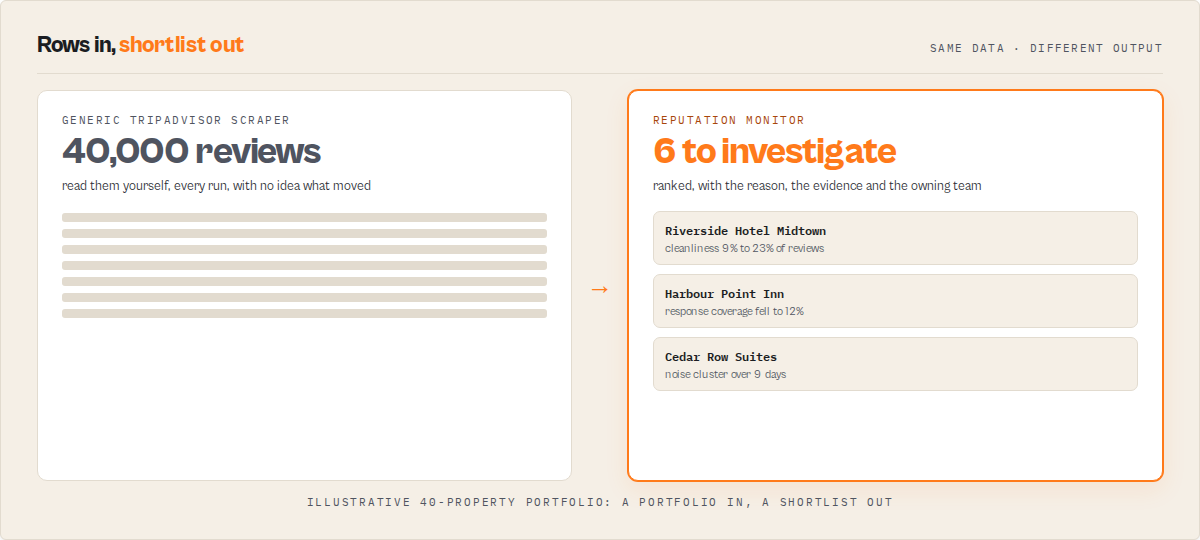
You need the lowest cost per raw record, every reachable historical review, restaurants or attractions, or a general dataset to analyse yourself. Those actors are very good at that job, and a bulk exporter is the cheaper way to get raw rows.
Use this one when you need:
- Change detection across scheduled runs
- Portfolio-level attention prioritisation
- Evidence-backed complaint themes
- Stable comp-set comparisons
- Operational routing to a responsible team
- Explicit freshness, coverage and confidence on every conclusion
What you pay for
$0.35 per property analysed. One charge, for a property that went through review collection and analysis: reviews gathered, themes measured, changes compared against its stored baseline, and any attention item produced with the evidence behind it.
Nothing else is charged. A property that only received the quick details check is not billed, because deciding which properties deserve the expensive collection is this actor's job rather than something to charge you for. Neither are review rows, since the collection that produced them is already covered by the analysis. Nor are deferred properties, failures, or the run summary. Apify bills its own platform compute separately, as it does for every actor.
In practice a 40-property portfolio on a weekly schedule, where roughly half the properties come
due for collection each run, costs about $7 per run. Use maxHydratedProperties to put a hard
ceiling on it.
Input parameters
| Parameter | Type | Notes |
|---|---|---|
mode | select | monitor, audit, compset, discover, reviews. Inferred when omitted, see below. |
propertyUrls | array | Tripadvisor hotel page URLs. Up to 500 entries. |
discoveryUrls | array | Hotel list page URLs for a city or area. Up to 50. |
watchlistName | string | A label shown on every record and alert. Renaming never resets history. |
focalPropertyUrl | string | Comp-set mode: the property everything is compared against. |
competitorUrls | array | Pinned competitors. Up to 30. |
includeGeoCompSetCandidates | boolean | Also score already-collected nearby properties for comparability. |
compSetRadiusKm | integer | One input to comparability, never the deciding one. Default 3. |
collectionPolicy | select | Overrides the mode's collection depth. Leave empty to let the mode choose. |
recentWindowDays | integer | The window that counts as recent. Default 90. |
baselineWindowDays | integer | How far back the comparison baseline may reach. Default 365. |
targetReviewSample | integer | Per-property collection target. Collection also stops on its other conditions. |
maxStalenessDaysOverride | integer | Force a periodic deep collection at least this often. Leave empty to derive it from each property's observed review velocity. |
controlSampleShare | number | Share of properties given a deep collection each run regardless of apparent change, as a check on the selection itself. Default 0.05. Set 0 to disable. |
analysisLanguage | select | English in this version. |
includeReviewRecords | boolean | Add one row per collected review. The mode decides when omitted. |
includeReviewerDisplayName | boolean | Off by default. See Responsible use. |
propertyMetadata | array | Your own identifiers, attached to every record. |
watchlistId | string | Advanced. See below. |
resetScope | select | Destructive. See below. |
maxProperties | integer | Effective default 50. The input form prefills 3 so a first run is cheap; that prefill is a form value, not the default. Schema maximum 500. |
maxHydratedProperties | integer | How many properties receive review collection in one run. The mode chooses when omitted. |
maxRunMinutes | integer | Wall-clock budget. Default 60. |
confirmReset | boolean | Required for resetScope to take effect. |
proxyConfiguration | object | See Connection below. |
Mode inference
When mode is omitted it is resolved in this order, and the first match wins:
- A focal property and at least one competitor URL,
compset - Otherwise, any property URLs,
monitor - Otherwise, any hotel list pages,
discover - Otherwise,
monitor
So a run carrying both property URLs and a focal property without competitors resolves to
monitor, and one carrying both hotel list pages and property URLs resolves to monitor with
the list pages still used for discovery. Set mode explicitly whenever you want something other
than that.
Connection
The run uses the Apify proxy you configure, defaulting to a residential group in the United States, which is the configuration the collection was measured against. Residential access depends on your Apify plan. If the proxy configuration cannot be created the run continues without a proxy rather than failing, which on a restricted plan is likely to mean more properties come back as retrieval failures. Country choice can affect the locale a page is served in, so a portfolio outside the United States may be worth pointing at a closer country.
Portfolio size
The schema accepts up to 500 properties in one run, and reaching a run limit defers properties
rather than dropping them. The actor is designed for portfolios of roughly 5 to 200 properties;
500 is the configured maximum, not a benchmarked throughput figure. Use maxProperties,
maxHydratedProperties and maxRunMinutes to bound a run, and expect deferrals above the range
it was designed for.
watchlistId
Normally omit it on every run, including the first. The actor resolves a stable identifier for the watchlist and reports it on every record and in the run summary.
Identity is pinned by the properties, not by the name. The first run registers its properties against a new identifier; later runs recognise the watchlist from any property already registered to it and adopt newly added properties into that same identifier. So renaming the watchlist, adding properties, or removing them all keep one continuous history.
The consequence to know about: overlap means identity. Two portfolios that share even one
property resolve to the same watchlist and therefore the same history. If you monitor two
portfolios that genuinely overlap, give at least one of them its own explicit watchlistId so
they stay separate. For the same reason, when splitting one portfolio into two, assign a new
explicit watchlistId to at least one of the halves. Leaving both unset makes both halves
continue the parent's history.
Supply an explicit watchlistId only when deliberately continuing, separating, or merging a
history. Two watchlists given the same explicit id share one history.
resetScope
Destructive, and deliberately explicit. A reset scope on its own does nothing. It takes
effect only when confirmReset is also set to true; without that the run proceeds normally with
your history intact and records the unconfirmed request in the run summary. Whatever is reset is
also reported there, because a silent history wipe is indistinguishable from a monitoring fault.
Applies to the properties in the current run.
| Value | Effect |
|---|---|
none | Keep all history. The default. |
propertyBaselines | Forget previous observations. Change detection restarts from this run. |
signalHistory | Forget open signals and their lifecycle. |
compSet | Forget stored comparison members. |
reviewBoundary | Collect reviews from scratch on the next run. |
entireWatchlist | Forget everything stored for these properties. |
A reset cannot be undone from inside the actor, and re-running does not rebuild what was
discarded. That is why it requires confirmReset alongside the scope.
Output
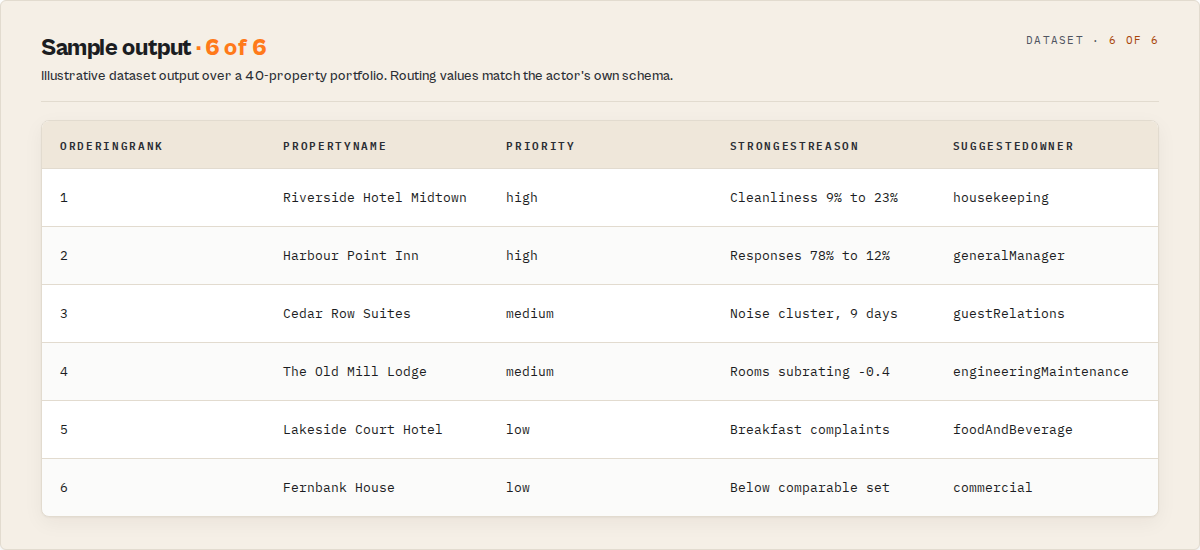
One dataset with typed rows. Read recordType first, then the fields belonging to that kind.
| Record type | What it is |
|---|---|
attention | The queue. One item per consolidated property issue, ranked. |
property | One row per property: ratings, subrating trajectory, response metrics, freshness, coverage, position. |
signal | Every detected change with its evidence, confidence and reason codes. Suppressed signals are included, with the reason. |
review | Individual reviews, when you switch them on. |
compset | Who a property is compared against, and why each member is in or out. |
failure | Source retrieval that did not succeed, with its type and diagnostics. |
runSummary | What the run covered, what it deferred, and where its conclusions stop. |
Eight views are configured: Attention queue first, then Properties, Signals, New reviews, Reviews, Comp-set, Failures, Run summary.
Deferral is not failure. A property that hit a run limit stays a property record with
processingStatus: "deferred", the reason, and when it becomes eligible again. failure records
are for source retrieval that did not succeed. A 100-property run with six retrieval failures
still emits the full set of records for the 94 that succeeded, plus six explicit failure records,
never one opaque failed run.
Emission order. Property, signal and review records are written as each property finishes, so the dataset fills during the run. The attention queue is ranked across the whole portfolio, so final ranked attention records are written after portfolio scoring completes.
Suppressed signals are emitted alongside active ones so a suppression is auditable rather than
invisible. On a large portfolio they can be a meaningful share of the rows; filter by
recordType and the suppressed flag, or use the Signals view.
An attention record, shortened
{
  "recordType": "attention",
  "orderingRank": 1,
  "propertyName": "Riverside Hotel Midtown",
  "internalPropertyId": "NYC-01",
  "priority": "high",
  "theme": "cleanliness",
  "lifecycleTransition": "worsening",
  "strongestReason": "Cleanliness share of reviews rose 14 percentage points, from 9% to 23%.",
  "suggestedOwner": "housekeeping",
  "priorityComponents": {
    "severity": 0.85, "acceleration": 0.62, "confidence": 0.7,
    "recency": 1, "persistence": 0.2, "portfolioOutlier": 0.33
  },
  "calibrationStatus": "provisional",
  "confidence": {
    "overall": "moderate", "classification": "moderate",
    "sample": "moderate", "freshness": "high", "baseline": "moderate"
  },
  "evidence": { "matchingReviews": 9, "recentMatching": 6, "sampleShare": 0.23, "reviewIds": ["ta_..."] },
  "supportingSignalIds": ["sig_1234567_issueAccelerating_cleanliness"],
  "alertEvent": { "eventKey": "evt_...", "eventType": "signalWorsened", "priority": "high" }
}
Confidence is decomposed rather than collapsed into one band, because a single band hides whether a signal is thin on evidence or thin on collection.
Alerts and integrations
An attention item that crosses an alert condition carries an alert event: a compact payload with
the property, your own property id, the priority, the theme, the confidence and the evidence
count. Items that do not cross a condition carry alertEvent: null, so a persistent issue does
not re-page your team every run.
The conditions are fixed in this version:
| Event | Fires when |
|---|---|
newCriticalSignal | A new issue appears at high or critical priority |
signalWorsened | An open issue worsens, or one previously closed reappears |
signalImproved | An open issue improves materially |
signalClosedByEvidence | An issue closes on evidence, not on absence |
ratingThresholdCrossed | The headline rating moves across a threshold |
propertyBecamePortfolioOutlier | A property becomes a clear outlier against the rest of the portfolio |
freshnessLagging | Collection for a property falls behind its own review velocity |
repeatedCollectionFailure | A property fails retrieval across several consecutive runs |
eventKey is derived from the watchlist, the property, the theme, the lifecycle transition and
the observation version. It contains no run id and no timestamp, so a retried run over the same
effective observation produces the same key. The observation version advances only when a
property's stored state actually advances, not when a run is repeated. Deduplicate on eventKey
and your team is paged once per event.
Wire it up with a scheduled run plus an Apify webhook or integration into Slack, email, a
warehouse or your own endpoint. The full set is also written to the run's key-value store under
ALERT_EVENTS, with the attention snapshot under ATTENTION_QUEUE and the run summary under
SUMMARY.
Using the API
Replace the input below with your own properties.
Python
from apify_client import ApifyClient

client = ApifyClient("<YOUR_API_TOKEN>")

run = client.actor("ryanclinton/tripadvisor-hotel-reputation-monitor").call(run_input={
    "mode": "monitor",
    "watchlistName": "Northeast portfolio",
    "propertyUrls": ["https://www.tripadvisor.com/Hotel_Review-g60763-d1234567-Reviews-Property_Name-New_York_City_New_York.html"],
})

for item in client.dataset(run["defaultDatasetId"]).iterate_items():
    if item.get("recordType") == "attention":
        print(item["orderingRank"], item["propertyName"], item["priority"], item["strongestReason"])
JavaScript
import { ApifyClient } from 'apify-client';

const client = new ApifyClient({ token: '<YOUR_API_TOKEN>' });

const run = await client.actor('ryanclinton/tripadvisor-hotel-reputation-monitor').call({
    mode: 'monitor',
    watchlistName: 'Northeast portfolio',
    propertyUrls: ['https://www.tripadvisor.com/Hotel_Review-g60763-d1234567-Reviews-Property_Name-New_York_City_New_York.html'],
});

const { items } = await client.dataset(run.defaultDatasetId).listItems();
const queue = items.filter((i) => i.recordType === 'attention');
console.log(queue.map((i) => `${i.orderingRank}. ${i.propertyName} (${i.priority})`));
Alert events for the run:
const alerts = await client.keyValueStore(run.defaultKeyValueStoreId).getRecord('ALERT_EVENTS');
How reliability works
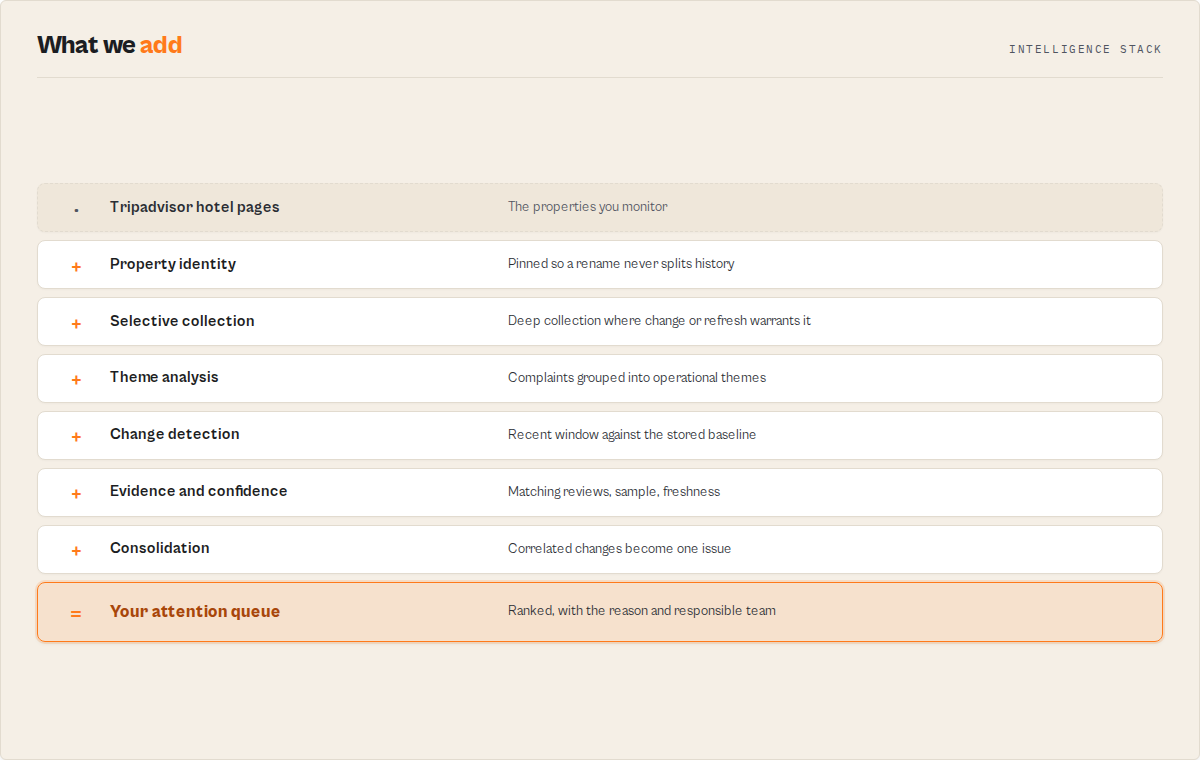
- Identity before anything else. Properties are keyed on their stable numeric Tripadvisor id, not the name in the URL, so a rename or a URL change does not split one property's history in two. Two URLs for the same property are one property, and you are told so.
- Selective collection with a floor. Review collection is expensive, so it goes to properties that changed, that carry an open high-priority signal, or that are due a periodic deep collection. A reproducibly selected control share gets one each run regardless, as a check on the selection itself. The selection is derived from the property and the run index, not from a random draw, so a rerun makes the same choices.
- Adaptive collection with a stated stop reason. Collection stops on whichever condition fires first, and the condition that fired is reported on the property record, so a thin sample is always explainable.
- Memory only advances when the collection earned it. If a property's collection did not pass its checks, the previous baseline is kept rather than moved. A boundary advanced on bad data corrupts every later run's "what is new", permanently and silently.
- A partial collection never closes a signal. Improvement needs evidence, and absence in a degraded collection is not evidence.
- Absence is never reported as absence of a problem. You will see "no matching reviews observed", never "no problems".
- Recalculations are visible. Every pinned version behind the numbers is on the run summary, and changing a setting that alters interpretation marks the run as not directly comparable to the previous one.
Limitations
- Hotels and lodging only in this version. Restaurants, attractions and vacation rentals are out of scope.
- Review text analysis runs on English. Reviews in other languages still count towards ratings, subratings, volume and response metrics, and the excluded share is reported per property and lowers the confidence attached to every signal for that property.
- Coverage of the full public review history is never claimed. Historical and recent-window coverage are reported separately, because the first will always be small on a property with thousands of reviews while the second can be complete.
- Subrating tracking and management-response measurement depend on the source exposing usable values. Where it does not, those fields are reported unavailable with the reason rather than estimated.
- Where a review has no stable identifier at the source, a content change is reported as possible rather than confirmed, and a review that stops being visible is only reported after several successful collections. The actor never infers why a review disappeared.
- Attention priority weights are provisional until calibrated against a labelled validation set.
Every attention row carries
calibrationStatussaying so. - The first run of a new watchlist produces a baseline rather than change detection.
- Comp-set position depends on how many comparable properties were actually collected. With a small comp set the position is reported as insufficient evidence rather than guessed.
- The output is decision support. It tells you what deserves investigation and why. It does not make the management decision, forecast rates or revenue, or predict what a rating will do next.
What this actor will not do
It does not book or modify reservations, quote live rates or availability, forecast rates or revenue, decide whether a review is genuine, identify or profile reviewers, or classify a property or an area as unsafe. It may report that reviewers raised a safety concern. It will not tell you a property is unsafe.
Reviews are evidence of what reviewers reported. They are not proof that an operational fact occurred exactly as described, and the actor does not present them as such.
Responsible use
It accesses publicly available pages without logging in, without solving verification puzzles, and without using anyone's credentials. It takes no action inside Tripadvisor.
Reviewer privacy. Reviewer profile links, contribution counts and stated home locations are
not parsed into output or into persistent analytical state, in any configuration. A reviewer
display name is read only when you switch includeReviewerDisplayName on. Raw page markup,
screenshots and browser traces are not persisted: the run's stored artifacts are the dataset
records and the three key-value summaries, nothing else.
Legality. Whether any particular collection is lawful depends on your jurisdiction, the source's terms, the data collected and your intended use. This actor is designed to read public pages without login and to minimise reviewer identity data. Take your own advice on your own use case.
Troubleshooting
The first run shows no changes. Expected. The first run establishes a baseline; change detection starts from the second.
A property came back deferred. A run limit was reached. It kept its previous baseline, and
the record carries the reason and when it becomes eligible again. Raise maxProperties,
maxHydratedProperties or maxRunMinutes, or split the portfolio across scheduled runs.
Response metrics say unavailable. Management-response timestamps were not readable for that property. The reason is on the record. Coverage is still reported where responses themselves are visible.
Renaming the watchlist did not reset anything. Correct. History is keyed on an id resolved from the properties, not the name.
A signal is marked suppressed. It did not clear its evidence threshold, or the run was not comparable to its baseline. The reason codes are on the record.
FAQ
Is this a Tripadvisor scraper? It reads Tripadvisor, but it is built to return changes, not records. If you want a bulk export of raw reviews, a general-purpose scraper is the cheaper and better-suited tool.
How often should I run it? Weekly suits most portfolios. Daily is reasonable on high-volume properties. The actor tracks each property's own review velocity and forces a periodic deep collection regardless of apparent change.
Can I get the raw reviews too? Yes, set includeReviewRecords to true in any mode.
Why do attention items say provisional? The priority weights have not yet been calibrated against a labelled validation set. The ranking is deterministic and reproducible; the weights themselves may be revised, and every row says so.
Does it detect fake reviews? No, and it does not try. Judging authenticity is not something this data supports.
What happens if a page cannot be retrieved? You get an explicit failure record with the
type and diagnostics. Other properties are unaffected, and no baseline is advanced for the
property that failed.
Not affiliated with Tripadvisor
This actor is an independent tool that reads publicly available pages. It is not affiliated with, endorsed by, or connected to Tripadvisor.
Related actors
Lead Quality & Outreach Readiness Auditor — Decide & Benchmark
Audit lead lists before outreach. Every lead gets a quality score, trust score, and a use/verify/repair/enrich/reject decision, then rolls up to account health, pipeline risk, and a vendor benchmark of which source delivers usable leads. Works with Clay, Apollo, ZoomInfo, CSV.
Intent Signal Tracker — Jobs, Tech & Funding
Track buying signals across job postings, tech stack changes, funding, and content updates. Composite intent score per company. $0.05/company — replaces Clay's $495/mo Web Intent.
Lead Enrichment Pipeline — 5-47x Cheaper Than Clay
All-in-one lead enrichment: email discovery, phone finding, verification, company research, and lead scoring in one run. CSV or JSON in, scored leads out. $0.12/lead — 5-47x cheaper than Clay.
Phone Number Finder — Direct Dials from Websites
Find mobile, direct-dial, and company phone numbers for any prospect list. Two-step waterfall: 3B-record database first, then company website scraping as fallback. Pay $0.10 only when a number is found — no subscription, no per-seat fee.
Ready to try Tripadvisor Hotel Reputation Monitor?
Run it on your own Apify account. Apify offers a free tier with $5 of monthly credits.
Open on Apify Store